
Own the sound, not the rack.
The cheapest way to master through real analog gear is to book time on it remotely instead of buying it. A three-stage chain (EQ, compressor, limiter) can be booked by the session through Access Analog, against more than $16,000 to own the same three units new. Set the chain in real time, print it with an offline bounce, and your connection speed stops mattering.
In this guide you'll learn what "budget" really means when the hardware is the expensive part, the minimum chain a master needs, three real hardware chains matched to the three Access Analog Subscription tiers, and a step-by-step workflow for printing your first analog master tonight.
It means paying for the circuit only while it's touching your audio. There are three main ways to get analog-style processing onto a master, and each one costs you something different.
Buy the hardware. You own it outright, but the purchase price is only the start. Tube gear needs tubes and periodic calibration, every box needs rack space, power and insurance, and you need good conversion to get in and out of it. Then there's recall: an owned analog chain with continuous pots can't remember last Tuesday's session unless you photograph the knobs and hope.
Use plugin emulations. Cheap, convenient, instant recall. Good emulations are genuinely useful, and plenty of great records have been mastered entirely in the box. What a model can't fully capture is the part that makes hardware hardware: component tolerances, transformer behavior that shifts with level and frequency, and tubes that react to the program in ways no two units do identically.
Book remote time on real units with Access Analog. You stream your mix from your DAW to hardware that stays racked, maintained and calibrated in our facility, and pay per session or through a subscription tier. The robotics recall every control. You give up the ability to put your hands on the knobs. Everything else comes with it.
Two other routes come up often. Booking a studio with an analog mastering rack gets you the room, the gear and often an engineer to run it, which can be worth every penny. But you pay for the day rather than the minutes the chain touches your audio, you work to the studio's calendar, and your recall ends when the session does. A gear-rental house is different again: it ships you the physical box for a few days, so you still need the converters, rack space and patching to run it, and the recall goes back in the crate with it.
Buying a mastering rack to master one EP is like buying a cement mixer to pour one patio. It works. It's also the most expensive way to get the job done.
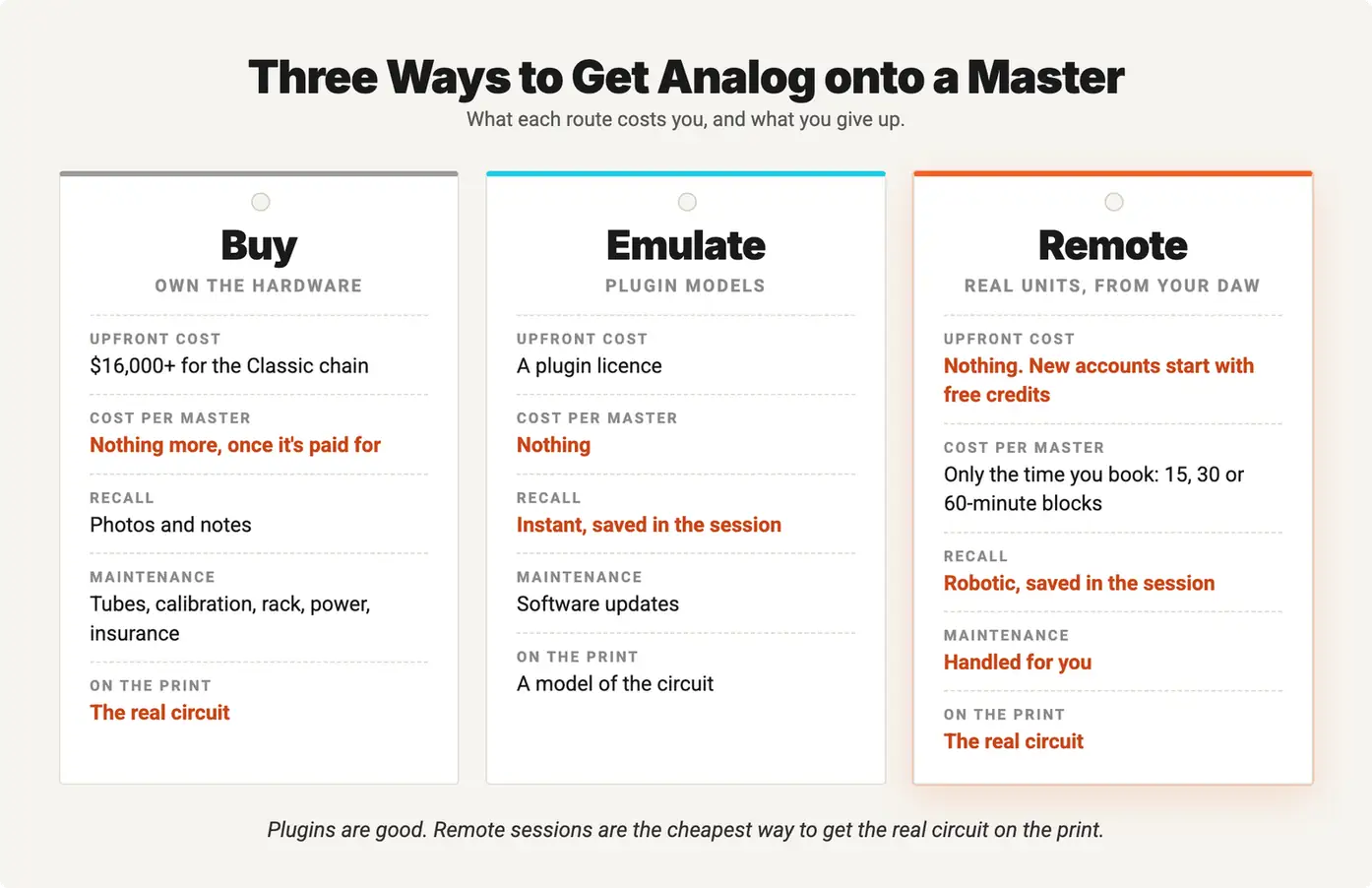
Plugins are good. This post is for the engineer who wants the real circuit on the final print, and wants to know the cheapest honest way to get it.
You don't need to own the rack. You need the rack for an hour.
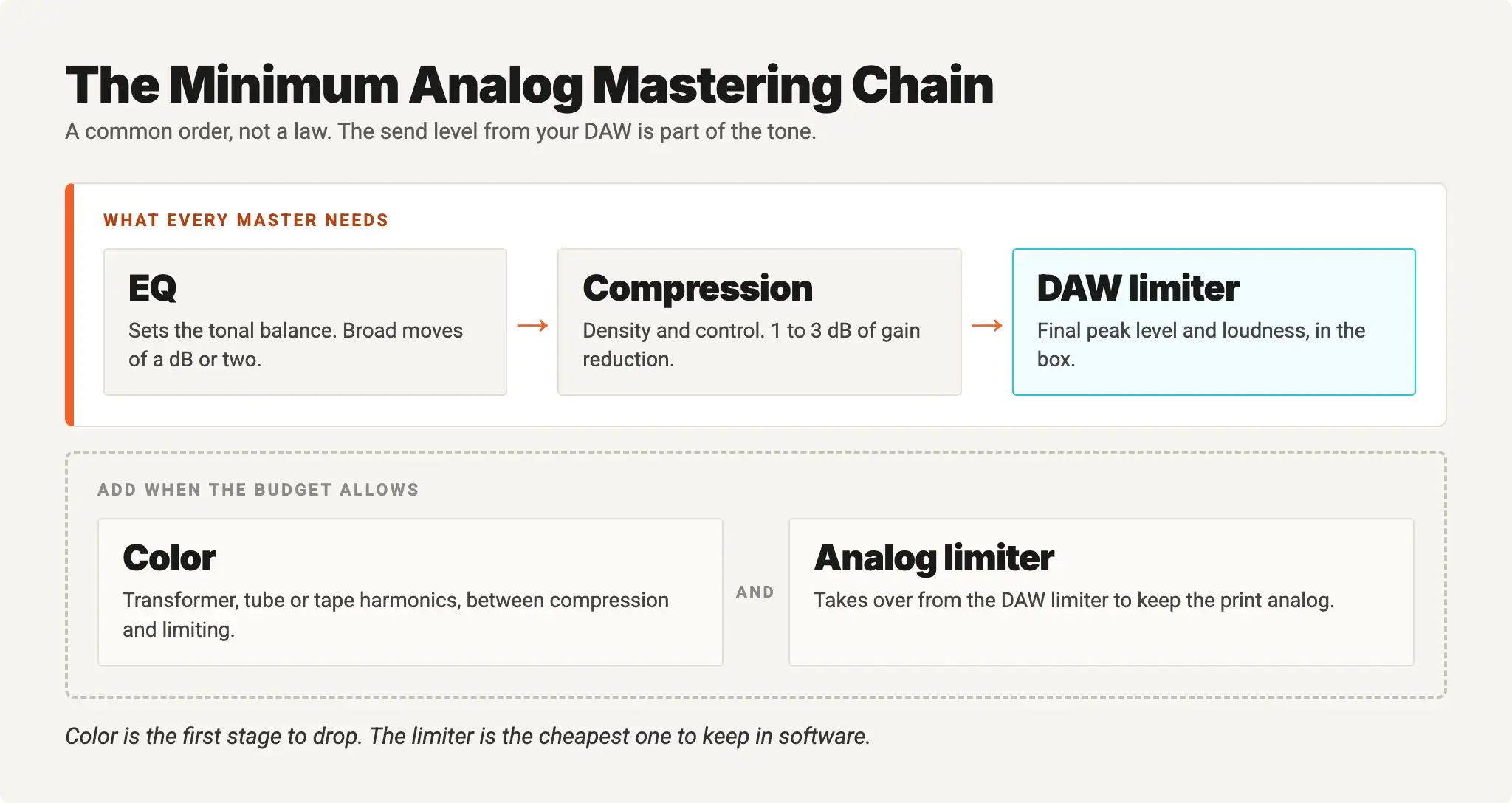
EQ, then compression, then an optional color stage, then a limiter. That order is a common starting point, not a law, but it covers what nearly every master needs.
EQ sets the tonal balance of the whole record: a touch of low-end weight, a little air, a dip where the mix is crowded. On a master these moves are broad and small, usually a decibel or two.
Compression controls the macro-dynamics and adds density. Mastering compression lives at 1 to 3 dB of gain reduction on the loudest sections, which is a common guideline rather than a rule.
Color (a transformer, tube or tape stage) adds harmonic content and weight. It's the stage a tight budget can skip first, because a good tube compressor already brings some of it.
Limiting sets the final peak level and loudness. On a budget, this is the stage you can leave in your DAW: a well-behaved digital true-peak limiter is the one place software is genuinely hard to beat on price.
There's one more thing that matters more with real hardware than with plugins: the level you send is a tone control. At Access Analog there's no universal send target. You set the level in the DAW, anywhere up to 0 dBFS, and the converter delivers it to the unit at a calibration that suits that device. Tubes, transformers and optical cells all respond to level, so the same settings driven harder or softer are two different sounds. Treat input level as part of the EQ, not as housekeeping.
For the deeper version of why each stage matters, and what tubes and transformers actually add, see our guide to mastering with analog gear.
Start with one chain per Access Analog Subscription tier: a single box on Essential, two boxes on Pro, and a full three-stage chain on Elite. These aren't the only chains that work. With 70+ units on the rack there are plenty of ways to build a master, and once you know what you like you'll build your own. These three are easy starting points that cover EQ, compression and limiting without overspending, from the lightest spend to the full rig.
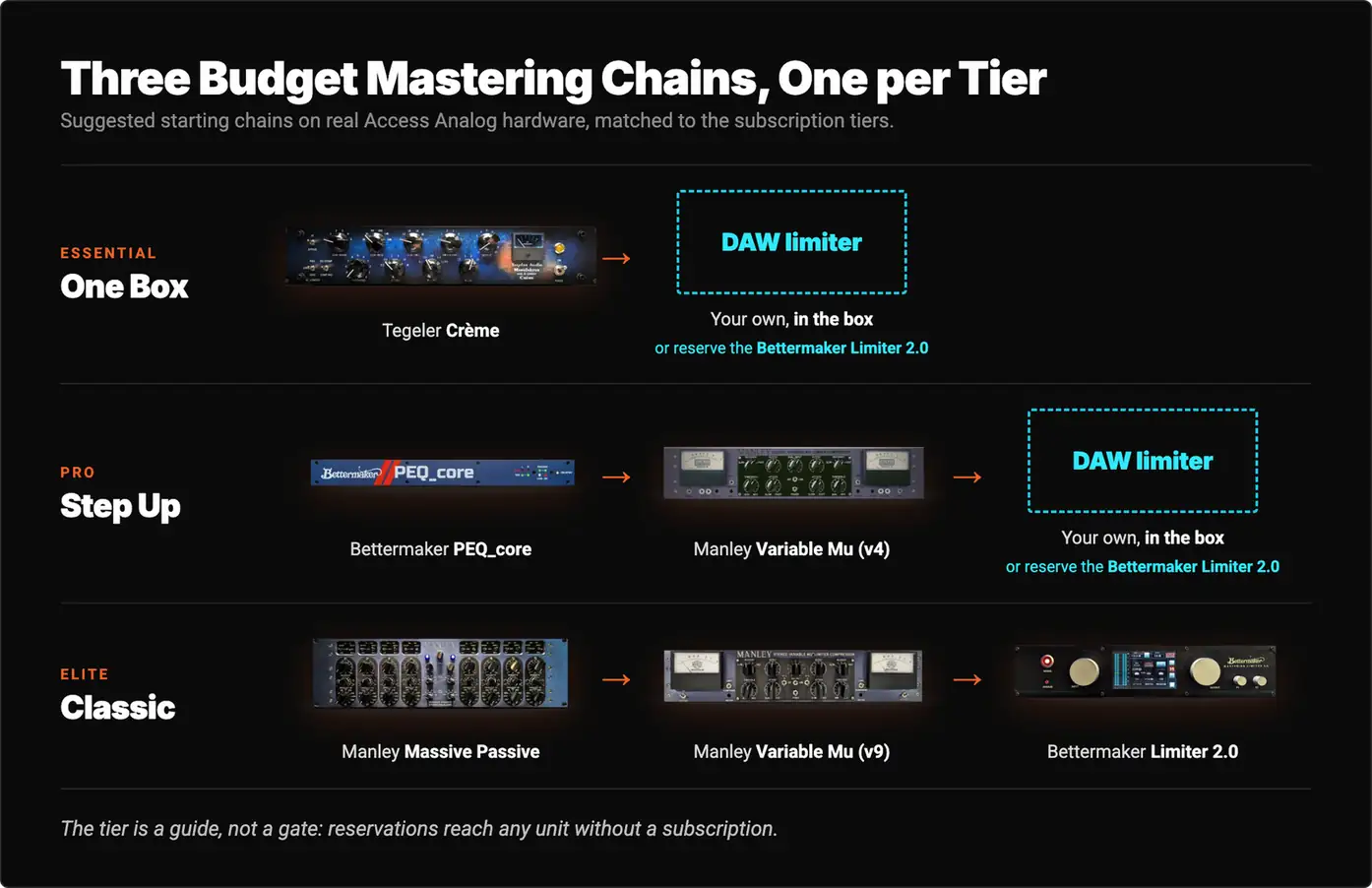
A note on tiers: reservations reach any unit without a subscription, so the tier is a guide, not a gate. If you only master a few songs a year, you can book the Elite chain by the session and never subscribe.
Choose it when the mix is nearly there and needs tone and glue, not surgery. The Tegeler Crème is a mix-bus EQ and compressor in one unit, built for exactly this job. Its two shelving bands come from Tegeler's Pultec-style Classic Equalizer EQP-1, limited to the boost ranges that make sense on a full mix (up to 5 dB each), and every control is a stepped switch, so values recall exactly.
The compressor side has Threshold, Attack, Release and Ratio, a sidechain low-cut that stops the kick from driving the gain reduction, and a switch that puts the EQ before or after the compressor.
Starting point. EQ → COMP, sidechain low-cut in. Set the Ratio first, as Tegeler's manual advises, then bring the Threshold down until the gain-reduction needle only just moves on the full mix (Tegeler's own suggestion for a complete mix). Add a step or two of low and high shelf, and let your DAW limiter do the final peak control.
Want the limiter in hardware too? The Bettermaker Limiter 2.0 can be reserved on its own and added to the end of this chain.
Choose it when you want a real passive EQ and a real tube compressor, each doing one job well. The Bettermaker PEQ_core is a stereo passive equalizer with a 100% analog signal path and a Pultec-style band layout: low boost and cut at 20, 30, 60 or 100 Hz, high boost from 3 kHz up to air bands at 20 and 28 kHz, and a high cut at 5, 10 or 20 kHz.
The Manley Variable Mu (v4) on our rack carries Manley's T-Bar modification, which Manley says stays cleaner than the standard tube stage as the gain reduction climbs. In a mastering chain, the tube's own curve sets the ratio, so loud peaks get held harder than quiet passages without you choosing a ratio at all.
Starting point. PEQ_core: a little low boost at 30 or 60 Hz, a step or two of air at 20 or 28 kHz, output trim matched to bypass. Variable Mu (v4): Compress, Link engaged, Attack at 12 o'clock (about 50 ms), Recovery 0.6 s, 1 to 2 dB of gain reduction. Our Manley Variable Mu guide covers every control and the v4 vs. v9 difference in depth.
Want an analog finish? Reserve the Bettermaker Limiter 2.0 on its own and put it after the Variable Mu in place of your DAW limiter.
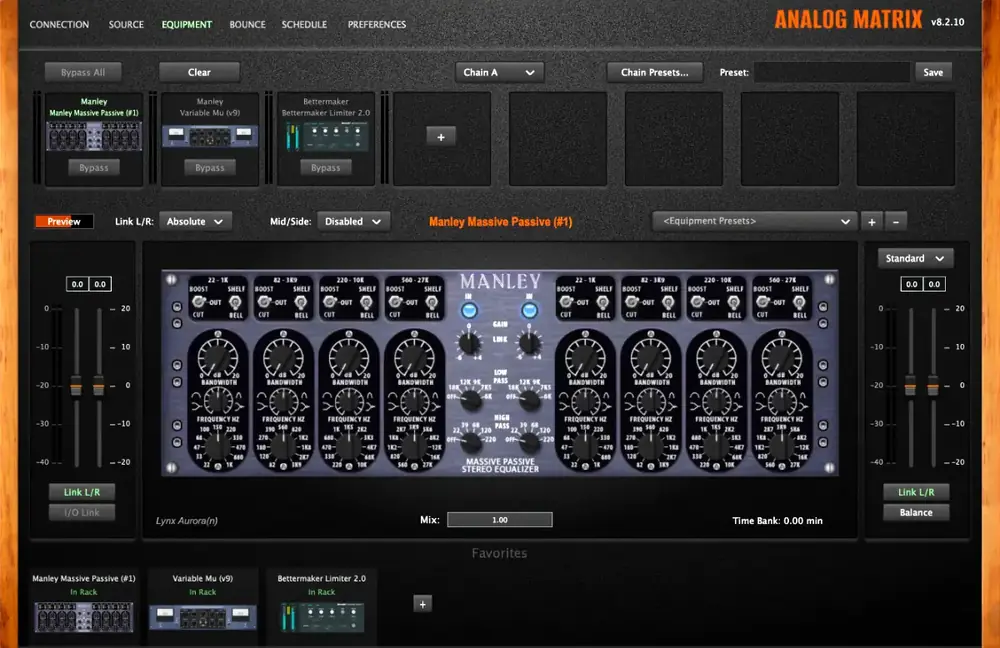
Choose it when the record deserves the full treatment. The Manley Massive Passive is a parallel, passive tube EQ whose bands interact by design, so a big-looking knob position is gentler than it reads. The Variable Mu (v9) adds a high-pass filter on the sidechain, so a heavy kick or 808 no longer pulls the whole mix down on every hit. The Bettermaker Limiter 2.0 finishes the chain in the analog domain, with up to 20 dB of gain reduction, a dual-stage soft clipper, and a sidechain HPF.
Starting point. Massive Passive: a broad low shelf and a broad high shelf of a dB or two, no bells, gain trims matched to bypass. Variable Mu (v9): HP SC in, Compress, Link, Attack at 12 o'clock, Recovery 0.6 s, 1 to 3 dB. Limiter 2.0: low input gain, a conservative threshold and the clippers off; raise the limiting only until you reach your loudness target, then try the High Soft Clip alone if transients need help.
One-box Elite alternative: the SSL Fusion. SSL designed it for finished stereo mixes, and Sound On Sound's launch coverage describes its broad EQ curves, high-frequency compression and stereo controls as suited to analog mastering chains. We walk through it stage by stage in Can You Master with the SSL Fusion?
If you'd rather not build a chain at all, Access Analog also runs complete mastering rigs designed by working mastering engineers. The Infrasonic Mastering Chain is modeled on Pete Lyman's mastering chain, with hardware from MAAG, Manley and Rupert Neve Designs wired through a custom insert console and its own dedicated conversion. The Magic Garden Chain is Brian Lucey's mastering rig, rebuilt for Access Analog by Lucey himself. Each one is a whole room's worth of gear in one booking, so it costs more per block than any single unit, but far less than building the same rig from parts. Neither chain is part of the Essential, Pro or Elite tiers: each has its own subscription, and both can be reserved outright.
Three tiers, three chains, one rule: every box earns its place or it comes out.
For the same reason a home producer on a budget does: real circuits on the print, without owning or maintaining the rack. But working engineers get two extra benefits that matter more when there's a client on the other end.
Recall for revisions. A client comes back three weeks later and asks for a decibel less low end on track six. With an owned analog chain on continuous pots, that's a re-master from memory and photographs. Here, every control is saved with the session and restored robotically, so the revision starts from exactly where the approved master finished.
A chain you don't have to own. A small hybrid room can put a client's record through a Massive Passive or a Variable Mu it has never had to buy, insure or recalibrate, and offer a choice of flavors it could never justify keeping in the rack.
Producer and composer Petr Petrosyan shows what that looks like over a whole album. For Aeropitune's album Fortune, he mastered the record through the Infrasonic Mastering Chain, recalling the same preset track after track. On one track he describes changing nothing inside the chain at all: only the input level in the Analog Matrix and the MAAG's make-up gain. One preset gave the album one sound, and the input level did the rest. Read how Aeropitune mixed and mastered Fortune.
The same circuits, by the session.
Prep the mix, build the chain in the Analog Matrix, set it in real time, print it offline, then compare and save. Here's the full sequence.
1. Prep the mix. Take the limiter and any clipper off your mix bus, and bounce the mix with peaks a few dB under 0 dBFS. Peak headroom is fully recoverable later; limiting printed into the file is not. Our post on gain staging after the mix explains why the old "−18 dBFS on every track" advice doesn't apply here.
2. Insert the Analog Matrix on the master bus and build the chain. Load the Analog Matrix plugin on your stereo bus, connect, and add your units in order. A chain can hold up to eight devices, so even the Classic chain leaves room to experiment.
3. Set the chain in real time. Play the loudest section of the song and dial in each unit while you listen, starting with input level, since that's a tone decision. Then play the quietest section and make sure the compressor isn't pumping where it shouldn't.
4. Print with an offline bounce. Once the settings are right, don't print the real-time stream. Load the mix in the Analog Matrix's Source tab and print it through the chain from the Bounce tab. It's the route Access Analog recommends for guaranteed-perfect prints, because the file is processed as a whole rather than streamed live, so a network dropout can't land on your master.
5. A/B loudness-matched. Compare the print against the unmastered mix at matched loudness. Louder always sounds better for the first ten seconds, so take that variable away and judge tone, depth and punch. The Analog Matrix's dual chains let you A/B two versions of the chain itself the same way.
6. Save the preset. Save the chain as a preset. The next song on the EP starts from the same settings, and a revision next month starts from exactly this one.
Set it live. Print it offline. Save it forever.
Less time than you'd think, and far less money than owning the gear. Every unit books in 15, 30 or 60-minute reservation blocks, or you can use it on demand with credits, which bill at the 60-minute rate. Live prices for every unit are on our gear prices page, which is the place to check before you book.
A realistic way to plan:
If you master regularly, the Access Analog Subscription is the better deal: Essential covers the Tegeler Crème, Pro adds the PEQ_core and Variable Mu (v4), and Elite opens the whole Classic chain. New accounts also start with free credits, so your first master can cost nothing at all.
Compare that with ownership. Buying the Classic chain new costs about $16,600 at US retailers as of October 2026: around $7,000 for a Massive Passive, $5,499 for a Variable Mu and $4,129 for a Limiter 2.0. That's before the converters to get in and out of it, the rack, the tubes and the calibration.
When what you need is a second pair of ears, not a second set of circuits. Hardware doesn't master a record. A mastering engineer does, and the best ones bring things no rack of gear can: years of reference points, a room built for hearing problems, and the objectivity of someone who didn't spend three months inside the mix.
Bob Katz, in Mastering Audio, describes a good mastering room as an "audio microscope," and the engineer as the objective, experienced listener who knows what can go wrong technically and aesthetically. If your record is going to radio, vinyl or a label, or if you've lost perspective on it, hire one.
Mastering it yourself through real hardware makes sense when you're learning, when the budget genuinely isn't there, when you're mastering your own demos and singles, or when you're the engineer and the chain is the thing you're missing.
For most engineers, what keeps analog mastering out of reach is the price of the hardware, the upkeep that comes with it, and a recall system made of photos and notebooks. Remote sessions take all three off the table and leave the part that matters: a real passive EQ shaping the tone, a real tube deciding how hard to hold the peaks, and your ears deciding when it's done.
Pick the chain that fits your tier, prep the mix, set it live and print it offline.
Your first analog master is one session away.
Can you master with analog gear without owning it?
Yes. Access Analog lets you run a mix through real, physical mastering hardware from your DAW through the Analog Matrix plugin. The units are controlled robotically and every setting is saved with your session, so you get the real circuit and full recall without buying, racking or maintaining anything.
What is the cheapest analog mastering chain?
A single all-in-one unit followed by a limiter in your DAW. The Tegeler Crème combines a mix-bus EQ and compressor and sits in the Essential tier of the Access Analog Subscription. Without a subscription, any unit can be reserved by the session.
Is analog mastering worth it for a home studio?
It's worth it when you want the character of real tubes, transformers and passive EQ on the final print, and booking remote time makes it affordable. Plugins are good tools; real hardware adds level-dependent, non-linear behavior that models approximate. Try one master both ways and compare them loudness-matched.
Does latency matter when mastering through remote hardware?
Not for the final print. You set the chain while listening in real time, which needs a reasonable connection, then print with an offline bounce that processes the whole file regardless of connection quality. Access Analog also runs standard servers alongside a dedicated AWS fast lane.
Can I master an album through the same chain on different days?
Yes. Every control is saved in your DAW session or as a preset and restored robotically the next time you open it, so day two starts exactly where day one finished.
Is it the real hardware or an emulation?
The real hardware. The Analog Matrix is a portal, not an emulation: your audio is converted to analog, passes through the physical unit in our Colorado facility, and comes back to your DAW.
How much does it cost to master one song through real analog gear?
It depends on the chain and how you pay. Units book in 15, 30 or 60-minute reservation blocks or on demand with credits, and new accounts start with free credits. See the gear prices page for live rates; one song usually fits in a short block.
Can mastering engineers use Access Analog for client work?
Yes. Independent and hybrid mastering engineers use it to offer clients hardware chains they don't own, and full recall makes client revisions quick: the session reopens with every knob where you left it.