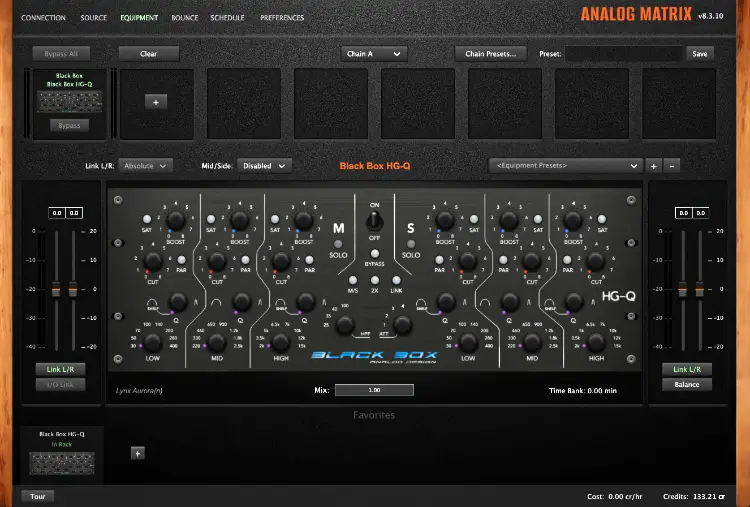
Control real analog gear straight from your DAW with the Analog Matrix. The Analog Matrix is not an emulation! It acts as a portal, connecting your digital audio workstation to actual physical gear in real time.
Reserve a session using the calendar below, or jump straight into the Analog Matrix plugin and use equipment on demand as it is available. Note: on-demand access requires credits or an active subscription.
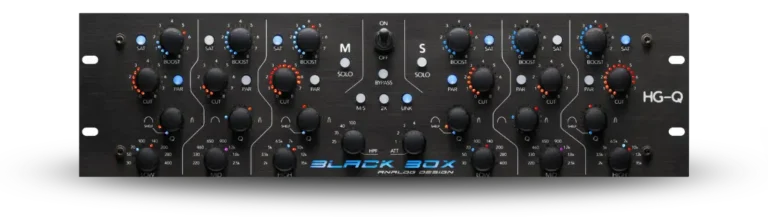
The Black Box Analog Design HG-Q looks like a mastering EQ, but it plays like something new. Seven years in development and unveiled at NAMM 2025, it comes from the makers of the HG-2 tube processor. Each of its three bands per channel is really two independent EQs: a clean solid-state cut and a boost with its own tube saturation stage. That’s six bands per channel, and curves an ordinary EQ simply can’t draw.
Run audio through it flat and it stays out of the way, with no input or output transformers and a ruler-flat response. Then boost, and things change. The parallel 12AT7 tube stage in each boost band pulls up low-level detail and density while transients and articulation stay intact. Cut and boost the same region, flip a band to parallel, and phase interactions bring mix elements forward. It shines on the mix bus and in mastering, M/S mode lets you work the center and sides separately, and 2X mode doubles the range for bolder moves on individual tracks.
Now it’s in your DAW. You’re running your audio through the actual HG-Q in our rack, controlled from your DAW through the Analog Matrix, with your settings saved right in your session.
TUBE GLOW! CLEAN CUTS! SIX BANDS!
See Our Blog Post – Demystifying Mid/Side Processing
The Black Box Analog Design HG-Q is a stereo tube EQ and saturator with three bands per channel, each split into an independent boost and cut. That makes it a six-band EQ per channel: solid-state cuts, plus boosts that each carry their own parallel tube saturation stage. Black Box describes it as an enhancement tool as much as an EQ, built to reshape and contour a mix rather than to perform surgery.
The HG-Q is best for mix-bus and mastering EQ where you want shape, density, and detail, not just tonal correction. Its M/S mode lets you treat the center and the sides separately, which makes it strong for focusing and widening a master. With 2X mode engaged, it also handles bolder moves on individual tracks and stems.
It’s the actual Black Box HG-Q: the signal path is 100% analog, with real 12AT7 tubes and solid-state circuitry, and the digital side is only for control. Your audio streams to the physical unit in our rack, and the Analog Matrix sets its real controls from your DAW. Real Gear. No Emulations.
The HG-Q is an analog EQ with digital control. Its audio path is fully analog and has no input or output transformers, while a digital control system runs the stepped encoders, LED rings, and recall. That’s why every setting can come back exactly, with none of the drift of hand-set analog knobs.
Each boost band has a parallel 12AT7 tube stage that clips asymmetrically and blends into the boost with a drive control. Because the saturation lives in the boost circuit, a band adds no saturation unless it’s boosting. Black Box voiced it for density and low-level detail rather than obvious fuzz, and its Dynamic Gain Compensation keeps levels usable as you raise the drive.
Series mode runs each band’s cut before its boost; parallel mode feeds both from the same full-range input and mixes them together. Series, the default, behaves like a clean corrective EQ followed by a colorful one. Parallel creates musical phase interactions between cut and boost and hits the tube stage with the full signal, so expect noticeably more gain when you cut and boost together.
The HG-2 is a tube saturation processor; the HG-Q is a tube EQ with saturation built into its boost bands. The HG-2 colors everything through its pentode and triode stages and transformers, while the transformerless HG-Q stays transparent until you boost. The HG-Q’s per-band saturation is essentially the HG-2’s parallel saturation circuit, so the family sound is there, aimed at specific frequency ranges. The Black Box HG-2 is in the Access Analog rack too.
A tube EQ adds harmonic color and density as the signal passes through its tube stages, while a solid-state EQ is typically cleaner and more precise. Tubes soften gradually as they’re driven, which is why engineers hear them as warm and musical; solid-state circuits stay tighter and more neutral. The HG-Q splits the job: clean solid-state cuts remove what you don’t want, and tube-driven boosts add what you do.
You can reserve the Black Box HG-Q for a timed session or use it on demand with credits or an active subscription. Current rates for every device are always listed on the Gear Prices page. When you create a new account, you start with 12 free credits (roughly 1 hour of use on an average device).
Yes. Your Analog Matrix settings are saved with your DAW session, so the HG-Q returns to your settings the next time you open the project. Because the HG-Q is digitally controlled with stepped controls, recalled settings land on exactly the same positions every time.
Saturation needs a boost. The tube stage lives inside each boost band, so a band set to zero boost adds no saturation. To add density without changing the tone much, boost a frequency and cut the same frequency to compensate.
Use ATT for band interaction, not gain staging. The HG-Q’s bands overlap, so a high and low shelf boost also lifts the midrange slightly. The output attenuation (up to 4 dB in 1 dB steps) is there to pull that back, and usually 1 dB or less is enough.
Link copies left to right. Engaging Link snaps the right channel to the left channel’s settings, and the previous right-channel settings are lost. Dial in the left side first, then link.