Control real analog gear straight from your DAW with the Analog Matrix. The Analog Matrix is not an emulation! It acts as a portal, connecting your digital audio workstation to actual physical gear in real time.
Reserve a session using the calendar below, or jump straight into the Analog Matrix plugin and use equipment on demand as it is available. Note: on-demand access requires credits or an active subscription.


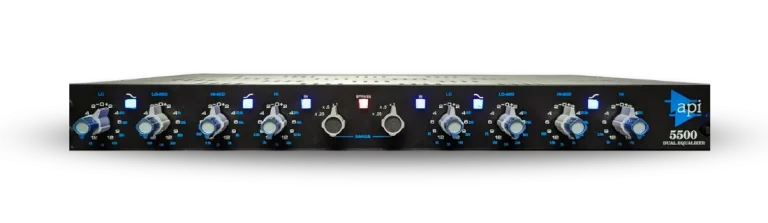
The API 5500 is a high-end, professional-grade stereo equalizer used in recording studios, live sound venues, and other professional audio environments. With its advanced equalization capabilities, the API 5500 allows users to fine-tune the sound of their recordings, providing precise control over frequency response, gain, and other important audio parameters. It is easy to use and offers a wide range of creative possibilities for engineers and musicians.
The 5500 is among the most highly regarded equalizers ever created due to its signature API sound and flexible design. Find the right combination of filters using the four overlapping bands with the ability to adjust the EQ range to 1/4 or 1/2 gain for mastering grade fine tuning or broad adjustments with the selectable high and low shelves. Just passing a signal through the 5500 gets you ‘that API sound’ from the custom API2503 transformer and the 2520 and 2510 OpAmps delivering +30db of headroom before clipping! Easily compare processed to unprocessed signals using the EQ bypass switch.
With its classic API sound and solid construction, the 5500 is a reliable and powerful equalizer for any professional recording or broadcast studio. Get the API tone and smooth musical sound that can only be found in analog filters!
This unit is on our Analog Switch, so it can link to the other switch units without leaving analog: one D/A in, one A/D out. Read Introducing Analog Switching: Real Hardware, One Conversion, Endless Creative Chains.
What is the API 5500?
The API 5500 is a dual-channel, four-band discrete analog equalizer built on API’s classic 550B console-EQ design. It packs two independent 550B circuits into one rackmount unit, so you can EQ a stereo pair or two separate mono signals. Every band runs through API’s hand-built 2520 op-amps and 2503 output transformer, the source of that signature API tone, with over +30 dB of headroom before clipping.
What is the API 5500 best for?
The API 5500 is best for adding punch, presence, and forward midrange to drums, bass, guitars, and vocals. Its proportional-Q curves are famous for making a track sit forward in a mix without sounding harsh or sticking out. With dual channels and the fine Range control, it also shines across a stereo bus or full mix for coloring and mastering.
Is the API 5500 the real hardware, or an emulation?
It is the actual API 5500 hardware, with real discrete circuitry, real 2520 op-amps, and a real output transformer, not a model of them. Real Gear. No Emulations. Through Access Analog’s Analog Matrix plugin, your audio streams to the physical unit in our racks and back to your DAW in real time.
How much does it cost to use the API 5500 at Access Analog?
You can reserve the API 5500 at Access Analog starting from $4.32. You can also use it on demand with credits or an active subscription, with subscriptions starting at $9.98/month. New accounts get a free hour (about 12 credits) to try real gear before committing.
How many bands does the API 5500 have, and what controls does it offer?
The API 5500 gives you two channels of four-band EQ, with each band offering seven overlapping, stepped frequency choices spanning roughly 30 Hz to 20 kHz. The low and high bands can each switch between bell (peak) and shelf shapes. There are no bandwidth knobs, because the API design uses proportional Q instead, plus a Range control on each channel and a true hardwire bypass.
What is proportional Q on the API 5500?
Proportional Q means the API 5500’s filter bandwidth automatically narrows as you boost or cut more, so you never set a Q control by hand. Small moves give wide, gentle, musical curves, while larger moves tighten up for more focused tone-shaping. It is a big part of why API EQs sound so musical and forward, letting you push a band hard without it turning harsh.
Is the API 5500 good for mastering?
Yes, the API 5500 is well suited to mastering thanks to its Range control, which switches the standard plus/minus 2 dB gain steps down to plus/minus 1 dB or plus/minus 0.5 dB per step for very fine adjustments. The stepped controls make precise, repeatable moves easy across a stereo mix. Many engineers run a full mix through the 5500 just for its color, even before dialing in any EQ.
Can I recall and save my API 5500 settings through Access Analog?
Yes, you can save and recall your API 5500 settings right inside your DAW session through the Analog Matrix plugin. Because the hardware is robotically controlled, your knob and switch positions are stored with your project and reset on the physical unit when you reopen it. The 5500 processes line-level audio from your DAW, so you route a track, bus, or full mix through it like any insert.
What is the difference between the API 5500 and the API 550B?
The API 5500 is essentially two API 550B equalizers in one stereo rackmount unit, with one key addition: the Range control. That switch changes the gain steps from the standard plus/minus 2 dB down to plus/minus 1 dB or plus/minus 0.5 dB, which the single-channel 550B does not offer, making the 5500 far more flexible for mastering and fine stereo work. The core proportional-Q sound is the same classic API tone.
Sound on Sound
https://www.soundonsound.com/reviews/api-5500
Gemtracks
https://www.gemtracks.com/guides/view.php?title=api-5500-review&id=3111
Audio Technology
https://www.audiotechnology.com/PDF/REVIEWS/AT57_API_5500_EQ.pdf