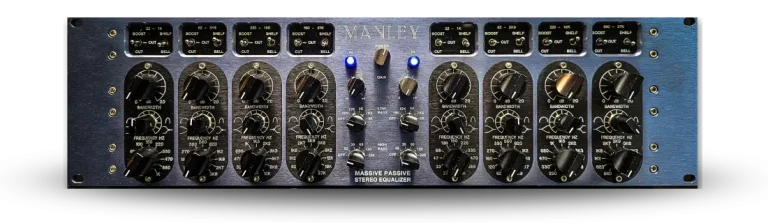
Control real analog gear straight from your DAW with the Analog Matrix. The Analog Matrix is not an emulation! It acts as a portal, connecting your digital audio workstation to actual physical gear in real time.
Reserve a session using the calendar below, or jump straight into the Analog Matrix plugin and use equipment on demand as it is available. Note: on-demand access requires credits or an active subscription.


The Manley Massive Passive Stereo EQ is a highly regarded and versatile equalizer known for its organic and unique sound. This EQ leverages the power of simple passive components to create natural, organic, and acoustic tones. It embraces the artistic side of audio processing, providing a fundamentally different approach to equalization.
Engineers have described the Massive Passive EQ as a “Pultec on steroids,” offering unmatched HF boosts, incredible fatness, and a unique sound that sets it apart from other EQs. Whether you’re tracking, mixing, or mastering, the Massive Passive EQ adapts to any situation. From radical EQ adjustments to subtle enhancements, it excels in all scenarios.
Designed and built in the USA, this passive EQ offers the renowned Manley sound and is a must-have tool for professional audio engineers and musicians.
This unit is on our Analog Switch, so it can link to the other switch units without leaving analog: one D/A in, one A/D out. Read Introducing Analog Switching: Real Hardware, One Conversion, Endless Creative Chains.
New to the Massive Passive? Read 5 Reasons To Use the Manley Massive Passive. For starting points, see Massive Passive Presets – Something For Everyone!
What is the Manley Massive Passive, and what does it do?
The Manley Massive Passive is a two-channel, four-band tube equalizer that shapes tone using a passive EQ network and all-tube makeup gain. Each band can act as a bell or a shelf, and the bands interact musically rather than clinically, producing broad, organic curves. Built in the USA with metal-film resistors, film capacitors, and hand-wound inductors, it adds warmth, weight, and air to a signal without sounding harsh or surgical.
What is the Manley Massive Passive best for?
The Massive Passive is best for broad, musical tone-shaping across tracking, mixing, and mastering, especially on the mix bus and stereo program material. It excels at big moves like adding low-end heft and high-frequency air without harshness, and it’s a favorite for sweetening vocals, fattening drums, and gluing full mixes. Because it’s a stereo unit with smooth, phase-friendly mid bands, it’s also a popular choice for mid/side work.
Is the Manley Massive Passive good for mastering?
Yes. The Massive Passive has been a mastering staple for more than two decades. Its passive design lets you shape broad tonal balance and pull elements forward without the phase smear that surgical EQs can introduce, which is why engineers reach for it on the stereo bus. With this EQ, small changes make a big, musical impact – a touch of low-mid body around 330 Hz or a gentle high-frequency shelf often goes a long way.
Why don’t the Massive Passive’s knob settings look like a normal EQ?
The Massive Passive’s controls interact on purpose, so its knob positions won’t “read” like a standard parametric EQ – the long-standing advice is to ignore your eyes and use your ears. Its four bands are wired in parallel rather than in series, so frequency, gain, and bandwidth all influence one another. It also uses proportional-Q, meaning the bandwidth control changes the amount of boost or cut, so the curves shift as you dial them in.
Is the Massive Passive just a Pultec?
No. The Massive Passive is inspired by the Pultec but is very much its own instrument, often called “Pultec on steroids.” It keeps the passive, musical philosophy of a Pultec while adding four fully featured bands, bell-or-shelf operation on every band, and dedicated high-pass and low-pass filters for far more tone-shaping range. The result is bigger, more flexible curves carrying the renowned Manley tube character.
What’s the difference between a passive EQ and an active EQ?
A passive EQ shapes tone using only passive components (resistors, capacitors, and inductors) that attenuate frequencies, then restores the level with a separate makeup-gain stage. An active EQ uses powered circuitry to boost frequencies directly. Passive designs like the Massive Passive are prized for their smooth, natural curves and lack of harshness, because the tone-shaping happens before any amplification rather than through it.
Is this the real Manley Massive Passive, or an emulation?
It’s the real hardware, you’re controlling an actual Manley Massive Passive, with its real tubes, transformers, and hand-wound inductors, not a model of them. Access Analog connects your DAW to the physical unit through the Analog Matrix plugin, which robotically moves the real knobs and switches in real time. Real Gear. No Emulations.
Can I save and recall my Massive Passive settings at Access Analog?
Yes. You can save your Massive Passive settings inside your DAW session and recall them instantly, just like a software plugin. The Analog Matrix plugin stores every knob, switch, and band setting and can save whole signal chains for later, and a collection of ready-made presets is available to get you started quickly. This solves the classic analog problem of hand-writing your knob positions to rebuild a sound.
How much does it cost to use the Manley Massive Passive at Access Analog?
The Manley Massive Passive starts at $7.02 to reserve a session, and you can also use it on demand with credits or an active subscription, billed only for the time you actually use it. Every new account gets one free hour of access (about 12 credits) to try it out. You can reserve a block of time in advance or drag it into the Analog Matrix plugin whenever the unit is available.
Manley Massive Passive
https://www.manley.com/pro/msmp
Record Production
https://www.recordproduction.com/reviews/manley-massive-passive