Control real analog gear straight from your DAW with the Analog Matrix. The Analog Matrix is not an emulation! It acts as a portal, connecting your digital audio workstation to actual physical gear in real time.
Reserve a session using the calendar below, or jump straight into the Analog Matrix plugin and use equipment on demand as it is available. Note: on-demand access requires credits or an active subscription.


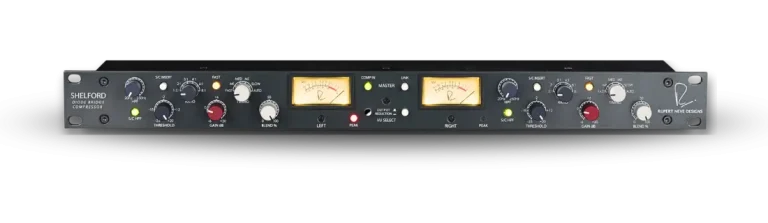
The Rupert Neve Designs Shelford Diode Bridge Compressor embodies the legacy of Rupert Neve’s exceptional audio engineering. Crafted for professionals who demand unparalleled sonic excellence, the compressor offers a blend of classic diode bridge compression with modern enhancements.
This dual-channel compressor is meticulously designed to deliver the warmth, richness, and dynamic control that have defined Rupert Neve’s work for decades.
Originally developed for the dynamics circuit of the acclaimed Shelford Channel, the Shelford Diode Bridge Compressor captures the soul of Rupert Neve’s original 2254 & 33609 units while providing modern updates including advanced timing control, significantly lower noise, fully stepped controls throughout, and internal parallel processing capabilities.
Whether you’re shaping the dynamics of a mix or adding character to individual tracks, the Shelford Diode Bridge Compressor provides the tools needed to achieve pristine, professional sound.
What is the Rupert Neve Designs Shelford Diode Bridge Compressor?
The Shelford Diode Bridge Compressor is a two-channel analog compressor built around Rupert Neve’s classic diode bridge circuit. It uses the same dynamics topology as the acclaimed Shelford Channel, pairing Neve custom transformers and Class-A line amps to deliver weight, color, and punch. It’s the modern evolution of the legendary vintage 2254 and 33609, the same larger-than-life tone, with far more control and a much lower noise floor.
What is the Shelford Diode Bridge Compressor best for?
The Shelford excels at adding punch, weight, and “glue” – it’s a go-to on drums, bass, electric guitar, vocals, and the mix bus. Diode bridge compression imparts a harmonically rich color that pushes important sources to the front of a mix rather than just controlling level. With its internal Blend control for parallel compression, it goes from subtle thickening to all-out smash without losing the vibe.
Is this the real Rupert Neve Designs hardware, or an emulation?
It’s the actual Rupert Neve Designs Diode Bridge Compressor – real Neve transformers and Class-A circuitry, not a model of them. Access Analog connects your DAW to the physical unit in real time through the Analog Matrix, so your signal genuinely passes through the hardware. Real Gear. No Emulations.
How much does it cost to use the Shelford Diode Bridge Compressor at Access Analog?
You can reserve the Shelford Diode Bridge Compressor from $4.42, and use it on demand with credits or an active subscription. On-demand use is billed at the same hourly rate as a reservation, with no minimum time. New accounts start with 12 free credits (roughly an hour on an average device) so you can try it before committing.
What is a diode bridge compressor, and how is it different from VCA, FET, or opto?
A diode bridge compressor uses a bridge of diodes as its gain-control element, a design Rupert Neve pioneered in the late 1960s. Where VCA designs aim for clean, exacting control and opto or FET units have their own characters, the diode bridge is prized for adding weight, harmonic color, and unmistakable punch as it compresses. That’s why engineers reach for it when a source needs to sound bigger and more “finished,” not just quieter.
Does the Shelford Diode Bridge Compressor have attack and release controls?
Instead of separate attack and release knobs, the Shelford uses a single unified Timing control with six musical settings – Fast, MF, Med, MS, Slow, and Auto – plus a FAST button that speeds things up for twelve total time constants. Fast settings clamp transients on drums and percussion, while slower settings (and Auto’s nonlinear release) give smooth, transparent leveling on vocals and the mix bus. Rupert Neve chose this approach because timing in a diode bridge circuit interacts with the other controls, so the preset time constants stay musical across the board.
What ratios does the Shelford offer, and how aggressive can it get?
The Shelford’s stepped Ratio control offers six positions from a gentle 1.5:1 up to a firm 8:1, and the ratio also shapes the overall character, not just the slope. Lower ratios glue and color the mix bus; higher ratios grab and thicken drums or a lead vocal. Because it’s so interactive, the best results come from auditioning ratios by ear rather than chasing numbers.
Is the Shelford Diode Bridge Compressor the same as the Rupert Neve Designs 5254?
Yes. The Shelford Diode Bridge Compressor and the RND 5254 are the same unit. Rupert Neve Designs renamed the 5254 to align it with the Shelford family; inside and out, the hardware is identical. So everything written about the 5254’s tone and controls applies directly to the Shelford you’ll be using at Access Analog.
Can I save and recall my Shelford settings, and can I use it in stereo?
Yes. Every knob, switch, and selector is saved, so you can recall your exact Shelford settings or an entire signal chain later. It’s a true stereo (dual-mono / stereo-linked) compressor, so you can process a stereo bus or two mono sources at once. You’re controlling the real hardware remotely through the Analog Matrix, with full per-control recall, just like a software plugin.