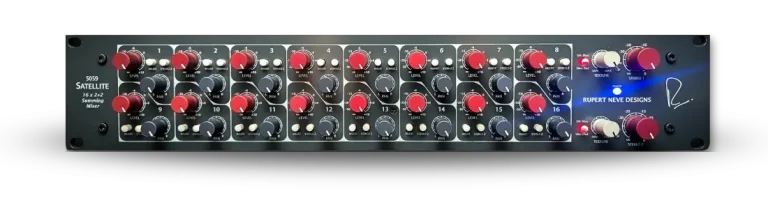
Control real analog gear straight from your DAW with the Analog Matrix. The Analog Matrix is not an emulation! It acts as a portal, connecting your digital audio workstation to actual physical gear in real time.
Reserve a session using the calendar below, or jump straight into the Analog Matrix plugin and use equipment on demand as it is available. Note: on-demand access requires credits or an active subscription.


Experience unparalleled sonic excellence with the Rupert Neve Designs 5059 Satellite 16 x 2+2 Summing Mixer. Crafted with class-A topologies and custom transformers, this mixer delivers exceptional warmth, clarity, and control to your audio productions.
The Rupert Neve Designs 5059 Satellite Summing Mixer is a versatile powerhouse that brings the legendary Rupert Neve sonic signature to your fingertips.
With 16 channels featuring individual level and pan, plus master Silk and Texture controls, the 5059 offers complete control over your mix. Whether you’re looking to add vintage vibe with Silk Red or thicken your sound with Silk Blue, the continuously variable Texture control lets you dial in the perfect amount of harmonic richness.
For more information: https://rupertneve.com/products/5059-satellite
Join the ranks of top engineers and producers who swear by the Rupert Neve sound!
New to the 5059? Read RND 5059 Satellite: Bringing Legendary Neve Console Sound to Your DAW: what analog summing actually changes, Silk Red vs Silk Blue, and how the 5059 works at Access Analog. To sum up to 16 tracks live from your session, see Real-Time Analog Summing From Your DAW.
What is the Rupert Neve Designs 5059 Satellite, and what does it do?
The Rupert Neve Designs 5059 Satellite is a 16 x 2+2 analog summing mixer that combines your DAW tracks through real Rupert Neve circuitry instead of inside the computer. It takes up to 16 channels, each with its own level, pan, and insert, and sums them across two independent stereo buses built on class-A topologies and custom transformers. The result is the warmth, depth, and dimensionality of a classic Neve console, added to your mix as it leaves the box.
What is the 5059 Satellite best for?
The 5059 Satellite is best for analog summing and stem mixing – gluing a digital mix together with real Rupert Neve color and width. Engineers route DAW tracks or stems out through its 16 channels to add transformer warmth, then sweeten the result with the Silk/Texture controls. It works equally well as a clean, high-headroom summing bus or a saturated, vintage-flavored mix engine, depending on how hard you drive it.
Is this the real RND 5059 Satellite, or an emulation?
This is the actual Rupert Neve Designs 5059 Satellite hardware. Real class-A circuits and custom transformers, not a model of them. Real Gear. No Emulations. At Access Analog you control the physical unit in real time from your DAW through the Analog Matrix, which robotically moves the knobs and switches on the box itself. The signal path is 100% analog; only the control and metering travel digitally.
How much does it cost to use the 5059 Satellite at Access Analog?
Access to the Rupert Neve Designs 5059 Satellite (#2) starts at $4.74 per reserved session when you book it on the calendar. You can also use it on demand through the Analog Matrix plugin with credits or an active subscription, paying only for the time you use. New accounts get a free hour (about 12 credits) to try real hardware before committing.
What does analog summing actually do, does it make a difference?
Analog summing combines your individual tracks or stems through a real analog signal path rather than the DAW’s internal math, and it audibly changes the sound. The tiny imperfections of transformers and class-A circuits add subtle harmonic richness, depth, and stereo width that many engineers describe as “glue.” Through the 5059, that difference carries the signature Rupert Neve character – the warmth, width, and dimensionality his classic consoles are known for.
What’s the difference between Silk Red and Silk Blue on the 5059?
Silk Red and Silk Blue are two flavors of transformer saturation, and the difference is which frequencies they enhance. Silk Red accentuates harmonics in the highs and high-mids for a brighter, sparkly sheen, while Silk Blue thickens the lows and low-mids to add weight and body. The continuously variable Texture knob sets how much you dial in, from completely clean to rich, vintage saturation, and the 5059 lets you apply different Silk settings to each of its two stereo buses.
Can I run two separate stem mixes through the 5059 at once?
Yes. The 5059 Satellite has two independent stereo buses (the “2+2” in 16×2+2), so you can split your inputs into two separate stem mixes. Any channel can be sent to the Stereo 2 buss, and each buss has its own Silk/Texture control for independent tonal shaping. A common move is Silk Blue on a drums-and-bass stem and Silk Red on a guitars-and-keys stem, then processing each independently before final summing.
Can I chain the 5059 (#2) with other gear and recall my settings?
Yes. This 5059 Satellite (#2) is connected to a relay-based analog switch, so it can be combined with the Rupert Neve Designs Master Bus Processor (#2) and the Master Bus Converter with full analog switching in between. Because you control it through the Analog Matrix, every setting saves inside your DAW session and recalls instantly, just like a plugin. That gives you a full analog Neve mix-and-master chain you can automate and recall on demand.