Control real analog gear straight from your DAW with the Analog Matrix. The Analog Matrix is not an emulation! It acts as a portal, connecting your digital audio workstation to actual physical gear in real time.
Reserve a session using the calendar below, or jump straight into the Analog Matrix plugin and use equipment on demand as it is available. Note: on-demand access requires credits or an active subscription.
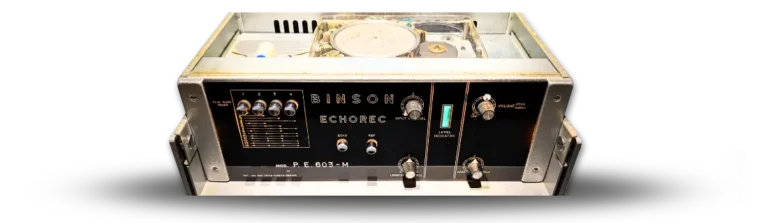
The Binson Echorec P.E. 603-M is a studio rack-mount magnetic disc echo unit produced in Milan, Italy around 1971. Part of the legendary PE-603 series, widely regarded as the most rugged and advanced machines Binson ever built, the 603-M was specifically designed for professional studio environments. Housed in a heavy-duty metal chassis built to withstand the demands of rack-mounted studio life, this unit was engineered to operate as a send/return effect on a mixing console, accepting a line-level input and delivering a wet-only echo output. Unlike the earlier Echorec 2 models with their gold-and-black Plexiglas stage units, the 603-M was purpose-built for the control room, where engineers could integrate its otherworldly sound into their mixing workflow.
The Binson Echorec family is one of the most celebrated echo units in recording history. The PE-603 series was used by David Gilmour of Pink Floyd alongside his Echorec 2 during the Dark Side of the Moon tours of 1973–75, and PE-603 units can be spotted in live footage from that era. Binson Echorecs more broadly were used by Syd Barrett, Roger Waters, Richard Wright, Hank Marvin of The Shadows, The Beatles, John Bonham of Led Zeppelin, and Rory Gallagher. In the modern studio world, legendary mix engineer Michael Brauer (The Rolling Stones, Paul McCartney, Coldplay) is known to keep an Echorec in his collection of vintage delays. The PE-603 series remains highly sought after by studios, producers, and mix engineers worldwide for its unique sonic character.
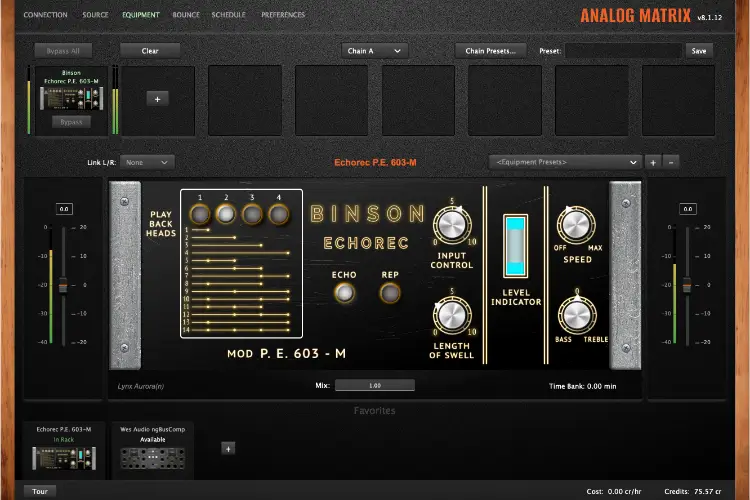
At the heart of the 603-M lies Binson’s signature innovation: a rotating magnetic disc (or drum) wrapped in a single layer of stainless steel wire just 0.1mm in diameter. This disc replaces the fragile tape loops found in other echo machines of the era, offering superior stability, durability, and a sound that is entirely its own. A motor-driven rubber jockey wheel spins the disc at a constant speed while record and playback heads arranged around its circumference capture and reproduce the signal. The result is a warm, slightly dark echo with a natural analog “warble”—an organic imperfection that gives every repeat a living, breathing quality. The 603-M features four playback heads that can be combined via individual selector switches, producing up to 14 distinct echo patterns.
In Echo mode, you get classic slapback delay. In Repeat mode, the echoes multiply and cascade. And in Swell mode, the repeats overlap into a lush, reverb-like bloom that is uniquely and unmistakably Binson. The Length of Swell control governs feedback intensity, from subtle thickening to full cosmic self-oscillation.
What makes the 603-M particularly special in the Echorec lineage is its position as a transitional design. According to the AudioExMachina Echorec Bible – the most comprehensive catalog of every Echorec model ever produced – the PE-603-M was introduced in 1971 and it retains the iconic EM84 “magic eye” vacuum tube as a level indicator, its green glow serving as both a functional VU meter and a visual signature of the Binson legacy.
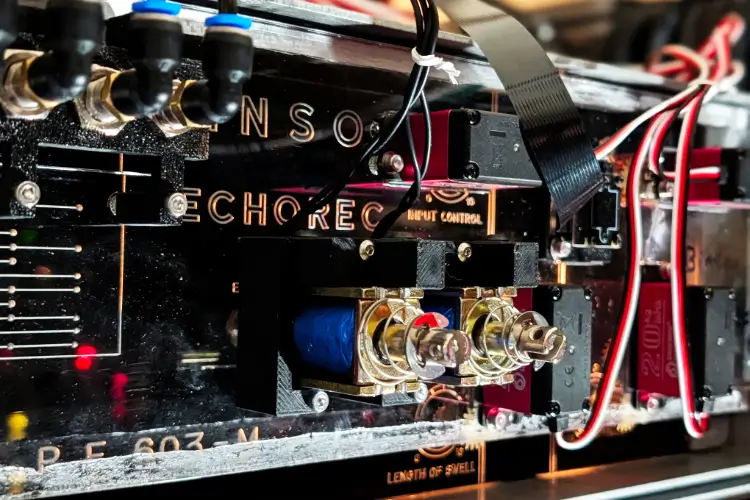
Note: The unit in the Access Analog rack has been modified with a control to change the speed of the rotating magnetic disc. This allows the user to control the length of the delay. Unlike most 603-M models, this unit uses tube-based technology instead of solid state.
Produced by Dr. Bonfiglio Bini’s team at the Binson Amplificatori HiFi factory in Milan, the Binson Echorec 603-M carries forward the same obsessive engineering quality that made Binson a household name among British Invasion and progressive rock acts. Every component was manufactured in-house. When asked if outsourcing would be cheaper, Dr. Bini famously responded that it would no longer be “Binson stuff.” That uncompromising ethos is in every echo this machine produces.
What is the Binson Echorec P.E. 603-M?
The Binson Echorec P.E. 603-M is a real analog magnetic-drum echo unit, built in Milan, Italy around 1971 for professional studios. Instead of tape, it records your signal onto a spinning steel drum read by multiple playback heads, producing warm, swirling echoes with an organic analog “warble.” It is the legendary delay behind David Gilmour’s Pink Floyd soundscapes and countless classic records, prized for a character no algorithm fully captures.
What is the Binson Echorec best for?
The Echorec is best for adding vintage, dimensional echo and ambience to guitars, vocals, synths, and keys – anywhere you want movement and depth rather than a clean, modern delay. Its Swell mode creates lush, reverb-like washes, while Echo and Repeat give classic slapback and cascading repeats. Engineers reach for it for psychedelic, ambient, and retro textures, or any time a part needs to feel “alive.”
How does the Binson Echorec work?
The Echorec records your audio magnetically onto a rotating steel drum wrapped in fine wire, then reads it back with a series of fixed playback heads positioned around the drum. Each head sits at a different point, so selecting different heads and head combinations produces different delay times and rhythmic patterns. Because it uses a mechanical drum rather than fragile tape, it is more stable and durable, with a warm, slightly dark tone and a living “warble” all its own.
What’s the difference between Echo, Repeat, and Swell modes?
Echo gives you a single classic slapback delay; Repeat produces multiple cascading repeats; and Swell blends all four playback heads into a lush, overlapping, reverb-like bloom. The Length of Swell control sets the feedback, from subtle thickening all the way to controlled self-oscillation. Together they are the source of the Echorec’s signature swirl.
What controls does the Binson Echorec 603-M have?
The 603-M offers Input Level, Echo Volume, Length of Swell (feedback), and Tone, plus individual head-selector switches and the Echo/Repeat/Swell mode selector. An EM84 “magic eye” tube glows green to show your input level. The specific unit in the Access Analog rack is also modified with a disc-speed control, letting you vary the delay time – something most stock 603-M units cannot do.
Should I use the Binson Echorec on an aux/send?
Yes. The 603-M is a wet-only, send/return device, so it is designed to sit on an aux/send rather than as a standard insert. Route a send from the track you want to treat, return the wet echo, and blend it under the dry signal to taste. That workflow lets several tracks share the Echorec while keeping your dry signal untouched.
Is the Access Analog Binson Echorec real hardware or an emulation?
It is a real, physical Binson Echorec, an electro-mechanical unit with an actual spinning magnetic drum and playback heads, not a digital model of one. Through Access Analog, the Analog Matrix plugin robotically controls the hardware in real time from inside your DAW, so your audio runs through the real drum and heads. Real Gear. No Emulations.
Can I save and recall my Echorec settings through Access Analog?
Yes. Every control on the Analog Matrix plugin is robotically linked to the physical hardware, so you can save, recall, and automate your settings inside your DAW session like any other plugin. That means your mode, head selection, swell, and tone come back exactly as you set them, session after session on a real spinning drum instead of an emulation.
How much does it cost to use the Binson Echorec at Access Analog?
The Binson Echorec P.E. 603-M reserves from $5.07 per hour, a rare chance to use a genuine vintage magnetic-drum echo without owning or maintaining one. Reserve a session on the calendar or use it on-demand with credits or an active subscription (subscriptions start at $9.98/month), and new accounts get a free hour (about 12 credits) to try real hardware.
Select Features of the Binson Echorec:
Reviews of the Binson Echorec:
Due to the rarity and vintage nature of this unit, formal magazine reviews of the PE-603-M specifically are scarce. However, the following resources provide excellent coverage of the Echorec family and the PE-603 series:
No standalone owner’s manual specific to the PE-603-M has been located in public archives. However, the following resources provide relevant technical documentation: