Control real analog gear straight from your DAW with the Analog Matrix. The Analog Matrix is not an emulation! It acts as a portal, connecting your digital audio workstation to actual physical gear in real time.
Reserve a session using the calendar below, or jump straight into the Analog Matrix plugin and use equipment on demand as it is available. Note: on-demand access requires credits or an active subscription.


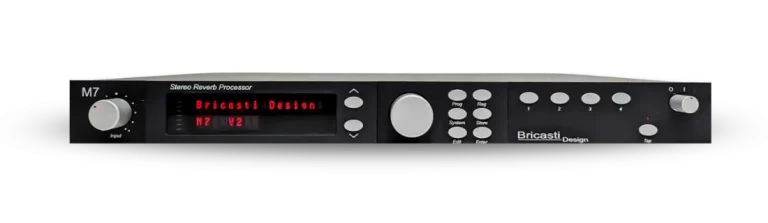
The Bricasti Design Model 7 is one of the most popular, versatile, and some would say ultimate digital reverberation units on the market. It provides the highest level of musicality and ease of control imaginable in a processor dedicated exclusively to reverb. A modern high resolution digital design, utilizing a stunning array of the latest DSP processors that provides a unique platform for reverb processing algorithms.
If you’ve never used a real reverb unit then try it once and you will immediately hear the difference compared to a plugin. It creates a unique warmth for vocals and an amazing depth for any musical instrument.
New to the M7? Read Bricasti M7 Reverb: How to Create Pro-Sounding Depth and Space in Your Mixes: how its three algorithms differ, which parameters shape depth, and pro reverb technique for vocals, drums and instruments.
What is the Bricasti M7 Stereo Reverb?
The Bricasti M7 is a high-end digital stereo reverb processor widely regarded as one of the best-sounding hardware reverbs ever made. It uses advanced DSP algorithms to create strikingly realistic spaces (halls, plates, chambers, rooms, and more) paired with a high-quality analog output stage. Engineers reach for it when they want lush, three-dimensional, true-to-life reverb around vocals and instruments.
What is the Bricasti M7 best for?
The M7 is best for adding realistic, high-fidelity space to vocals, drums, strings, piano, and full mixes – anywhere you want depth that sounds like a real room rather than an obvious effect. It is a favorite on lead vocals, where it adds warmth and air, and for mastering-grade ambience. Reach for it whenever a mix feels flat and needs a believable sense of space.
Is the Bricasti M7 analog or digital?
The M7 is a digital reverb, its reverb algorithms run on dedicated DSP, but it pairs that with a fully analog output section and a transformer-based linear power supply for its sound quality. So while the reverb itself is generated digitally, the unit is built to true high-end analog standards on the way out. Through Access Analog you are using that actual hardware, not a software version of it.
What reverb types and presets does the Bricasti M7 have?
The M7 comes loaded with a large library of factory programs grouped by type: Halls, Plates, Rooms, Chambers, and ambient Spaces, including big outdoor spaces like canyons and forests. It ships with well over 100 presets, covering everything from tight, realistic rooms to long, lush halls. Each program is a starting point you can fine-tune to fit your track.
What’s the difference between a hall, plate, chamber, and room reverb?
A hall is large and lush with a long, smooth tail, great for orchestral and ballad material. A plate is dense and bright with a fast build, a classic on vocals and snares. A chamber sits in between – smooth and natural – while a room is short and tight, adding realism without an obvious “reverb” sound. The M7 offers all of these as program types, so you can match the space to the source.
What parameters can I adjust on the Bricasti M7?
Each M7 program can be fine-tuned with a deep set of parameters, including Pre-Delay, Reverb Time, Size, Diffusion, Density, and high/low-frequency damping. Pre-Delay sets the gap before the reverb starts, useful for keeping vocals clear, while Reverb Time controls the length of the tail. Note that on the M7 itself, edits are lost when you change programs, the unit does not store custom edits back into a preset.
Should I use the Bricasti M7 on an aux/send or as an insert?
Most engineers use the M7 on a dedicated aux/send, so multiple tracks can share one reverb and you control the wet level with the send. In Access Analog it defaults to aux use, Dry Gain off and Wet Gain up, so it returns wet-only reverb you blend under your dry tracks. You can insert it on a single track instead, but the send approach is the classic, most flexible reverb workflow.
Is the Access Analog Bricasti M7 the real unit or an emulation?
It is the actual Bricasti M7 hardware – the real processor running its own DSP, not a software recreation of it. Through Access Analog, the Analog Matrix plugin robotically controls the physical unit in real time from inside your DAW, and your audio streams through the real M7. Real Gear. No Emulations.
Can I save and recall my Bricasti M7 settings through Access Analog?
Yes. The Analog Matrix plugin saves your program choice and parameter settings with your DAW session and re-applies them to the hardware on recall, and you can automate parameters from your DAW, so your reverb comes back the way you left it even though the M7 itself does not store custom edits. That gives you plugin-style recall on a real hardware reverb.
How much does it cost to use the Bricasti M7 at Access Analog?
The Bricasti M7 reserves from $5.04 per hour, an affordable way to use a reverb that costs several thousand dollars to own. Reserve a session on the calendar or use it on-demand with credits or an active subscription (subscriptions start at $9.98/month), and new accounts get a free hour (about 12 credits) to try real hardware.
With over 100 factory programs it’s hard to imagine a space that hasn’t been modeled.
In addition there are 18 different parameters for each program, such as Pre Delay and Reverb Time, that allow a user to customize their space/program to exactly match the audio.
A separate, fully differential analog section, and dedicated transformer based linear power supply provides the finest analog specifications of any product of its kind.
If you are not familiar with the Bricasti M7 then we suggest you watch the overview video on this page to get an understanding of the operation, menu structure and system options.
The Program button allows you to select from 100+ factory programs. The programs are grouped into types such as Halls, Chambers, Rooms, Plates, Spaces, etc.. You can access the types by using the up/down buttons. From there use the Modify wheel to scroll through the options for that type. Press Enter to execute your program of choice. The Edit button may then be used to modify the parameters for this program such as Pre Delay and Reverb Time. Note all edits are lost when the next program is selected. Edits cannot be saved.
The Enter button – if you see an asterisk in the upper right part of the menu then your changes have not taken effect. Press the Enter button for the change to be activated.
Users are free to setup the Bricasti for any DAW configuration, however our defaults have been setup assuming it will be placed on an auxiliary track. Therefore Dry Gain is Off and Wet Gain can be adjusted from Full to Off in 0.5 dB steps. We have defaulted the unit to Stereo operation. The System button will allow you to change the Audio Format (default Stereo) as well as the Wet Gain (default Full) – When first using the equipment please ensure these are set correctly for your tracks and please restore them to the defaults if you change them during your session.