Control real analog gear straight from your DAW with the Analog Matrix. The Analog Matrix is not an emulation! It acts as a portal, connecting your digital audio workstation to actual physical gear in real time.
Reserve a session using the calendar below, or jump straight into the Analog Matrix plugin and use equipment on demand as it is available. Note: on-demand access requires credits or an active subscription.


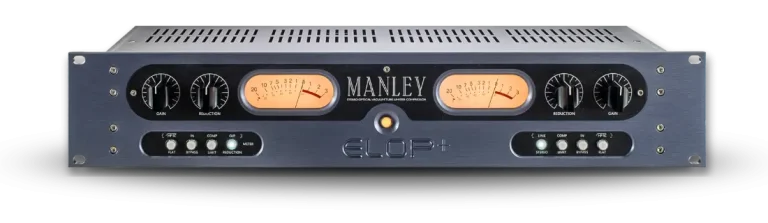
The Manley ELOP®+ Stereo Limiter Compressor is a high-performance audio device designed to deliver the iconic classic, all-tube sound Manley Laboratories is renowned for.
This LA-2A style unit provides deep limiting capabilities without compromising high frequencies, mimicking the natural sound of a dynamically controlled volume.
Originally introduced in the early 1990s, the ELOP® has been upgraded for enhanced buildability, featuring a modern MANLEY POWER™ switch mode power supply for low noise and universal voltage compatibility.
The new ELOP+ offers a versatile 3:1 compression ratio, complemented by a high-quality vacuum tube amplifier and precision CNC-milled design.
What is the Manley ELOP+?
The Manley ELOP+ is an all-tube, dual-channel electro-optical compressor and limiter, hand-built by Manley Labs in California. It uses a light-dependent optical cell to control gain, giving smooth, natural-sounding dynamics from very few controls -just reduction, make-up gain, and a ratio switch. Inspired by the legendary LA-2A, it adds a second channel, a versatile 3:1 compression mode alongside deep 10:1 limiting, and Manley’s signature tube warmth.
What is the Manley ELOP+ best for?
The ELOP+ shines on vocals, where its optical compression levels out a performance without dulling the top end. It is also a favorite on bass, guitar, brass, synths, and room mics, and the stereo pair makes it equally at home gluing a full mix or stereo bus. Because it is genuinely hard to make it sound bad, many engineers reach for it as a go-to tracking compressor.
Does the Manley ELOP+ have attack and release controls?
No. The ELOP+ has no attack, release, or knee controls, by design. Its optical cell sets attack and release automatically in response to the program material, which is exactly what gives optical compressors their smooth, musical feel. You control just three things: the amount of reduction, the make-up gain, and whether you are in 3:1 compression or 10:1 limiting mode.
What’s the difference between the ELOP+’s 3:1 and 10:1 settings?
The 3:1 setting is a gentler compression mode for everyday leveling and glue, while 10:1 is a true limiting mode for catching peaks and harder dynamic control. The 3:1 ratio was added on the ELOP+ to make it more versatile for mix-bus and 2-buss work, where the original ELOP only limited. Note that these ratios are approximations – the optical circuit responds to whatever you feed it, so trust your ears alongside the meters.
What is electro-optical (optical) compression?
Optical compression uses a light source and a light-sensitive cell to control gain: the louder the signal, the brighter the light, and the more the cell turns the level down. This light-and-cell behavior is naturally smooth and program-dependent, which is why optical compressors are prized for transparent, musical dynamics on vocals and bass. The ELOP+ pairs this electro-optical attenuation with an all-tube audio path using 5751 and 6922 vacuum tubes for added warmth.
What does the ELOP+’s side-chain high-pass filter do?
The side-chain high-pass filter stops the ELOP+ from over-reacting to low frequencies like kick and bass. It filters the detector circuit (not the audio) so the compressor “listens” past the lows and responds more to midrange and highs, keeping the low end tight instead of pumping. On the ELOP+ it is switchable between 80 Hz and 150 Hz.
How does the Manley ELOP+ compare to the LA-2A?
Both are tube optical levelers with the same simple, hands-off workflow, but the ELOP+ tends to sound brighter, more transparent, and more defined, where the LA-2A is warmer and more colored. The ELOP+ also gives you two channels for stereo work plus a switchable 3:1/10:1 ratio, where a single LA-2A handles one channel. Many engineers keep both on hand and choose by source, and at Access Analog you can audition each one on real hardware before you decide.
Is the ELOP+ at Access Analog the real hardware or an emulation?
It is the actual Manley ELOP+ hardware – real tubes, real Manley IRON transformers, and a real optical cell, not a model of them. Real Gear. No Emulations. Through the Analog Matrix plugin, robotics physically turn the knobs and flip the switches on the genuine unit in our facility while your audio streams through it in real time.
How much does it cost to use the Manley ELOP+ at Access Analog, and can I recall my settings?
The Manley ELOP+ reserves from $4.74, and you can also use it on demand with credits or an active subscription. Every control is fully recallable – save your reduction, gain, ratio, and filter settings inside your DAW session and bring them back instantly, like any plugin. New accounts get a free hour to try it on real hardware.