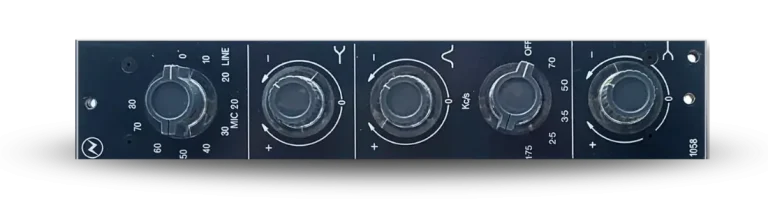
Control real analog gear straight from your DAW with the Analog Matrix. The Analog Matrix is not an emulation! It acts as a portal, connecting your digital audio workstation to actual physical gear in real time.
Reserve a session using the calendar below, or jump straight into the Analog Matrix plugin and use equipment on demand as it is available. Note: on-demand access requires credits or an active subscription.


The Neve 1058 was one of Neve’s first germanium microphone preamp/equalizer designs. It has some of the same basic circuitry as the Neve 1057, with high and low fixed-frequency cut/boosts and a switchable mids. It is an extremely rare Neve module.
How does the 1058 compare with its vintage Neve siblings? Read The Neve 1064 and Its Vintage Siblings: What Each Module Does and How to Use It, with settings from F. Reid Shippen.
What is the Neve 1058?
The Neve 1058 is a rare vintage germanium mic preamp and EQ module from the late 1960s, one of Neve’s first germanium designs. It has fixed low and high shelves and a switched presence band, with a gritty, dark, forward character. Our vintage Neve units are from the personal collection of F. Reid Shippen, and they’re unusual even by 1058 standards.
Why doesn’t this Neve 1058 have an input transformer?
The original Neve 1058 was designed to use input transformers mounted outside the module, so a module running without one is a documented configuration, not a fault. According to F. Reid Shippen, our units have no input transformers and use Marinair output transformers designed for later modules like the 1073. That combination gives them a completely different character from a typical 1058: grittier, darker, and with unusual midrange presence.
What is the Neve 1058 best for?
The Neve 1058 is best for bass, electric guitars, and analog synths. F. Reid Shippen’s move on bass is “Dime the low and the 1.75k. Watch your levels,” and he notes that Michael Beinhorn used 1058s exclusively on the bass and guitars for Soundgarden’s “Superunknown.” On vocals it adds attitude and grain, and it works well blended in parallel with the Analog Matrix’s Mix slider.
What controls does the Neve 1058 have?
The Neve 1058 has a switched line gain control, a fixed low shelf, a switched presence band, and a fixed high shelf. The presence band selects 1.75, 2.5, 3.5, 5, or 7 kHz, points that sit in different places from later Neve modules and give the 1058 its unusual midrange. There’s no high-pass filter, and at Access Analog the line gain runs 0, +10, or +20.
What does a presence band do on a vintage EQ?
A presence band boosts or cuts the upper midrange, where a source’s definition and bite live. On the Neve 1058 it’s the one band with selectable frequencies, so you choose the point that makes a guitar, bass, or synth jump forward. Boost it for edge and articulation, or cut it to push a harsh source back in the mix.
Is this the real Neve 1058 or an emulation?
It’s the actual vintage Neve 1058, with its real germanium circuitry and Marinair output transformer, not a model of them. Your audio streams from your DAW to the physical module in our rack, and robotics set its controls as you adjust the Analog Matrix plugin. Real Gear. No Emulations.
Can I track a microphone through the Neve 1058, or run it in stereo?
The Neve 1058 at Access Analog processes audio that’s already in your DAW at line level; it isn’t used to track a live microphone. Your track passes through the real module and comes back into your session, with your settings saved and recalled robotically. We have two 1058s, so you can use one in mono or link both with the Analog Matrix’s Link L/R setting for a matched stereo pair on synths or a guitar bus.
How much does it cost to use the Neve 1058?
The Neve 1058 is included in the Pro and Elite tiers of the Access Analog Subscription, and you can also reserve it outright from the reservation calendar on this page. Current rates for every device are always listed on the Gear Prices page. New accounts start with 12 free credits to try the service.