
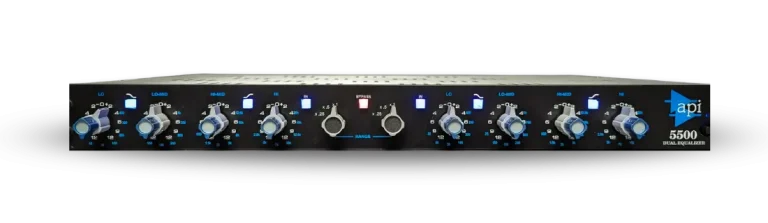
API 5500
$4.32 / 15 min
ProGermanium Gem. Tonal Shaping.
The Neve 2057 is a rare, early 3-band EQ module featuring germanium transistors. It delivers rich, classic tonal shaping. Use it to put some attitude into a flat vocal and make your guitars sound rad. Unbelievable for drums!
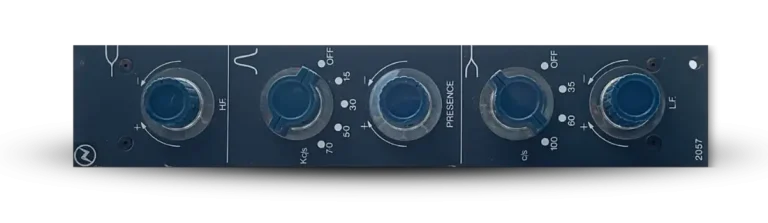
The Neve 2057 is a vintage equalizer designed by Rupert Neve and is considered a rare and highly sought-after piece of gear by audio professionals. It is part of Neve’s first generation of combination mic preamp and equalizer designs and incorporates germanium components contributing to its huge sound.
How does the 2057 compare with its vintage Neve siblings? Read The Neve 1064 and Its Vintage Siblings: What Each Module Does and How to Use It, with settings from F. Reid Shippen.
The Analog Matrix plugin is not an emulation. It connects your DAW to the real Neve 2057 (#1) in our racks, in real time: turn a knob in the plugin and our robotics turn it on the hardware. Reserve a time above, or open it on demand whenever it's free.


The Neve 2057 is a rare vintage three-band equalizer module designed by Rupert Neve in the late 1960s. It uses germanium transistors and St. Ives input/output transformers in a Class-A circuit, giving it a thick, grainy, character-rich tone. Unlike later Neve modules, it's a combo mic preamp/eq, built purely for tonal shaping. Engineers prize it as one of the most sought-after early Neve modules ever made.
The Neve 2057 is best known for drums, where it's widely regarded as one of the greatest drum EQs ever built. It also adds attitude and presence to flat vocals, and its germanium circuit makes electric guitars sound bigger and grittier. Reach for it any time you want to inject vintage Neve thickness, grain, and mojo into a track.
The Neve 2057 earns its drum reputation from its huge low end and aggressive, musical midrange, courtesy of its germanium transistors and St. Ives transformers. Producer Michael Beinhorn used these modules on landmark drum sounds for records like Superunknown, Celebrity Skin, and Mechanical Animals. On a drum bus or individual kit pieces, it adds punch and dimension that flat EQ simply can't deliver. It's the kind of EQ that makes drums jump out of the speakers.
The Neve 2057 is a three-band EQ with a high-pass filter, a low band, a switchable midrange, and a high shelf. The high-pass filter offers 20/45/70/160/360 Hz; the low band covers 35/60/100/220 Hz; the mid selects 0.7/1.2/2.4/3.8/7 kHz; and the high band is a 10 kHz shelf. Frequencies are switch-selected, so you dial in classic Neve curves quickly rather than sweeping freely.
The germanium transistors are the heart of the Neve 2057's sound, giving it a warmer, grittier, more vintage character than later silicon-based Neve modules. Germanium was the transistor technology of the 1960s, and its slightly looser, more harmonically rich behavior is a big part of why early Neve gear sounds the way it does. In the 2057 that translates to grain, thickness, and mojo: Neve Class-A with a little extra edge.
An active EQ uses powered circuitry such as transistors or tubes to boost and cut frequencies, while a passive EQ uses only inductors, capacitors, and resistors and then makes up the lost level with a separate amplifier stage. The Neve 2057 is an active, Class-A design, so its germanium transistors and transformers add their own color as you shape the tone. That's why even modest moves on a 2057 sound rich and finished rather than clinical.
It's the real, physical Neve 2057, the actual vintage hardware with its real germanium transistors and transformers, not a model of them. Access Analog connects your DAW to the genuine unit through the Analog Matrix plugin, which controls the gear remotely and streams your audio through it in real time. Real Gear. No Emulations. You hear exactly what the hardware does, because the hardware is doing it.
You can reserve the Neve 2057 for a timed session or use it on demand with credits or an active subscription. Current rates for every device are always listed on the Gear Prices page. When you create a new account, you start with 12 free credits (roughly 1 hour of use on an average device).
$4.32 / 15 min
Pro
$4.60 / 15 min
Pro
$2.75 / 15 min
Pro
$5.07 / 15 min
Elite