Control real analog gear straight from your DAW with the Analog Matrix. The Analog Matrix is not an emulation! It acts as a portal, connecting your digital audio workstation to actual physical gear in real time.
Reserve a session using the calendar below, or jump straight into the Analog Matrix plugin and use equipment on demand as it is available. Note: on-demand access requires credits or an active subscription.


The Newton Channel from Rupert Neve Designs is a powerhouse of modern audio processing, encapsulating the legendary sonic heritage of Rupert Neve in a sleek and intuitive channel strip. Designed for engineers, producers, and artists who demand nothing but the best, the Newton Channel delivers classic sound with unparalleled versatility.
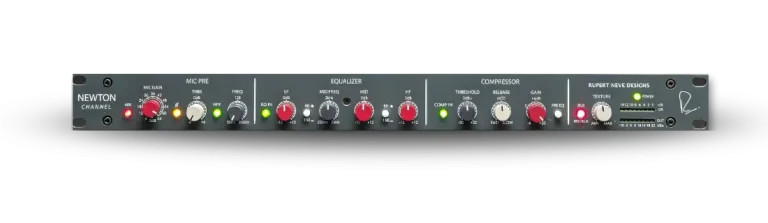
The Rupert Neve Designs Newton Channel combines decades of audio engineering expertise into a single unit that promises both versatility and the classic Rupert Neve sound. It is designed to deliver pristine sound enhancement, featuring a fully Class-A mic preamp, a 3-band EQ, and a VCA compressor, combined with an iconic Rupert Neve custom transformer coupled output and Silk Red & Blue texture controls for harmonic saturation.
Audio professionals commend the Newton Channel for its operational simplicity, excellent build quality, and the musical quality of its EQ and compressor. Its performance is highlighted by its ability to quickly achieve desired sound results, making it a favorite among engineers and producers for its accessibility and intuitive design.
Its time to discover the power of the Newton Channel!
What is the Rupert Neve Designs Newton Channel?
The Newton Channel is a single-rack analog channel strip from Rupert Neve Designs that combines a Class-A mic preamp, a 3-band EQ, a VCA compressor, and the famous Silk harmonic-saturation circuit in one signal path. It captures the instantly recognizable Rupert Neve tone with a fast, intuitive workflow, and its custom transformer-coupled outputs deliver that legendary Neve color on the way out. Think of it as a complete front end and tone-shaping box rolled into one box.
What is the Newton Channel best for?
The Newton Channel is best for adding rich Rupert Neve character to vocals, and it shines on almost any source you push through it – guitars, bass, drums, keys, and full mix elements. Its clean 72dB preamp and musical EQ make it a fast tracking front end, while the EQ, compressor, and Silk also work beautifully on already-recorded material. Reach for it whenever you want a track to sound richer, more present, and more finished.
What’s in the Newton Channel’s signal chain?
The Newton Channel’s signal flows through four main sections in order: a Class-A mic preamp with a variable high-pass filter, a 3-band EQ, a VCA compressor, and the Silk harmonic-saturation stage feeding a custom transformer-coupled output. The compressor can be placed before or after the EQ, and the EQ and compressor each have their own bypass switch. That layout lets you shape, control, and color a sound in a single pass.
What does the Silk circuit do, and what’s the difference between Silk Red and Silk Blue?
Silk is Rupert Neve Designs’ harmonic-saturation circuit that drives the output transformer to add 2nd- and 3rd-order harmonics for a richer, more vintage character. Silk Red enhances the highs and high-mids – a sparkly sheen that flatters vocals, snare, strings, piano, and acoustic instruments. Silk Blue beefs up the lows and low-mids, making it ideal for drums, bass, electric guitar, and deeper male vocals. The Texture control sets how much you add, from a subtle glow to heavy color.
Can I use just the EQ or just the compressor on its own?
Yes. The Newton Channel’s EQ and compressor each have their own bypass switch, so you can run one, both, or neither. You can also place the compressor before or after the EQ to change how they interact. That flexibility lets you treat the Newton as a full channel strip or as a single dedicated EQ, compressor, or Silk color box.
What kind of compressor is in the Newton Channel?
The Newton Channel uses a feedback VCA compressor, the latest version of Rupert Neve Designs’ VCA design. It has a fixed 20ms attack and 2:1 ratio with a variable release (50–500ms) and up to 20dB of makeup gain, so it behaves almost like a fast, musical “one-knob” compressor that lets transients through cleanly. It’s prized for smooth, natural dynamic control without fuss.
What’s the difference between the Newton Channel and the Shelford Channel?
The Newton and the Shelford are both Rupert Neve Designs channel strips, but the Newton uses a cleaner, transformer-less (electronically balanced) mic input for a more modern, transparent front end, while the Shelford’s transformer input leans more vintage. The Newton’s EQ is a transparent parametric design, where the Shelford uses a vintage-style inductor EQ, and the Newton’s VCA compressor is simpler and faster than the Shelford’s diode-bridge compressor. Both share the same Silk circuit and transformer-coupled output, so the Newton still delivers that signature Neve color – it’s the more streamlined, accessible take on the RND channel-strip sound.
Is this the real Newton Channel, or an emulation?
It’s the actual Rupert Neve Designs Newton Channel – real circuitry, real transformers, the genuine hardware, not a model of it. Real Gear. No Emulations. At Access Analog you control the physical unit in real time from your DAW through the Analog Matrix, which robotically moves the real knobs and switches while your audio streams through the actual box and back.
At Access Analog, can I track a live mic through the Newton, or does it process my DAW audio?
At Access Analog, the Newton Channel processes the audio already in your DAW (line level) rather than tracking a live microphone in your room. You stream a track or bus out to the real hardware; the Newton’s preamp, EQ, compressor, and Silk shape it; and the processed audio returns to your session. You also get full recall – save your settings in the session and recall them instantly on the real unit.
How much does it cost to use the Newton Channel at Access Analog?
The Newton Channel starts at Reserve From: $3.77 at Access Analog. You can reserve a session on the calendar, or use it on demand through the Analog Matrix plugin with credits or an active subscription (subscriptions start at $9.98/month). New accounts get a free hour (about 12 credits) to try real analog gear before committing.
* The Access Analog device is robotically limited to 18dB for line level use.