Control real analog gear straight from your DAW with the Analog Matrix. The Analog Matrix is not an emulation! It acts as a portal, connecting your digital audio workstation to actual physical gear in real time.
Reserve a session using the calendar below, or jump straight into the Analog Matrix plugin and use equipment on demand as it is available. Note: on-demand access requires credits or an active subscription.


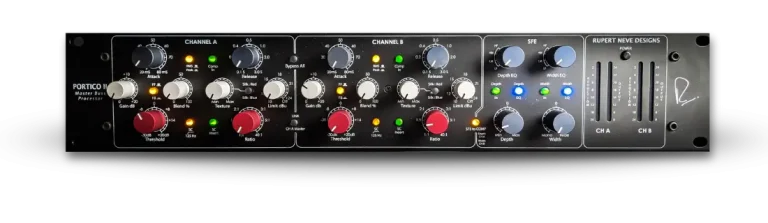
The Rupert Neve Designs Portico II Master Buss Processor is a high-end analog processor designed to deliver exceptional audio quality and versatility. It offers a comprehensive suite of features for processing and shaping audio.
Based around the high voltage, discrete, and class-A signal paths made famous in the 5088 Mixer, the Portico II Master Buss Processor is a creative tool that redefines the boundaries and limitations of traditional 2-channel compression and limiting.
Though originally developed for mastering applications, the MBP quickly became a favorite of mix engineers, tracking engineers, and even FOH engineers.
From mixing bass-heavy EDM to a delicate master of a chamber ensemble, it has something to offer everyone, no matter the use or genre.
Note – The Side Chain (SC) buttons for the Portico II are set to fixed positions and not controllable from the Plugin. The SC 125Hz High Pass Filter button is engaged. The SC Insert button is disengaged, and there is no equipment connected to the side chain ports.
This unit is on our Analog Switch, so it can link to the other switch units without leaving analog: one D/A in, one A/D out. Read Introducing Analog Switching: Real Hardware, One Conversion, Endless Creative Chains.
New to the Portico II? Read How to Get the Most Out of the Rupert Neve Designs Portico II.
The Portico II Master Buss Processor (MBP) is a 2-channel analog compressor, limiter, and stereo field processor built for the mix and master bus. It pairs two fully featured VCA compressor sections with a one-knob limiter, Silk harmonic saturation, and a Stereo Field Editor for shaping the stereo image. Built on the high-voltage, discrete Class-A topology from Rupert Neve’s 5088 console, it adds glue, weight, and dimension to a stereo mix. Originally designed for mastering, it has become a go-to for mixing and tracking engineers too.
What is the Portico II Master Buss Processor best for?
The Portico II MBP is best for gluing and finishing a full stereo mix or master bus. Engineers reach for it to control dynamics, add Neve harmonic warmth, and widen or focus the stereo image all in one pass. It also shines on stereo subgroups like the drum bus, and on dual-mono sources when you unlink the two channels. From bass-heavy EDM to delicate acoustic masters, it flatters nearly any genre.
What does the Silk / Texture control do on the Portico II?
Silk adds Rupert Neve’s signature analog harmonic saturation, with a Texture knob that dials the effect from a whisper to obvious vintage color. Silk Red emphasizes low-end harmonics for warmth and weight, while Silk Blue emphasizes high-end harmonics for air and presence. The Texture control is continuously variable, so you choose exactly how much character to add. It’s the fastest way to make a clean mix sound like a classic Neve.
What’s the difference between feed-forward and feed-back compression on the MBP?
Feed-forward mode gives a transparent, modern, more accurate response, while feed-back mode gives a smoother, more musical vintage response. The MBP lets you switch between the two on each channel, and also choose Peak or RMS detection, so a single box covers everything from gentle bus glue to aggressive grab. Feed-back with RMS is the classic, traditional setting many mastering engineers default to. Feed-forward with Peak detection bites harder and faster for punch.
What is the Stereo Field Editor on the Portico II?
The Stereo Field Editor (SFE) is a mid-side section that lets you reshape the width and spatial balance of a stereo mix. It processes the center (mid) and sides separately, so you can widen a mix, tighten a lopsided image, or focus the low end to the center. This makes the MBP a powerful mastering and stereo-imaging tool, not just a compressor. Used gently, it adds space and dimension without phase problems.
Can I use just one section, like the compressor or limiter on its own?
Yes. Each section of the Portico II MBP can be engaged independently. The compressor, limiter, Silk saturation, and Stereo Field Editor all have their own controls, so you can use just the Silk for color, just the limiter for peak control, or the full chain together. A Blend control also lets you mix dry and compressed signal for instant parallel compression. That flexibility is why one box can cover so many jobs.
Is the Portico II at Access Analog the real hardware, or an emulation?
It’s the actual Rupert Neve Designs Portico II Master Buss Processor – real transformers, real Class-A circuitry, robotically controlled in real time. Real Gear. No Emulations. The Analog Matrix plugin acts as a portal from your DAW to the physical unit racked at Access Analog, so your audio streams through the genuine hardware and back. You hear the real box, not a model of it.
Can I save and recall my Portico II settings?
Yes. You can save your Portico II settings inside your DAW session and recall them instantly, just like any other plugin. Because the Analog Matrix robotically sets the physical knobs and switches, your recalled session returns the real hardware to the same positions. You can also automate parameters for evolving, dynamic moves. (Note: the side-chain buttons are set to fixed positions on this unit and are not controllable from the plugin.)
How much does it cost to use the Portico II at Access Analog?
Reserve From: $5.52. You can reserve a session on the calendar, or use it on demand through the Analog Matrix plugin with credits or an active subscription. Credit bundles start at $15 and never expire, and subscriptions start at $9.98/month. New accounts get 12 free credits (about one free hour) to try real analog gear before you commit.