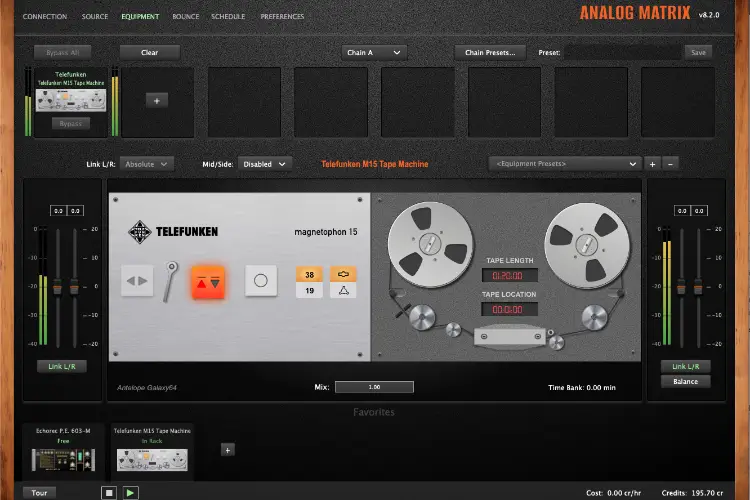
Control real analog gear straight from your DAW with the Analog Matrix. The Analog Matrix is not an emulation! It acts as a portal, connecting your digital audio workstation to actual physical gear in real time.
Reserve a session using the calendar below, or jump straight into the Analog Matrix plugin and use equipment on demand as it is available. Note: on-demand access requires credits or an active subscription.
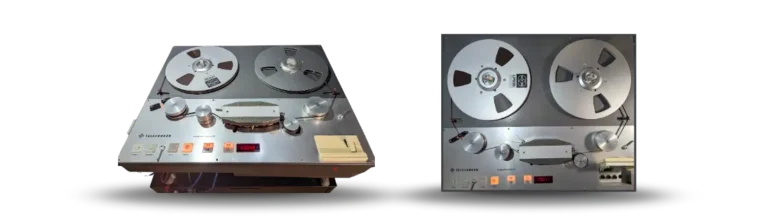
The Telefunken M15 is one of the most quietly revered master recorders in audio history. Introduced by AEG-Telefunken in 1971, it rides what many engineers consider the high-water mark of tape transport design – what one historian calls the best tape transport the company was to design, and one of the finest tape transports ever made, if not the best. Everyone who’s Googled “tape machine” knows the Studer A80; the M15 was Germany’s answer to that throne, built so rugged and reliable it earned the nickname “Arbeitspferd der ARD” – the workhorse of West German public broadcasting. Its transport runs slow, but the sound is great.
Here’s what sets the Telefunken M15 apart from its successor, and why it matters to anyone chasing real analog character: the M15 is fully discrete. While the latter, M15A, is full of integrated circuits, the M15’s audio path is built from discrete transistor circuitry. That’s the same philosophy behind the most sought-after vintage outboard gear – individual components doing the work instead of ICs, and it’s exactly the kind of non-linear, transformer-and-transistor behavior that digital tape plugins keep trying, and failing, to fully capture. The M15 also uses butterfly heads and a synchronous AC capstan motor driving a large capstan for excellent speed stability. True to its minimalist German design, it has no meters – the assumption being you’d set levels on your console – and a single button for fast-forward and rewind, with a lever beside it to control winding direction and speed.
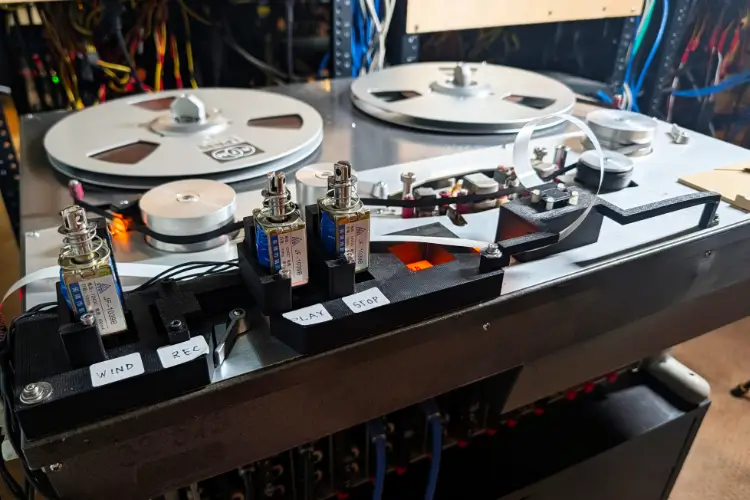
The catch with the real thing: a clean, properly calibrated M15 is rare, heavy, and demands a tech fluent in vintage German circuit boards. Calibration is famously hands-on, since the record and repro boards do double duty for input and output. With Access Analog, none of that is your problem. Through the Analog Matrix plugin, you patch straight into our daily-calibrated M15, robotically controlled from inside your DAW, with full recall on every pass. Drive the input and output, find the sweet spot where the tape starts to compress and bloom, and print a master that breathes.
Inside the Analog Matrix, the Telefunken M15 becomes more than a vintage machine. It becomes a creative processor you can use directly from your session. Shape the signal before tape with EQ or compression, then follow the tape return with another analog processor for finishing moves. Drums get thicker. Bass gains authority. Guitars and synths feel more dimensional. Vocals smooth out. Mixes pick up that elusive “finished” quality that only real tape can deliver.
This is a rare opportunity to use a true tape machine without owning, aligning, or maintaining one!
New to the M15? Read Telefunken M15: Getting a Great Tape Sound – the quick guide to nailing your levels, keeping the transport rolling, and getting the most out of real tape.
Want a head start? Telefunken M15: Gain Staging, Presets, Tips, and More covers how to gain stage into real tape and walks through Karl Barnes’ M15 chain presets.
What is the Telefunken M15?
The Telefunken M15 is a fully discrete, mastering-grade analog tape machine introduced by AEG-Telefunken in 1971, widely regarded as having one of the finest tape transports ever built. Running your mix or master through it prints the signal to real magnetic tape, adding the saturation, harmonic warmth, and gentle compression that defined countless classic records. At Access Analog you drive a real, daily-calibrated M15 straight from your DAW through the Analog Matrix plugin, no tape reels to thread or machine to maintain.
What is the Telefunken M15 best for?
The M15 is best for adding real tape character to a full mix or master, and for thickening subgroups like the drum bus. Driving its input and output lets you dial in everything from a subtle analog sheen to rich, musical tape compression and glue. Engineers reach for it to make drums hit thicker, give bass more authority, add dimension to guitars and synths, smooth vocals, and lend a mix that finished, cohesive quality only real tape delivers.
Is the M15 at Access Analog real tape, or a tape emulation?
It is a real, physical Telefunken M15 running actual magnetic tape, not a plugin model of one. Real Gear. No Emulations. The Analog Matrix plugin robotically controls the genuine machine in our racks in real time, so your audio is printed to and returned from real tape through the M15’s discrete analog circuitry.
What’s the difference between the Telefunken M15 and the M15A?
The key difference is the electronics: the original 1971 M15 has a fully discrete, transistor-based audio path, while the later M15A moved to an integrated-circuit design. Both share the same acclaimed tape transport, but the M15’s discrete circuitry gives the component-level, non-linear analog character prized in the most sought-after vintage gear. Access Analog’s machine is the fully discrete M15, so you get that original, more colorful tape tone.
How do you use a tape machine like the M15 in a mix?
Patch it across your mix bus, master, or a subgroup, then use the input and output drive to set how hard the signal hits the tape – that’s what controls the saturation and compression. Start clean, then push the input until the tape just begins to compress and bloom; on a master, aim for only a couple dB of transient softening so the mix sounds finished rather than obviously distorted. Because tape reacts to level, watch loud sections so choruses don’t over-saturate, and trust an A/B against the dry signal.
How does the M15 compare to a Studer tape machine?
The Telefunken M15 was Germany’s answer to the Studer throne, and many engineers consider its 1971 transport the equal of (or better than) anything of its era, earning the nickname “the workhorse of West German broadcasting.” Where a Studer is the most-Googled tape name, the M15 offers a comparably revered transport with its own fully discrete, characterful electronics. Both are mastering-grade machines; the M15’s draw is that rugged German transport paired with a discrete, colorful signal path.
What is tape saturation and tape “glue”?
Tape saturation is the natural, musical distortion and harmonic enhancement that happens when you drive an audio signal onto magnetic tape, while tape “glue” is the gentle compression that rounds transients and binds a mix together. Together they soften harsh peaks, add low-end weight, and enrich the mids and highs, making a digital mix feel warmer and more cohesive. The M15 produces both for real, because your audio is actually being recorded to tape.
Does the M15 add noise or color to my audio?
Yes, and that coloration is the point. As a real tape machine, the M15 imparts harmonic saturation, subtle compression, and the characteristic weight of magnetic tape, which is exactly why engineers print through it. Its butterfly heads help reject crosstalk for a clean, low-noise path, and Access Analog calibrates the machine daily so you get consistent, musical tape character rather than unwanted artifacts.
Can I record to the M15, or is it processing my DAW audio?
At Access Analog the M15 is used as a real-time processor for your DAW audio – your signal streams from your session, prints through the tape machine, and returns to the plugin. You drive the input and output to shape the saturation and compression on your mix, master, or subgroup, rather than threading and capturing to a physical reel yourself. It’s the tape sound in your chain, controlled entirely from inside your DAW.
Can I recall my M15 settings at Access Analog?
Yes. You get full recall on every pass through the Analog Matrix plugin, so your M15 drive and level settings are saved with your DAW session and restored exactly when you reopen it. The machine is robotically controlled and daily-calibrated, which means you can return to a master months later and print through tape at the same settings, something that’s famously hard to do with a real tape machine you own.
How much does it cost to use the Telefunken M15 at Access Analog?
Reservations for the Telefunken M15 start at $11.44. You can book a session on the calendar, or use it on demand from the Analog Matrix plugin when it’s available – on-demand access requires credits or an active subscription. New accounts receive a free hour (about 12 credits) to try real analog gear before committing.