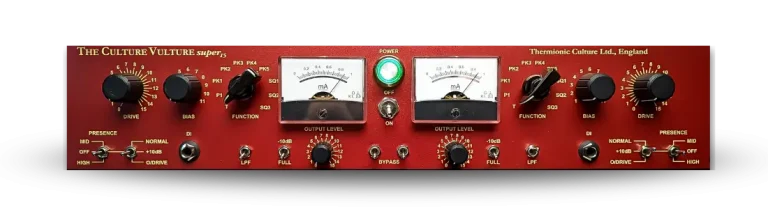
Control real analog gear straight from your DAW with the Analog Matrix. The Analog Matrix is not an emulation! It acts as a portal, connecting your digital audio workstation to actual physical gear in real time.
Reserve a session using the calendar below, or jump straight into the Analog Matrix plugin and use equipment on demand as it is available. Note: on-demand access requires credits or an active subscription.


The Thermionic Culture Vulture Super 15 is an exceptional tube distortion unit, designed to deliver a wealth of sonic possibilities to your studio.
This extraordinary device incorporates the tenets of its original Culture Vulture counterpart and takes them to new heights with an expanded set of 15 saturation modes, skillfully mimicking the sound of a myriad of vintage and modern recording and processing devices.
Incorporating several innovative features, the Super 15 boasts a Drive switch with three positions, including a +10dB option nestled right in the center, providing an extensive range of distortion effects. The unit is equipped with balanced line inputs and unbalanced line outputs, a design choice firmly backed by the creator Vic Keary, who asserts that unbalanced lines can deliver superior sound quality.
The Culture Vulture Super 15 offers an array of tools for sculpting saturation. Explore the drive, level, and tone controls in combination with the various saturation modes, from subtle to scorching tube color. The Super 15 ensures longevity and minimal noise with carefully selected NOS valves, meticulously matched for stereo.
This versatile and potent unit is exactly why tube saturation is celebrated for mixing applications worldwide; connect and see why the Culture Vulture is popular with engineers in all styles of music!
What is the Thermionic Culture Vulture?
The Thermionic Culture Vulture is an all-valve harmonic distortion and saturation unit, prized for turning clean digital audio into warm, gritty, or downright demonic tube tones. It is the original studio box dedicated purely to valve-produced distortion, with no solid-state components in the signal path. The Super 15 version available at Access Analog expands this to 15 saturation modes, going from the slightest analog warmth to scorching, over-the-top color.
What is the Culture Vulture best for?
The Culture Vulture is best for adding analog warmth, weight, and character to almost any source. Engineers reach for it on guitars, drums, bass, vocals, synths, and the mix bus. At gentle settings it works as a “de-digitizer” that thickens in-the-box mixes and softens harsh digital highs. Pushed harder, it becomes a creative distortion tool for blown-out drums, aggressive synths, and trashed vocal effects.
Is this the real Culture Vulture hardware, or an emulation?
It is the actual Culture Vulture hardware – real valves, real circuitry, processing your audio in real time, not a model of them. Real Gear. No Emulations. Through the Analog Matrix plugin you remotely control the physical unit in Access Analog’s facility straight from your DAW, so your audio passes through genuine tubes and comes back to your session.
What’s the difference between Triode and Pentode mode on the Culture Vulture?
Triode (T) mode is the smoother, more musical setting that adds even-order harmonics for warming and thickening, ideal on individual sources or a full mix. Pentode (P) mode switches the distortion valve to add odd harmonics, giving a harder, more aggressive edge that suits guitars, synths, and special vocal effects. The Super 15 builds on these with an expanded bank of saturation modes for everything in between.
What do the Drive and Bias controls do?
Drive sets how hard the input signal hits the distortion valve, so more Drive means more saturation and grit. Bias adjusts the current through that valve and shapes the character of the distortion: a medium setting gives clean, restrained warmth, while “starving” the valve at low current produces a leaner, edgier, lo-fi break-up. Use them together with the Output Level and low-pass filter to dial in anything from subtle color to total mayhem.
How do I get subtle warmth versus heavy distortion?
For subtle warmth, use Triode mode with a moderate Bias and conservative Drive, just enough to thicken the source without obvious distortion. For heavy distortion, switch to a Pentode mode, push the Drive, engage Overdrive for extra gain, and experiment with lower Bias settings for grittier break-up. The low-pass filter helps tame fizzy high-frequency overtones when things get aggressive.
Should I use the Culture Vulture on an insert or in parallel?
Both work, and the choice depends on how much of the effect you want. Insert it directly when you want the tone fully committed to a track or bus. Use it in parallel – on a send or an aux/group – when you want to blend a heavily driven, saturated signal underneath the clean source, which is a popular way to add grit and presence to drums or an entire mix while keeping the dynamics intact.
What’s the difference between even and odd harmonics?
Even-order harmonics (2nd, 4th, 6th…) fall on octaves and fifths and are heard as smooth, round, and warm, while odd-order harmonics (3rd, 5th, 7th…) fall on thirds and bring a harder, more aggressive edge. The Culture Vulture lets you choose between them: its Triode mode emphasizes warm even harmonics, and its Pentode modes add the grittier odd harmonics, which is why one box can sound either silky or savage.
How much does it cost to use the Culture Vulture at Access Analog?
Reserve From: $4.74. You can book a session in advance or use the Culture Vulture on demand through the Analog Matrix plugin, paying with credits or an active subscription. Every new account gets 12 free credits (about one hour on an average device) so you can try real tube distortion before spending anything.
Doctor Mix
https://www.doctormix.com/blog/thermionic-culture-the-culture-vulture-super-15
Sound on Sound
https://www.soundonsound.com/news/thermionic-culture-celebrate-15-years-new-hardware