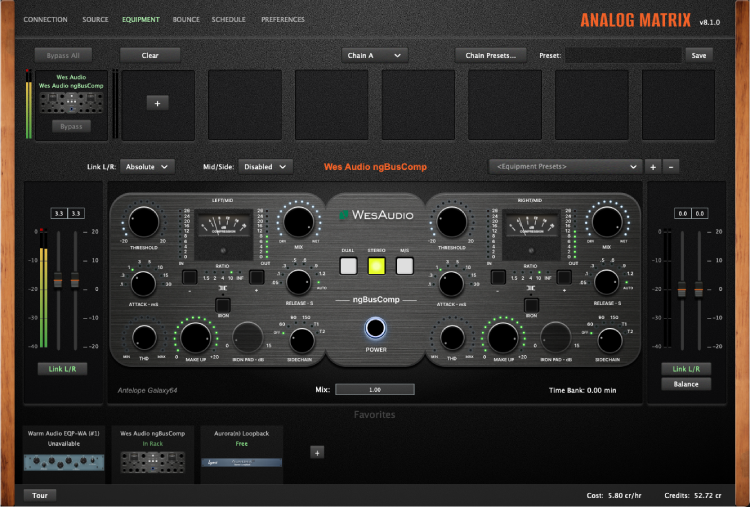
Control real analog gear straight from your DAW with the Analog Matrix. The Analog Matrix is not an emulation! It acts as a portal, connecting your digital audio workstation to actual physical gear in real time.
Reserve a session using the calendar below, or jump straight into the Analog Matrix plugin and use equipment on demand as it is available. Note: on-demand access requires credits or an active subscription.
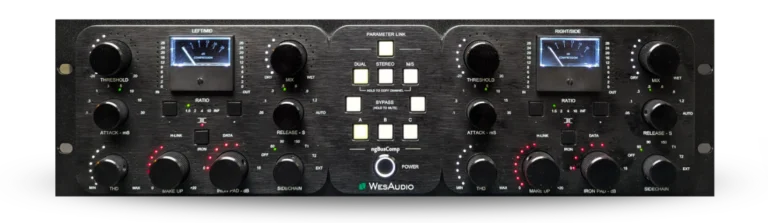
The WesAudio ngBusComp represents the evolution of the legendary stereo bus compressor that has been the cornerstone of professional mixing for over four decades.
This fully analog device maintains a pristine signal path while offering unprecedented control and capabilities that seamlessly integrate with your DAW workflow. Built around four THAT 2181 VCAs in the signal path plus additional VCAs in the sidechain detector circuit, the WesAudio ngBusComp delivers authentic VCA compression with an impressive +24dBu of headroom for exceptional clarity and professional-grade performance.
What sets the ngBusComp apart is its sophisticated approach to analog coloration.
The proprietary THD control offers precise harmonic distortion from subtle enhancement to obvious attitude, while the transformer-balanced IRON mode provides that coveted vintage British console character. The IRON PAD passive attenuator allows you to drive the Carnhill output transformers for musical saturation while maintaining perfect level control. The integrated MIX knob makes parallel compression effortless and fully automatable within your DAW, enabling dynamic compression changes throughout your mix – perfect for pushing harder during choruses or creating movement in your productions.
Flexibility is a key feature of the WesAudio ngBusComp, with dual mono, stereo, and mid-side compression modes that can be switched on-the-fly to suit any mixing scenario.
This unit is on our Analog Switch, so it can link to the other switch units without leaving analog: one D/A in, one A/D out. Read Introducing Analog Switching: Real Hardware, One Conversion, Endless Creative Chains.
What is the WesAudio ngBusComp?
The WesAudio ngBusComp is a 100% analog stereo VCA bus compressor built on the legendary SSL-style bus-compressor design that has been the glue on hit records for over 40 years. Its signal path runs through four THAT 2181 VCAs per the classic topology, with a fifth VCA in each channel’s sidechain detector, delivering authentic VCA compression with +24dBu of headroom. What sets it apart is full digital recall and DAW automation of every analog parameter, so you get real analog glue with modern, recallable control.
What is the ngBusComp best for?
The ngBusComp is best for mix-bus and master-bus “glue” – tightening a full mix into one cohesive, punchy whole. It also excels on subgroups like the drum bus, where its VCA character adds energy and front-to-back depth. Dual mono, stereo, and mid-side modes let you compress the whole stereo image or treat the center and sides independently, and the built-in MIX knob makes parallel “crush” compression effortless.
Is the ngBusComp at Access Analog the real hardware or an emulation?
It is the actual WesAudio ngBusComp hardware, real THAT 2181 VCAs and real Carnhill transformers, not a model of them. Real Gear. No Emulations. The Analog Matrix plugin acts as a portal that robotically controls the physical unit in real time, so your audio is processed by genuine analog circuitry, not software.
Is the ngBusComp analog or digital?
The ngBusComp’s signal path is 100% analog, the digital side is only control, recall, and metering. Your audio passes through real analog VCAs and transformers via balanced XLR connections, never through any digital conversion in the processing path. The digital layer simply lets you save, recall, and automate the analog knobs from your DAW, giving you analog sound with in-the-box convenience.
How do you use a bus compressor like the ngBusComp?
Place it across your mix bus or a subgroup and aim for gentle, musical gain reduction rather than heavy squashing. A classic SSL-style starting point on a full mix is around a 2:1 ratio, a 30 ms attack, Auto release, and just 2–4 dB of gain reduction, enough to add cohesion without flattening transients. Engage the sidechain high-pass filter (try 60–150 Hz) so a heavy kick doesn’t pump the whole mix, then blend in the MIX knob if you want parallel density. Adjust by ear to your tempo and material.
What’s the difference between the ngBusComp and a classic SSL bus compressor?
The ngBusComp delivers the classic SSL-style VCA glue but extends it with features the original never had. It uses four THAT 2181 VCAs in the signal path for a low noise floor, and adds dual mono and mid-side modes, a continuously variable THD saturation control, an IRON transformer mode, a parallel MIX knob, and expanded sidechain filtering. Crucially, every parameter has full digital recall and DAW automation, so you keep the legendary sound while gaining a modern, recallable workflow.
What do the THD and IRON controls do on the ngBusComp?
THD and IRON are the ngBusComp’s two ways to add analog color. The THD (Total Harmonic Distortion) knob dials in harmonic saturation continuously, from subtle warmth to obvious attitude, so you can flavor the mix without heavy compression. IRON mode routes the output through Carnhill transformers for vintage British console character, and the IRON PAD passive attenuator lets you drive those transformers hard for musical saturation while keeping your output level under control.
What is VCA compression, and how does it sound?
VCA (Voltage-Controlled Amplifier) compression uses a VCA chip to control gain, giving a fast, clean, punchy response that handles dense material without falling apart. It’s the workhorse sound behind decades of mix-bus and drum-bus compression – energy and control without the heavy coloration of tube or FET designs. The ngBusComp’s four THAT 2181 VCAs deliver exactly this character, then let you add color on top via the THD and IRON circuits if you want it.
Does the ngBusComp have attack, release, and ratio controls?
Yes. The ngBusComp gives you full hands-on control with selectable attack, release, and ratio. It offers eight attack times (0.1 to 30 ms), seven release times plus an Auto mode, and five ratios: 1.5:1, 2:1, 4:1, 10:1, and INF (crash) mode. The gentle 1.5:1 and 2:1 ratios are ideal for transparent mix-bus glue, while 4:1, 10:1, and INF open up more aggressive, characterful compression.
Can I recall my ngBusComp settings at Access Analog?
Yes. Full recall is a core part of using the ngBusComp through Access Analog. Because it’s a recall-capable analog unit, you save every knob and switch position inside your DAW session through the Analog Matrix plugin, then instantly restore your exact settings when you reopen the project. You can also automate any parameter, so you can push the compressor harder in a chorus and ease off in a verse, all within your mix.
How much does it cost to use the ngBusComp at Access Analog?
Reservations for the WesAudio ngBusComp start at $4.68. You can book a session on the calendar, or use it on demand straight from the Analog Matrix plugin whenever it’s available, on-demand access requires credits or an active subscription. New accounts receive a free hour (about 12 credits) to try real analog gear before committing.
100% analog device with +24dBu of headroom, powered by QUAD VCA THAT 2181.
Dual mono, stereo, and mid-side compression modes.
Two selectable output stages: electronically balanced and transformer balanced (IRON).
IRON PAD passive attenuator for driving the output transformer.
Mix knob for easy parallel compression.
Proprietary THD (Total Harmonic Distortion) control for adjustable saturation.
Sidechain filters with three high-pass options (60, 90, 150 Hz) and two tilt filters.
Five ratio settings: 1.5:1, 2:1, 4:1, 10:1, and INF.
Tony Maserati (Grammy Award-Winning Mixer/Engineer for Beyoncé, Lady Gaga, Notorious B.I.G.): “This is technology that I’ve been waiting for a long time… Wes Audio has created an analog compressor that sounds amazing and has the flexibility of any great stereo analog box.”
Stuart White (Grammy Award-Winning Mixer/Engineer for Beyoncé, Jay-Z, FKA Twigs): “WesAudio nailed it with ngBusComp. It’s been on my mix bus since the first time I tried it. After A/B’ing it with the original quad VCA unit, I was honestly blown away by how much better it is.”
Mitch McCarthy (Mixing & Mastering Engineer for Olivia Rodrigo, Carly Rae Jepsen, Lady Gaga): “I did a lot of a/b with my other SSL clones and plugins. I find that ngBusComp sounds better than all of them.”
Toby Francis (Front of House Engineer/Mixing Engineer for Katy Perry, Red Hot Chili Peppers, Ariana Grande): “I like the WesAudio stuff mainly for how it sounds.”
https://wesaudio.com/uploads/manuals/WesAudio_ngbuscomp_manual.pdf