Control real analog gear straight from your DAW with the Analog Matrix. The Analog Matrix is not an emulation! It acts as a portal, connecting your digital audio workstation to actual physical gear in real time.
Reserve a session using the calendar below, or jump straight into the Analog Matrix plugin and use equipment on demand as it is available. Note: on-demand access requires credits or an active subscription.
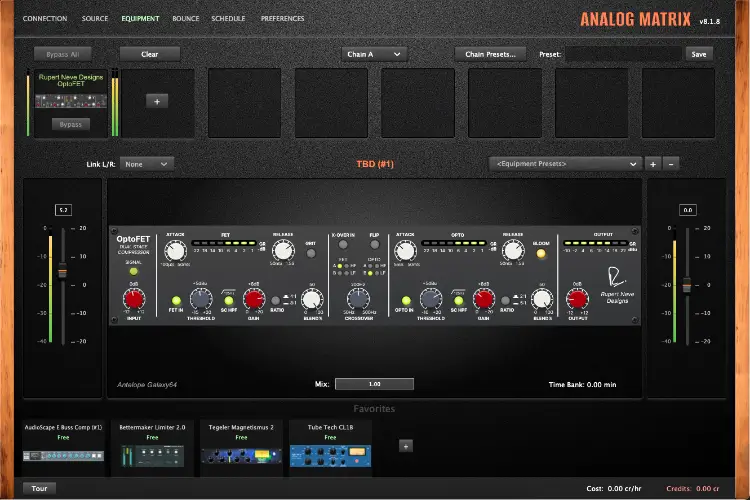
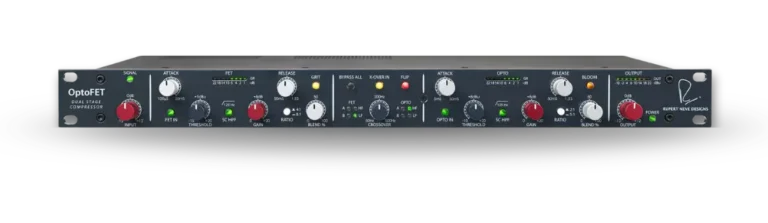
The Rupert Neve Designs OptoFET is built for engineers who want precision and personality. On one side, you’ve got a fast, assertive FET compressor for punch, grab, and attitude. On the other, an OPTO compressor for smooth, musical leveling. This is especially killer on vocals and sources that want “finished” without sounding squashed. Each section includes deep control (including parallel blend) so you can go from invisible to unmistakable without losing the vibe.
Where it gets seriously fun: the OptoFET gives you two primary workflows. In Dual-Stage mode, the compressors run in series for full-spectrum dynamic control. And, you can flip the order (FET → OPTO or OPTO → FET) depending on whether you want punch-first or polish-first. In Dual-Band mode, engaging the crossover assigns each compressor to high or low frequencies, letting you tighten the bottom while letting the top breathe (or vice versa). It’s like “mix-bus thinking” on a single source.
And then there’s the tone: GRIT turns the FET section into a wave-shaping machine with harmonics focused up top, while BLOOM enriches low-order harmonics for extra warmth, roundness, and low-end confidence; often reducing the need for “fix-it EQ” when used with the blend control. Add flexible gain staging (global trims + make-up gains), and you’ve got a compressor that doesn’t just control dynamics. It creates character on demand.
The Rupert Neve Designs OptoFET covers more ground than units that cost twice as much and take up four times the rack space. With multiple gain staging options, 31-detent high-quality potentiometers, and that unmistakable Rupert Neve transformer-balanced output, this is creative compression at its finest.
New to the OptoFET? Read Two Compressors, One Rack Space: The Rupert Neve Designs OptoFET Gear Guide: every mode, the GRIT and BLOOM harmonics, and source-by-source starting settings.
What is the Rupert Neve Designs OptoFET?
The Rupert Neve Designs OptoFET is a single-channel analog compressor that combines a newly designed FET compressor and an optimized optical compressor in one 1U unit. The FET side delivers fast, assertive punch and grab, while the OPTO side adds smooth, musical leveling. Together they cover everything from transparent vocal smoothing to aggressive, harmonically rich wave-shaping – all controlled straight from your DAW through Access Analog.
What is the OptoFET best for?
The OptoFET excels at vocals, but it’s built to shape almost any source – drums, bass, guitars, and full mixes included. Run both compressors in series for full-spectrum control, or split them across frequency bands to tighten the low end while letting the top breathe. Add GRIT and BLOOM for character, and it moves from invisible leveling to bold, finished tone on a single source.
Is the OptoFET good for vocals?
Yes. Vocals are one of the OptoFET’s signature applications. It packs the classic fast-FET-into-smooth-optical vocal chain that engineers have loved for decades into one box, so you can catch peaks with the FET section and level the performance with the OPTO side. The independent parallel Blend controls let you add as much control as you want while keeping the natural feel of the take.
What’s the difference between FET and optical compression?
FET compression is fast and aggressive, grabbing transients for punch and attitude, while optical compression is slower and smoother, leveling a signal gently and musically. FET designs add energy and edge; optical designs add warmth and a “finished” feel. The OptoFET gives you both topologies in one unit, so you can blend speed and smoothness on the same source instead of choosing between them.
What’s the difference between Dual-Stage and Dual-Band mode?
In Dual-Stage mode the FET and OPTO compressors run in series for full-spectrum dynamic control, and you can flip their order. FET first for punch, or OPTO first for polish. In Dual-Band mode, engaging the variable crossover assigns each compressor to a high or low frequency band, so you can tighten the bottom while letting the top breathe. It’s like mix-bus thinking applied to a single source.
What do GRIT and BLOOM do on the OptoFET?
GRIT and BLOOM are the OptoFET’s harmonic character controls. GRIT turns the FET section into a wave-shaping machine, adding edge and harmonics focused in the upper frequencies. BLOOM enriches low-order harmonics on the OPTO side for extra warmth, weight, and roundness, often reducing the need for fix-it EQ when paired with the Blend control.
Is the Access Analog OptoFET the real hardware or an emulation?
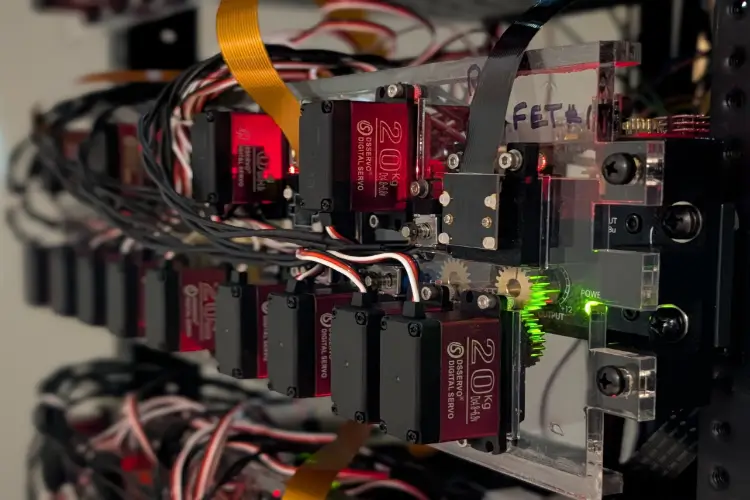
It’s the real, physical Rupert Neve Designs OptoFET – Real Gear. No Emulations. Access Analog robotically controls the actual hardware in its racks while your audio streams through the real FET and optical circuitry and transformer-balanced output in real time. You’re using the genuine unit from your DAW, not a software model of it.
Can I recall my OptoFET settings through Access Analog?
Yes. Every knob, switch, and selector on the OptoFET has independent recall, so your settings are saved with your session and recalled exactly. You can also save presets for the device or capture an entire signal chain to reload later. That recall pairs naturally with the unit’s detented potentiometers, which are built for precise, repeatable settings.
How much does it cost to use the OptoFET at Access Analog?
You can reserve the OptoFET from $4.52, or use it on demand with credits or an active subscription. On-demand access lets you drag it into your chain instantly and pay only for the time you use, with a free 40-second preview to audition it first. Every new account also starts with 12 free credits (about one free hour on an average device).
Select Features of the Rupert Neve Designs OptoFET