
Every engineer eventually builds the same vocal chain: a fast FET compressor to grab the peaks, then a slow optical compressor to smooth what's left. It works because each box does half the job. It also eats two rack spaces, two sets of cables, and a whole afternoon of gain staging.
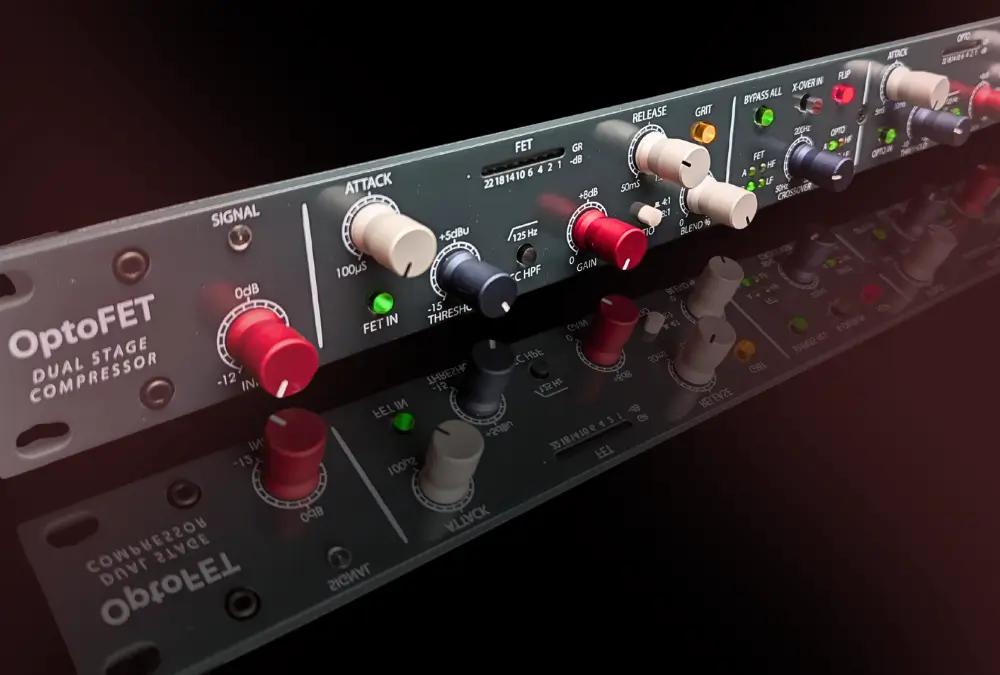
The Rupert Neve Designs OptoFET puts both halves of that chain in one 1U mono unit, then adds three things the classic pair never had: a button that swaps their order, a crossover that hands each compressor its own frequency band, and two harmonic modes (GRIT and BLOOM) that turn a dynamics tool into a tone tool. This guide covers how the OptoFET works, what to run through it, how to set it up without losing the plot, and how to use the real unit from your DAW.
One mono channel, two compressors, and more ways to combine them than most racks can offer.
The Rupert Neve Designs OptoFET is a single-channel analog compressor that contains two independent compressors: a newly designed FET compressor and an optical compressor developed from the optical circuits RND had already built, including the Color Comp in the Master Bus Transformer. Both live in one 19-inch, 1U chassis, and both feed a custom Rupert Neve Designs transformer-coupled output.
The FET side is a first for the company. RND had experimented with FET designs for years, according to their own account, and only released one when the two-compressor concept made it feel complete. That matters because the OptoFET is not a pair of vintage clones bolted together. The timing ranges are wider than the classics, the sidechains are new, and the routing between the two stages is the point of the box.
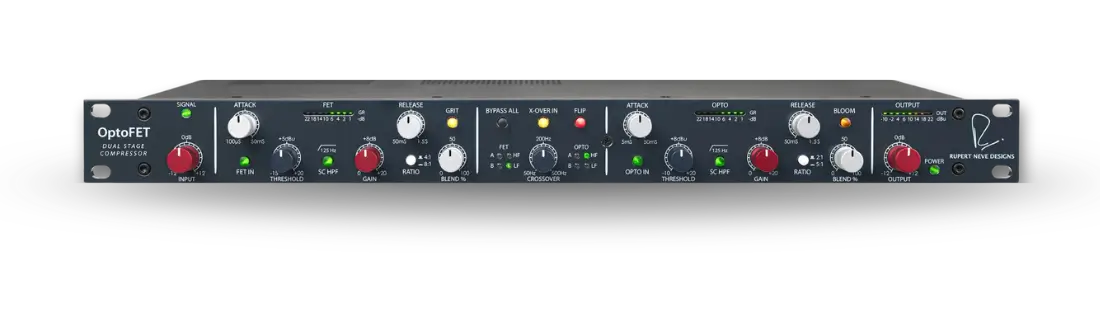
The front panel reads left to right: FET controls, a global section (input and output trims, Flip, X-Over, crossover frequency, hardwire Bypass All), then OPTO controls. Every variable control is a 31-detent potentiometer, so any setting you find can be written down and found again.
Sound On Sound's Matt Houghton, reviewing the unit in February 2026, called it a bold step outside RND's comfort zone and one of the more versatile analog compressors he had tested. Tape Op's Adam Kagan reached a similar conclusion in issue 171, judging it a credible stand-in for the 1176 and LA-2A pairing with more flexibility than either.
Because they are good at opposite things, and the best vocal, bass, and drum chains have been pairing them for decades.
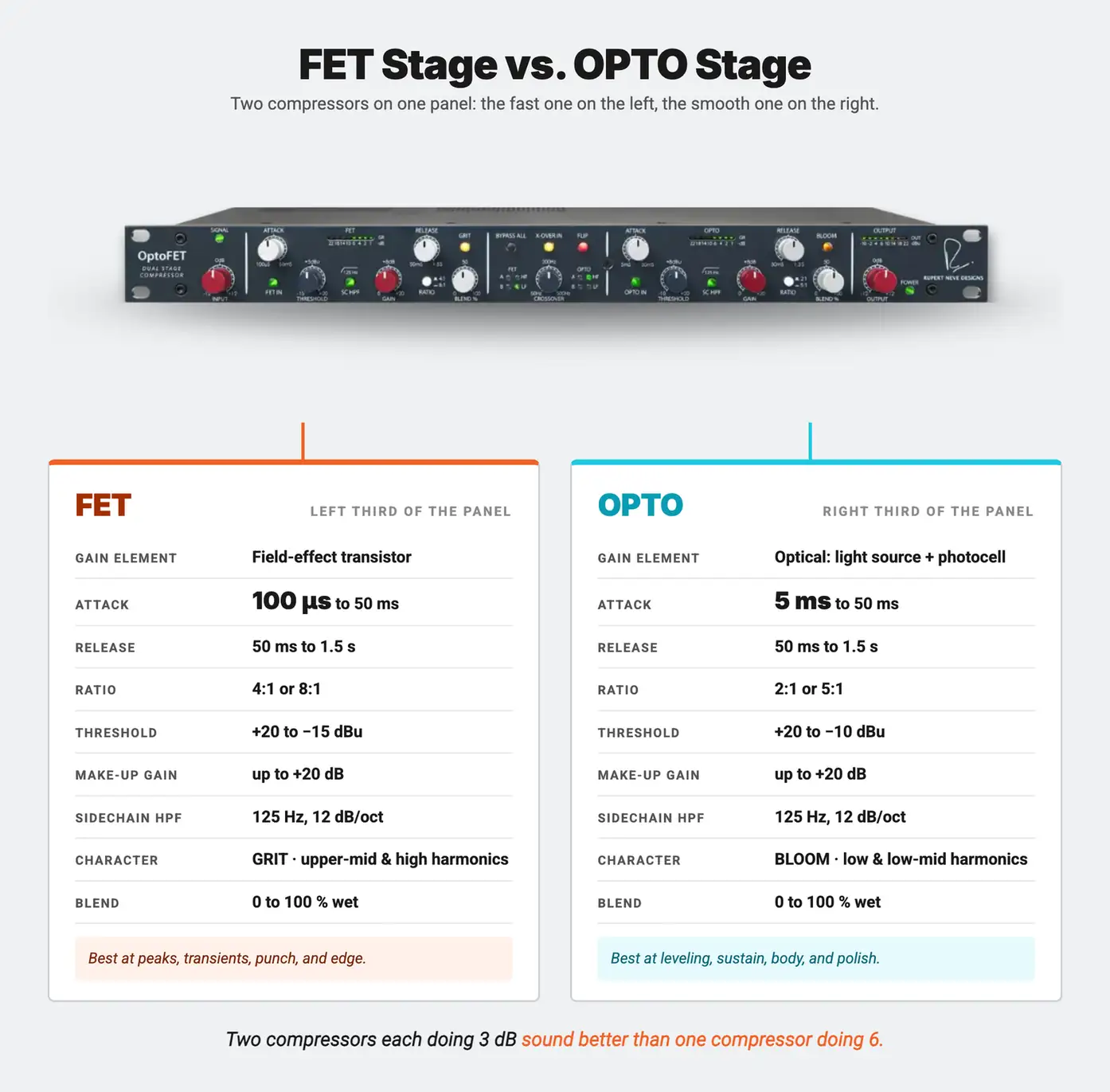
A FET compressor uses a field-effect transistor as the gain element, and it can react in microseconds. That speed is why the 1176 ended up on nearly every professional vocal: it catches consonants and pick attacks before they fully exist. The price of that speed is that a FET left to do everything tends to sound worked, and fast release settings pump.
An optical compressor uses a light source and a photocell, and the photocell's physical recovery time makes the action slow and progressive. That is how an optical gain cell levels a performance without anyone hearing it move. The price is that it can't grab a fast peak; the peak is through before the cell has reacted.
Put them in series and each one does less. The FET trims the spikes so the OPTO never sees them. The OPTO rides the long-term level so the FET never works hard. Both meters read a few dB, and the result sounds controlled without sounding compressed. We covered that division of labor in our 1176 vs. LA-2A on vocals post. The OptoFET builds it into one chassis and, unlike the classics, gives both stages fully variable attack and release.
The global section decides how the two compressors relate to each other. There are two modes, and the Flip button means something different in each.
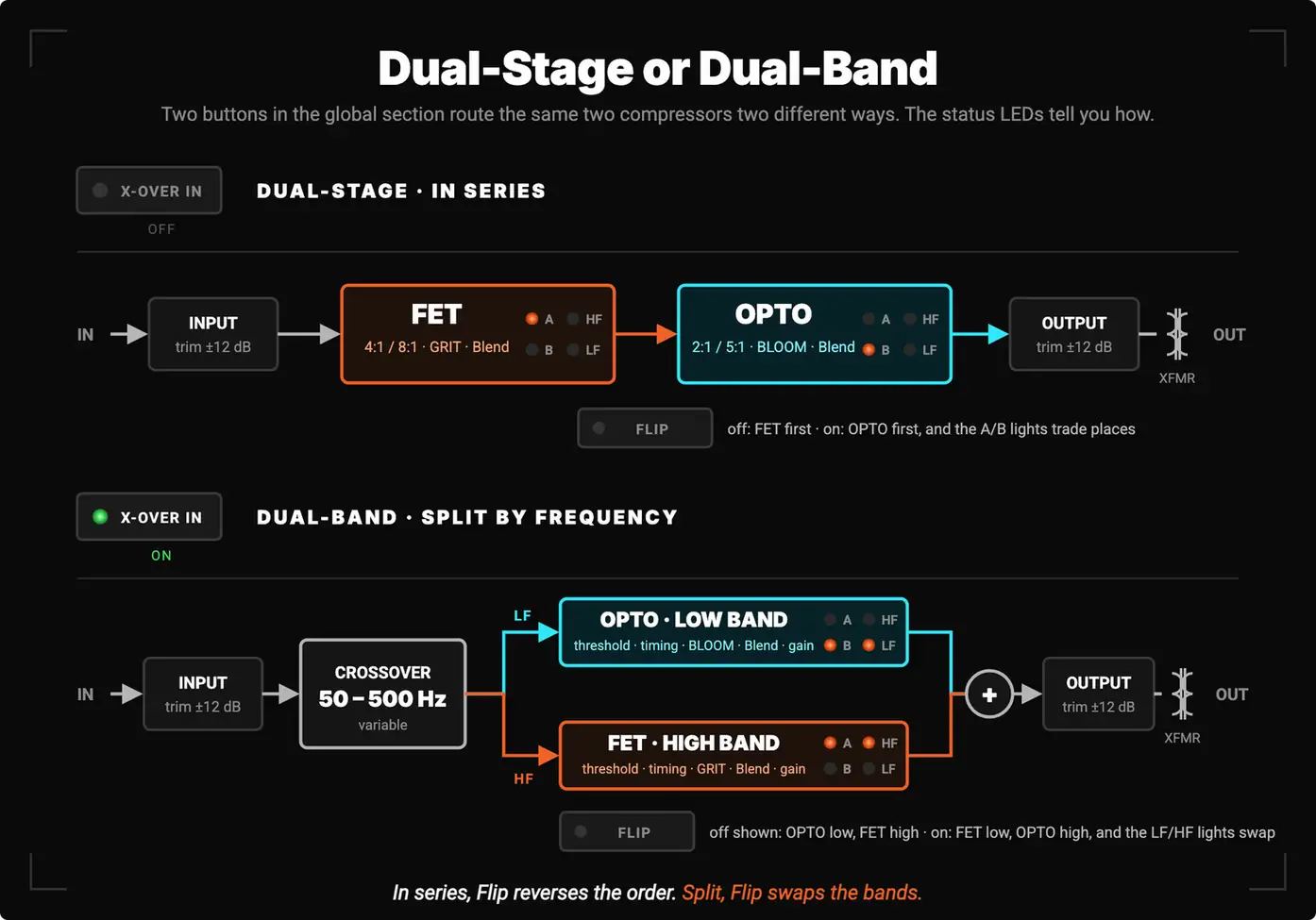
Dual-Stage mode (X-Over off) is series operation. Signal enters, passes through the Input trim, then hits the FET compressor, then the OPTO compressor, then the Output trim and the transformer. Press Flip and the order reverses: OPTO first, FET second. Two status LEDs beside each compressor tell you where it sits (A is first, B is second), so you never have to guess which one is upstream.
Dual-Band mode (X-Over In) is split-band operation. The crossover filters divide the signal into a low band and a high band at a frequency you set anywhere from 50 Hz to 500 Hz. With Flip off, the OPTO compressor takes the low band and the FET takes the high band, and the two bands are summed back together before the output. Here Flip swaps the band assignments instead of the order, so the FET moves to the lows, and the same status LEDs switch to reading LF or HF.
Either compressor can be switched out with its own FET IN or OPTO IN button, and Bypass All is a true hardwire bypass for honest before-and-after checks.
The point to hold onto: in Dual-Stage mode the second compressor only hears what the first one hands it, so the first stage's make-up gain sets how hard the second is driven. The FET Gain knob is also an OPTO threshold knob in disguise.
In series, the first compressor's output level is the second compressor's threshold. Treat make-up gain as a routing control.
They add harmonics, but not the way most people assume.
RND's SILK circuit, found on many of their other units, saturates the output transformer. GRIT and BLOOM don't touch the transformer. Each one alters its compressor's sidechain detection circuit, and the harmonics come from how the compressor reacts to that changed sidechain. RND says this produces far more dramatic wave-shaping than SILK. Think of SILK as warming the room and GRIT as changing what the compressor is listening to.

GRIT belongs to the FET stage. It pushes harmonic content into the upper midrange and highs, and it makes the FET feel faster and more assertive. At low gain reduction with the Blend backed off, it adds presence and bite that helps a source cut. Pushed hard and fully wet, it becomes an envelope shaper that will snarl on a vocal or turn a drum room into something else entirely. One catch: engaging GRIT disables the FET sidechain high-pass filter, because GRIT rewrites how that sidechain works.
BLOOM belongs to the OPTO stage and does the opposite job. It increases low-order harmonics in the lows and low mids, so sources get thicker, rounder, and heavier without an EQ boost. Houghton found it especially flattering on exposed acoustic guitar and on thin vocals that needed authority. It works on sources that already have plenty of low end too, if you want to lean into the weight rather than tame it.
Both modes scale with their Blend controls. That is the real trick: dial in an obnoxious amount of GRIT, then blend it 30 % under the dry signal, and you get the harmonics without the wreckage.
The OptoFET has eight controls that change level: Input, two thresholds, two make-up gains, two Blends, and Output. Flexibility like that rewards discipline. A louder setting always sounds better for the first ten seconds, and the box will happily let you fool yourself. Here is the routine that keeps comparisons honest.
Match levels first. Every OptoFET opinion formed at unequal loudness is wrong.
Vocals are the headline application. Halsey's front-of-house engineer, quoted on the RND page, replaced a Distressor into a Tube-Tech CL 1B with one OptoFET. But it is a strong bass, drum, and acoustic compressor too, and split-band mode reaches places no single classic compressor can. These starting points come from the Sound On Sound review and the engineers RND quotes. Treat every one as a place to begin, then move the knobs.
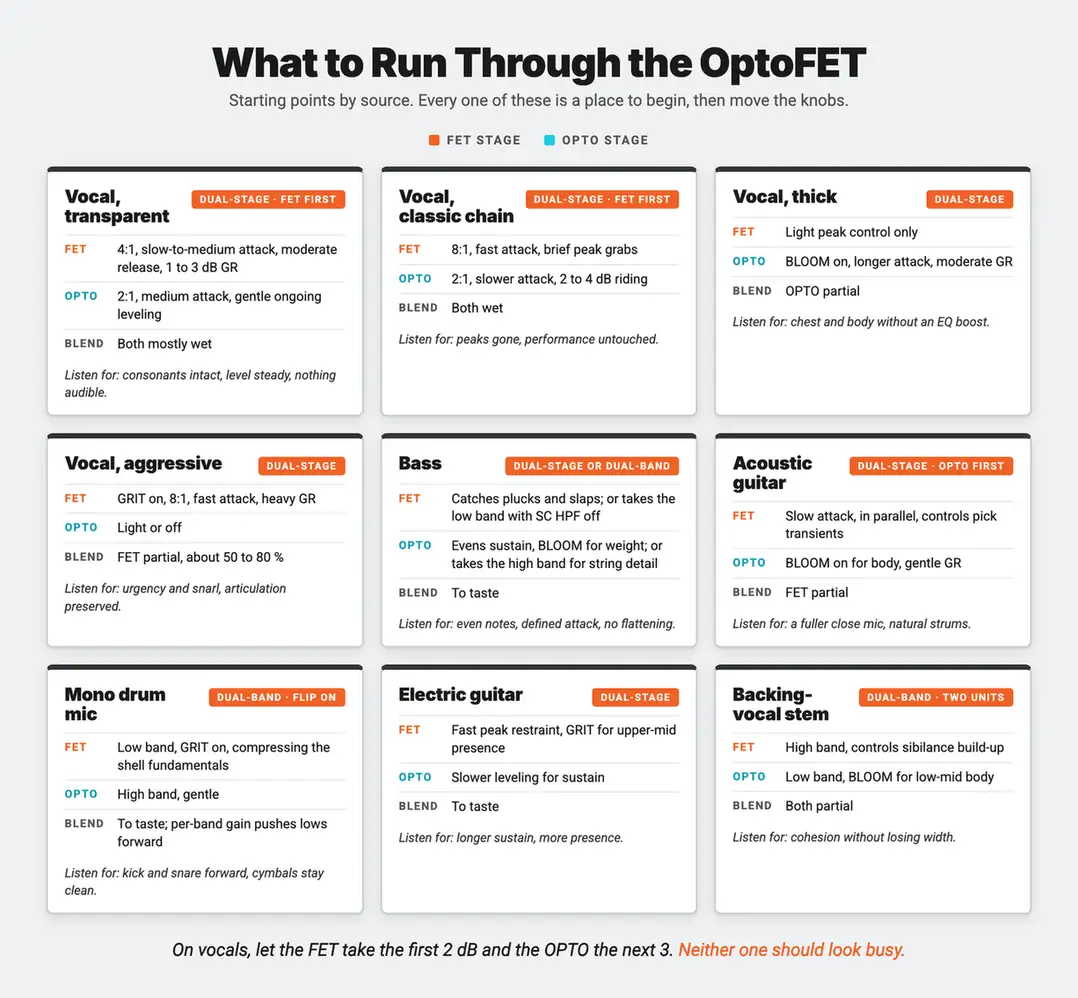
A few of those deserve a sentence more.
The mono drum mic recipe is producer Mike Crossey's (The 1975, Arctic Monkeys), from the RND site. He splits a single kit mic at the crossover, presses Flip to hand the low band to the FET with GRIT on so the shell fundamentals get compressed and slightly distorted, and keeps the OPTO gentle on the cymbals. The per-band make-up gains then push the lows forward and tuck the highs back: a mix-bus move on one microphone.
The vocal Blend trick comes from a customer review RND quotes: FET on the fast transients, OPTO on the slower sections, and Blend on each stage at roughly 80 %. The 20 % of dry signal is what keeps the top end open and the mids detailed.
The dynamic-singer trick is Houghton's, for a performance that whispers in the verse and shouts in the chorus. First stage heavy and in parallel to bring up the quiet verse detail, second stage fully wet to hold the chorus peaks. The hardware does what you would otherwise spend an hour automating.
For how the OptoFET sits against the other vocal compressors in the racks, see our roundup of the best analog compressors for vocals.
Whenever the source's problem is level before it is peaks.
FET first is the classic order: catch the spikes, then smooth. It suits sharp, irregular transients over a fairly steady level, which describes most lead vocals and slapped bass.
OPTO first suits sources whose overall level wanders more than their peaks do. The optical stage pulls the performance into a narrower window and hands the FET a predictable signal. It also changes the harmonic story: BLOOM on the first stage into GRIT on the second feeds a low-end-enriched signal into a high-end-enriching compressor, and Houghton used exactly that to build body before adding edge.
There is no correct order, only the one that suits the source, and checking both costs one button press and a level match.
Flip is a free experiment. Take it every time, after you gain-match.
Yes. Dual-Band mode turns the OptoFET into something close to a two-band dynamic EQ with two different compressor personalities.
A broadband compressor reacts to the whole spectrum, so a heavy kick or bass fundamental pulls everything down even when the highs needed nothing. Splitting at the crossover fixes that. Each band gets its own threshold, ratio, timing, character mode, Blend, and make-up gain. The same logic that makes a bus compressor glue a mix applies here to a single channel.
Two things make this more useful than a generic multiband compressor. First, the two bands get two different compressor types: optical smoothness on the lows and FET grip on the highs, or the reverse with Flip. Second, GRIT and BLOOM become band-limited. BLOOM only below the crossover adds weight exactly where you want it; GRIT only above adds presence without dirtying the low end. Raise one band's make-up gain and you have a tone control that acts only on the compressed material.
1. Use the sidechain high-pass filter on vocals with bleed. The 125 Hz filter only affects what the detector hears, not what you hear. Engage it and a headphone-bleed kick or a boomy room stops triggering gain reduction on the singer.
2. Treat FET make-up gain as your OPTO drive control. In Dual-Stage mode with FET first, turning FET Gain up pushes the OPTO harder without touching its threshold. That is often the fastest way to get the second stage to "sit."
3. Audition each stage alone before you judge the pair. FET IN and OPTO IN are there for a reason. Knowing what each one is contributing tells you which knob to reach for when something is off.
4. Dose the character modes with Blend. Heavy GRIT at 30 % wet is a texture. Heavy GRIT at 100 % is an effect. Both are useful, but only one of them belongs on a lead vocal.
5. Try the parallel-verse, wet-chorus move on inconsistent singers. First stage heavy and parallel, second stage fully wet. It is faster than automation and often sounds more natural.
6. Use two units for stereo stems. The OptoFET is mono with no stereo-link connector, but two units in dual-mono work well on backing-vocal stems and drum buses. Strong center-panned events trigger both sides similarly, and the detented controls make matching settings easy.
Mistake 1: judging Flip at unequal levels. Reversing the order almost always changes loudness. If you don't re-match, the louder order wins by default.
Mistake 2: expecting the FET sidechain filter to work with GRIT. It doesn't. GRIT disables it. If bass is triggering the GRIT-mode FET, move the low end to the OPTO in Dual-Band mode instead.
Mistake 3: over-Blooming a source that already has lows. BLOOM adds low and low-mid harmonics on top of whatever is there. On a full-range bass or a mix stem, back the Blend off or use it only below a low crossover.
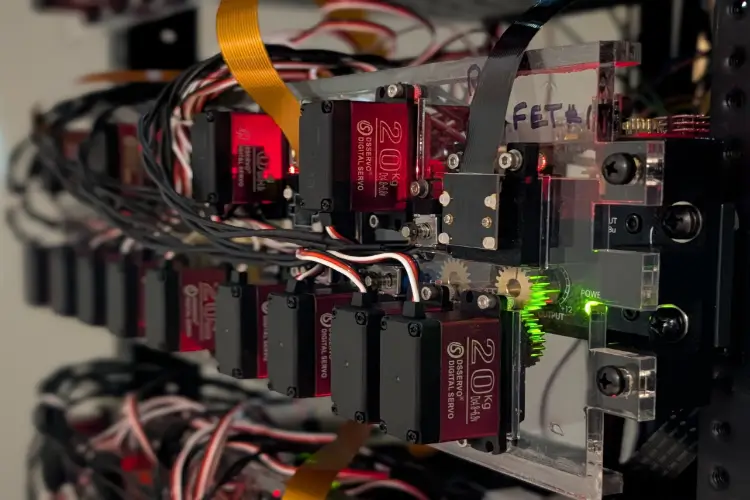
Two OptoFETs sit in the Access Analog racks, and both are the real Rupert Neve Designs hardware, not a model of it. Your audio streams through the actual FET and optical circuits and the actual transformer output. Robotics turn the knobs.
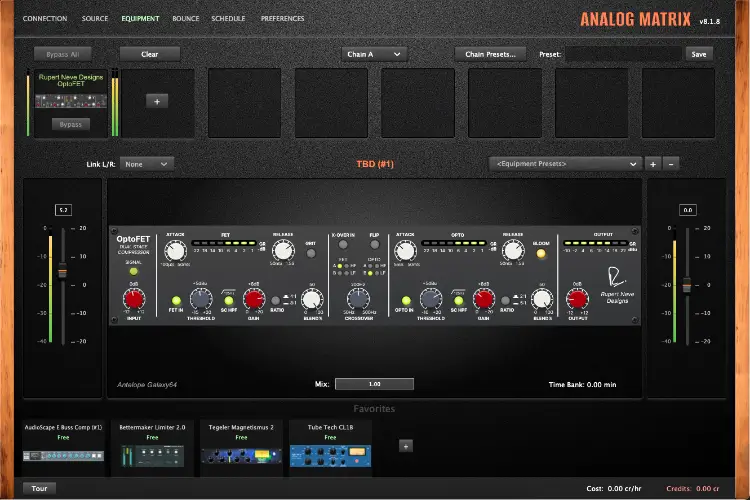
That pairing suits this unit unusually well. RND fitted 31-detent potentiometers so settings could be recalled by hand; the Analog Matrix plugin recalls every knob and switch with your session, and you can save a device preset or capture the whole chain. Flip, X-Over, GRIT, and BLOOM are switches, so an A/B between orders or modes is a click, not a repatch.
Because there are two units, stereo work is covered too. Patch OptoFET #1 and #2 on a stereo stem and the plugin can link the robotics, so one move turns the same control on both units in sync. The detectors stay independent, exactly as with two boxes on a desk, which is the dual-mono behavior Houghton found effective on drum buses and backing-vocal groups.
The OptoFET is included in the Elite tier of the Access Analog Subscription. Without a subscription you can reserve a session from $4.52, or use it on demand with credits, and every new account starts with 12 free credits, roughly an hour on an average device. There is also a free 40-second preview to audition it on your own track before spending anything.
The classic two-box vocal chain, one box, no repatching, fully recalled, from inside your session.
The OptoFET earns its place not because it contains a FET compressor and an optical compressor, but because of what sits between them. Flip lets you decide which one hears the source first. The crossover lets you decide which one hears which half of the spectrum. GRIT and BLOOM let each one add harmonics where its band lives, and the two Blend controls let you dose all of it. That is a set of decisions no pair of vintage boxes offers, and it fits in one rack space.
Learn the gain-staging routine, keep both meters lazy, and the OptoFET will disappear into a vocal or bass track. Push the Blends up and the modes on, and it becomes an instrument.
Punch on one side, polish on the other, and a whole studio's worth of routing in the middle. Go find out what your vocals sound like through it.
What is the Rupert Neve Designs OptoFET?
The Rupert Neve Designs OptoFET is a single-channel, 1U analog compressor that combines a newly designed FET compressor and an optical compressor in one chassis. The two can run in series in either order (Dual-Stage mode) or be split across a variable 50 to 500 Hz crossover so each handles one frequency band (Dual-Band mode). Each stage has its own attack, release, ratio, threshold, make-up gain, sidechain high-pass filter, harmonic mode, and parallel Blend control, and the unit feeds a custom transformer-coupled output.
Is the OptoFET good for vocals?
Yes. Vocals are its signature application. The FET stage catches consonants and peaks with an attack as fast as 100 microseconds, and the OPTO stage levels the performance with a slower, smoother action. That is the classic 1176-into-LA-2A vocal chain in one box, with fully variable timing on both stages and a Blend control on each to keep the take open.
What is the difference between Dual-Stage and Dual-Band mode on the OptoFET?
In Dual-Stage mode the FET and OPTO compressors run in series over the full signal, and the Flip button reverses their order. In Dual-Band mode the X-Over button engages a crossover filter set anywhere from 50 Hz to 500 Hz, one compressor processes the low band, the other processes the high band, and Flip swaps which compressor gets which band.
What do GRIT and BLOOM do on the OptoFET?
GRIT is the FET compressor's harmonic mode. It alters the sidechain detection circuit to generate harmonics in the upper midrange and highs and makes the FET feel faster and more assertive; it also disables the FET sidechain high-pass filter. BLOOM is the OPTO compressor's harmonic mode and generates low-order harmonics in the lows and low mids for weight and roundness. Unlike RND's SILK circuit, neither mode works by saturating the output transformer.
How can I use an OptoFET without buying one?
Access Analog racks two real Rupert Neve Designs OptoFETs that you control from your DAW through the Analog Matrix plugin, with every knob and switch recalled with your session. The OptoFET is included in the Elite subscription tier, and anyone can reserve a session from $4.52 or use it on demand with credits. New accounts start with 12 free credits, and every unit has a free 40-second preview.