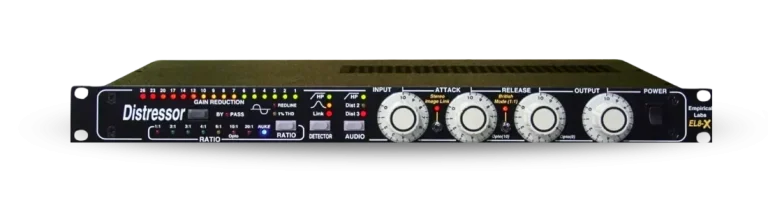
Control real analog gear straight from your DAW with the Analog Matrix. The Analog Matrix is not an emulation! It acts as a portal, connecting your digital audio workstation to actual physical gear in real time.
Reserve a session using the calendar below, or jump straight into the Analog Matrix plugin and use equipment on demand as it is available. Note: on-demand access requires credits or an active subscription.


The Empirical Labs Distressor is a versatile and powerful compressor saturation device that offers a range of options to achieve the perfect sound for your recordings. Besides providing a wide range of control and a unique feature set, the Distressor offers a warm, vintage sound using a custom-designed gain control circuit. It is versatile, super fast, and offers tons of color!
If you’ve turned on the radio in the last ten years, it’s almost certain that you’ve heard the distinct sound of this compressor. The Distressor has become a modern classic for its versatility – from transparent to gritty, slow compression to fast, and tons of great sounds between. There’s almost no task that the Distressor can’t handle.
This compressor is excellent for adding additional harmonic content using the distort 2 for second-order tube-like harmonics or distort 3 for third-order magnetic tape-like harmonics. Check out the Nuke mode for some intense brick wall limiting or flip the British Mode switch and keep the attack fast for some 1176 all-buttons-in style grunge. Don’t forget about using the EQ filters for even more control. There are truly hundreds of great sounds to be found from this great compressor!
Choosing between the Distressor and an 1176? Read Distressor vs 1176: Can the Distressor Really Do the 1176 Thing?
What is the Empirical Labs Distressor?
The Empirical Labs Distressor is a single-channel analog compressor, controlled digitally, that is famous for being one of the most versatile and colorful compressors ever made. It combines selectable compression curves with built-in harmonic distortion, so it can go from clean and transparent to gritty, slammed, and saturated. A modern classic heard on countless records, it handles almost any source you throw at it.
What is the Distressor best for?
The Distressor is best for almost anything. Vocals, drums, bass, guitars, room mics, and the mix bus all benefit from its punch and character. It excels at adding aggression and “glue” to drums, weight to bass, and presence to vocals, and doubles as a saturation tool when you want color without heavy compression. Reach for it whenever you want a compressor with attitude and tons of usable sounds.
Is the Distressor analog or digital?
The Distressor is a hybrid: it runs a fully analog signal path while using digital control for its switches, curves, and timing. That means your audio is processed by real analog circuitry, the digital side just handles the controls and recall. The result is a characterful, non-surgical sound with the convenience of precise, repeatable settings.
What are the Distressor’s compression ratios and curves?
The Distressor offers eight selectable compression settings (1:1, 2:1, 3:1, 4:1, 6:1, 10:1, 20:1, and Nuke) each with its own custom curve and knee. Lower ratios like 2:1 and 3:1 have long, silky knees for gentle leveling; the 1:1 setting applies no compression so you can use just the distortion; the 10:1 setting uses a separate circuit for a vintage opto-style response; and Nuke is an aggressive brick-wall limiter. Stepping through the settings is how you dial in everything from subtle to extreme.
What do the Dist 2 and Dist 3 modes do?
Dist 2 and Dist 3 are the Distressor’s built-in harmonic distortion modes. Dist 2 adds mostly second-order harmonics for a warm, tube-like “Class A” character, while Dist 3 adds third-order (plus second) harmonics for a grittier, tape-like edge. You can engage them with or without compression to add analog color, weight, and attitude to a source.
What do Nuke mode and British Mode do?
British Mode emulates the classic 1176 “all-buttons-in” sound, adding fast, gritty, aggressive compression. Flip the switch and keep the attack low (well under 4, since lower numbers are faster on the Distressor) to stay in 1176 territory. Unlike the 1176, it works with any ratio. Together, they are a big part of why the Distressor is famous for attitude.
Is the Access Analog Distressor real hardware or an emulation?
It is the actual Empirical Labs Distressor – a real unit with a genuine analog signal path, not a software model of it. Through Access Analog, the Analog Matrix plugin robotically controls the physical hardware in real time from inside your DAW, so your audio runs through the real analog circuit. Real Gear. No Emulations.
Can I recall and automate my Distressor settings through Access Analog?
Yes. Every control on the Analog Matrix plugin is robotically linked to the physical hardware, so you can save, recall, and automate your settings inside your DAW session like any other plugin. Because the Distressor is digitally controlled, recall is exact – your ratio, attack, release, and distortion settings come back precisely, on real analog hardware.
How much does it cost to use the Distressor at Access Analog?
The Empirical Labs Distressor reserves from $3.41 per hour, an affordable way to run audio through one of the most sought-after compressors in modern production. Reserve a session on the calendar or use it on-demand with credits or an active subscription (the Distressor is included in the Pro and Elite subscription tiers, from $20.98/month), and new accounts get 12 free credits (roughly an hour on an average device) to try real hardware.