
Everyone who owns a Distressor plugin eventually asks the same question: if this box can do the 1176, why does anyone still chase the real one?
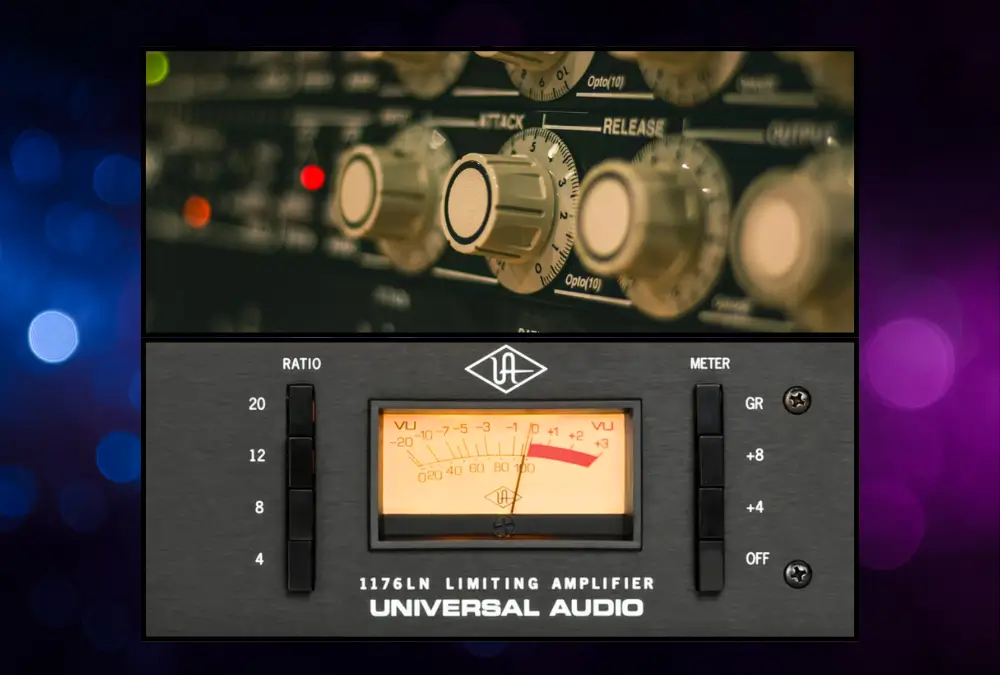
It's a fair question, and the Distressor invites it. Empirical Labs founder Dave Derr designed it in the mid-1990s out of a love for classic compressors like the 1176 and the LA-2A, gave it a mode that recreates the 1176's famous all-buttons-in trick, and printed a recipe for sounding like an 1176LN right in the manual. So the claim isn't forum folklore. It's Empirical Labs' own. The useful question is how far the impression goes, and the answer turns out to be very specific.
The Distressor vs 1176: The Distressor can copy the 1176's envelope. It can't copy the 1176's transformers. Which of those you're after decides which box you reach for.
In this guide you'll learn how each circuit works, exactly which 1176 behaviors the Distressor reproduces (with Empirical's own settings), where the two genuinely part ways on room mics and bass, how to chain them, and how to run both real units on the same take from inside your DAW using Access Analog.
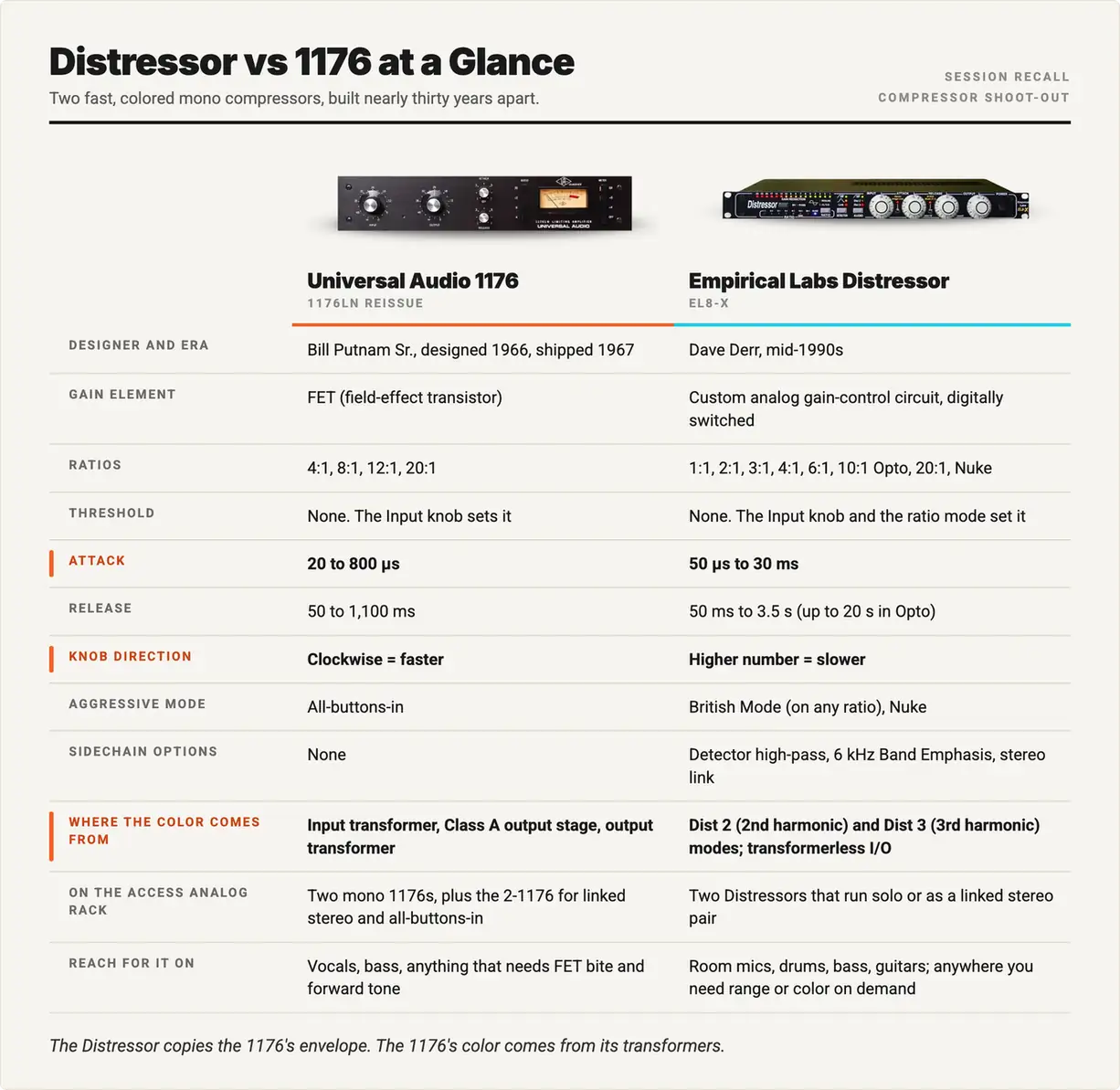
Both are fast, mono, colored compressors with a famous aggressive mode, which is why they get compared so often. But they come from different decades and were built for different jobs. The Universal Audio 1176 is a 1960s FET peak limiter: four ratios, no threshold control, and attack and release times that both sit in a narrow, very fast window. The Empirical Labs Distressor is a 1990s analog compressor with digital control: eight curves, time constants that run from faster-than-you-need to slower-than-an-LA-2A, a filtered sidechain, and a distortion generator you switch on when you want it.
The short version: the 1176 is a specialist with one unforgettable voice. The Distressor is a session player that does impressions, and one of its best is the 1176.
The 1176 uses a FET as its gain-reduction element, and its tone comes from what happens to your signal on the way in and out of it.
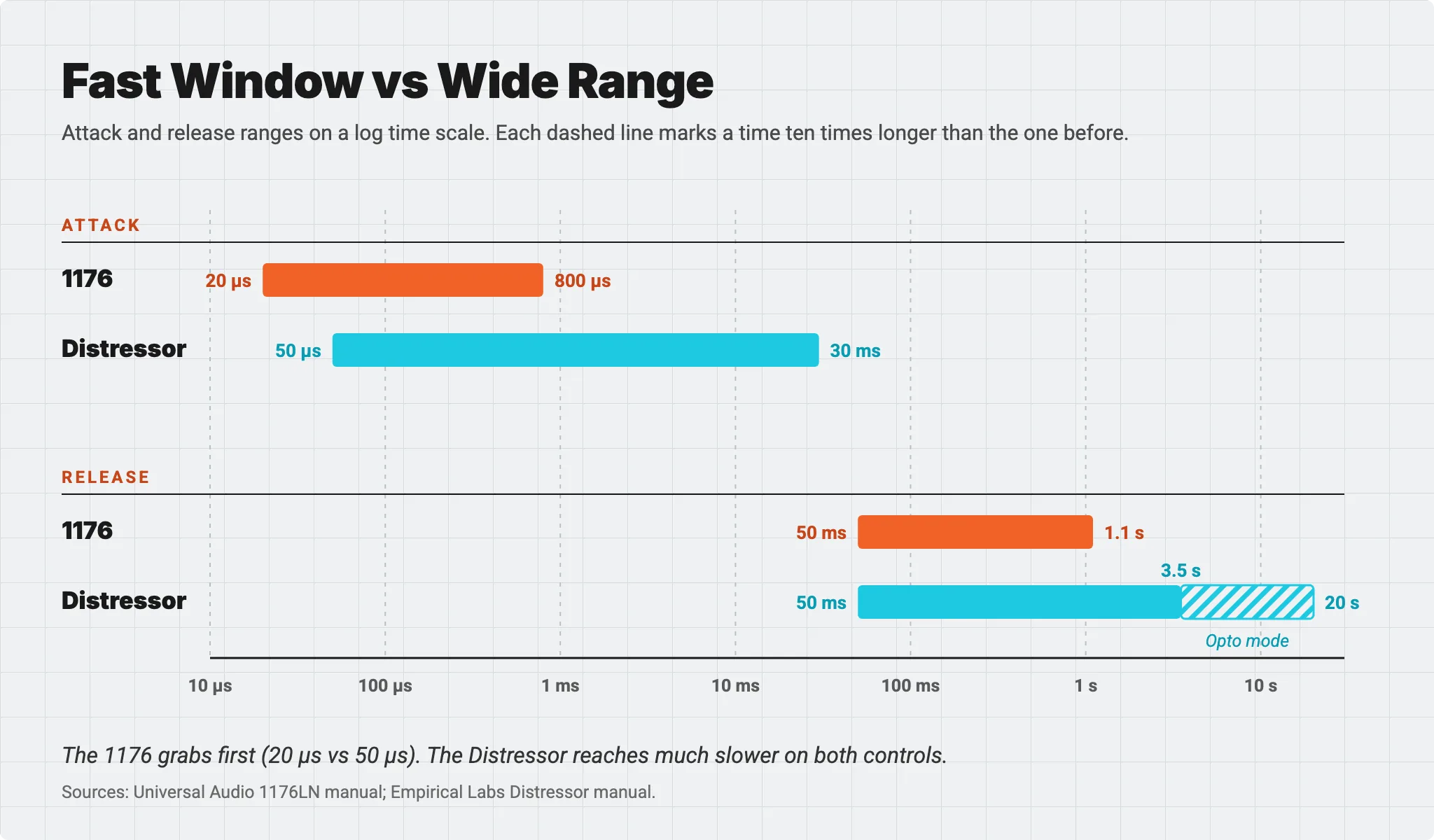
The Universal Audio 1176 replaced the tube gain stages of Bill Putnam Sr.'s earlier 175 and 176 limiters with a field-effect transistor, and that made it dramatically faster. The attack runs from 20 to 800 microseconds, so even its slowest setting is quick by most compressors' standards. Release runs from 50 milliseconds to 1.1 seconds. Both knobs work backwards from almost everything else in your rack: clockwise is faster, and turning the Attack fully counter-clockwise switches compression off entirely while your signal still passes through the circuit.
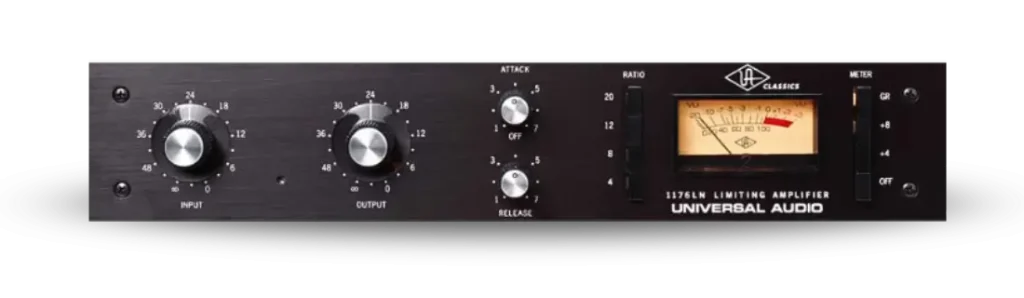
There's no threshold control. The Input knob sets how hard you hit the gain cell, so more Input means more compression. The four Ratio buttons (4:1, 8:1, 12:1, 20:1) set how hard it clamps.
That Input knob is also where the 1176's tone lives. The Universal Audio reissue follows the blackface D and E revisions of the original: a transformer-balanced input, the low-noise "LN" circuitry, a Class A output amplifier borrowed from Putnam's 1108 preamp, and a custom output transformer whose extra windings form part of the amplifier's feedback loop. Turn the Input up and you drive all of it harder. Hugh Robjohns, reviewing the reissue for Sound On Sound, heard a forward, slightly bright character that helps a track cut through, and the engineers quoted in UA's own manual keep using the same words: bright, present, energy.
We go deeper into the FET, the backwards knobs, and the revisions in our guide to how the 1176's FET circuit works.
The Distressor is an analog compressor with digital control that bundles eight compression curves, a filtered sidechain, and a switchable distortion generator into one rack space.
The Empirical Labs Distressor runs your audio through an analog path while a digital brain handles the buttons, which is why it can offer so many modes in a single rack unit. Its controls fall into three groups.
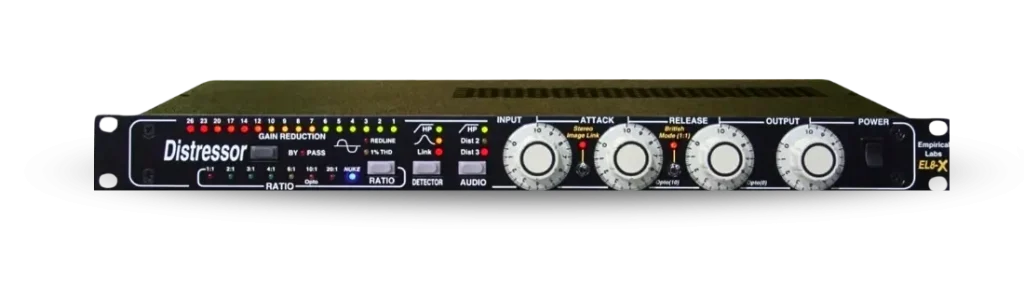
Ratio. Eight curves: 1:1, 2:1, 3:1, 4:1, 6:1, 10:1 Opto, 20:1, and Nuke. Each one sets the knee and the threshold as well as the ratio, so they behave less like numbers on a dial and more like eight different compressors. The 2:1 and 3:1 curves have long, gentle knees (on 2:1 the knee can stretch across as much as 30 dB). The 4:1 and 6:1 curves get steeper and gradually move toward limiting. The 10:1 Opto mode switches in separate detector circuitry to imitate optical compressors like the LA-2A. Nuke is a brick-wall limiter that holds any normal signal within about 1 dB, with a logarithmic release that lets go quickly and then slows. And 1:1 doesn't compress at all; it just passes audio through the unit's warming circuits.
Attack and Release. The attack runs from 50 microseconds to 30 milliseconds, and the release from 50 milliseconds to 3.5 seconds, stretching to 20 seconds in Opto mode. Both knobs run 0 to 10, and lower numbers are faster, the opposite of the 1176.
Audio and Detector modes. The Audio button adds a gentle high-pass filter (an 18 dB-per-octave Bessel filter about 3 dB down at 65 Hz), Dist 2, which emphasizes the 2nd harmonic for what Empirical calls a "Class A" type warmth, and Dist 3, which emphasizes the 3rd harmonic, closer to tape saturation. A red LED lights when distortion passes 3%. The Detector button changes what the compressor listens to without changing what you hear: a high-pass to stop low end from pumping the gain reduction, a 6 kHz Band Emphasis that makes it react harder to harsh upper mids, and Stereo Link. The EL8-X version we rack adds two switches: British Mode and Image Link, which keeps a stereo pair from shifting the image when one side gets louder.
Empirical calibrates every unit so the same settings sound the same on any Distressor, and because the switching is digital, a recalled setting comes back exactly.
The Distressor's color is a choice you make with a button. The 1176's color is a consequence of how hard you hit it.
Yes for the timing, no for the tone. The Distressor convincingly copies how an 1176 grabs and releases, but not the transformers and Class A stage the signal runs through.
A good impressionist can nail a singer's phrasing, timing, and attitude so well you'd swear it's the real thing on the radio. What they can't do is borrow the singer's vocal cords. That's the Distressor and the 1176 in one sentence. The envelope (how fast the compressor grabs, how hard it clamps, how it lets go) is the phrasing. The transformers and output stage are the vocal cords.
What the Distressor copies. The Distressor manual includes Empirical's own 1176LN emulation. Use the 3:1, 4:1, 6:1, and 20:1 curves to stand in for the 1176's four ratios. Keep the attack under 4, because the 1176 attacks extremely fast and the Distressor's attack range goes far slower. Leave Dist 2 and Dist 3 off. Empirical's "familiar sound" is 6:1 with attack on 2 and release on 4. And the British Mode switch exists precisely because of the 1176: it borrows the all-buttons-in behavior and lets you apply it to any ratio.
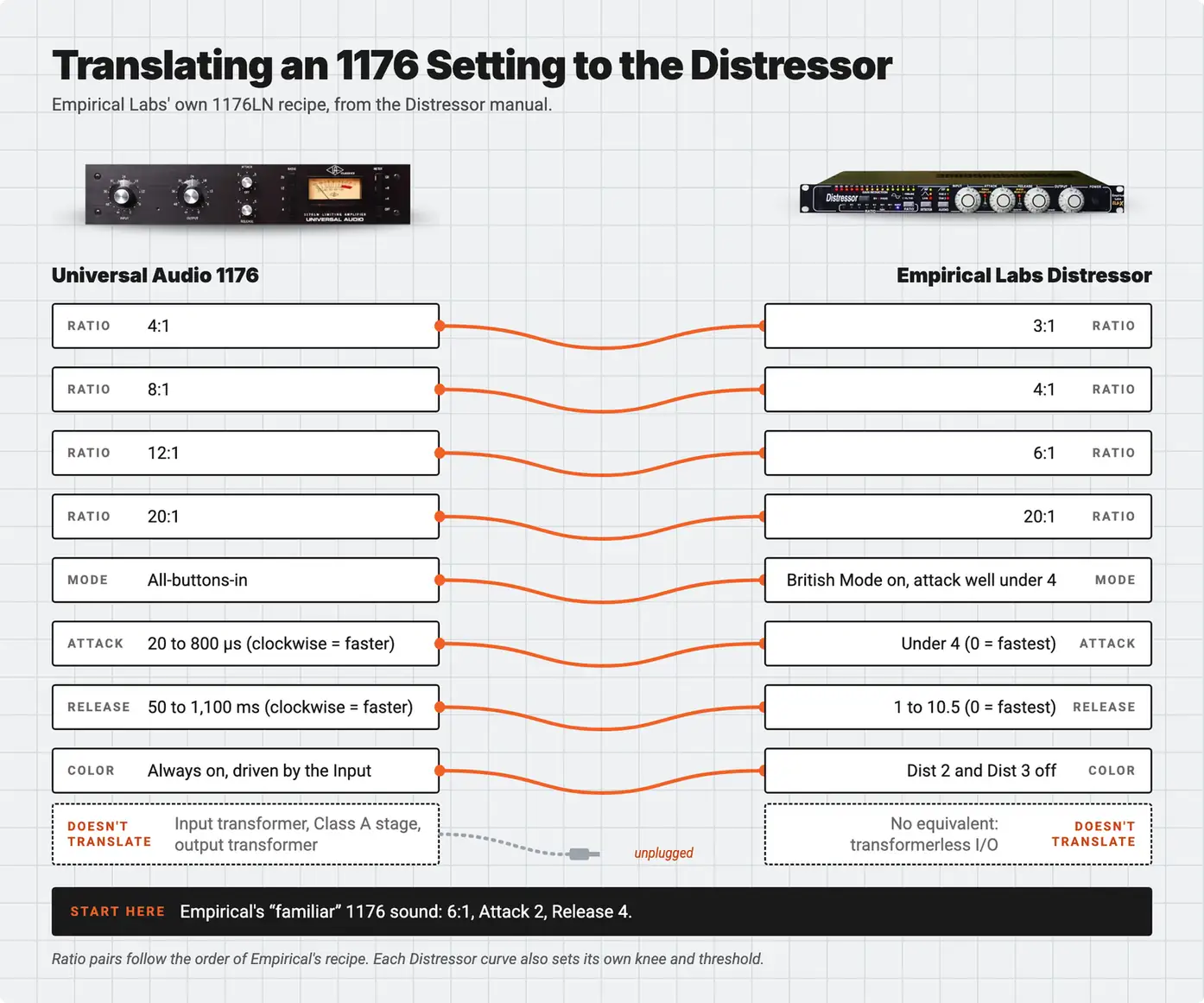
What it doesn't copy. Three things.
One more detail worth knowing: Empirical says every Distressor curve matches from unit to unit except British Mode, which can vary by about half a dB. Even the impression has a little personality.
Both turn a drum room into an event. The 1176 does it with the chaotic, original grit; the Distressor does it with more control, and with options the 1176 doesn't have.
All-buttons-in on the 1176. Pressing all four ratio buttons at once was never in the design, and that's the point. According to Universal Audio, the ratio lands somewhere between 12:1 and 20:1, the attack picks up a lag on initial transients, and the bias points shift all over the circuit, so the attack and release keep changing and distortion climbs sharply. The meter often just pins. On drums, UA's recipe is plenty of Input, a slowish attack so the transients sneak through, and a quick release. The kick hits, the room ducks in behind it, and then it breathes back up before the next beat.
On our rack, all-buttons-in lives on the 2-1176. Holding four buttons in at once is beyond what the robotic control on our mono 1176s can do. The Universal Audio 2-1176 solves it: Universal Audio replaced the four buttons with a ratio switch that has ALL as a labeled position. As a bonus, its LINK mode turns its two channels into one stereo compressor, which is exactly what a stereo pair of room mics wants.
British Mode on the Distressor. Flip the British Mode switch on the 1:1 setting and you get Empirical's "British" ratio. Flip it on any other ratio and that curve picks up the same aggressive attack and release shape. Keep the attack well under 4 to stay in 1176 territory, or push it slower for something no 1176 can do: Empirical notes that long attacks in British Mode make drums distort in a way of their own. For radical room-mic treatment, Empirical's recipes start at 20:1 or Nuke with Input at 10, Attack 6, Release 2.5, and Output 6, or Nuke with attack around 4 and release around 2.
Stereo is where the Distressor gets clever. Link two Distressors and Image Link holds the stereo picture steady. Or leave them unlinked: Empirical points out that letting each side react to its own room ambience can make room mics sound wider.
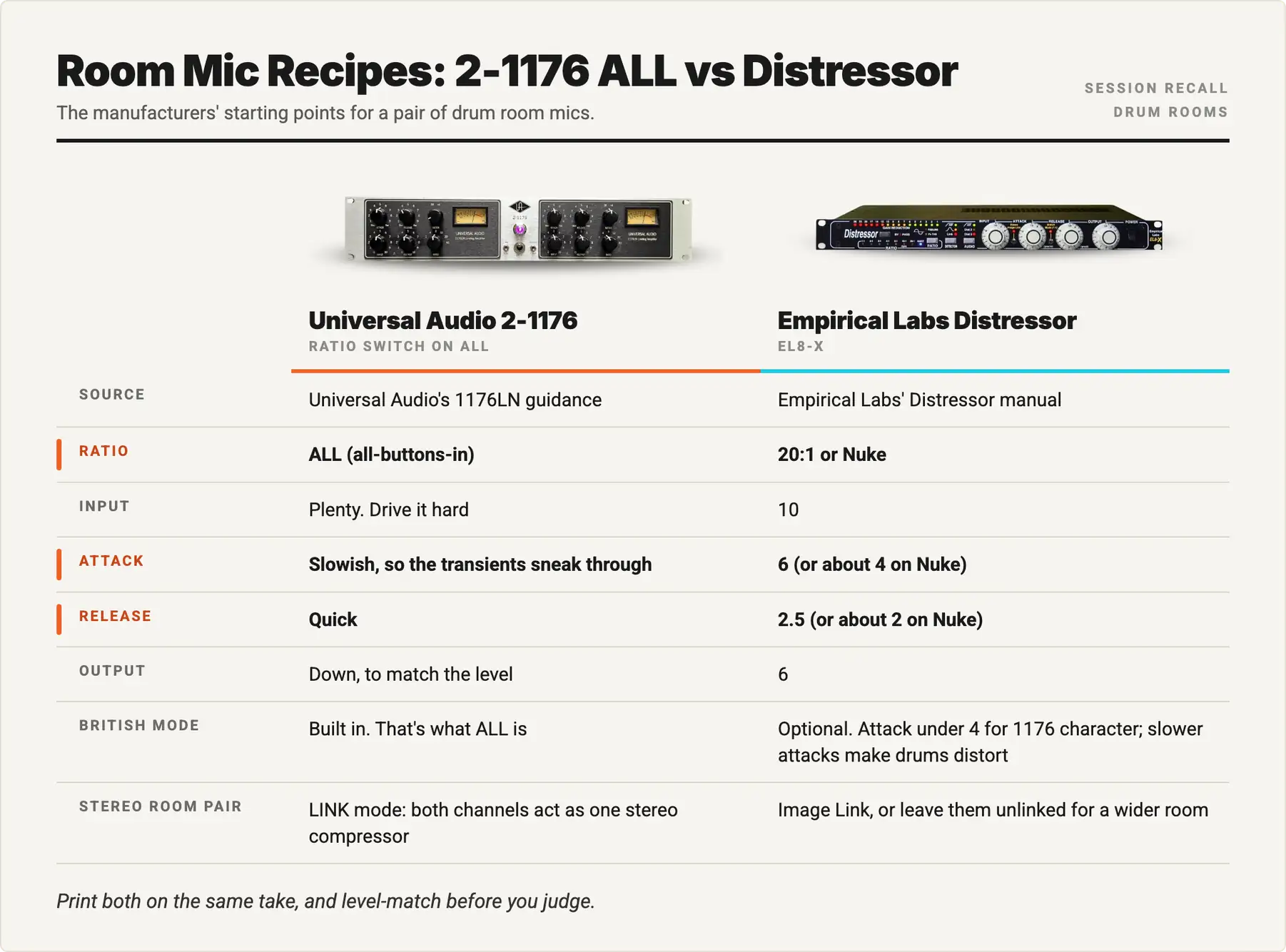
The verdict. If you want the sound on the records, the unpredictable 1960s explosion, the 2-1176 in ALL is the original. If you want to shape it (slower attacks so the snare cracks through, a release you can time to the tempo, Nuke for absolute flattening, filtered detection so the kick doesn't run the show), the Distressor gives you more handles.
All-buttons-in is a happy accident you ride. British Mode is that accident with a steering wheel.
They do two different jobs. Distressor Opto mode levels a bass line; an 1176 at 4:1 grabs every note. Pick the one that matches what the bass is doing wrong.
The 1176 on bass is a classic for a reason. UA's starting point is 4:1 with fairly fast attack and release (both knobs around 3 o'clock) and Input and Output near unity, which makes almost any bass sound fatter while keeping its definition. Step up to 8:1 with a touch more Input for more control and a little distortion. Hugh Robjohns found the reissue handled the wildest upright and electric playing without losing the player's feel. This is the move when individual notes jump out: the FET catches each one fast, and the transformers add weight on the way through.
Distressor Opto mode solves a different problem: a part that wanders in level across a phrase or a whole section. Empirical's recipe is 10:1 Opto with the attack on 10, the release on 0, and the detector high-pass on, hitting it for 10 to 20 dB on peaks (the Distressor's LED meter moves much faster than a VU, so it reads hotter than it sounds). Keep the attack above 4 to hold onto the optical flavor. The separate opto detector and its long release, up to 20 seconds, smooth the line instead of grabbing notes. If that sounds like LA-2A behavior, that's the idea; we explain the optical gain cell Opto mode imitates in a separate guide.
And a third option only the Distressor has. Empirical's bass amp trick: British Mode on, Nuke, attack 1 to 2, release 0 to 5, and 10 to 20 dB of compression. It saturates each low note like a bass amp. Run it on a duplicate of the DI and blend the "amp" and the clean direct to taste.
Notes jumping out? 1176 at 4:1. Level drifting across the part? Distressor Opto. Want grit you can blend? Distressor in British Mode on a parallel track.
The 1176 wins where its voice is the point. The Distressor wins where you need range. These starting points come from the two manufacturers' manuals; treat them as places to start listening, not answers.
Lead vocals. The 1176 is the one engineers have trusted on vocals for decades. Robjohns found it surprisingly transparent at 4:1 used gently, and it gets raunchy when pushed. Start at 4:1, attack and release around the middle, and 3 to 7 dB of gain reduction on the loudest phrases. The Distressor is no slouch: Empirical suggests 6:1 or less, attack 5, release 4, and anywhere from 3 to 17 dB of compression, with Band Emphasis for singers whose upper mids get piercing. Reach for the 1176 when you want presence and forward tone; the Distressor when the singer's dynamics need more taming than an 1176 can do gracefully.
Bass. Both are excellent. See the section above: 1176 for note-by-note grab and weight, Distressor for leveling, filtered detection on boomy parts, and Band Emphasis on clacky players.
Snare, kick, and toms. Advantage Distressor. Its attack runs far slower than the 1176's, so you can let a lot more of the stick through before it clamps. Empirical suggests 3:1 to 6:1 with Input 6, Attack 5, Release 5, Output 6, shortening the release to bring up the ring.
Room mics. Both, for different flavors (see the British Mode section). Try them both on the same take.
Electric guitar. Distressor, especially in British Mode, which Tape Op's reviewer found essential on guitar. Band Emphasis smooths edgy solos.
Acoustic guitar. Either. Empirical says engineers have called the Distressor one of the best units they've heard on acoustic (6:1, Input 7, Attack 2, Release 5, Output 7), while Tape Op's reviewer still preferred a vintage 1176 there. That's exactly the kind of disagreement your own ears should settle.
Stereo sources. The 2-1176 in LINK, or two Distressors with Image Link.
Yes, and they suit each other because they're good at different things. Two orders work well, and neither is a rule.
1176 first, Distressor second. Let the 1176 catch peaks fast and add its tone (4:1, modest gain reduction), then let the Distressor do gentle leveling on a soft-knee curve (2:1 or 3:1), adding Dist 2 if the part needs density. This mirrors the classic fast-then-smooth logic from our 1176 vs LA-2A comparison: the first compressor handles the spikes, so the second can work smoothly.
Distressor in Opto first, 1176 second. Level the performance with Opto mode, then use the 1176 for bite and forward tone. Because the Opto stage has already evened out the level, the 1176 sees a steadier signal and its gain reduction becomes more consistent.
In either order, keep the total modest. Two compressors each doing a few dB usually sound more natural than one doing all of it.
If you like the idea of two characters in one box, our Rupert Neve Designs OptoFET guide covers a unit built around exactly that.
This is where a decades-old argument gets settled in an afternoon. The Distressor and the 1176 are both on the Access Analog rack, and you run them from inside your DAW through the Analog Matrix plugin. It isn't an emulation. Your audio goes to the physical hardware, robotics set the controls, and the processed signal comes back to your session.
That changes the "which one first?" question. You don't have to guess from forum threads which box will suit your material. Instead:
One honest note on drive: the level you send from your DAW is the level the hardware sees. On an 1176 that matters more than on most compressors, because the Input knob drives the transformers as well as setting the compression. Treat send level as part of the sound.
Both units are in the Pro tier of the Access Analog Subscription, along with the 2-1176. You can also reserve a session or run them on demand with credits, and new accounts start with 12 free credits.
Stop arguing about which box is better in theory. Run the same take through both, level-match, and let the track decide.
The Distressor earns its reputation. It copies the 1176's timing closely enough that Empirical can print the recipe in its manual, it turns all-buttons-in into a switch you can apply to any ratio, and then it keeps going: slower attacks, longer releases, Opto, Nuke, filtered detection, distortion on demand. If you can own only one compressor, it covers more ground than anything else in its class.
But the thing people mean when they say "the 1176 thing" isn't only timing. It's a FET slamming shut in microseconds while your signal is pushed through an input transformer, a Class A amplifier, and an output transformer, all driven harder at the same moment. The Distressor was deliberately built without that path. That's not a flaw. It's a different instrument.
The Distressor can do the 1176's moves. Only the 1176 has the 1176's voice. Hear both on your own track and the argument ends.
Can the Distressor replace an 1176?
For timing and attitude, largely yes. Empirical Labs designed the Distressor to emulate classic compressors, its manual includes an 1176LN recipe, and British Mode is built on the 1176's all-buttons-in behavior. What it can't replace is the 1176's transformer-balanced input, Class A output stage, and output transformer, which give the 1176 its forward, saturated tone. Many engineers keep both for that reason.
What is British Mode on the Distressor?
British Mode is a switch on the Empirical Labs Distressor EL8-X that recreates the aggressive attack and release of the 1176's all-buttons-in mode. On the 1:1 setting it becomes a "British" ratio of its own, and on any other ratio it gives that curve the same aggressive character. Empirical recommends keeping the attack well under 4 (fast) to stay close to the 1176 sound.
What does all-buttons-in do on an 1176?
Pressing all four ratio buttons on an 1176 at once produces a ratio somewhere between 12:1 and 20:1, adds a lag to the attack on transients, and shifts the circuit's bias points, so attack and release constantly change and distortion rises sharply. It's famous on drum room mics, and also used to dirty up bass and guitar or push a rock vocal forward. At Access Analog, all-buttons-in is available on the Universal Audio 2-1176 through its labeled ALL ratio position.
What Distressor settings sound like an 1176?
Empirical Labs suggests the 3:1, 4:1, 6:1, and 20:1 curves to emulate the 1176LN's four ratios, with the attack under 4, release anywhere from 1 to 10.5, and Dist 2 and Dist 3 off. Their "familiar" 1176-style sound is 6:1 with attack at 2 and release at 4. For all-buttons-in character, engage British Mode and keep the attack fast.
Is the Distressor or the 1176 better on vocals?
The 1176 has the longer track record on vocals because its fast FET response and transformer-coupled Class A output add presence and help a voice cut through. The Distressor handles more dynamic singers well, offers Band Emphasis to tame harsh upper mids, and can compress heavily while staying clean. Choose the 1176 for tone and the Distressor for range and control.
Should my first serious compressor be a Distressor or an 1176?
If you can own only one, the Distressor covers more ground: eight curves, much wider attack and release ranges, sidechain filtering, distortion modes, and a convincing 1176 impression. If your work centers on vocals and bass and you specifically want the 1176's sound, the 1176 is the one to get. With Access Analog you can try both on your own material before you decide.
How can I compare a real Distressor and 1176 without buying them?
Access Analog racks both the Empirical Labs Distressor and the Universal Audio 1176, plus a 2-1176, and controls them robotically from your DAW through the Analog Matrix plugin. You can run the same take through each, level-match, and recall the settings with your session. Both are included in the Pro tier of the Access Analog Subscription, or you can reserve time or use credits, and new accounts start with 12 free credits.