Control real analog gear straight from your DAW with the Analog Matrix. The Analog Matrix is not an emulation! It acts as a portal, connecting your digital audio workstation to actual physical gear in real time.
Reserve a session using the calendar below, or jump straight into the Analog Matrix plugin and use equipment on demand as it is available. Note: on-demand access requires credits or an active subscription.


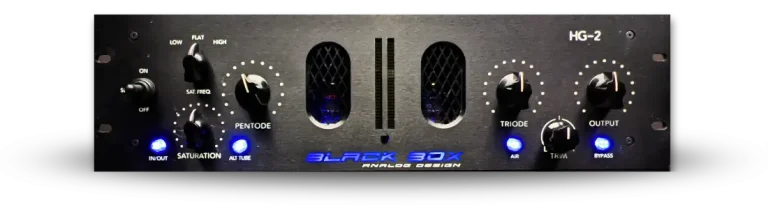
The Black Box Analog Design HG-2 is a line-level, stereo unit designed to add saturation, harmonics, natural compression, increased RMS, and enhancement during mixing and mastering. Using tubes, transformers, and tone to enhance the audio, it does what usually requires multiple pieces of gear and does it better! This is the tube color box you’ve been looking for!
Feed the pentode tube into the triode tube to find the sweet spot for your audio. Get even more tone by adding the saturation stage with the flexibility to choose what frequency range hits the transformers.
Professional mixing and mastering engineers love the analog sound of the tubes and transformers – it makes their mixes sound louder, bigger, and punchier!
New to the HG-2? Read How to Use the Black Box HG-2: A Complete Guide to Tube Saturation, Harmonics & Mix Bus Glue: how the signal flow works, what every control does, and starting settings by source.
What is the Black Box Analog Design HG-2?
The Black Box HG-2 is a line-level stereo tube processor that adds saturation, harmonics, natural compression, and increased RMS to a mix or master. It runs your signal through a pentode tube stage into a triode stage, plus a parallel saturation circuit, so it can range from subtle analog warmth to full-on distortion. Engineers call it a mix bus’s best friend – a single box that makes mixes sound louder, bigger, and punchier.
What is the Black Box HG-2 best for?
The HG-2 is best for mix-bus and mastering coloration, adding tube warmth, harmonic richness, and perceived loudness without reaching for an obvious compressor or EQ. It also excels on submixes and individual tracks, from gently thickening a vocal or bass to aggressively saturating a single instrument. Reach for it whenever a mix sounds flat, thin, or “too digital” and needs analog dimension.
How does the HG-2 work, and what do the Pentode and Triode stages do?
The HG-2 sends your signal through a pentode tube stage that feeds into a triode stage, and you shape the tone by playing these two gain stages against each other. The Pentode generates smooth, musical even-order harmonics (think warm guitar-amp color) while the Triode adds grittier, edgier harmonics, like pushing a signal hard onto tape. Custom input and output transformers add their own weight and character on the way in and out.
What is the HG-2’s parallel saturation circuit?
The parallel saturation circuit is a separate path running off the input through saturation-voiced tubes, blended back in with a Mix control. Because it is parallel, you can add anything from barely-there harmonic density to obvious grit while keeping the core signal intact. A selectable saturation frequency lets you choose which range gets driven, and the saturation tubes are instantly swappable for different flavors.
How do I get subtle warmth versus heavy distortion on the HG-2?
For subtle warmth, keep the Pentode and Triode gains modest and use a small amount of parallel saturation for tone rather than level – increased RMS and tamed peaks come as nice byproducts. For heavier color, push the Pentode toward its sweet spot, lean into the Triode, and blend in more parallel saturation. Watch the gain into the Triode, though: too much going in turns musical harmonics into harsh distortion.
What’s the difference between even and odd harmonics?
Even-order harmonics, like those the Pentode adds, are musically related to the original note, so they sound warm, full, and pleasing – the classic “tube” sweetness. Odd-order harmonics, emphasized by the Triode, add edge, grit, and aggression, the kind of bite you get from pushing tape or a console hard. The HG-2 lets you dial in a blend of both, which is why it can sound smooth and lush or raw and driven.
Is the Access Analog HG-2 real hardware or an emulation?
It is the actual Black Box Analog Design HG-2, a real tube-and-transformer unit with genuine pentode and triode stages, not a software model of it. Through Access Analog, the Analog Matrix plugin robotically controls the physical hardware in real time from inside your DAW, so your audio runs through real tubes and transformers. Real Gear. No Emulations.
Can I recall and automate my HG-2 settings through Access Analog?
Yes. Every control on the Analog Matrix plugin is robotically linked to the physical hardware, so you can save, recall, and automate your settings inside your DAW session like any other plugin. That means your pentode, triode, and saturation settings come back exactly as you left them, session after session, on real tubes and transformers.
How much does it cost to use the HG-2 at Access Analog?
The Black Box HG-2 reserves from $4.42 per hour, an affordable way to run a mix through a real tube saturation processor that normally costs thousands. Reserve a session on the calendar or use it on-demand with credits or an active subscription (subscriptions start at $9.98/month), and new accounts get a free hour (about 12 credits) to try real hardware.