
The Black Box Analog Design HG-2 is a line-level, stereo tube processor that adds harmonics, saturation, natural compression, and increased RMS to mixes and masters.
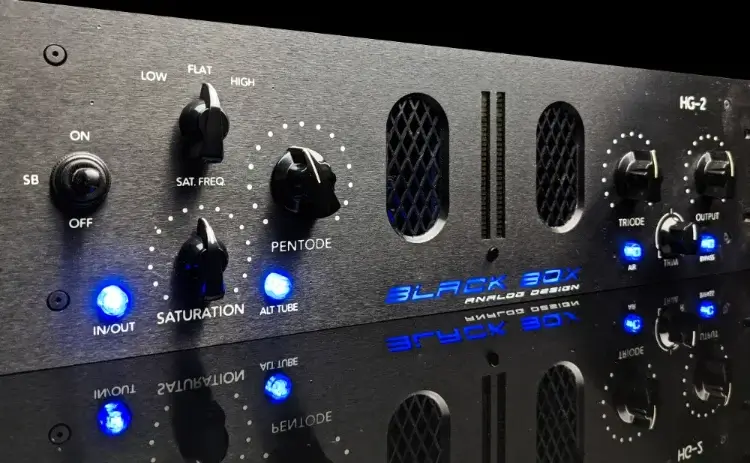
The HG-2 is a line-level, stereo tube processor built to add harmonics, saturation, natural compression, and increased RMS to a finished mix or master. It isn’t an EQ, and it isn’t a traditional compressor. It’s the box you reach for when a mix is technically fine but sounds flat, small, or a little lifeless, and you want it to feel bigger and more cohesive without obviously processing it.
It was designed by producer/engineer Eric Racy and filmmaker/engineer Robert Wainscott, the team behind Black Box Analog Design, after more than five years of development. Their goal was to fill a gap nobody else was really building for – a dedicated “make-it-sound-better” box, sometimes only half-jokingly called a “nicerizer” – rather than another compressor or EQ.
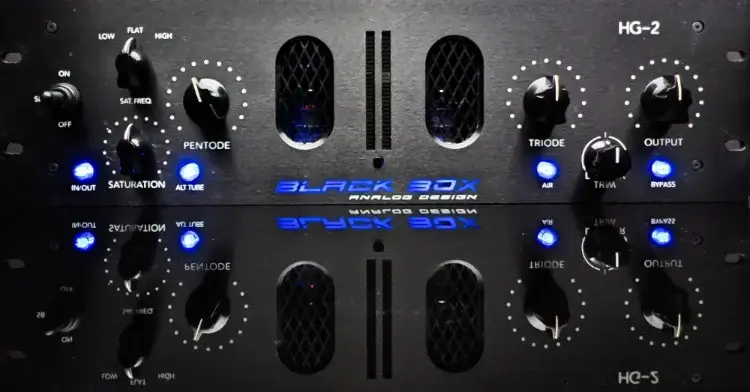
The physical unit is a substantial piece of hardware: a 3U, roughly 26 lb chassis with custom input and output transformers, true hardware bypass, and a 30-segment meter that has three modes but no numeric scale – a deliberate choice we’ll come back to. Everything about it is built to be set by ear.
The HG-2 doesn’t fix problems; it adds the analog richness a clean digital mix can’t generate on its own.
The HG-2 splits your signal into two parallel paths at the input, processes them differently, and recombines them. Understanding that split is the key to using the unit well.
A custom input transformer feeds the signal into two paths. The main path runs through a 6U8A tube, first into its Pentode gain stage and then into its Triode gain stage. Each of those stages has a drive (attenuation) control in front of it, so the Pentode and Triode knobs don’t set output level – they set how hard you push the signal into each tube. Drive them gently, and you get subtle harmonic color; push them, and you move through saturation into natural, program-dependent compression.
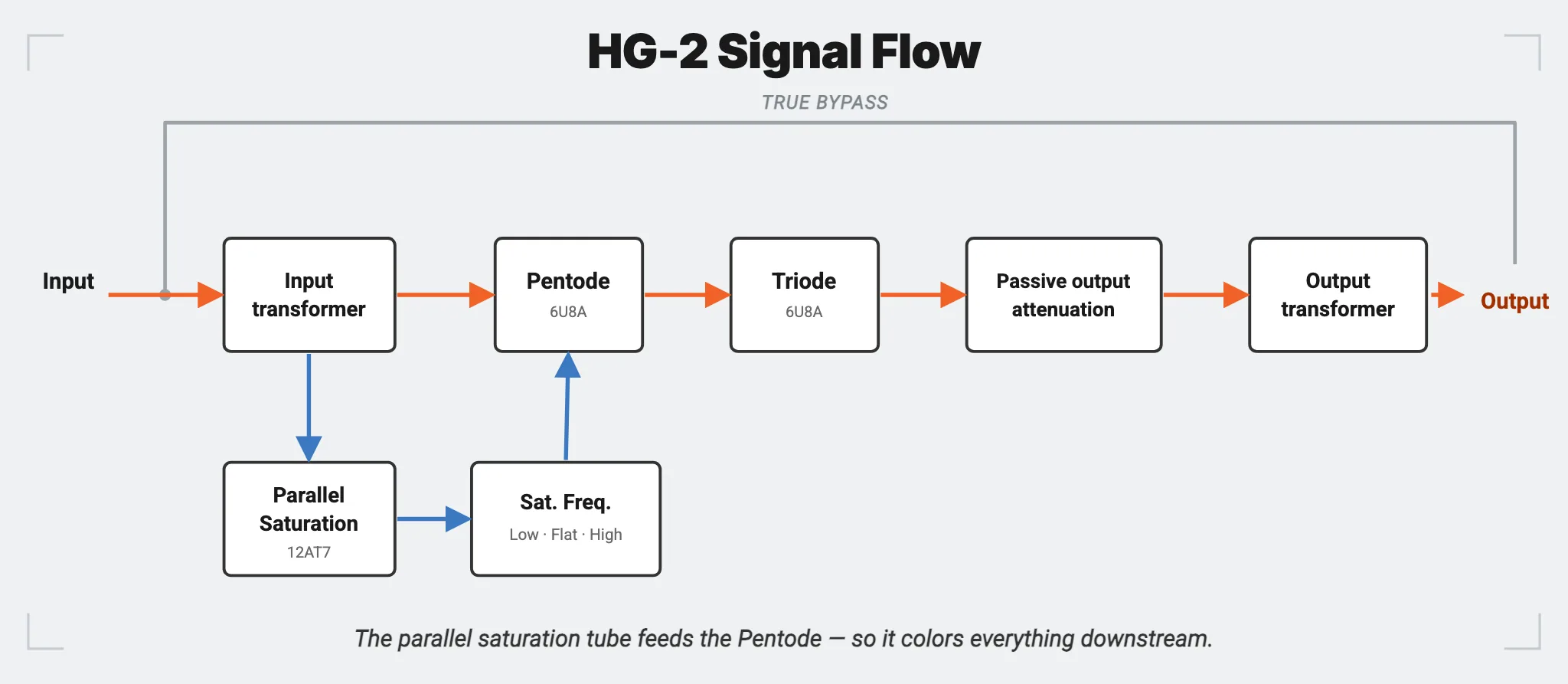
Running alongside that is the parallel saturation path, built around a set of 12AT7 tubes voiced specifically for harmonics and grit. This parallel circuit is blended back into the main path – ahead of the Pentode stage – via the Saturation knob, so whatever you add in parallel then also passes through the Pentode and Triode tubes. That interaction is the whole game: the parallel circuit doesn’t just sit beside the main path, it feeds it.
After the tube stages, the signal hits a fully passive output attenuation stage, then a pair of custom output transformers on the way out. There’s also an Air switch that adds a fixed high-frequency lift starting around 10 kHz for sheen.
Two paths, recombined: a clean main path you can drive into harmonics, and a parallel circuit that saturates and then feeds those same tubes.
Plenty. It was designed for the stereo mix bus, but it earns its rack space across an entire session.
Mix Bus Glue and Enhancement: the flagship use. Subtle harmonics plus natural compression make a finished mix sound bigger, fuller, and more cohesive at the same peak level. To choose the bus compressor that goes with it, see SSL G vs API 2500: glue or punch.
Mastering Tone and RMS: added density and perceived loudness while gently taming peaks, used as a tonal stage rather than as a limiter.
Drum Bus: weight, punch, and front-to-back depth; the parallel “low” mode is great for thickening kick and sub.
Bass: parallel saturation gives a full, present low end that sits in the mix without overpowering it.
Vocals and Guitars: harmonic sweetening, a touch of “air” for sheen, and light saturation for presence and grit.
Dull or Thin Material: the “high” sat mode adds sizzle to lifeless tracks; “low” mode adds body more transparently than piling on EQ.
Drives the signal into the pentode section of the main tube. It’s quick to color – a little movement adds noticeable harmonics – so it’s your fastest route to obvious tube character.
Drives the signal into the triode section that follows. Fed a moderate signal it’s smooth and “velvety,” adding saturation and natural compression; pushed hard it gets grittier and more aggressive.
The In/Out switch engages the parallel 12AT7 circuit; the Saturation knob sets how much of it blends back into the main path. Start from zero and bring it up slowly. Remember it feeds the Pentode and Triode, so it interacts with everything downstream.
Selects between two sets of 12AT7 tubes for the parallel circuit. The “alt” set is voiced more aggressively, for when you want the parallel saturation to bite harder.
Sets which frequency range feeds the parallel saturation circuit: Low concentrates it on the low mids and sub for body and weight, High pushes it into the high mids and top for sizzle, and Flat saturates the full band.
Engages a gentle, fixed high-frequency lift starting around 10 kHz. Allows for an easy way to add open, expensive-sounding top end without reaching for an EQ.
The Output control is fully passive attenuation, used to match the processed level back to bypass. A separate left/right Trim gives you up to .4 dB per side of fine balance adjustment. True Bypass shorts the XLR inputs directly to the outputs for an honest A/B. The 30-segment meter offers three modes – VU, VU with peak hold, and Energy – and deliberately carries no numeric scale.
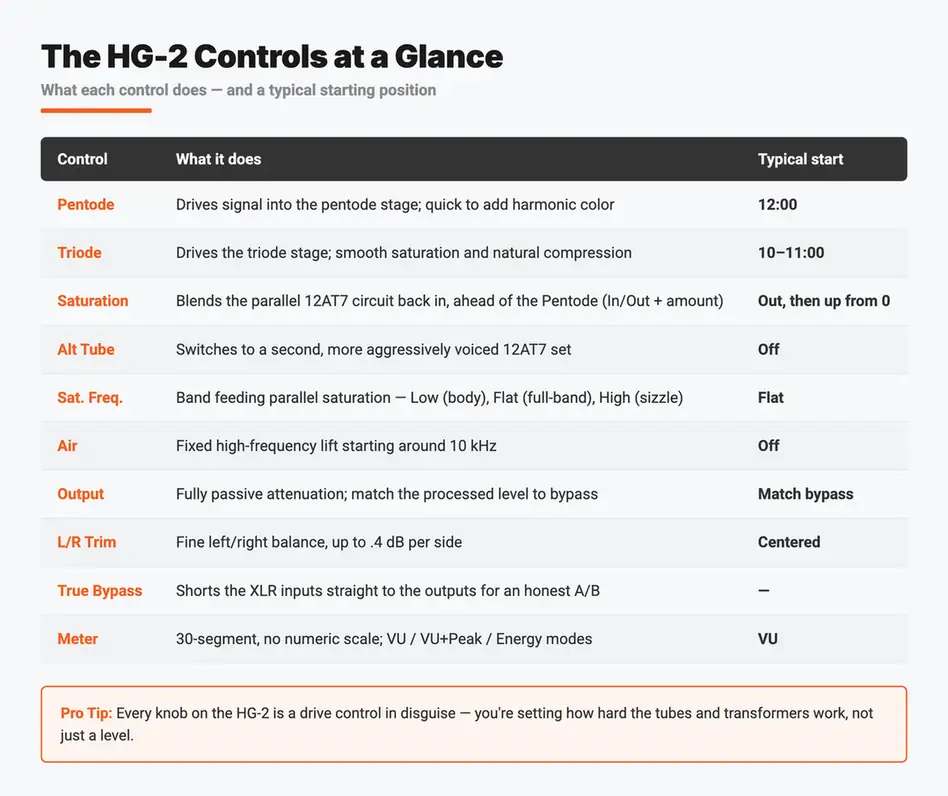
Every knob on the HG-2 is a “drive” control in disguise. You’re setting how hard tubes and transformers work, not just a level.
Start neutral, then add. The manufacturer’s own baseline is a genuinely useful zero point:
The single most important habit here is driving the unit correctly. The Pentode and Triode knobs push into the tubes, so how hot the signal arrives matters. If a track is too quiet to get the tubes working, raise the level feeding the HG-2; if it’s slamming the unit harder than you want, pull that input level down. Set the drive at the source, then fine-tune with the knobs.
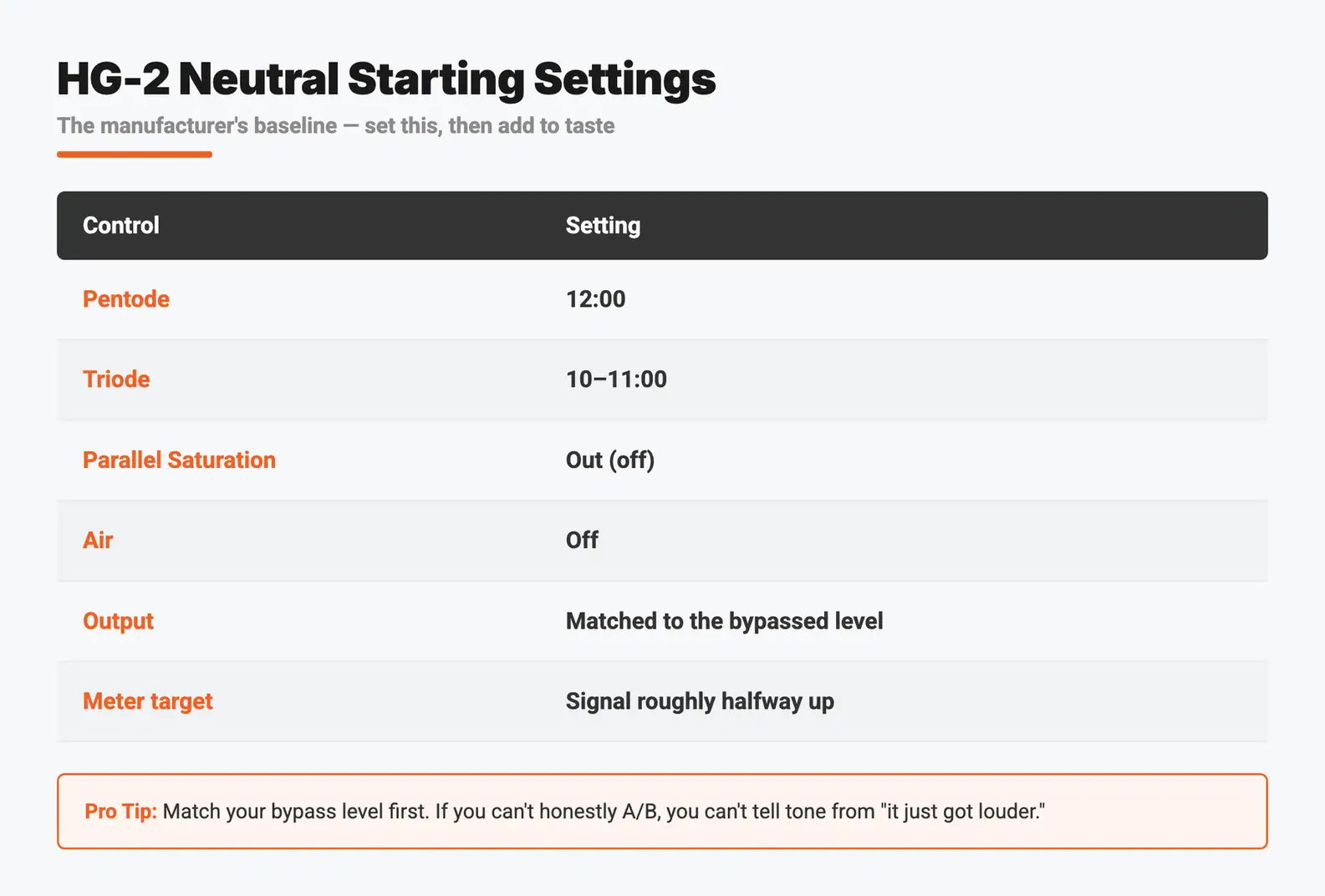
Match your bypass level first. If you can’t honestly A/B, you can’t tell tone from “it just got louder.”
Treat these as starting points, not absolutes. The right amount always depends on how hot you drive the unit and on the material itself. Each is a scannable “try this” recipe.
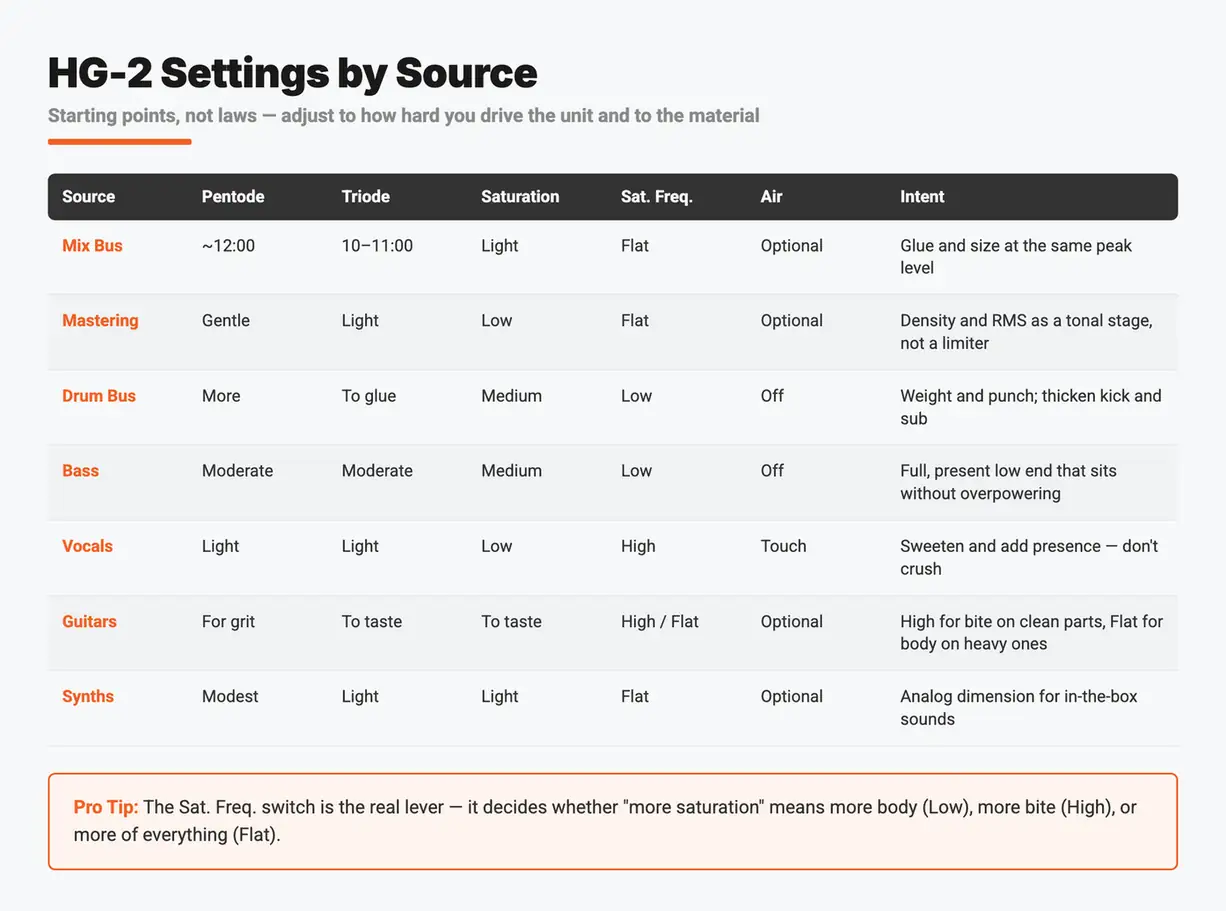
The Sat. Freq. switch is the secret weapon here: it decides whether “more saturation” means more body, more bite, or more of everything.
Drive, compensate, compare. The HG-2 rewards small moves and honest level-matching far more than big gestures.
The Black Box HG-2 is a premium, stereo-only unit that runs around $4,000 – a real commitment for one tone box. Through Access Analog, you can try the real thing before buying.
Our Analog Matrix plugin is a portal, not an emulation: it connects your DAW to the actual physical HG-2 in our racks and controls it robotically, in real time. You dial the knobs from inside your session, the signal runs through the real tubes and transformers, and it comes back to your timeline. Because the settings live in your DAW session, you get full recall — the classic analog problem of “I’ll never get that exact setting back” simply goes away, and you can save whole chains.
There’s a practical tube bonus, too. Tube gear sounds its best once it’s warmed up and sitting at a stable operating temperature. Because our gear runs 24/7, the HG-2 is always warm and ready the moment you open a session. No cold-start wait, no biasing, no maintenance on your end.
New accounts get one free hour, and after that, you can work on demand with credits or a subscription. This way, you can hear the real HG-2 on your own mix before you ever think about buying one. If you’re putting it on a master, it’s worth pairing this with our guide to mastering with analog gear.

Run the real, physical HG-2 from inside your DAW. Get full recall.
Through Access Analog, the Analog Matrix plugin controls the actual Black Box HG-2 in our racks, robotically and in real time. You dial the Pentode, Triode, and parallel saturation from your session; the audio runs through real tubes and transformers, and your settings save with the project.
Always warmed up, always recallable, and calibrated and tested daily to keep it ready.
The HG-2 rewards restraint. Its whole reason for existing is to make a finished mix sound the way the best records sound – bigger, denser, more three-dimensional – without you obviously hearing “processing.” Get the level-matching honest, learn the parallel-feeds-the-tubes interaction, and make small moves, and it becomes one of the most musical boxes you can put across a mix.
Set it by ear, match your bypass, and let the tubes do the part that plugins still can’t.
Download the Analog Matrix and start your first session — new accounts get one free hour.
What does the Black Box HG-2 do?
It adds harmonics, saturation, natural tube compression, increased RMS, and high-frequency “air” to stereo mixes, masters, busses, and individual sources. In one box it covers tonal jobs you’d otherwise chase across several pieces of gear, making finished material sound bigger and more cohesive at the same level.
What are the key features of the Black Box HG-2 amplifier?
The Black Box HG-2 amplifier is a high-end tube processor renowned for its ability to add saturation, harmonics, natural compression, and increased RMS, making it ideal for mixing and mastering.
The Black Box HG-2 is prized for its rich harmonic generation, flexible saturation options, unique parallel circuit with selectable frequency focus, and the ability to enhance mixes with warmth, presence, and dynamic control all in one unit. It is widely used for adding analog tube character to both individual tracks and full mixes in professional studios.
How does the Black Box HG-2 compare to other boutique tube amplifiers?
The Black Box HG-2 is highly regarded among boutique tube amplifiers and saturation units, particularly for its unique dual-tube design and versatile harmonic generation.
Compared to other boutique tube amplifiers, the Black Box HG-2 stands out due to its dual-tube architecture, extensive harmonic shaping controls, robust build, and versatility across mixing and mastering applications. It provides a more musical, less fizzy saturation with greater tonal control than many competitors, though at a higher price point. For those seeking a high-end tube saturation box capable of both subtle warmth and aggressive distortion, the HG-2 is often considered the “mix bus’s best friend” and a unique tool in the boutique analog gear landscape.
What does it mean when the Black Box HG-2 “increases RMS”?
RMS (Root Mean Square) is a measure of a track’s average loudness over time — not the brief, sharpest spikes. Think of Peak as the top speed your car hits for a split second, and RMS as your steady cruising speed. It’s RMS that determines how loud a mix actually feels to the human ear.
The HG-2 raises that average loudness without reaching for a traditional compressor or limiter. As you feed its high-voltage Pentode tube into the Triode stage, the tubes gently round off the sharpest transient peaks while adding harmonic saturation. That tames the spikes and lets you push the continuous volume higher, shrinking the gap between the loudest peaks and the average energy. The result is a mix that sounds fuller, fatter, and louder — with the weight and punch only real tubes deliver.
What’s the difference between the Pentode and Triode stages?
Both are tube gain stages in the main path. Driving the Pentode quickly adds harmonic color; pushing the Triode adds more saturation and smooth, natural compression. The Pentode feeds the Triode, so they interact — changing one changes how the other responds.
What are good starting settings for the HG-2?
Pentode at noon, Triode at 10–11 o’clock, parallel saturation off, Air off, and the Output matched to your bypassed level. Aim for the signal sitting about halfway up the meter, then drive each stage to taste while A/B-ing against true bypass.
What does the Sat. Freq. switch do?
It sets which frequencies feed the parallel saturation circuit. Low concentrates saturation on the low mids and sub for body and weight, High pushes it into the top end for sizzle, and Flat saturates the full band. It’s the fastest way to aim the parallel character.
What does the Air switch do?
It engages a gentle high-frequency lift starting around 10 kHz, adding open, airy sheen to the top end. On the hardware it’s a fixed, musically chosen amount — a switch rather than a sweepable control — so you simply decide whether the material wants it or not.
Why is there no scale on the knobs or meter?
By design. Black Box wants you setting the HG-2 by ear rather than by numbers — less staring at values, more listening. The 30-segment meter shows you relative level and energy across its VU, peak-hold, and Energy modes, but never asks you to hit a target number.
Can I use the HG-2 on individual tracks?
Yes. It was built for the stereo mix bus, but it excels on drum busses, bass, vocals, guitars, and synths. On individual sources you’ll usually make smaller moves than on the bus, letting the tubes and the parallel saturation add character rather than reshape the sound.
Is the HG-2 hardware better than the plugin?
Both are well regarded. Engineers report the hardware has a superior high-frequency response and the analog character of real tubes and transformers behaving non-linearly at every level. The plugin is the accessible, fully recallable alternative — and through Access Analog you can use the real hardware with recall, too.
How can I try the real HG-2 before buying?
Through Access Analog, you control the physical HG-2 from your DAW via the Analog Matrix plugin, with full recall and no emulation. New accounts get one free hour, so you can run your own mix through the real unit to try it out.