Control real analog gear straight from your DAW with the Analog Matrix. The Analog Matrix is not an emulation! It acts as a portal, connecting your digital audio workstation to actual physical gear in real time.
Reserve a session using the calendar below, or jump straight into the Analog Matrix plugin and use equipment on demand as it is available. Note: on-demand access requires credits or an active subscription.


See our post on Getting Started with the Gyraf G24
Compression, redefined. Times two.
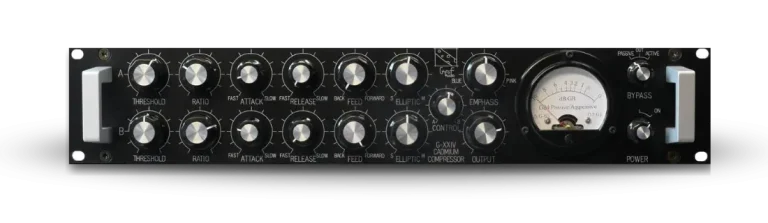
So this is just another stereo compressor, right? Well no actually, it’s more like two, and then some. The Gyraf G24 excels at those demanding mixing and mastering tasks where your usual tools fail to get you all the way across the finishing line.
Hand built by Danish audio mastermind Jakob Erland, this unit has re-drawn the map for what you can achieve in the department of subtle corrections. The unit is based on a meticulously designed passive signal path, which has not only one but two complete and separate stereo sidechains. This in effect creates two different stereo compressors, which in turn are continuosly variable between L/R and M/S action. The Gyraf G24 also has a built-in simplified tilt equalizer, affecting which part of the frequency spectrum will trigger the compression.
On a side note, a rather famous opera house has one of these. It is the only unit known to them that can slightly attenuate the vibrato on a vocal without ruining the take sonically.
We know that this unit is something out of the ordinary, which is why we are so happy to offer you this piece of truly original gear.
What is the Gyraf G24 Passive/Aggressive Compressor?
The Gyraf G24 is a hand-built analog stereo compressor for mixing and mastering, designed by Danish engineer Jakob Erland for transparent, surgical dynamic control. It is built on a passive, optical signal path and is unusually flexible: it behaves like two separate stereo compressors at once, each continuously variable between standard stereo (L/R) and Mid/Side operation. Engineers reach for it when an already-balanced mix needs subtle dynamic correction without losing definition.
What is the Gyraf G24 best for?
The G24 is best for mastering and mix-bus work where you need transparent, precise dynamic control, taming part of a mix without disturbing the overall balance. Its Mid/Side flexibility lets you compress the center and the stereo sides independently, and its dual compressors can split fast-transient and slow-leveling duties. It is famous for subtle, almost impossible jobs, even gently taming a vocal’s vibrato without ruining the take.
What makes the G24 different from a normal stereo compressor?
The G24 is really two complete stereo compressors in one, each with its own sidechain acting on the signal at the same time. You can set one to grab fast transients and the other to slowly ride gain, then blend between them. On top of that, each is continuously variable from L/R to Mid/Side, making it far more flexible than a standard single-sidechain stereo compressor.
What do the Feed and Elliptic controls do?
Feed sets where each compressor “listens” to the signal – stepless from feed-forward to feed-back – which changes the feel and timing of the compression. Elliptic continuously morphs the sidechain from Mid-only to Side-only; centered, it behaves like a normal stereo compressor, while off-center it focuses compression on the center or the stereo edges. A simplified sidechain tilt EQ (labeled Emphasis) also lets you choose whether highs or lows trigger the compression more.
What’s the difference between feedforward and feedback compression?
In feedback compression, the detector listens to the signal after gain reduction, which tends to sound smoother and more vintage. In feedforward compression, it listens before gain reduction, which is faster and more precise and lets more transient “smack” through. The G24’s Feed control blends continuously between the two (and can set its two compressors differently) so you can dial in exactly the feel you want.
What’s the difference between the G24’s Active and Passive modes?
Passive mode runs through the G24’s purely passive signal path for an especially smooth, transparent sound, which engineers favor on full mixes and mastering. Active mode brings in the unit’s active stage for a more present, characterful result that suits more aggressive or detailed work. The name “Passive/Aggressive” captures that range, from gentle and clean to bold and assertive.
Is the Access Analog Gyraf G24 real hardware or an emulation?
It is the actual Gyraf G24. A real, hand-built analog optical compressor, not a software model of it. Through Access Analog, the Analog Matrix plugin robotically controls the physical hardware in real time from inside your DAW, so your audio runs through the real passive signal path and opto cells. Real Gear. No Emulations.
Can I recall and automate my Gyraf G24 settings through Access Analog?
Yes. Every control on the Analog Matrix plugin is robotically linked to the physical hardware, so you can save, recall, and automate your settings inside your DAW session like any other plugin. That means your dual-compressor, Feed, Elliptic, and threshold settings come back exactly as you left them, session after session, on a real, hand-built analog compressor.
How much does it cost to use the Gyraf G24 at Access Analog?
The Gyraf G24 reserves from $5.14 per hour, an affordable way to use a rare, boutique mastering compressor that is expensive to own. Reserve a session on the calendar or use it on-demand with credits or an active subscription (subscriptions start at $9.98/month), and new accounts get a free hour (about 12 credits) to try real hardware.