Control real analog gear straight from your DAW with the Analog Matrix. The Analog Matrix is not an emulation! It acts as a portal, connecting your digital audio workstation to actual physical gear in real time.
Reserve a session using the calendar below, or jump straight into the Analog Matrix plugin and use equipment on demand as it is available. Note: on-demand access requires credits or an active subscription.

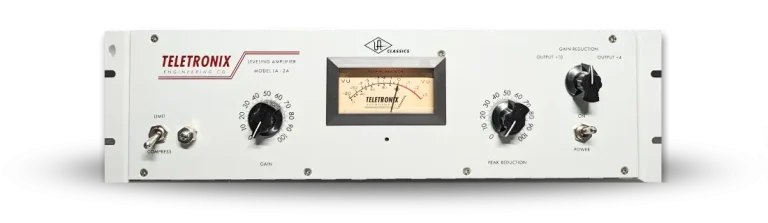
Experience the warmth and character of vintage audio with the Universal Audio LA-2A compressor/limiter. This iconic piece of gear has been used on countless hit records and adds a touch of magic to your audio. Its simple but effective design allows for smooth and natural compression, making your vocals, instruments, and mixes come to life like never before.
Since the 1960’s the LA2A has proven itself as the benchmark for musical compression. Just two knobs to take you from gentle to aggressive sound shaping. Polish or add grit to a vocal, clamp down a snare, or give a bass some bark – you can’t go wrong with the LA2A’s tube-driven sound.
Get the classic sound of the LA-2A in your studio and take your productions to the next level. You’ve heard the emulations, now try the real thing and see why the LA2A remains the world’s most popular compressor!
New to the LA-2A? Read The LA-2A: How an Optical Gain Cell Became the Most Musical Compressor Ever Made: how the T4 cell works, what Peak Reduction really does, and which sources respond best. Choosing between compressors? See 1176 vs. LA-2A on Vocals.
The Universal Audio LA-2A is a tube-driven optical compressor/limiter that smooths out the dynamics of a signal, making it sit more consistently in a mix. It uses a T4 optical gain-reduction cell to lower the loudest parts of a performance gently and automatically, adding warmth and weight along the way. With just two main knobs – Gain and Peak Reduction – plus a Compress/Limit switch, it is one of the simplest and most musical compressors ever built.
Yes. The LA-2A is widely considered one of the best vocal compressors ever made. Its slow, program-dependent optical compression levels a vocal without choking it, so the feel of the performance stays intact while the level becomes steady and upfront. Engineers reach for it on lead vocals because it adds tube warmth and presence with almost no audible pumping. A common starting point is to set Peak Reduction for about 3–5 dB of gain reduction on the loudest phrases, then use Gain to bring the level back up.
No. The LA-2A has no user-adjustable attack, release, or ratio controls, which is a big part of why it sounds the way it does. Its timing is set by the physics of the T4 optical cell and is program-dependent, with an average attack near 10 ms and a two-stage release that reacts to the incoming signal. You only set two things: how much compression (Peak Reduction) and the output level (Gain). The Compress/Limit switch is the one ratio choice, gentle compression in Compress, hard limiting in Limit.
The LA-2A is a slow tube optical compressor, while the 1176 is a fast FET compressor – they do opposite jobs and pair beautifully together. The LA-2A levels and warms a signal smoothly and almost invisibly, which is why it shines on vocals and bass. The 1176 reacts in microseconds to grab transients and add punch and attitude. A classic engineer move is to run the 1176 first to catch fast peaks, then the LA-2A to glue the overall level, both available to chain at Access Analog.
Optical compression uses a light source and a light-sensitive resistor to control how much a signal is turned down. In the LA-2A, louder audio makes an internal panel glow brighter, which raises the resistance of the photocell and smoothly reduces the gain. Because the cell reacts gradually and recovers in stages, optical compressors sound slow, smooth, and musical, the opposite of the fast, aggressive grip of an FET compressor like the 1176. This is the character that makes the LA-2A so flattering on vocals and bass.
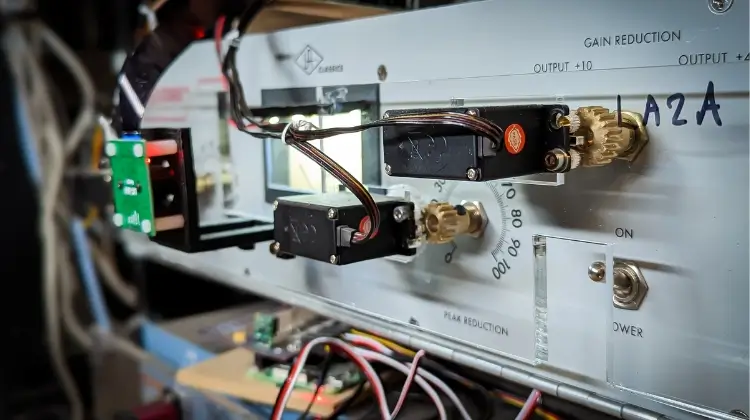
It is the actual LA-2A hardware. Real tubes, real transformers, and a real T4 optical cell, not a model of them. Access Analog connects your DAW to the physical unit in our racks through the Analog Matrix, and robotics move the real knobs and switch while your audio streams through the box in real time. Real Gear. No Emulations. You hear the genuine optical-tube compression, controlled from inside your session.
The LA-2A excels on bass, where its smooth optical compression rounds out the low end and keeps the level rock-steady. It is also a favorite for acoustic guitar, piano, and for adding gentle glue and tube warmth across many sources. Flipping the switch to Limit lets it clamp harder for more aggressive, characterful control. Because the controls are fixed and forgiving, it is famously hard to make the LA-2A sound bad.
Yes. Every knob, switch, and selector on the LA-2A has an independent control that is saved with your session, so you can recall your exact settings later. You can save a preset for the LA-2A on its own using the “+” button on the device panel, or save a whole signal chain. For example an 1176 into the LA-2A – and recall the entire chain at once. This is the analog hardware being processed at line level inside your DAW, with the recall and automation convenience of a plugin.
The LA-2A reserves from $5.26 for a session, and you can also use it on demand through credits or an active subscription. Every new account gets one free hour of access (about 12 credits), so you can try the LA-2A before spending anything, and on-demand use is billed only for the time the device is actually inserted. Subscriptions start at $9.98/month for ongoing access.
Music Radar
Mix Online
https://www.mixonline.com/technology/universal-audio-la-2a-370120
Tape Op
https://tapeop.com/reviews/gear/26/la-2a-leveling-amplifier/