
If you only reach for one compressor on every vocal, you’re leaving the easy wins on the table.The two most famous vocal compressors ever built – the Universal Audio 1176 and the LA-2A – aren’t competitors. They’re different tools that solve different problems.
Reach for the 1176 when a vocal needs fast peak control, attitude, or aggression, and the LA-2A when it needs smooth, transparent, hands-off leveling. And chain the 1176 into the LA-2A when you want both.
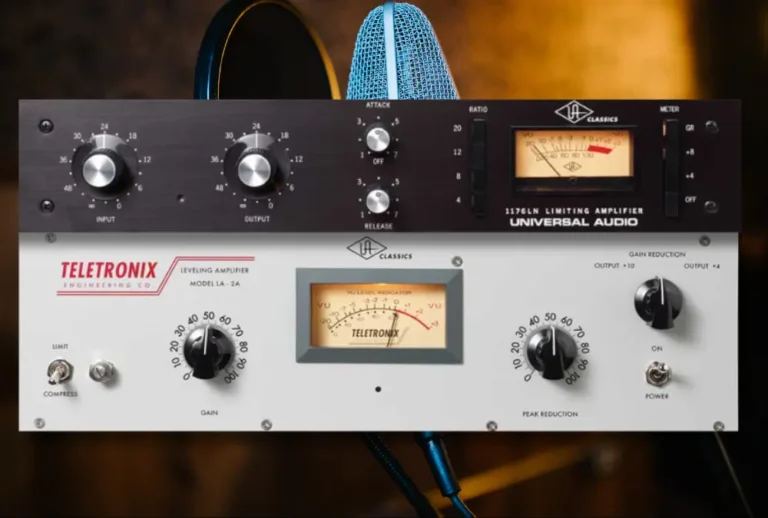
The 1176 is a fast FET compressor that grabs transients and adds attitude; the LA-2A is a smooth optical compressor with a tube gain stage that levels a vocal almost invisibly. That single difference – how quickly and how aggressively each circuit reacts – drives every decision about which to use.
The LA-2A is an optical compressor, using a tube circuit and an optical attenuator. It is known for its smooth, slow compression with a natural, warm tube coloration. The controls are simple, mostly just input gain and peak reduction, making it easy to use but less flexible. Learn why the LA-2A has only two main controls.
The 1176 is a solid-state FET (Field Effect Transistor) compressor with very fast attack and release times. It offers more control with input, output, attack, release, and ratio settings, making it highly versatile. It has a more aggressive, punchy character compared to the LA-2A. Learn more about how the 1176’s FET gain cell works.
The LA-2A has fewer controls (input gain, peak reduction, and a compress/limit switch), focusing on simplicity and musicality.
The 1176 offers adjustable attack and release times, ratio settings (4:1, 8:1, etc.), and more hands-on control over the compression behavior.
The LA-2A is prized for its smooth, gentle compression and warmth, making it ideal for vocals, bass, and acoustic instruments where you want a natural, musical leveling effect without harshness. It excels on slower, sustained sounds.
The 1176 is often described as a “Swiss army knife” compressor, great for punchy sounds like drums, bass, guitars, and aggressive vocals. Its fast attack and release can catch transients quickly and add presence and snap to the sound.
It’s common in professional studios to use the 1176 and LA-2A together in series on vocals or other instruments. The 1176 handles fast transient peaks with its quick attack, while the LA-2A smooths and levels the overall performance with its gentle, warm compression. This combination helps maintain dynamics and add character without sounding overly compressed. The same FET-into-opto chain in one box.
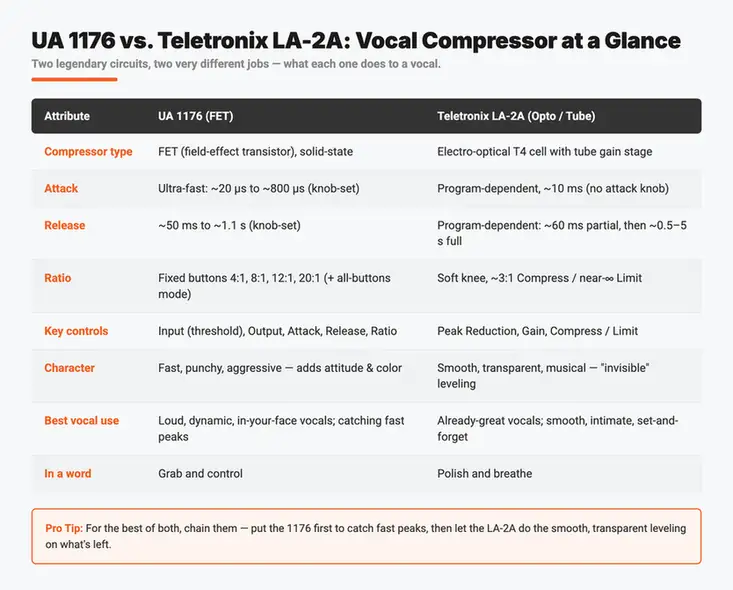
Here’s each one at a glance: the 1176’s fast FET attitude on the left, the LA-2A’s smooth opto leveling on the right.
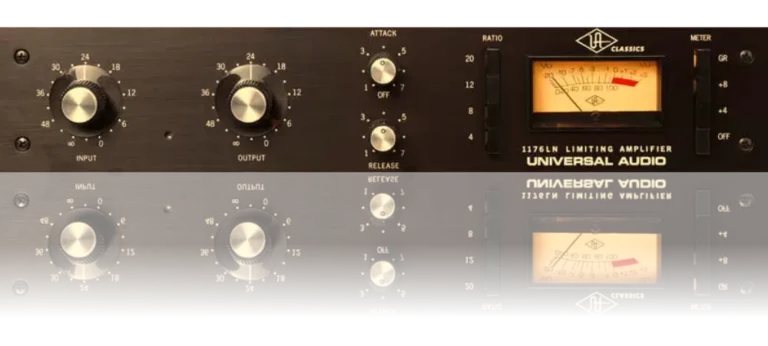
The 1176 is the go-to when a vocal needs to be grabbed and pushed forward — its ultra-fast FET circuit catches transients in microseconds and adds unmistakable attitude.
The Universal Audio 1176 is a field-effect-transistor (FET) compressor with a ~20 μs attack, fixed ratio buttons (4:1, 8:1, 12:1, 20:1), and the famous “all-buttons-in” mode for aggressive, colored gain reduction. You set the threshold with the Input knob and make up level with Output.
Reach for the 1176 on loud, dynamic, in-your-face vocals — or to catch the fast peaks before a smoother leveler takes over.
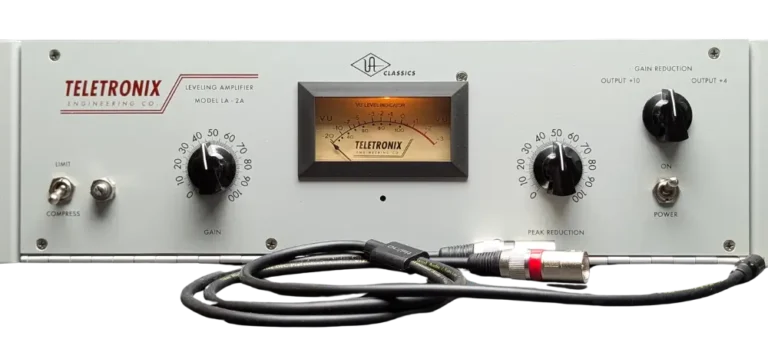
The LA-2A is the go-to when a vocal is already great and just needs smooth, transparent leveling — its optical cell rides dynamics the way a great engineer rides a fader.
The LA-2A (a Teletronix design, now made by Universal Audio) levels with an electro-optical T4 cell feeding a tube gain stage. It has just two main controls — Peak Reduction and Gain — plus a Compress/Limit switch. There are no attack or release knobs because the optical timing is program-dependent, responding in roughly 10 ms and releasing over a fraction of a second to several seconds.
Reach for the LA-2A on intimate, already-polished vocals — or as the second stage that smooths everything the 1176 just caught.
Before you reach for an 1176 or an LA-2A on a vocal, it helps to understand what each compressor is actually doing under the hood. Both are legendary for a reason, but they solve very different problems: the 1176 is fast, forward, and full of attitude, while the LA-2A is smooth, musical, and naturally forgiving. Here’s how each one works, why it sounds the way it does, and when to choose one over the other in a real vocal mix.
The 1176 controls level with a FET (field-effect transistor) acting as a voltage-controlled resistor, and it reacts fast – attack times reach roughly 20 microseconds. You set the threshold indirectly with the Input knob, make up level with Output, and choose from fixed ratio buttons of 4:1, 8:1, 12:1, and 20:1. Push all four ratio buttons in at once — the famous “all-buttons-in” mode — and the 1176 shifts into an aggressive, harmonically rich gain reduction that engineers have used on vocals for decades.
That microsecond-fast FET response is exactly why the 1176 adds attitude: it can clamp a transient before it gets away, and the circuit colors the signal as it works.
The LA-2A levels with an electro-optical T4 cell, a light source and a photoresistor, feeding a tube gain stage. There are only two main controls: Peak Reduction and Gain, plus a Compress/Limit switch. There are no attack or release knobs because the optical cell’s timing is program-dependent: it responds in roughly 10 milliseconds and releases in two stages over a fraction of a second to several seconds, following the music itself.
That program-dependent optical behavior is why the LA-2A sounds so effortless: it levels a vocal the way a great engineer rides a fader, smoothing dynamics without drawing attention to itself.
Reach for the 1176 when a vocal is loud, dynamic, or needs to sit right at the front of the mix with energy and attitude – rap, rock, aggressive pop. It’s also your tool for catching fast peaks that a slower compressor would miss.
Reach for the LA-2A when a vocal is already well-recorded and you want smooth, intimate, set-and-forget leveling – ballads, jazz, soul, singer songwriter material, or any time you want the compression to be felt and not heard.
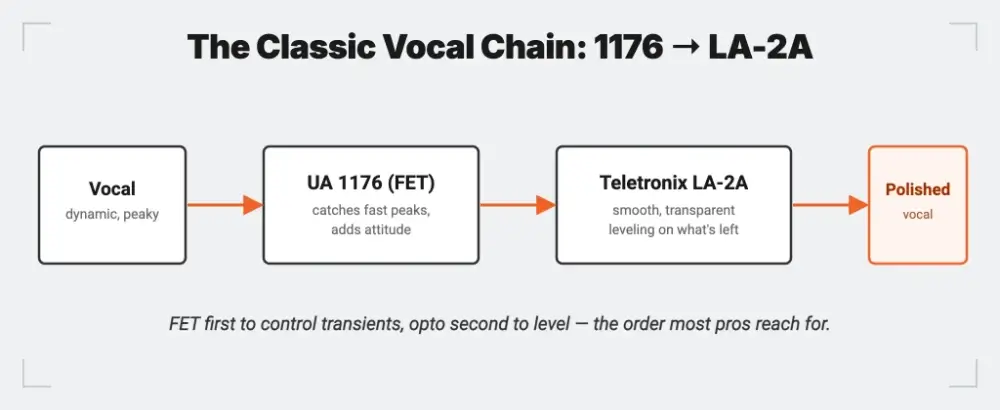
Yes. And the classic professional move is to run the 1176 first, then the LA-2A. The fast FET catches the sharpest transients and adds character, then the optical LA-2A smooths the overall level of what’s left. The result is a vocal that’s both controlled and natural.
Keep each stage gentle. A few dB of gain reduction on the 1176 and a few more on the LA-2A, so the two compressors share the work instead of fighting over it.
This is where Access Analog comes in. The Analog Matrix plugin is a portal that connects your DAW to real, physical hardware in our racks via robotic control. It is not an emulation. You can load a real Universal Audio 1176 and a real LA-2A, run your own vocal through each, and A/B them back to back on the same take.
Because our gear is tested several times a day, it’s always ready. And your settings are saved in your DAW session and robotically recalled, so the traditional analog recall problem simply goes away.
It’s not a competition. The 1176 grabs and controls; the LA-2A polishes and breathes. Knowing which job a vocal needs – and that you can have both in series – is what separates a vocal that sits in the mix from one that just sits there.
The fastest way to learn the difference is to run your vocals through the real hardware, not a model of it.
Suggested Reading
Check out the same head-to-head for bus compressors.
The rest of a professional vocal chain.
Is the 1176 or the LA-2A better for vocals?
Neither is universally better. They do different jobs. The 1176 is a fast FET compressor that controls peaks and adds attitude, ideal for loud or aggressive vocals. The LA-2A is a smooth optical compressor that levels transparently, ideal for already-great vocals and intimate material. Many engineers use both in series.
How do the sonic characteristics of an optical compressor compare to a FET compressor?
Optical Compressors:
Smooth and Musical: Optical compressors, like the classic LA2A, are known for their naturally smooth and gentle response . They use a light source and a light-dependent resistor to control gain reduction, which contributes to their characteristic sound .
Warmth and Vibe: They tend to add warmth and a pleasant “vibe” to the audio . Many engineers describe them as “set and forget” tools because of their forgiving and musical nature .
Ideal for: Optical compressors are often favored for vocals and instruments that need a gentle, musical touch . They are not as fast as FET designs, but their smooth compression is highly desirable for certain applications .
FET Compressors:
Fast, Punchy, and Aggressive: FET (Field Effect Transistor) compressors, such as the iconic 1176, are recognized for their quick reaction times, making them excellent for adding punch and energy .
Colorful and Gritty: They often impart a “colorful” and aggressive character to the sound, especially when pushed . They can introduce a bit of desirable distortion and grit, making signals sound brighter and more present .
Versatile for Individual Instruments: While not typically used as a clean option on a mix bus, FET compressors are stellar on individual instruments like vocals, guitars, kick drums, and snare drums . The famous “all buttons in” mode on an 1176 can even turn it into a saturation device for aggressive parallel compression .
In essence, if you’re looking for smooth, warm, and musical compression, an optical compressor is a great choice. But if you need fast, punchy, and aggressive compression with a bit of character, a FET compressor will likely be your go-to . Both types have their own signature sound and specific applications where they truly shine .
Do you put the 1176 before or after the LA-2A in a vocal chain?
The classic order is the 1176 first, then the LA-2A. The fast FET catches sharp transients and adds character, then the optical LA-2A smooths the overall level of what remains. Keep each stage gentle.
What does the 1176’s “all-buttons-in” mode do to vocals?
Engaging all four ratio buttons at once puts the 1176 into an aggressive, program-dependent mode with a distinctive distortion and harmonic color. On vocals it adds energy and attitude; blend it in with the Input backed off for control.
Why doesn’t the LA-2A have attack and release knobs?
The LA-2A’s timing is set by its electro optical T4 cell, which responds to the program material itself, roughly 10 milliseconds of attack and a two-stage release. That program-dependent behavior is what makes it sound so natural, so there’s nothing to dial.
What ratio should I use on the 1176 for vocals?
A 4:1 ratio is a great starting point for controlled, musical vocal compression. Step up to 8:1 for firmer control on dynamic performances, or engage all buttons-in mode when you want attitude.
Can I use the real 1176 and LA-2A without buying them?
Yes. Access Analog gives you remote access to real 1176 and LA-2A hardware from inside your DAW through the Analog Matrix plugin. You process audio through the actual circuits in real time, with full recall – no purchase or racking required.