
Only two of the LA-2A’s controls affect the sound, and neither of them is attack or release. You cannot set the timing. The compressor decides.
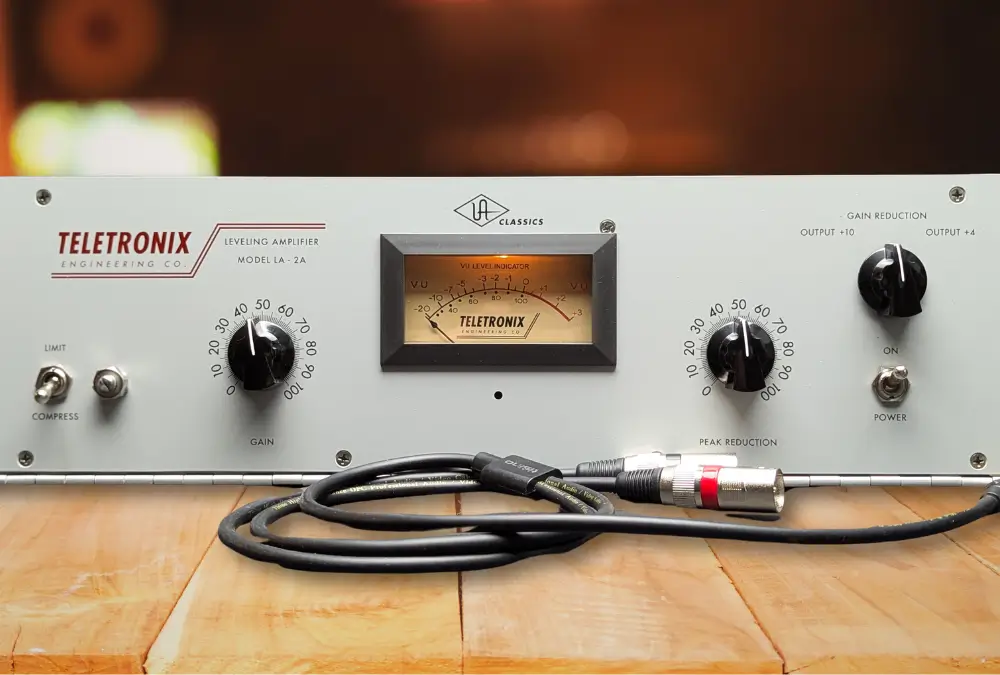
The LA-2A has been on more hit vocals than almost any other compressor ever built. Understanding why engineers have spent sixty years trusting its decision is what this guide is about: the T4 optical gain cell, the feedback side-chain, the two-stage release that makes it program-dependent, what “musical” actually means in circuit terms, the unit’s variants, and which sources respond best to it. Two Universal Audio LA-2A units run on the Access Analog rack.
Key Takeaways
The LA-2A is not a compressor you set. It is a compressor you feed.
The Teletronix LA-2A is a tube-driven electro-optical leveling amplifier introduced in 1965, designed by James F. Lawrence II at Teletronix in Pasadena, California. It was built for broadcast, where a transmitter needed level control that no operator had to babysit, and it arrived in recording studios almost immediately.
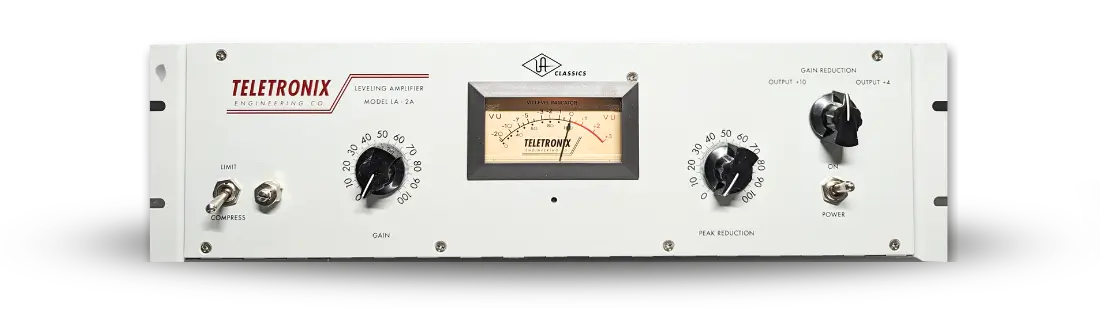
Its front panel carries three knobs and a switch, but only two of them touch the audio: Peak Reduction, which sets the compression, and Gain, which sets the output level. The third knob is a meter selector that changes what the VU meter reads, either output level (+4 or +10) or gain reduction in dB, and it has no effect on the sound. A Compress / Limit switch changes the shape of the curve. That is the entire user interface of a unit that has been on hit records continuously for six decades.
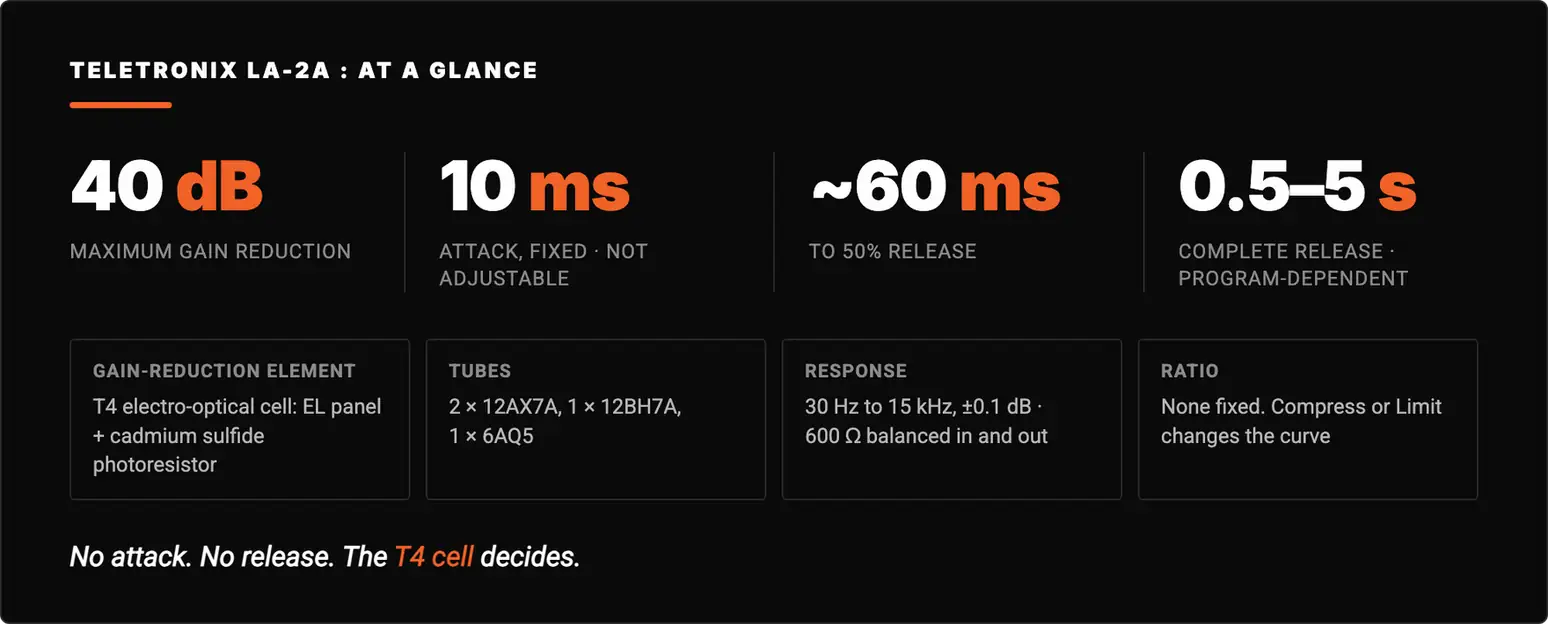
The published specification, from Universal Audio’s own manual, reads: up to 40 dB of gain reduction, 40 dB ±1 dB of gain, frequency response within ±0.1 dB from 30 Hz to 15 kHz, 600-ohm balanced input and output, and a tube complement of two 12AX7A, one 12BH7A, and one 6AQ5. The original Teletronix document is archived at the Library of Congress.
The LA-2A does not reduce gain with a transistor or a tube. It uses light, and that single design decision explains almost everything about the compressor’s character.
Imagine a dimmer switch in a dark room. When a loud signal arrives, the room gets brighter. A light-sensitive panel on the opposite wall notices the change and turns down the volume accordingly. The speed at which the panel responds, and the speed at which it stops responding once the light fades, is a physical property of the materials involved. You cannot override it with a knob.
That is, in mechanical terms, what happens inside the T4 opto cell.
The T4 is the electro-optical gain reduction element Teletronix designed for the LA-2A. It contains two physically separate components: an electro-luminescent panel that glows in proportion to the voltage driving it, and a cadmium sulfide photoresistor sitting adjacent to it. As the panel brightens, the photoresistor’s resistance falls. That photoresistor forms the bottom leg of a voltage divider in the audio path, so a drop in its resistance is a drop in level. When the light dims, the resistance recovers, and gain is restored.
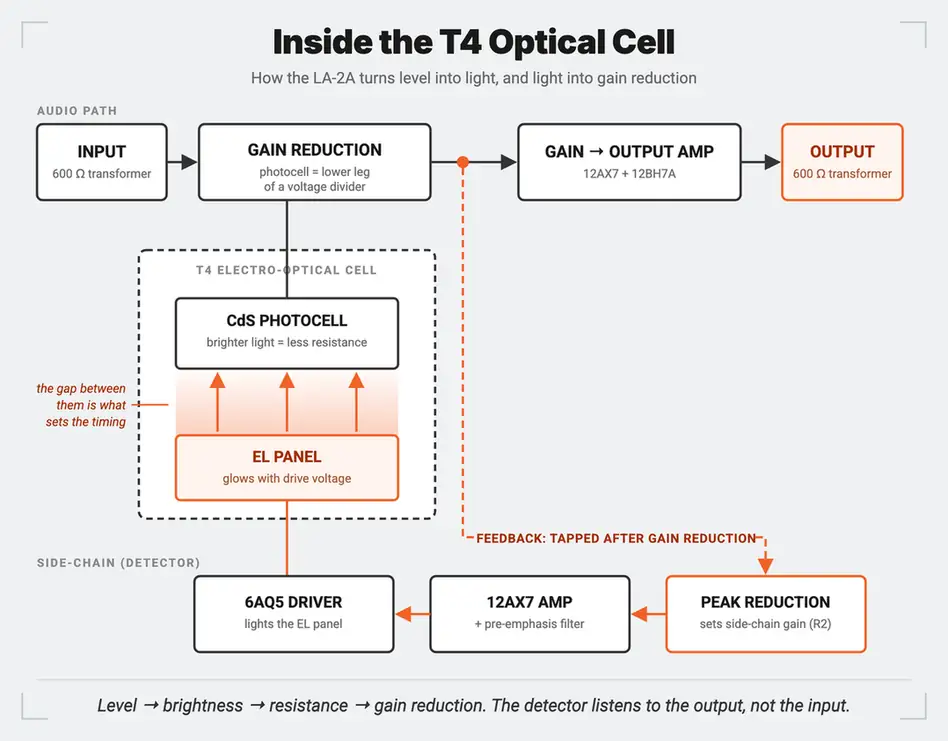
The physical separation is the key detail. The panel and the resistor are adjacent objects with a gap between them. That gap means the gain reduction relationship is not instantaneous, not perfectly linear, and not symmetrical on the way in and out. Cadmium sulfide’s material properties determine the attack and release timing. Teletronix did not add attack and release controls because the T4 cell’s natural behavior was musically appropriate. The decision was not an oversight. It was the design.
Here is the part most descriptions of the LA-2A leave out. The LA-2A is a feedback compressor. The signal driving the side-chain is taken after gain reduction, not before it.
So the electro-luminescent panel is not glowing in proportion to what arrives at the input. It is glowing in proportion to what has already left the gain reduction stage. The circuit is measuring its own output and correcting toward a target, rather than reacting to a signal it has not yet processed. A feed-forward compressor sees a peak coming and clamps it. The LA-2A hears its own output drifting loud and eases it back down.
A feedback detector cannot overshoot, because it never reacts to a peak it has not already passed. That is a large part of why the LA-2A is so hard to catch in the act.
Because the T4 cell already made those decisions, and the numbers behind them are unusually specific.
Attack is about 10 milliseconds. That is genuinely quick. Teletronix chose an electro-luminescent panel over the neon and incandescent lamps used in earlier optical designs precisely because it lit fast, and the manual’s own specification sheet calls the result a very fast attack for its era. But set it next to a Universal Audio 1176, whose attack is continuously variable from about 20 to 800 microseconds, and 10 milliseconds is a different world (see 1176 explained.) The 1176 clamps a transient before it fully exists. The LA-2A lets the leading edge through and closes around what follows. The attack reads as smooth rather than aggressive: you hear the note start, then you hear it settle.
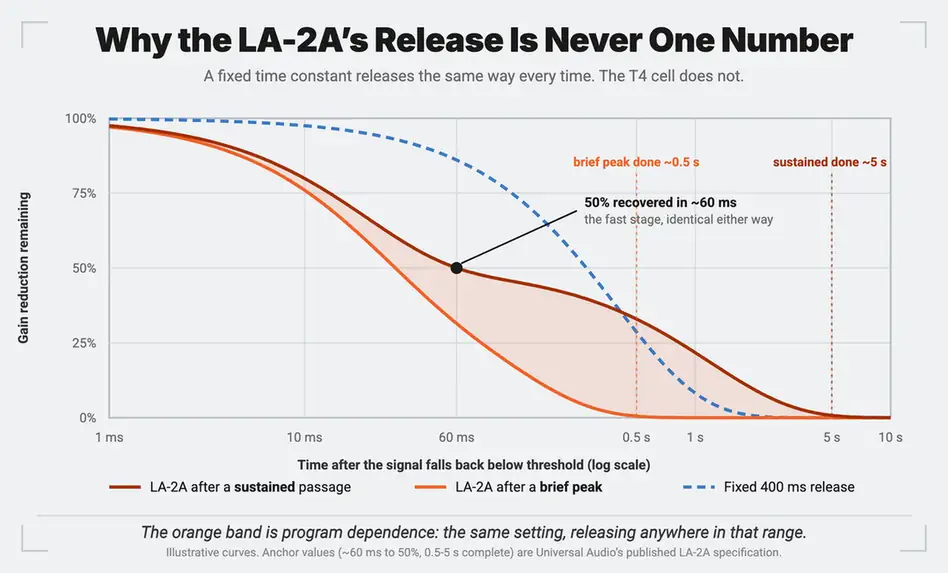
Release happens in two stages. After the light is removed, the cadmium sulfide cell recovers quickly to roughly half of its off-resistance, in about 40 to 80 milliseconds. The remainder can take as long as several seconds. Universal Audio publishes it as approximately 0.06 seconds for 50% release, then 0.5 to 5 seconds for complete release, depending on how much reduction preceded it.
That second number, the one with a range instead of a value, is the whole story.
The LA-2A’s release time is not a fixed number. It changes with the content, specifically with the history of what has been playing through the cell in the moments before.
Think of the T4 cell as retaining a memory of recent brightness. A brief, loud peak lights the panel and dims quickly when it passes, so the cell recovers near the fast end of its range. A sustained loud passage keeps the panel illuminated, and when that signal subsides the cadmium sulfide takes noticeably longer to let go. Universal Audio’s engineering documentation calls this the “memory” of the cell, and states the behavior plainly: the release is slower if the unit has either been in compression for a while or the amount of compression is large.
Program dependence is not a marketing word on the LA-2A. It is a measurable property of cadmium sulfide, and it spans an order of magnitude, from half a second to five.
This is why the same Peak Reduction setting behaves differently on a whispered verse and a belted chorus without you touching anything.
This is where the LA-2A is most often misdescribed, and where it differs most sharply from every compressor with a threshold knob.
Peak Reduction does not set the threshold. The LA-2A’s threshold is fixed. Peak Reduction is a potentiometer that controls the gain of the side-chain circuit. The more side-chain gain you apply, the earlier the detector reaches the fixed threshold, so you get a lower effective threshold and more gain reduction from a single control. The 1176 solves the same problem the opposite way, with a fixed threshold and an Input control that changes the level hitting the detector.
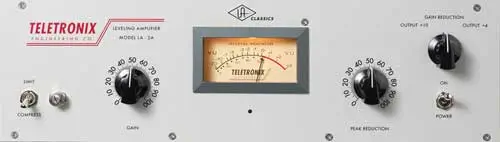
Gain does not affect the compression at all. It is a make-up output control, and the manual is explicit about the order of operations: set Peak Reduction for the compression you want, then set Gain for the level you want.
Compress and Limit changes the shape of the curve. In Compress, the curve is gentler and the effective ratio is lower. In Limit, the ratio is higher. Note what is missing: there is no ratio number anywhere on an LA-2A, because there is no fixed ratio. The slope moves with level, which is another reason the unit tracks a performance instead of enforcing a rule on it.
Because the dial markings on Peak Reduction are an arbitrary 0 to 100 scale with no dB mapping, set it by the meter, not by the number. Switch the meter to gain reduction and dial in the dB you want.
“Musical” is not a compliment. It is a mechanism. The LA-2A earns the word through a specific, demonstrable relationship between its gain reduction behavior and the human voice’s natural dynamic envelope.
A fixed-time-constant compressor forces the engineer to negotiate one release setting across a whole performance. Set it fast enough for the verse and it pumps on the chorus. Set it slow enough for the chorus and it ducks the verse. The LA-2A does not negotiate. After a belted chorus the cell has been charged and releases slowly. When the vocalist returns to a quiet verse, the cell is in a lower-compression state and treats the lighter phrasing lightly. The compressor moves with the music.
That is what engineers mean when they say “musical”: the release time is a function of the performance, not of a knob.
The LA-2A’s character is defined by a 10-millisecond attack and a release that stretches with sustain, so it belongs on sources where the envelope carries the expression.
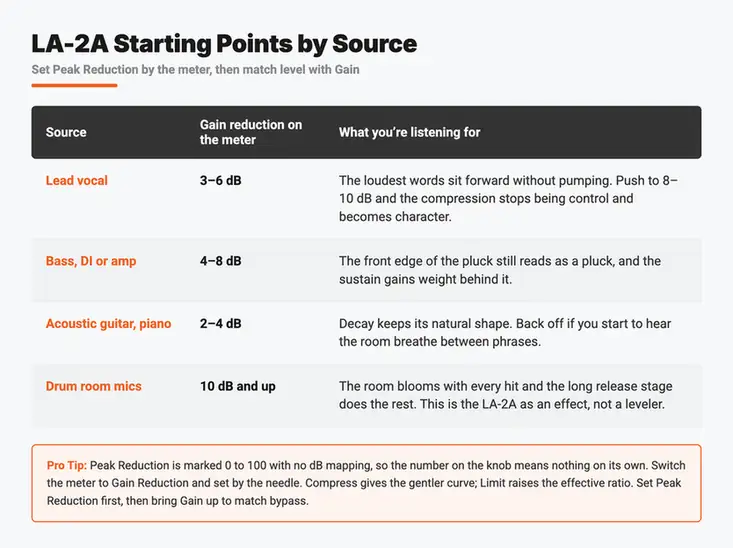
Lead vocals. The primary application, and the reason most LA-2As exist. Start in Compress with 3 to 6 dB of gain reduction on the loudest words, then bring Gain up to match bypass. Push to 8 or 10 dB and the compression stops being control and starts being character. Universal Audio’s own documentation quotes Mike Shipley (Def Leppard, Shania Twain) describing cranking an LA-2A on a vocal to the point where you almost want to put tape over the meter. It is a legitimate sound.
Bass, DI or recorded. Excellent for level consistency across a part. The 10-millisecond attack lets the front edge of a pluck through before the cell closes, so you keep articulation and gain sustain. 4 to 8 dB on the loudest notes is a useful window.
Acoustic guitar and piano. The slow tail of the two-stage release leaves decay shape intact rather than pumping it back up. Keep it gentle, 2 to 4 dB, or you will hear the room breathe.
Room mics on drums. Push it. 10 dB or more of gain reduction blooms the room with every hit and the long release stage does the rest. This is the LA-2A as an effect, not as a leveler.
If you want the fast, aggressive end of the dynamics spectrum instead, that is an 1176 conversation. We covered the whole comparison in 1176 vs. LA-2A on Vocals, including why running the 1176 first and the LA-2A second is the classic order. For a broader survey, see Best Analog Compressors for Studio-Quality Vocals, and for the other great tube-optical vocal compressor, the Tube-Tech CL 1B.
The LA-2A did not have a single production run under a single owner. Three versions were built between 1965 and 1969, as the company changed hands twice. Teletronix was sold to Babcock Electronics in 1965. In 1967, Bill Putnam’s Studio Electronics acquired Babcock’s broadcast division, shortly before the company was renamed UREI. Production ended around 1969. Universal Audio reintroduced the LA-2A in 1999, and the current unit is a hand-wired reproduction of that circuit. The optical approach outlived the LA-2A itself in the solid-state LA-3A and LA-4.
The more practical variation is the one inside each unit. The T4 cell is a physical component with aging electro-luminescent material, and the tubes fatigue at their own rate. Engineers have always observed that LA-2As vary more from unit to unit than 1176s do, and both of those parts are why.
Which is why the cell is not something we leave to chance. Access Analog uses Kenetek T4B opto cells in both of our units. These are custom-built, premium replacement opto-attenuator modules. (T4B is the module designation for the optical cell used in the LA-2A and LA-3A.)
There is no universal LA-2A sound. There is the sound of a specific unit, on a specific day, with a specific cell in it.
Which is a real argument for hearing one before you buy one.
Learn more about a modern optical stage with variable attack and release.
Two Universal Audio LA-2A units run on the Access Analog rack, both available for real-time processing through the Analog Matrix plugin directly from your DAW.
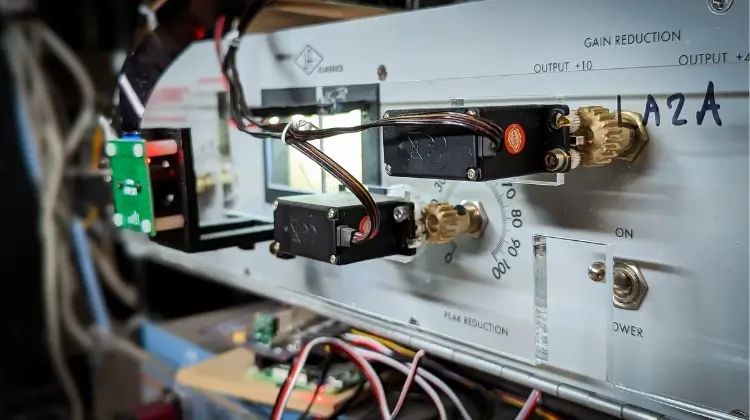
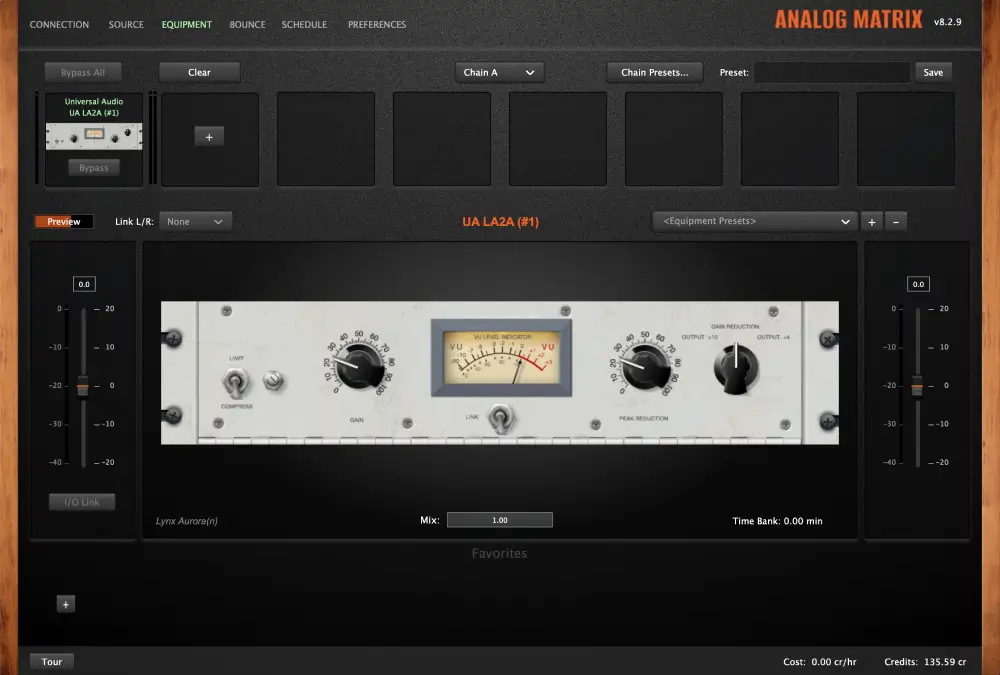
Two units means you can put a vocal through one, run a different source through each, or take both for a stereo pass. Robotic recall makes the matching part easy. Setting two LA-2As to genuinely identical positions by hand is difficult. Setting them from a saved session is not.
Real gear. No emulations.
Both units run continuously, powered and thermally stable, so you connect to a unit at operating equilibrium rather than a cold one. Your knob and switch positions are saved with the session and robotically recalled, so a total recall on this compressor is two knob positions and a switch. The Analog Matrix plugin is a free download, new accounts start with free credits so you can hear the rack on your own material first, and you reserve time by the block or run on demand. Current rates are listed on the Access Analog gear prices page. You can reserve LA-2A #1 or LA-2A #2 directly, or browse the full compressor rack.
The LA-2A gives you only two controls that touch the sound because a cadmium sulfide photoresistor turned out to be a better timing engineer than most humans. The attack is fixed at about 10 milliseconds because that is how fast an electro-luminescent panel lights. The release stretches from half a second to five because that is how cadmium sulfide forgets. The detector listens to the output instead of the input, so the unit corrects rather than clamps. None of that is magic, and all of it is why a sixty-year-old broadcast leveler is still the first thing many engineers put on a vocal.
You do not dial in an LA-2A. You point it at a performance and let the chemistry keep up.
Hear what a real T4 cell does to your own vocal, from your own DAW.
What is the Universal Audio LA-2A?
The Universal Audio LA-2A is a tube-driven electro-optical compressor and leveling amplifier that has been a studio benchmark since 1965. It uses a T4 electro-optical gain reduction element, and only two of its controls affect the sound: Peak Reduction and Gain. A Compress / Limit switch changes the shape of the curve, and a third knob selects what the meter reads. Up to 40 dB of gain reduction is available. Engineers reach for it because of the warm, natural way it levels a signal without choking the performance.
Does the LA-2A have attack and release controls?
No. The LA-2A’s attack and release are set by the physical behavior of its T4 optical cell and cannot be adjusted. Attack is roughly 10 milliseconds. Release is program-dependent and happens in two stages: about 60 milliseconds to recover half the gain reduction, then anywhere from 0.5 to 5 seconds for the rest, depending on how much compression preceded it. That is why the front panel needs only Peak Reduction and Gain, and why the LA-2A is famously hard to get a bad sound out of.
What is optical (opto) compression?
Optical compression uses a light source and a photocell to control gain. As the signal gets louder the light gets brighter, and the photocell’s resistance falls, attenuating the signal. Because the photocell’s recovery depends on how long and how brightly it was lit, opto compression is naturally smooth and program-dependent. That is a different approach from FET or VCA compression, and it is why opto compressors are so prized on vocals and bass.
What is the LA-2A’s compression ratio?
The LA-2A has no fixed ratio and no ratio control. The Compress position gives a gentler curve and a lower effective ratio; the Limit position gives a higher one. The slope varies with signal level rather than holding a set number, which is part of why the unit tracks a performance instead of enforcing a fixed rule on it.
How much gain reduction should you use on an LA-2A?
Set it with the meter, not the dial markings, since Peak Reduction uses an arbitrary 0 to 100 scale with no dB mapping. Switch the meter to gain reduction and aim for 3 to 6 dB on the loudest words of a lead vocal, 4 to 8 dB on bass, and 2 to 4 dB on acoustic sources where you want the decay left alone. Beyond about 8 to 10 dB the LA-2A stops being a leveler and becomes a character effect, which is a legitimate and well-used sound on vocals and drum room mics.
What is the LA-2A best for?
The LA-2A is best known as one of the greatest vocal compressors ever made, sitting a lead vocal forward with warmth and almost no audible pumping. It also shines on bass, adding round, consistent body, and works beautifully on acoustic guitar and piano. Its program-dependent response suits sustained sources more than fast, transient-heavy material.
What’s the difference between the LA-2A and the 1176?
The LA-2A is a tube optical compressor with a roughly 10-millisecond attack, while the 1176 is a solid-state FET compressor that attacks in about 20 microseconds. They sit at opposite ends of the dynamics spectrum. The LA-2A smooths and levels with gentle, program-dependent compression and tube warmth, ideal for vocals and bass. The 1176 reacts fast and aggressively, which is what makes it good at catching transients and adding punch. Many engineers run them in series, the 1176 to grab peaks and the LA-2A to smooth and glue. We compared them in depth in 1176 vs. LA-2A on Vocals.
Is this the real LA-2A hardware or an emulation?
This is the actual LA-2A hardware: real tubes, a real T4 optical cell, and real transformers in the signal path, not a model of them. With Access Analog you control the physical unit in real time, straight from your DAW, through the Analog Matrix plugin. Real gear. No emulations.
Can I save and recall my LA-2A settings at Access Analog?
Yes. Access Analog robotically recalls your settings, so every knob and switch position on the LA-2A can be saved and brought back exactly. You can store the LA-2A on its own or as part of a whole signal chain and reload it later for revisions. Because only Peak Reduction, Gain, and the Compress / Limit switch affect the sound, a complete recall of an LA-2A is three values.
How much does it cost to use the LA-2A at Access Analog?
You reserve the LA-2A in blocks of 15, 30, or 60 minutes, or use it on demand through credits or a subscription, paying only for the time the unit is actually inserted in your chain. New accounts start with free credits, so you can hear the real hardware on your own material before committing to anything. Current rates for every unit are listed on the Access Analog gear prices page.