Mastering with Analog Gear: What You Really Need to Know

Table of Contents

An Introduction To Mastering with Analog Gear

Analog mastering is where good mixes become great, adding depth, glue, and musical “finished record” polish through the natural behavior of real circuits (tubes, transformers, and analog gain stages).

Industry-standard analog processors (discussed in this article) — along with purpose-built, specialty mastering rigs — are trusted for their ability to shape tone and density in a way many engineers find more effortless and cohesive than purely digital workflows.

With Access Analog, you can master with this professional gear online, directly from your DAW, achieving authentic analog sound with full recall capability.

Why Analog Mastering Still Defines Commercial Sound

Listen to any commercially successful record from the past five decades, and you’ll notice a shared quality: a sonic polish that feels both powerful and effortless. That finish comes from mastering, and more often than not, from analog gear.

While digital tools have revolutionized music production, analog mastering remains the gold standard for producing professional-grade masters. There’s a reason Grammy-winning engineers keep reaching for tube EQs, transformer-coupled processors, and optical compressors when polishing final mixes.

Mastering with analog gear isn’t about nostalgia; it’s about physics. Real circuits deliver harmonic complexity, smooth transient response, and dimensional depth that algorithms can approximate but never fully replicate. The result is masters that translate across playback systems and connect emotionally with listeners.

What Analog Gear Adds to Mastering

Knowing the unique qualities that analog processing brings helps us understand why expert engineers put so much effort into hardware setups. It’s these special analog properties that give professionally mastered records their distinct signature sound.

Harmonic Richness from Tubes and Transformers

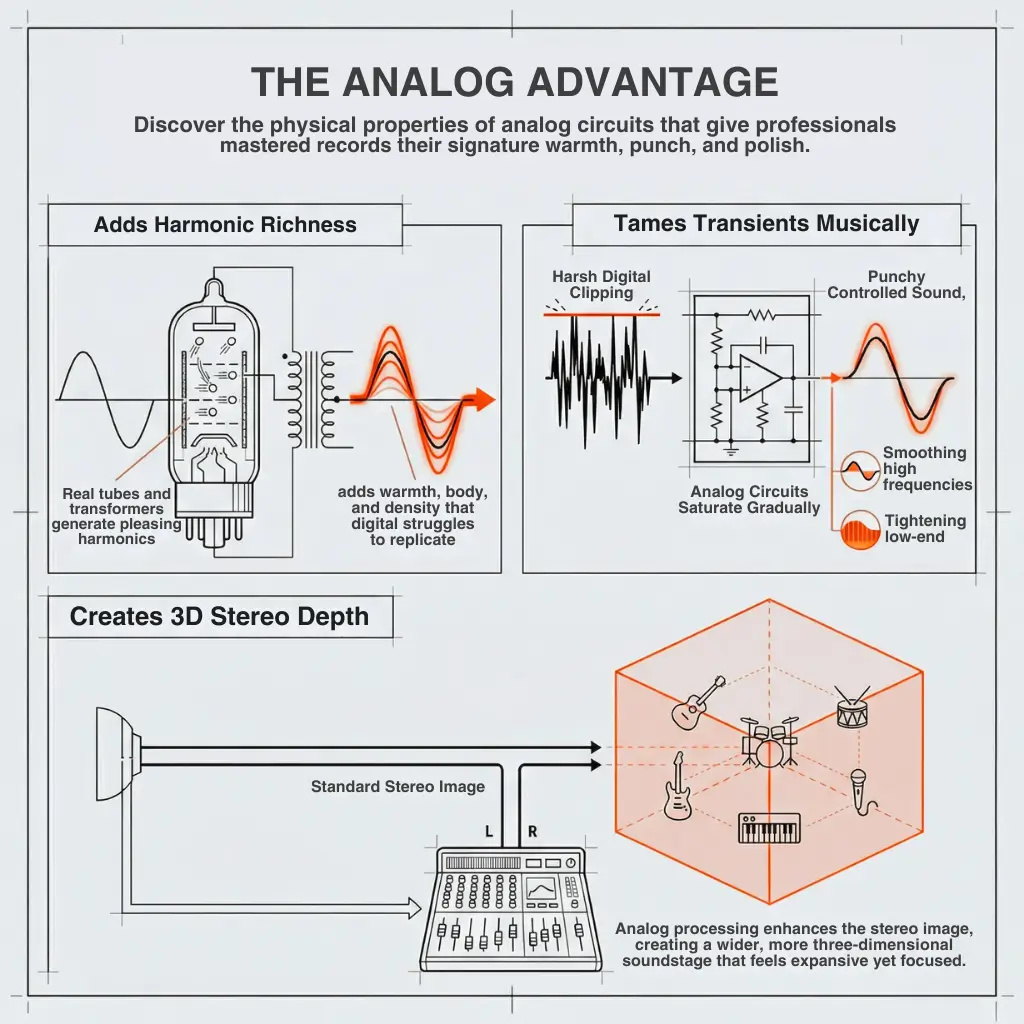
Vacuum tubes and audio transformers produce pleasing harmonic distortion that fills out the frequency spectrum. As a signal passes through tube circuitry, even-order harmonics are added, creating warmth and body without muddiness.

Transformers contribute their own character through magnetic saturation, adding subtle low-end weight and high-frequency silk. This harmonic generation occurs continuously and organically across all frequencies, creating complexity that digital emulations struggle to match.

Smoother Highs, Tighter Lows, and Natural Dynamics

Analog circuits handle transients differently than digital systems. When a signal exceeds an analog circuit’s headroom, it saturates gradually rather than clipping harshly. This natural compression tames peaks musically while preserving punch.

High frequencies round off smoothly, recalling the behavior of analog tape. The low end gains definition and weight without becoming boomy.

A Wider, More Cohesive Stereo Image

Analog processing often enhances stereo width and depth, creating a three-dimensional feel. Transformers can subtly shift phase relationships between channels, creating a sense of space. Tube circuits introduce micro-variations that prevent the sterile, flat quality sometimes associated with purely digital masters.

The cumulative effect is a soundstage that feels both expansive and focused.

Mastering with Analog Gear

Transformers and tube stages don’t just “EQ.” They add harmonics and change the way the signal behaves at different levels, which can create the sense of depth and density people describe as warmth.

Analog stages can subtly round transients and shift perceived balance in a way that feels controlled rather than clinical, especially when you’re chasing loudness without harshness.

Some mastering hardware is purpose-built to enhance width and space (without “phasey” side-effects when used tastefully), which helps mixes feel bigger while staying anchored.

Essential Analog Mastering Gear

Though many analog processors are up to the task, certain ones have achieved legendary status in mastering circles. Here are four proven workhorses relied on by professionals worldwide.

Manley Massive Passive: Musical, Transparent EQ

MANLEY MASSIVE PASSIVE

The Manley Massive Passive mastering staple because its passive EQ design paired with tube make-up gain encourages broad, musical tone-shaping. It’s great for air, weight, and gentle mix correction.

The Manley Massive Passive takes a different approach to equalization. Its passive topology uses no active components in the EQ circuit, with all-tube makeup gain stages restoring signal level. The result is organic, musical curves that enhance rather than surgically dissect. Unlike conventional EQs, where bands add mathematically, the Massive Passive’s parallel design allows overlapping bands to interact musically. This design delivers massive high-frequency boosts without sibilance and low-end enhancement without mud.

SSL Fusion: Stereo Width, Harmonic Drive, and Polish

SSL FUSION

The Fusion is an all-analog stereo processor designed for hybrid workflows, offering multiple color stages that can add weight, space, and “record-ready” finish on the mix bus or stems.

The SSL Fusion integrates five analog processing tools into a single 2U unit designed for modern hybrid workflows. Its Vintage Drive circuit delivers harmonic saturation from subtle thickening to aggressive distortion. The Violet EQ offers two-band shelving equalization for broad tonal shaping. The HF Compressor tames harsh high frequencies with tape-like smoothing, while the Stereo Image enhancer uses true analog mid-side processing to widen or narrow the stereo field. A custom transformer circuit adds low-frequency warmth and high-frequency sparkle.  For mastering engineers, the Fusion delivers final-stage polish with remarkable flexibility.

Rupert Neve Designs MBT: Transformer Warmth and Punch

RND MBT

Built around Rupert Neve Designs transformers, the Master Bus Transformer is designed to sweeten, enhance, drive, widen, and transform mixes and masters with musical coloration options.

The Master Bus Transformer represents the culmination of Rupert Neve’s six decades of analog circuit design philosophy. Built around custom transformers and Class A amplification, the MBT offers a suite of coloration tools, including a 2-band shelf EQ with gentle slopes and minimal phase shift, an optical Color Comp compressor that accentuates the musical characteristics of opto-cell compression, a Width section for stereo enhancement, and the advanced Super Silk circuit. Super Silk provides independent control over Red (low/low-mid) and Blue (high-mid/high) harmonic modes, plus Zener Drive for more aggressive saturation. The result is everything from subtle sweetening to transformative tonal reshaping.

Black Box HG-2: Harmonic Saturation for Depth

BLACKBOX HG2

The Black Box HG-2 is a mastering favorite for controlled tube harmonic content, featuring high-voltage pentode and triode stages plus parallel saturation with a mix control—great when a mix feels flat or sterile.

The Black Box Analog Design HG-2 is a stereo mastering processor that adds saturation, harmonics, and natural compression. It uses custom input transformers feeding two paths: a main signal path through 6U8A Pentode and Triode tube stages in series, and a parallel saturation circuit with 12AX7 tubes. The three-way frequency selector lets you saturate only the low-mids, the full bandwidth, or the high frequencies. The Pentode generates musical even-order harmonics, while the Triode adds grittier third-order harmonics. The interplay between these stages creates everything from subtle harmonic enhancement to full saturation, making thin mixes sound fuller and adding dimension to flat-sounding masters.
Access Analog's Mastering Chains

Access Analog offers two professionally designed mastering chains, each crafted by Grammy-winning mastering engineers and available through the Analog Matrix plugin.

The Magic Garden Mastering Chain

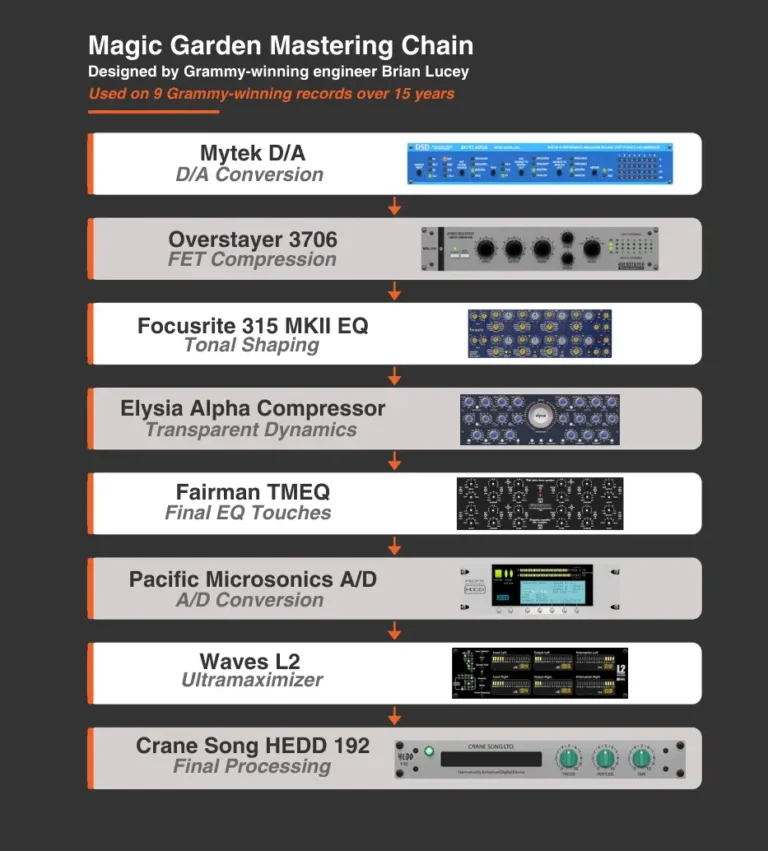
Designed by Grammy-winning mastering engineer Brian Lucey (Depeche Mode, The Black Keys, Arctic Monkeys, Liam Gallagher), the Magic Garden Chain has been used on nine Grammy-winning records and thousands of other releases over 15 years. 

The signal path includes Mytek D/A conversion feeding into an Overstayer Model 3706 for FET-style compression, a Focusrite 315 MKII EQ for tonal shaping, an Elysia Alpha Compressor for transparent dynamics control, and a Fairman TMEQ for final EQ touches, all captured through Pacific Microsonics A/D conversion with a Waves L2 Ultramaximizer and Crane Song HEDD for final processing.

This chain delivers warmth, punch, and polish with remarkable musicality.

Note: This is a complete mastering rig in the cloud – a curated signal path rebuilt for Access Analog.


The Infrasonic Mastering Chain

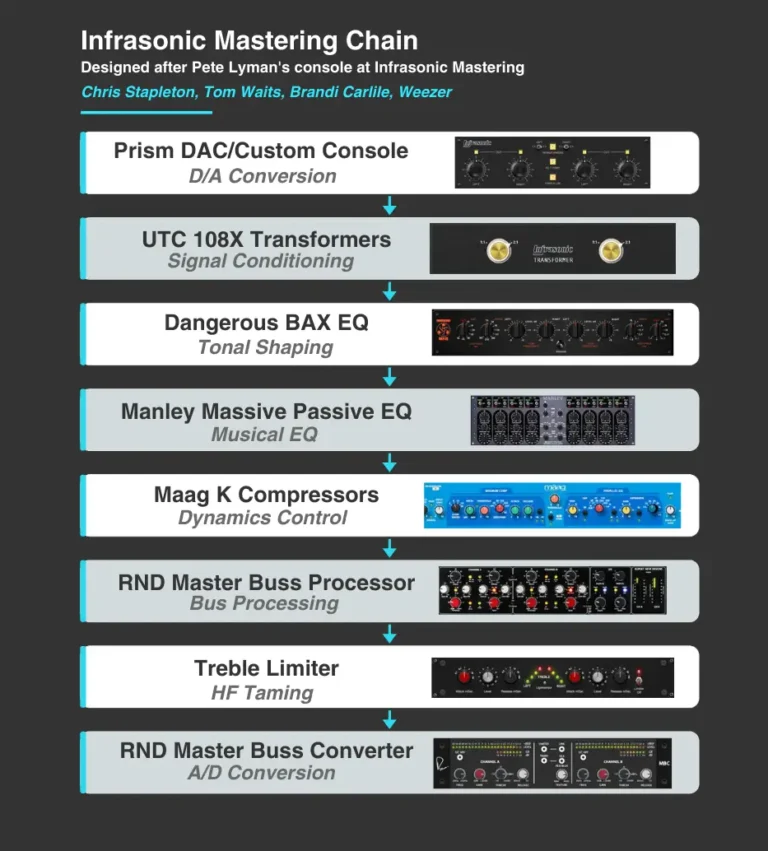
The Infrasonic Mastering Chain is designed after Pete Lyman’s mastering console at Infrasonic Mastering (Chris Stapleton, Tom Waits, Brandi Carlile, Weezer). This chain integrates gear from MAAG, Manley, and Rupert Neve Designs via a custom insert console. It uses Prism Sound Lyra 2 D/A conversion and the Rupert Neve Designs Master Bus Converter for A/D. This setup excels at both transparency and saturation, making it versatile for mastering diverse genres. Whether you need subtle enhancement or bold character, the Infrasonic chain delivers professional results.

Designed for both mastering and 2-bus mix finishing, with a console flow. It also has dedicated conversion and matching the hardware sample rate to your DAW to avoid sample-rate conversion in the path.

Note: This is a complete mastering rig in the cloud – a curated signal path rebuilt for Access Analog.


Analog vs. Digital Mastering

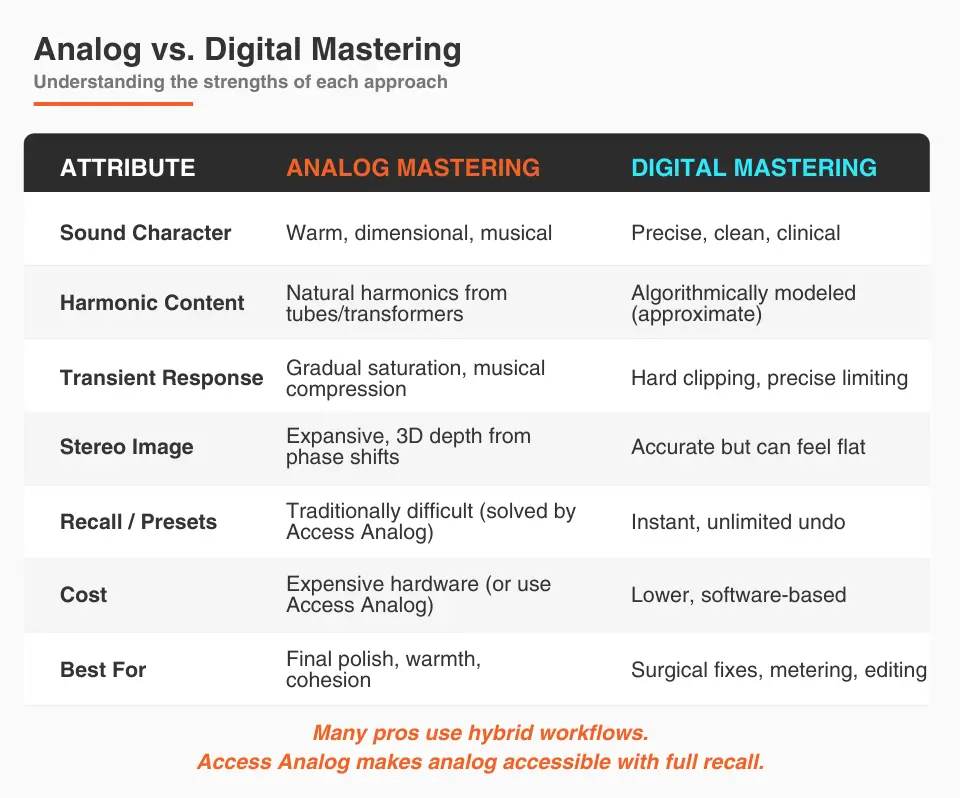
Analog and digital mastering each offer distinct advantages. Understanding how they differ – sonically, practically, and in workflow – can help you choose the right approach for each track and make more confident mastering decisions.

Digital Mastering: Fast and Flexible, but Often Clinical

Digital mastering offers several advantages. Settings can be saved and recalled instantly (note that Access Analog offers this for real analog gear). Unlimited undo makes experimentation risk-free. Processing is precise and repeatable. Costs are lower because there’s no expensive hardware to purchase or maintain.

For certain genres, particularly electronic music that evolved on computers, a clean digital aesthetic may be desirable. However, overuse of digital processing can sound sterile or clinical. Stacking multiple plugins can introduce artifacts that accumulate throughout the signal chain.

Despite remarkable advances in modeling, plugin emulations cannot fully capture the nonlinear behavior and harmonic complexity of real analog circuits.

Analog Mastering: Musical, Dimensional, and Emotionally Engaging

Analog mastering offers something distinct: the harmonic richness, smooth transient handling, and dimensional depth that define commercial masters. As a signal passes through real tubes, transformers, and analog circuits, subtle imperfections add life. These aren’t flaws but features, contributing warmth that makes music feel more human and emotionally resonant. Analog processing handles dynamics musically, responding to transients in a natural way.

The cumulative effect across a mastering chain creates cohesion and polish that listeners recognize, even if they can’t articulate exactly what they’re hearing. The trade-offs include higher hardware costs, the inability to save settings (a problem solved with Access Analog), and a workflow that requires more deliberate decision-making.

Real-World Takeaway

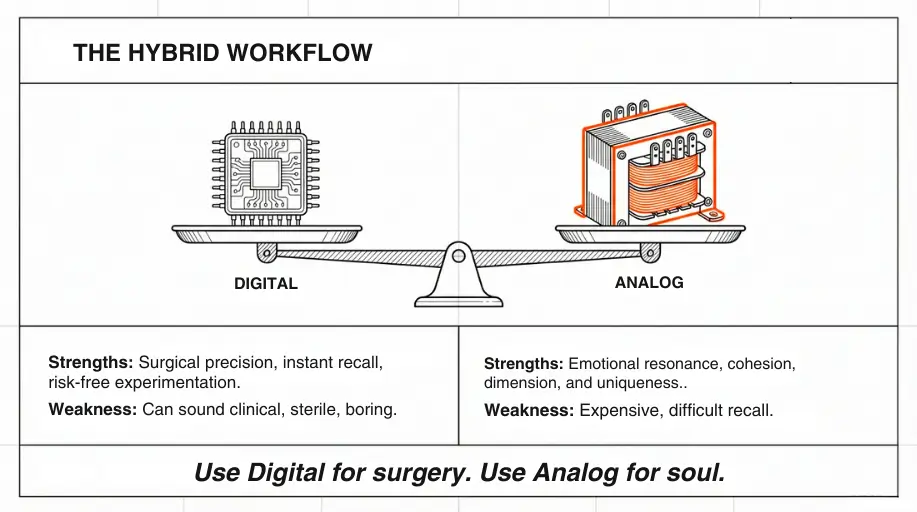
Many professional mastering engineers use hybrid workflows, combining analog hardware for character and cohesion with digital tools for surgical corrections and precise metering.

Access Analog makes this approach accessible to everyone by providing cloud-based access to real analog gear with full recall.

Pro Tips for Analog Mastering

Getting the most from analog mastering gear requires a different approach than working purely in the box.

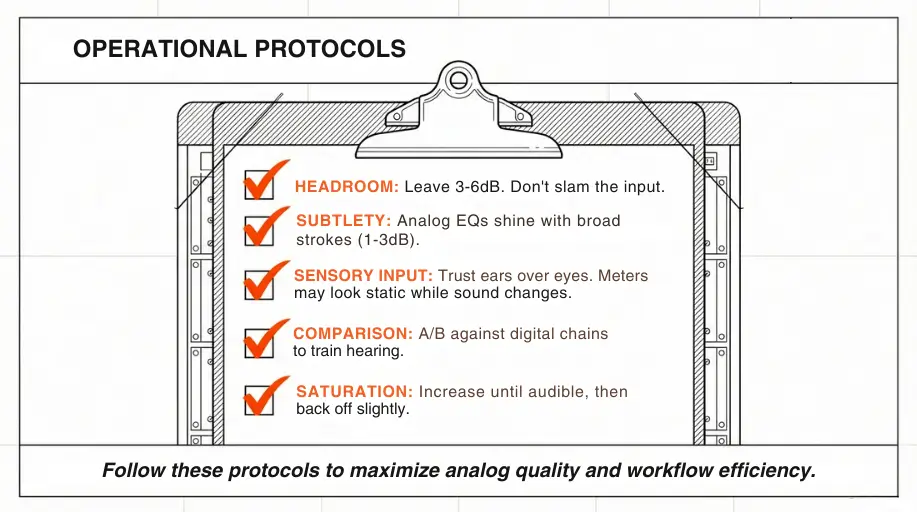
Keep EQ moves subtle.

Analog EQs shine with broad, gentle curves. Use 1-3 dB boosts and cuts for musical enhancement rather than surgical correction. The Massive Passive, for example, delivers magic with subtle moves that would be nearly invisible on a digital EQ.

Leave 3-6 dB of headroom.

Analog gear needs headroom to operate optimally. Masters that arrive already slammed to 0 dBFS leave no room for the subtle saturation and dynamics processing that analog excels at. Export your mix with peaks around -6 dBFS for best results.

Compare analog vs. plugin chains to train your ear.

Process the same mix through both approaches and listen critically. This comparison builds awareness of what real analog adds, helping you make better decisions in future sessions.

Use saturation intentionally.

Harmonic saturation should enhance, not overwhelm. Start with conservative settings on the Vintage Drive or tube stages, then increase until you hear the effect, then back off slightly.

Trust your ears over your eyes.

Analog processing often shows minimal readings on meters but sounds dramatically improved. Make decisions based on what you hear, not what the meters show.

Professional Sound Without the Studio

Analog mastering has defined the sound of commercial music for decades. The warmth, dimension, and musical cohesion that real hardware provides remain the benchmark for professional masters. For most producers, the cost of building an analog mastering chain has made this quality inaccessible.

Access Analog changes the equation. With over $300,000 worth of premium gear available through the Analog Matrix plugin, you can master using the same equipment as Grammy-winning engineers. Real circuits, real transformers, real tubes, processing your audio in real time with full recall capability.

You don’t need a full mastering studio to sound like one.

FAQs

What’s the difference between analog mastering and digital mastering?

Analog mastering processes audio through physical circuits, tubes, and transformers, adding harmonic richness, smooth transient response, and dimensional depth. Digital mastering uses software plugins that offer precision and recall but can sound clinical. Analog provides the warmth and musicality heard on commercial releases, while digital offers flexibility and cost savings. Many mastering workflows blend both.

What’s the best analog gear for mastering?

It depends on the goal, but here are a few recommendations: tone-shaping EQ (Massive Passive), finishing/color tools (SSL Fusion), transformer coloration (RND MBT), and harmonic depth (HG-2) are popular for mastering.

How much headroom should I leave before mastering?

A common guideline is 3–6 dB, but it’s not a strict rule. Prioritize avoiding clipping and maintaining a clean signal path so mastering moves behave predictably.

What order should my mastering chain be in?
There’s no single “correct” order, but a common approach is EQ → compression → (optional) saturation/stereo enhancement → limiting. Adjust as the mix needs.

How do I master with analog gear if I don’t own any hardware?

Access Analog provides cloud-based access to real analog mastering equipment. Download the free Analog Matrix plugin, create an account, and then process audio through actual hardware from your DAW. New accounts receive one free hour of access to try the service.

Does Access Analog use emulations or real hardware?

Access Analog uses 100% real analog hardware. The Analog Matrix plugin is not an emulation; it’s a portal that connects your DAW to physical gear. Every knob, switch, and parameter on the interface controls real equipment via robotic automation. Your audio is processed through genuine tubes, transformers, and analog circuits.

What about latency when mastering in the cloud?

Access Analog offers multiple options to manage latency, including standard servers and a dedicated AWS fast lane for optimal performance worldwide. For mastering (processing full mixes rather than individual tracks), latency is typically not an issue because you’re working offline rather than tracking. The platform also supports uploading audio for processing to reduce round-trip time.

Can I recall my analog mastering settings later?

Yes. This is one of Access Analog’s key advantages. Because the hardware is robotically controlled, your settings are saved within your DAW session and recalled instantly when you return. This solves the traditional analog recall problem that has historically made revisions time-consuming and expensive.

What formats and sample rates does Access Analog support?

Access Analog’s main gear library uses industry-standard 24-bit, 96kHz conversion with minimal jitter. The mastering chains feature premium converters expertly matched to the included hardware for optimal results.

Follow Us on Social Media