The Ultimate Guide to Understanding and Using a Bus Compressor: Everything You Need to Know

Table of Contents

Do I Need Bus Compression?

If your mix sounds like a bunch of great parts that still don’t feel like one record, you probably need bus compression. 

A bus compressor is the secret weapon for making your mix sound cohesive, polished, and professional. Bus compression is about balance, not brute force. It’s about gentle ratios, smart attack/release, and tasteful gain reduction to bring unity and energy to your mix.

In this guide, you’ll learn what a bus compressor is, why it matters, how the controls actually shape your sound, and practical settings for drums, vocals, and your mix bus.

We’ll also cover why real analog bus compressors tend to “glue” in a way plugins often struggle to mimic, and how you can run real hardware from inside your DAW using Access Analog.

Bus Compression: The Heart of a Polished Mix

There’s a reason virtually every professional mix engineer reaches for a bus compressor at some point in their process. It’s not about crushing dynamics or making things louder. It’s about creating that elusive cohesion, where every element feels like it belongs together, moving and breathing as one unified piece of music.

Bus compression is one of those techniques that separates amateur mixes from professional ones. When done right, it’s barely noticeable, yet its absence is immediately apparent. Your mix might have all the right elements perfectly balanced, but without that subtle glue holding everything together, it can still feel like a collection of separate tracks rather than a finished record.

What Is a Bus Compressor?

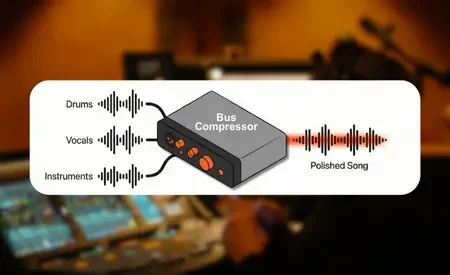
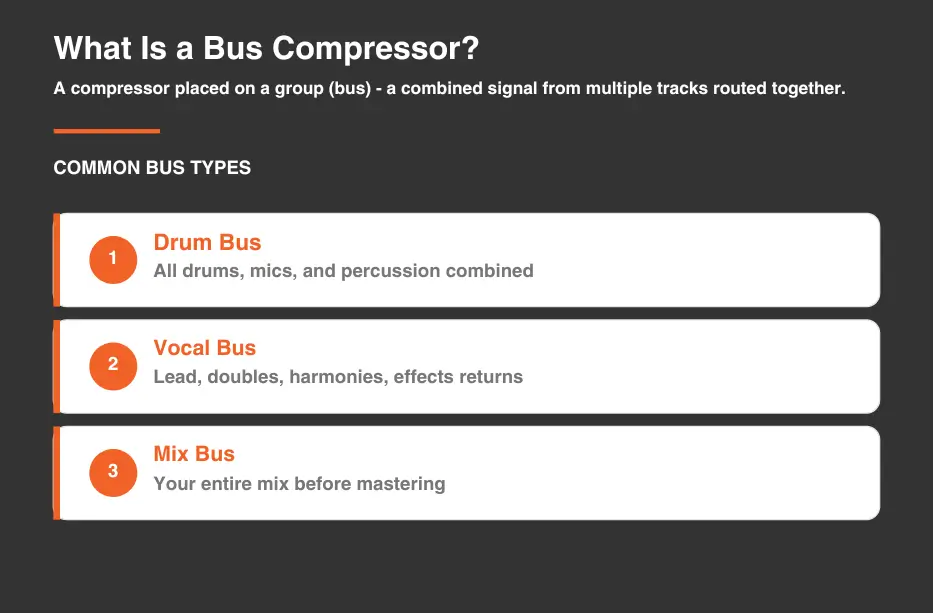
A bus compressor is simply a compressor placed on a group (bus) – a combined signal made from multiple tracks routed together.

Common examples:

  • Drum bus – all drum mics and percussion.
  • Vocal bus – lead, doubles, harmonies, vocal effects returns.
  • Mix bus/Stereo bus – your entire mix before mastering.
 

Instead of controlling dynamics on a single track, bus compression manages the relationship among multiple elements. Done well, it makes your mix feel unified, as if everything is playing in the same room.

What makes bus compression different from compressing individual tracks is that it affects how multiple elements interact dynamically. When a snare hits, it raises the overall level, which in turn affects how the compressor responds to the kick, the vocals, and everything else. This creates a subtle pumping and breathing that, when dialed in correctly, makes everything feel more musical and connected.

Why Use a Bus Compressor?

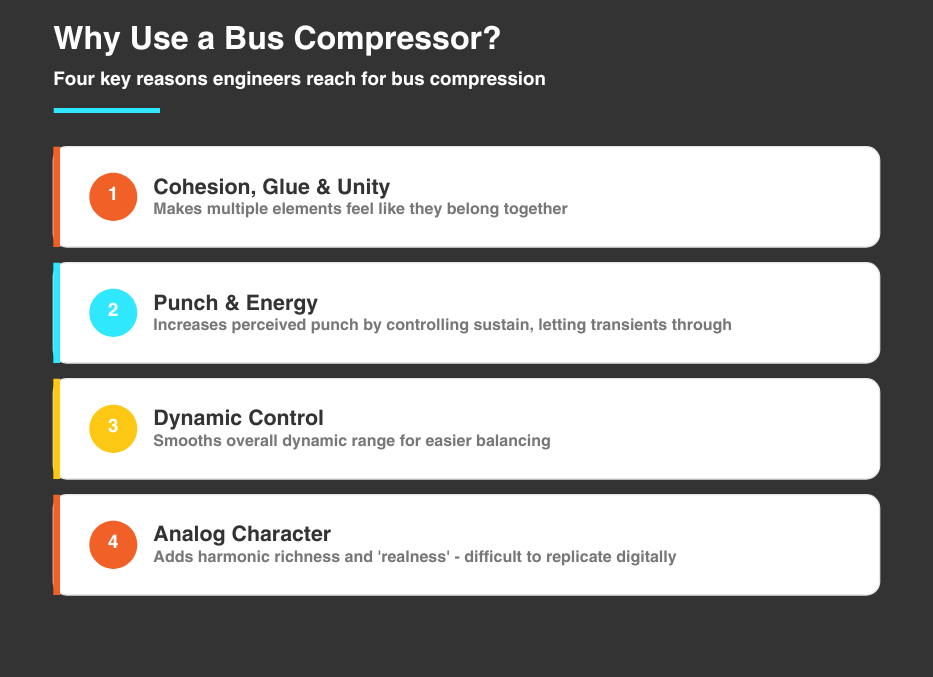
Understanding the “why” behind bus compression will help you use it more intentionally and effectively. Here are the key reasons engineers reach for a bus compressor.

1. Cohesion, Glue, and Unity

The primary purpose of bus compression is to make multiple elements feel like they belong together. When you have a drum kit recorded with eight different microphones, or a mix with dozens of tracks from different sessions and studios, bus compression helps unify these disparate elements into a cohesive whole.

2. Punch and Energy

Paradoxically, compression can make things feel punchier, not less so. By controlling the sustain and body of sounds while allowing transients through (with proper attack settings), bus compression can actually increase perceived punch and impact. The controlled dynamics create a sense of power and energy that’s hard to achieve any other way.

 3. Dynamic Control

Bus compression smooths the overall dynamic range of a group of sounds, making the mix easier to balance and more consistent across sections. This is especially valuable on the mix bus, where you want the quiet parts and loud parts to sit well together without constant automation.

4. Analog Character

Beyond the compression itself, analog bus compressors add harmonic character, subtle saturation, and a certain “realness” that’s difficult to replicate digitally. The transformers, tubes, or solid-state circuits in classic hardware units contribute tone even when barely compressing. This is where real analog hardware truly shines.

How Bus Compression Works: The Fundamentals

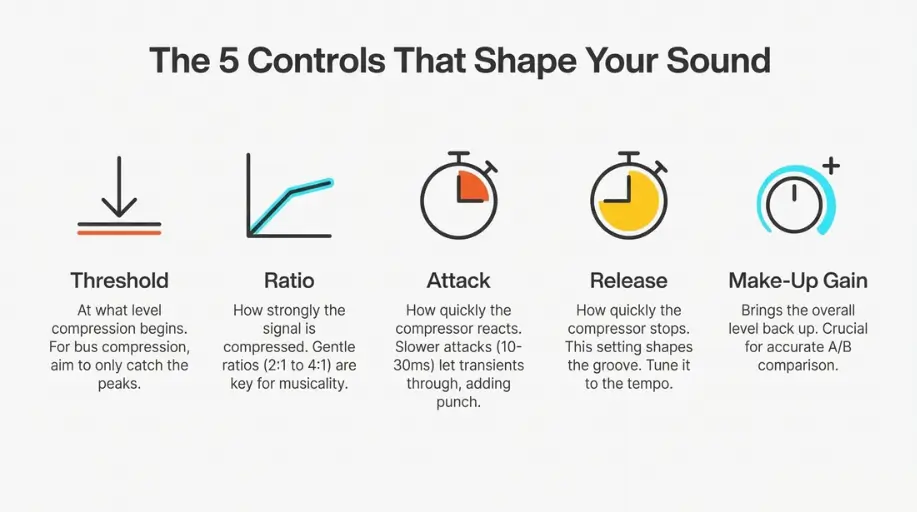
While different compressors may have additional features, these five parameters are universal.


Threshold

The threshold determines at what level compression begins. Signals below the threshold pass through unchanged; signals above it get compressed. On a bus compressor, you typically want the threshold set so that compression only engages on peaks, usually the louder transients. Setting it too low means constant compression with no breathing room.

For mix bus glue, the threshold often ends up at about 2–4 dB of gain reduction in loud sections.

Ratio

The ratio controls how strongly signals above the threshold are compressed. A 2:1 ratio means that for every 2 dB the signal exceeds the threshold, only 1 dB comes through. For bus compression, gentler ratios (2:1 to 4:1) are typically preferred to maintain musicality and avoid an over-compressed “squashed” sound.

Common bus ratios: 2:1 for subtle mix bus glue and 3:1 – 4:1 for drums or a more “worked” sound

Attack

Attack time determines how quickly the compressor responds once the signal exceeds the threshold. This is perhaps the most critical setting for bus compression. A slower attack lets transients punch through before compression kicks in, preserving impact. A faster attack clamps down immediately, controlling transients but potentially robbing the mix of punch.

Slower attack (10–30 ms) lets transients through – leading to more punch. / Faster attack clamps transients – smoother, but can feel smaller.

Release

Release time determines how quickly the compressor releases once the signal falls below the threshold. The release setting dramatically affects the groove and feel of your mix. Too fast, and you get audible pumping; too slow, and the compressor never fully recovers between transients, creating a flat, lifeless sound. Many engineers find that auto-release settings work beautifully for bus compression.

Make-Up Gain

Because compression reduces level, make-up gain lets you bring the output back up to match the input level. Always gain-match when A/B’ing. Louder usually sounds “better,” even when it’s worse.

Common Bus Types and Compressor Applications

While the principles of bus compression remain consistent, different buses call for different approaches:

Drum Bus

The drum bus is where many engineers first experience the magic of bus compression. Drums are inherently transient-heavy, making them ideal for compression that adds punch and cohesion.

Faster attack times (10-30ms) help control explosive transients, while medium release times keep the groove intact.

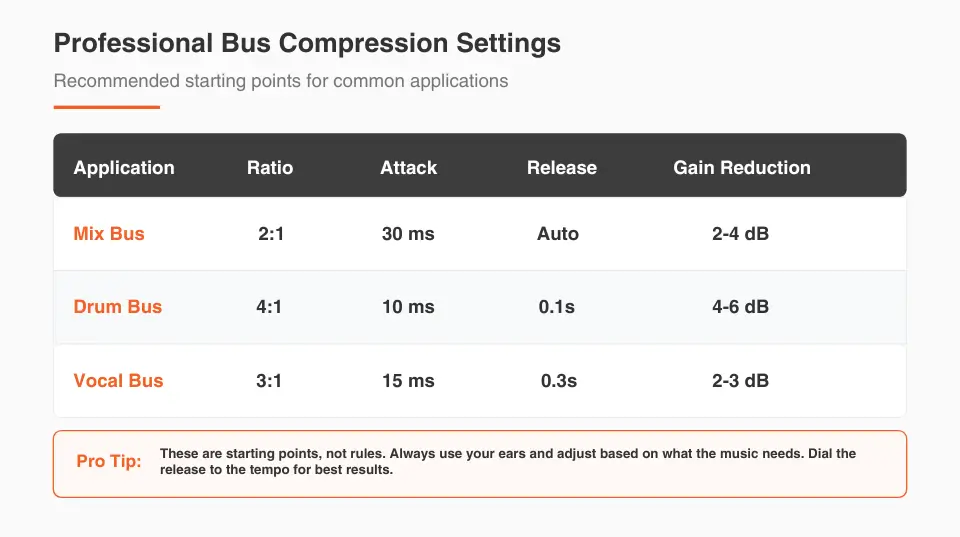
Moderate ratios (4:1) with 4-6 dB of gain reduction can transform a collection of drum tracks into a tight, powerful kit.


Professional Bus Compression Settings

Vocal Bus

When you have multiple vocal tracks (lead vocals, harmonies, doubles) bus compression helps them gel and sit consistently in the mix. Gentler settings work best here: lower ratios (2:1-3:1), medium attack times to preserve articulation, and moderate release times. The goal is cohesion without squashing dynamic expression.

Mix Bus (Stereo Bus)

The mix bus is where bus compression has its most profound and subtle effect. Here, you’re affecting the entire mix, so restraint is key. Light ratios (2:1), slower attack times (30ms+) to preserve transients, and auto-release settings are common starting points. The goal is 2-4 dB of gain reduction – enough to provide glue and cohesion without obviously compressing the music.

Legendary Analog Bus Compressors That Define the Sound

Certain hardware compressors have become legendary for their bus compression capabilities. Each brings its own character and sonic signature. Below is a description of some of the most revered units; all available through Access Analog’s cloud-based platform.

SSL G Series

SSL GCOMP

Known for punchy, transparent glue that tightens the mix without getting cloudy. The SSL G Compressor is one of the most popular mix bus compressors.

Originally part of the SSL 4000 G console, its VCA-based design delivers transparent punch and legendary “glue.” The sound is clean and controlled with a characteristic pumping quality that adds energy without coloring the tone. Its auto-release setting is particularly musical, making it a go-to for engineers across all genres.

Tube-Tech CL1B

TUBE TECH

The Tube-Tech CL1B is an industry standard compressor thanks to its one-of-a-kind sound. The Tube-Tech CL1B Compressor is basically an optical compressor on steroids.

Its all tube design delivers smooth, musical compression without introducing harshness, even when the needle is pegged. Capable of quickly and easily producing radio-ready vocals, the CL1B is a well-known secret in the rap community.

Neve 33609N

AMS NEVE 33609NThe Neve 33609N represents the opposite end of the spectrum from the SSL.

This diode-bridge compressor adds warmth, depth, and a subtle thickness that makes mixes feel larger than life.

The transformers in the signal path contribute harmonics even at unity gain. It’s particularly beloved for genres where you want weight and presence without clinical precision.

Rupert Neve Designs MBT

RND MBTOften adds transformer weight and depth, especially when you want the mix to feel a little bigger and more “expensive.”

The MBT isn’t a compressor in the traditional sense; it’s a transformer-based processor that adds harmonic richness and “glue” through saturation rather than dynamics control. When combined with a compressor, it adds that sought-after analog warmth and depth. The Silk circuit adds controllable harmonic character that can range from subtle to aggressive.

Manley Variable Mu

MANLEY VARI MU V9The Variable Mu is a tube-based compressor that’s become a mastering room staple.

Its gentle, program-dependent compression adds warmth and cohesion while the tube circuitry imparts a pleasing harmonic character.

It’s known for making mixes feel “finished” and professional with minimal effort.

Tegeler Creme

TEGELER CREMEA popular “mix polish” tool because it combines smooth VCA-style bus compression with musical tone shaping.

This German-made unit combines smooth VCA compression with a musical analog EQ section, making it a complete bus processing solution. The compression is refined and transparent, while the EQ adds air and polish. It’s particularly effective for adding the final sheen to a mix without adding harshness.

Common Bus Compression Mistakes to Avoid

Even experienced engineers can fall into these traps. Being aware of them will help you use bus compression more effectively.

  1. Over-Compressing: More than 4-6 dB of gain reduction on a mix bus is usually too much. You want the compressor to gently massage the dynamics, not crush them. If you’re seeing 10+ dB of reduction, you’ve gone too far.
  2. Using Too Fast an Attack: A super-fast attack will clamp down on transients before they punch through, making your mix feel flat and lifeless. Unless you specifically want to soften transients, keep your attack times moderate to slow (20-30ms or more on mix bus).
  3. Not Gain-Matching for A/B Comparisons: Our ears perceive louder as better. If your compressed signal is louder than your bypassed signal, you’ll think the compression sounds better even when it’s doing damage. Always level-match before comparing.
  4. Setting It and Forgetting It: Different sections of a song have different dynamics. A setting that works for the verse might pump too hard on the chorus. Consider automation or accepting some variation in gain reduction throughout the song.
  5. Compressing Before Balancing: Get your mix balanced first, then add bus compression. If your mix isn’t working before compression, compression won’t fix it – it’ll just make the problems more consistent.

Analog Bus Compressors vs. Plugin Emulations

Let’s address the elephant in the room; plugin emulations are good and can approximate the behavior of classic analog compressors. So why bother with real hardware?

The answer lies in what plugins can’t fully capture:

  • Non-Linear Behavior: Real analog circuits respond differently at every input level, creating subtle variations that add life and dimension. Plugin algorithms are inherently predictable.
  • Harmonic Complexity: The harmonics generated by real transformers, tubes, and transistors have an organic complexity that’s extraordinarily difficult to model mathematically.
  • Component Interaction: In real hardware, every component affects every other component in subtle ways. The sum is greater than its parts in ways that don’t translate to code.
  • Cumulative Effects: When you stack multiple plugins, digital artifacts can accumulate. Stacking real analog gear? The sound gets richer, not harsher.


This doesn’t mean plugins are bad; they’re not. They’re valuable tools that have democratized professional-quality mixing. But when you need that extra 10% that separates good from great, real analog hardware delivers in a way plugins simply can’t match.

Conclusion: It's More Than Compression. It's Connection

A great bus compressor doesn’t just compress; it connects. It takes separate elements and weaves them into a unified whole. It adds energy without harshness. It provides glue without sacrificing dynamics. And when it’s real analog hardware, that connection feels alive in a way that’s difficult to describe but immediately apparent to the ear.

The techniques in this guide will help you use bus compression more effectively, whether you’re working with plugins or hardware. But if you’ve never experienced what real analog bus compression can do for your mixes – the depth, the warmth, the effortless cohesion – you owe it to yourself to try it.

FAQs

What is a bus compressor?

A bus compressor is a compressor placed on a group (bus) – like drums, vocals, or your full mix to control combined dynamics and add cohesion.

What is meant by “glue”?

Engineers often describe bus compression as “glue.” Just as glue binds separate materials into a unified object, bus compression binds separate audio elements into a cohesive whole. The compressor responds to the combined signal, creating shared dynamics that make disparate elements sound as if they were recorded together in the same room at the same time.

How do you use a bus compressor correctly?

Use gentle settings, listen for glue and groove, and keep gain reduction tasteful. Start with 2:1, 30 ms attack, Auto release, and 2–3 dB of gain reduction on the mix bus.

What are the best settings for mix bus compression?

A strong starting point is 2:1 ratio, 30 ms attack, Auto release, and 2–4 dB of gain reduction on loud sections – then fine-tune to your tempo and style.

Analog bus compressor vs plugin bus compressor: what’s the difference?

Plugins can sound excellent, but real analog compressors often add natural nonlinearities and harmonic “glue” that feels deeper and more dimensional – especially when you only compress a couple dB.

What’s the best way to learn bus compression?

One of the fastest ways to learn bus compression is to experiment so you can hear what small changes do on real hardware. And Access Analog makes it easy and very cost-efficient.

  1. Load the Analog Matrix Plugin: Install the free Analog Matrix plugin in your DAW. It’s available for Mac and Windows in all major plugin formats (VST, VST3, AU, AAX).
  2. Route Through the Plugin: Insert the Analog Matrix on your drum bus, mix bus, or any other bus you want to process.
  3. Select Your Hardware: Choose from legendary compressors like the SSL G Compressor, Neve 33609N, or create custom chains combining multiple units.
  4. Adjust in Real Time: Every knob and switch on the plugin interface is robotically linked to the physical hardware. Move a knob, and the actual hardware moves with it.
  5. Save and Recall: Save your settings as presets within your DAW session. Full recall means you can return to a mix months later and instantly restore your exact hardware settings.

 The real magic happens when you A/B your processed audio against the original. The difference that real analog hardware makes – the depth, the glue, the harmonic richness – is immediately apparent. It’s the difference between a good mix and a professional one.

Follow Us on Social Media