Control real analog gear straight from your DAW with the Analog Matrix. The Analog Matrix is not an emulation! It acts as a portal, connecting your digital audio workstation to actual physical gear in real time.
Reserve a session using the calendar below, or jump straight into the Analog Matrix plugin and use equipment on demand as it is available. Note: on-demand access requires credits or an active subscription.


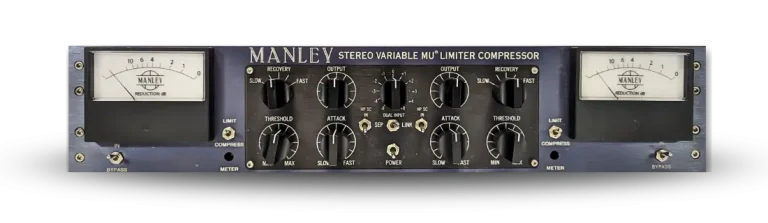
Manley’s best selling modern day masterpiece gives you control of your sound like nothing else. Known for it’s sweet sounding color courtesy of all tube circuitry and custom Manley input/output transformers, glue your tracks together with this compressor/limiter. The Variable Mu can kiss your audio with a touch of light 1.5:1 compression or smash unruly transients using the 20:1 limiting.
You’ve heard the Manley Variable Mu on thousands of songs, now hear it on yours!
This unit is specifically the version 9 model with the side chain high pass filters.
What is the Manley Variable Mu, and what does it do?
The Manley Variable Mu is an all-tube stereo compressor and limiter that adds warmth and “glue” to a mix. It uses a vacuum-tube gain-reduction circuit – the “variable mu” principle – along with custom Manley input and output transformers to level dynamics while imparting a sweet, musical tube color. Engineers reach for it to make tracks feel cohesive and finished, from a gentle kiss of compression all the way to hard limiting.
What is the Manley Variable Mu best for?
The Variable Mu is best known as a mix-bus and mastering compressor, and it is a genuine standard in mastering rooms worldwide. Its slow, program-dependent compression pulls a full mix together and adds tube richness without obvious pumping. It also shines on stereo subgroups like drums and on individual sources such as vocals and bass.
What is variable-mu (vari-mu) compression?
Variable-mu compression uses the changing gain of a vacuum tube itself to reduce level, rather than a VCA chip or an optical cell. As the signal gets louder, the tube re-biases and naturally compresses more, so the ratio rises with the input, soft on quiet passages, firmer on peaks. This “remote cut-off” behavior is why vari-mu units like the Manley sound smooth, musical, and forgiving on transients.
Does the Manley Variable Mu have attack and release controls?
Yes. The Variable Mu gives you a variable Attack control and a stepped Recovery (release) control, plus a Compress/Limit mode switch. Attack is continuously adjustable (roughly 25–70 ms), and recovery is selectable, so you can dial anything from gentle leveling to firmer peak control. A Sep/Link switch lets you treat the two channels independently or gang them for perfectly matched stereo compression.
What does the high pass side chain filter do on the v9 Variable Mu?
The high pass side chain filter tells the compressor to ignore low frequencies when it decides how hard to compress. With it engaged, heavy bass and kick energy (below roughly 100 Hz) no longer trigger the gain reduction, so the unit stops “pumping” on the low end and keeps the bottom of your mix punchy and solid. This sidechain high-pass is the feature that defines the version 9 unit at Access Analog.
Manley Variable Mu vs Fairchild 670, what’s the difference?
Both are all-tube “variable-mu” compressors, but the Manley is the modern studio standard while the Fairchild 670 is the vintage original. They share the same remote-cutoff tube gain-reduction principle, which is why both are prized as smooth, gluey bus and mastering compressors. The Manley uses its own hand-selected tubes, custom transformers, and a more practical control set, giving it a clean, transparent character all its own.
Is the Manley Variable Mu good for vocals?
Yes. The Variable Mu is excellent on vocals when you want warmth and gentle control. Its soft Compress mode evens out a performance without choking it, while the tube circuitry adds a rounded, analog sheen that helps a voice sit forward. Start conservative and let the tubes do the coloring.
Is this the real Manley Variable Mu, or an emulation?
This is the real, physical Manley Variable Mu. Real Gear. No Emulations. You control the actual all-tube hardware unit, with its genuine vacuum tubes and custom Manley transformers, in real time from your DAW through the Analog Matrix. Nothing is modeled; your audio passes through the real analog circuitry.
Can I recall my settings when I use the Variable Mu at Access Analog?
Yes. Access Analog controls the Variable Mu robotically, so your settings are saved with your session and recalled automatically the next time you load it. You dial the unit in from the Analog Matrix plugin and the physical knobs are set for you, giving real analog hardware the total recall of a plugin.
How much does it cost to use the Manley Variable Mu at Access Analog?
You can reserve the Manley Variable Mu from $5.72, or use it on demand with credits or an active subscription, where the on-demand rate matches the hourly reservation rate. Subscriptions start at $9.98/month, and new accounts get a free hour of processing to try it. There’s no purchase and no maintenance, just the real hardware when you need it.