
Run a finished mix through a 33609/N at a dB or two of gain reduction and something changes that the meter can't explain: the kick, the snare, the guitars and the vocal stop sounding like parts placed next to each other and start sounding like one record.
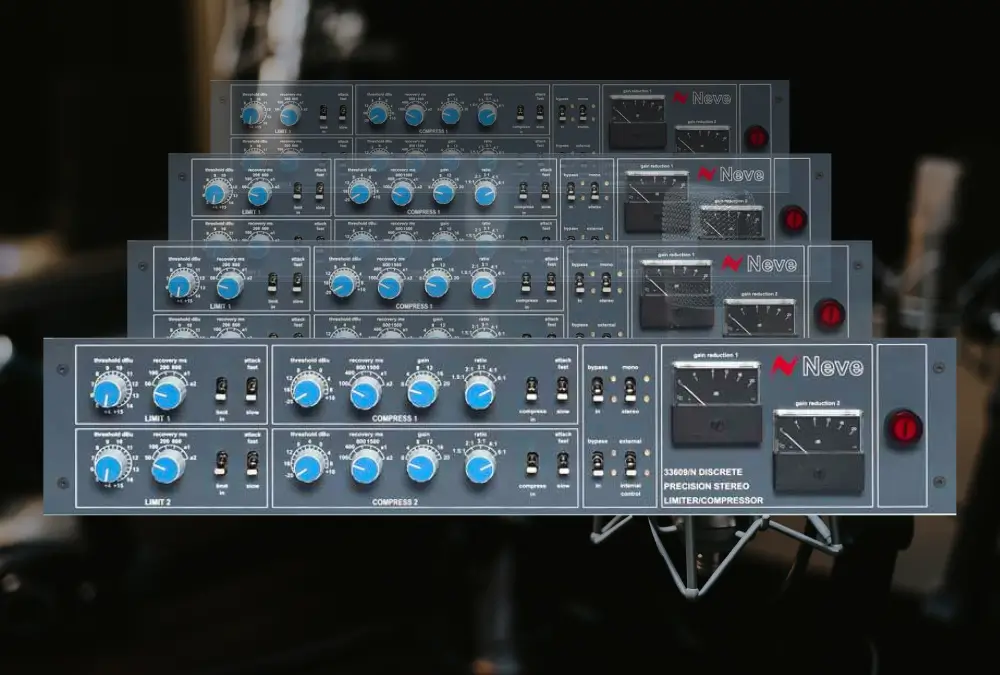
That isn't mystique. It comes from three physical things working together: a diode-bridge gain element that behaves differently from a VCA, a feedback detector with a soft, progressive knee, and Marinair-specification transformers wrapped around the whole path. This guide explains each mechanism, corrects a few popular myths about the unit, and gives you real starting settings built on the 33609/N's actual stepped controls.
The 33609/N is the current production version of Neve's classic stereo diode-bridge limiter/compressor: two channels, stepped controls, built by AMS Neve in Burnley, England.
The AMS Neve 33609/N is a 2U rack unit containing two complete compressor/limiters. Each channel has its own compressor section, its own limiter section, and a gain-reduction meter. A mono/stereo switch decides how they relate: in mono the two channels are fully independent, and in stereo their side-chains are linked, so both channels always receive the same gain reduction and the stereo image holds still.
The design's roots go back to the Neve 2254, a diode-bridge limiter/compressor console module introduced in 1969 that became a fixture of Neve 80-series desks, as Hugh Robjohns recounts in his Sound On Sound review of the 2254/R reissue. The diode-bridge approach then spread into later Neve console modules and standalone processors, and the 33609 became the one engineers put in their racks. AMS Neve's own manual says the 33609 has been "in manufacture since the early 1980s" and has gone through several design changes since. The /N is the current build, and it keeps the same basic circuitry as the earlier discrete models.
Two popular stories about the unit need correcting. First, the 33609 is a rack processor, not the bus compressor built into the centre section of every classic Neve console. Its reputation on records comes from engineers patching it across their stereo bus. Second, AMS Neve (formed when Neve Electronics merged with AMS in 1992) is the company that carries the Neve name today. It is a separate company from Rupert Neve Designs, whose own diode-bridge compressor also sits in our racks (more on that below).
Why choose the current model over a vintage one? A 40-year-old 33609 comes with aged electrolytic capacitors, unknown service history, and channel matching that has drifted. The 33609/N comes out of the factory matched and in spec: ±0.5 dB from 20 Hz to 20 kHz, more than +26 dBu of output, and stepped controls that make both channels land in exactly the same place. For bus work, that matching is not a luxury.
The 33609/N is the 33609 circuit in its most stable form: same topology, same diode bridge, with channels that actually match.
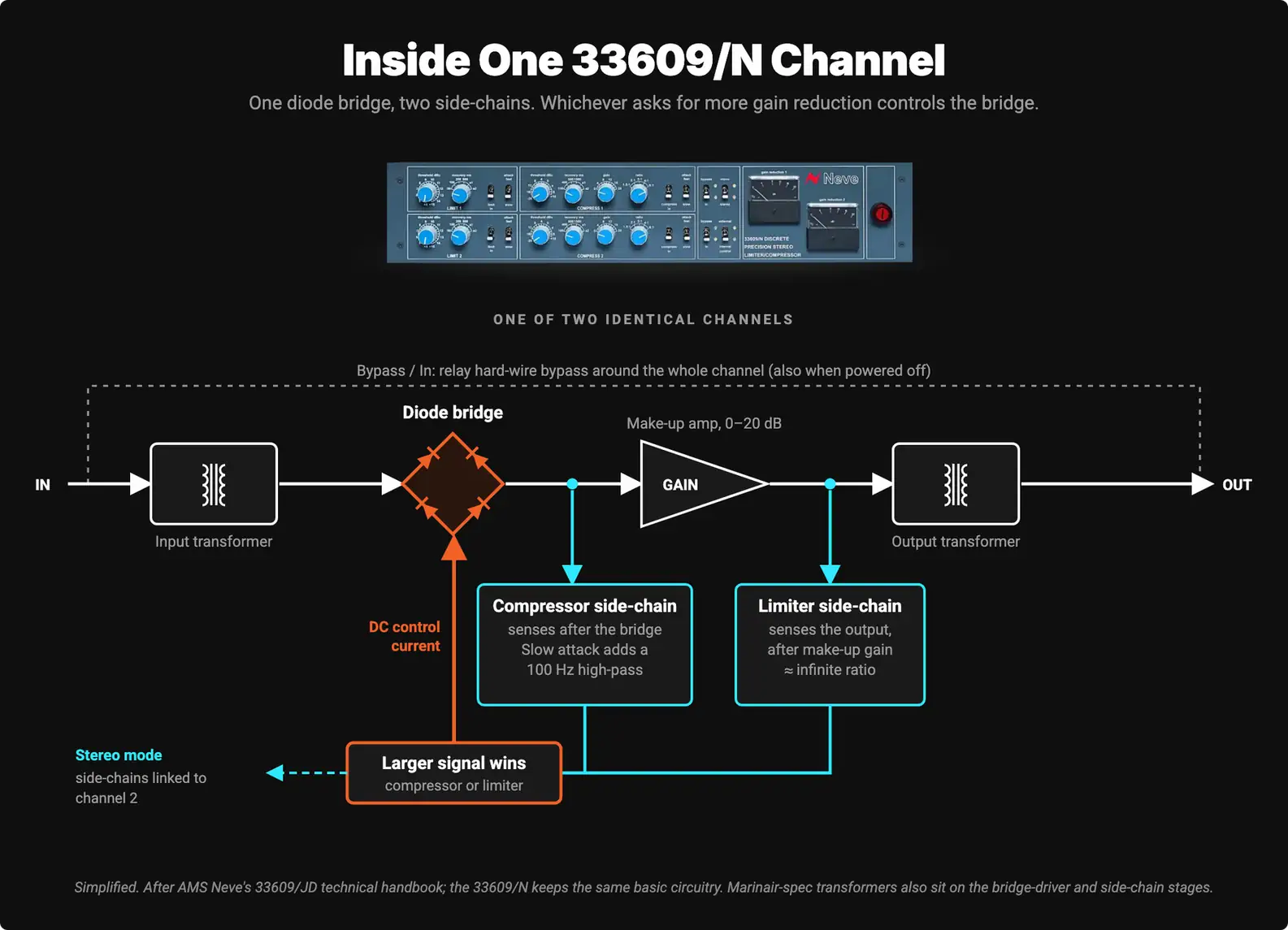
A diode bridge is a variable attenuator made from four diodes. The same non-linearity that lets it control gain is what gives it a sound.
A diode conducts easily in one direction and hardly at all in the other. Its resistance also isn't fixed: it depends on how much current is flowing through it. Arrange four diodes in a bridge, push a DC control current through them from the side-chain, and the bridge becomes a resistance you can steer electrically. More control current changes the bridge's effective resistance, and with it how much signal gets through. AMS Neve credits Neve with pioneering the approach, choosing the bridge arrangement and control voltages so that distortion is significantly reduced.
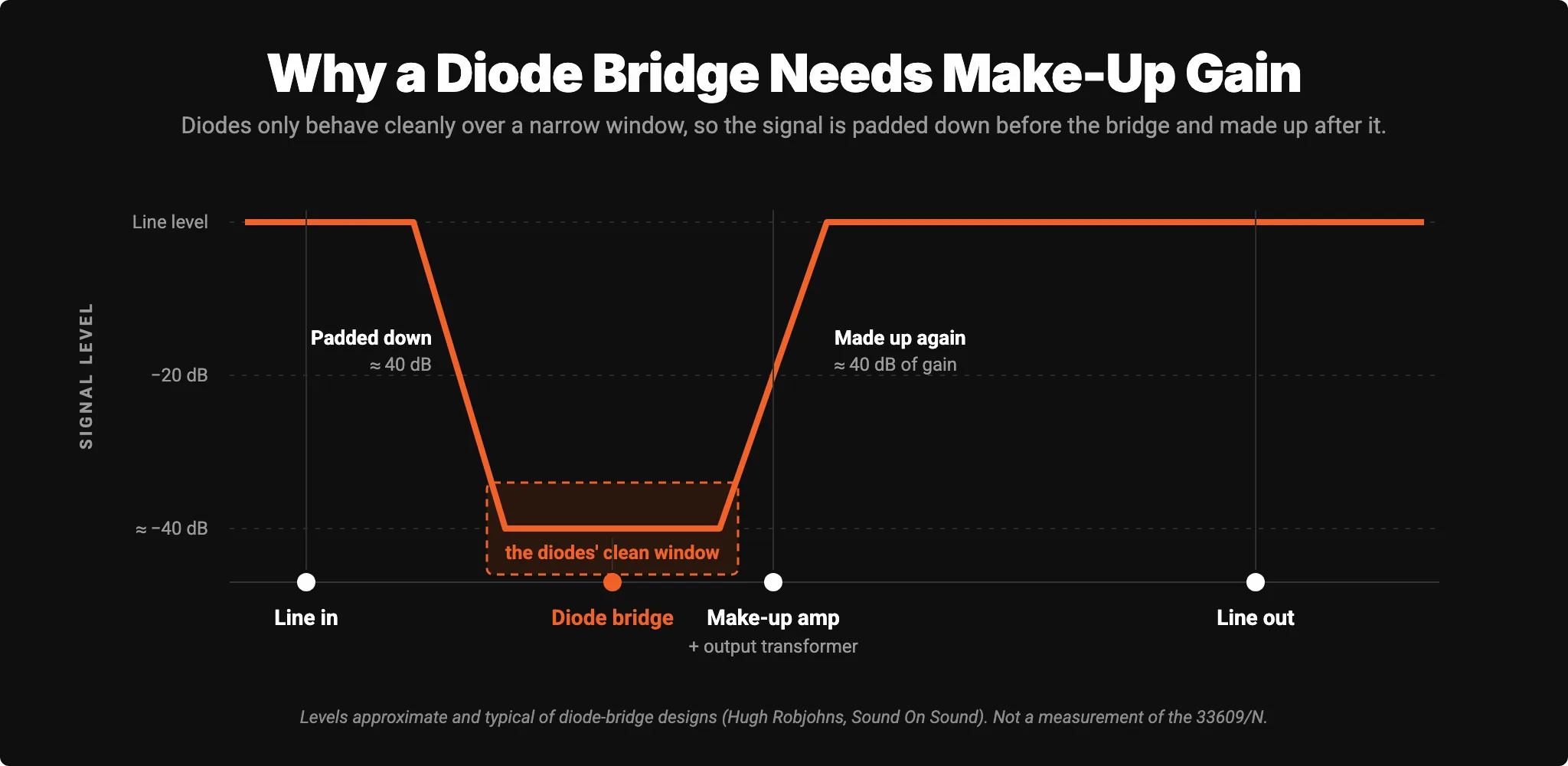
The catch is that a diode only behaves like a clean, proportional resistor over a very small window of voltage, as Robjohns explains in his Sound On Sound review of the Buzz Audio DBC-20. So diode-bridge designs work at a very low signal level. In the Neve 2254 lineage, Robjohns notes, the bridge's output is typically around 40 dB below its input, and the circuit then needs 40 dB or more of gain to bring the signal back to line level.
Think of a garden valve that only tracks its handle smoothly over the first few degrees of travel. Push more water through it and the flow stops following the handle. So you drop the pressure before the valve, work it gently, and put a pump after it. In the 33609/N, the pump is the make-up amplifier and the output transformer. That's why those stages matter as much as the bridge.
What does that add to a mix? Three things, all measurable in principle:
Low-level harmonic distortion that rises with gain reduction. A balanced bridge cancels much of its own distortion, and Robjohns notes that what survives is predominantly odd-order. It sits very low when the unit is barely working and climbs as you compress harder or drive it harder. On the 33609/N's spec sheet it stays under 0.2% at 1 kHz even with the compressor in at 6:1 and 20 dB of make-up gain. This is density, not fuzz, until you really lean on it.
Iron in the path. The 33609/N uses Marinair-specification transformers on the input, bridge-driver, side-chain and output stages. Transformers are level- and frequency-dependent: they add a little low-frequency harmonic content and slightly soften the fastest edges as they're driven. That's the same mechanism we unpacked in our Black Box HG-2 guide to mix-bus harmonics, in a much subtler dose.
A feedback detector with a soft knee. AMS Neve describes the 33609 as "feedback-style": the compressor's detector listens after the gain cell, so it's always reacting to a signal it has already turned down. That gives a rounded onset, and the knee is soft and progressive. The manual says the labelled ratio is only reached more than 5 dB above threshold. At bus-compression depths, the 33609/N never really clamps. It leans.
This is also why the unit colors the signal before it compresses anything. Switch a channel in with both the compressor and limiter out, and the audio still passes through the transformers and amplifiers. Don Smith told Bobby Owsinski (The Mixing Engineer's Handbook) that he starts with the unit switched in and no threshold, "just to hear it." Elliot Scheiner said something similar: he keeps a 33609 across his mixes for the sound of the box more than for compression, with the needle barely moving.
Put the 33609/N's "glue" down to three causes you can name: a gain cell that adds a little distortion as it works, transformers that add weight, and a feedback detector that never quite clamps.
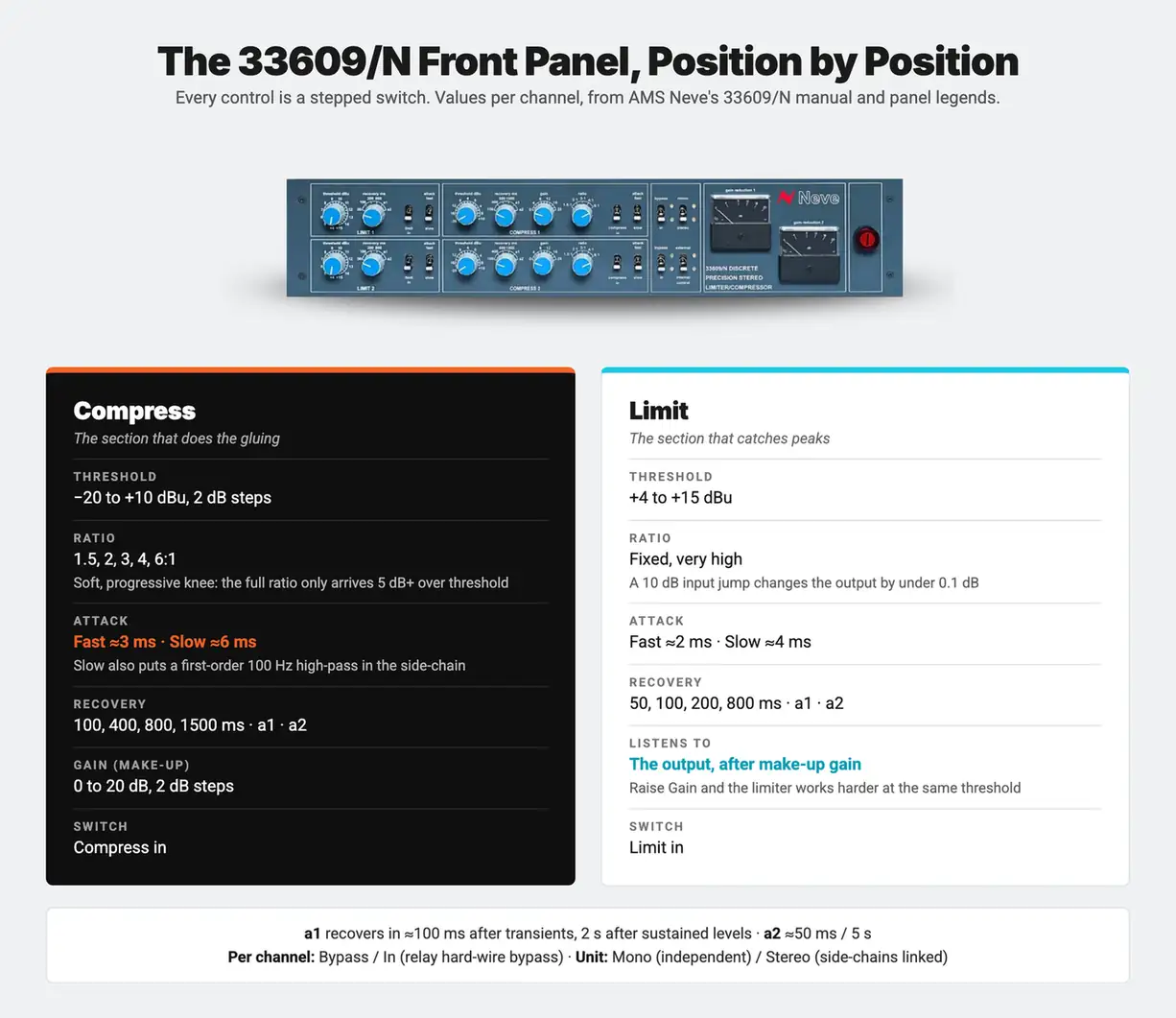
Every control on the 33609/N is a stepped switch. Learn the positions and the unit becomes one of the most repeatable compressors you'll ever use.
This is the section most online settings guides get wrong, because they describe attack and release as continuous knobs. They aren't. Here is each channel's panel, per AMS Neve's manual and the front-panel legends.
The auto recovery positions, a1 and a2, are two-speed. After a short transient the gain recovers quickly, and after a sustained loud passage it recovers slowly, so brief peaks don't leave a hole behind them. a1 recovers in about 100 ms from transients and 2 seconds from sustained levels. a2 is more extreme at both ends: about 50 ms and 5 seconds.
Bypass/In, compress in, limit in, mono/stereo. Each section has its own in switch, and the whole channel has a true relay bypass (it also falls back to bypass if the power drops).
Two consequences of the layout are worth knowing before you touch anything.
First, the slow attack switch is really a side-chain filter switch. A full mix carries most of its energy below 200 Hz. With a flat detector, kick and bass drive most of the gain reduction, and every kick hit ducks the vocal and cymbals with it. Rolling off at 100 Hz, 6 dB per octave, turns the bass down in the compressor's ears. That single switch is a large part of why the 33609/N sounds so composed on a mix bus.
Second, the limiter listens after the make-up gain. In the circuit, the limiter's side-chain is taken from the output stage, so adding make-up gain pushes more level at the limiter. If you raise Gain by 2 dB, the limiter works 2 dB harder at the same threshold. Set the compressor first, then the limiter.
Fast/slow, stepped recovery, stepped threshold: the 33609/N trades infinite adjustability for settings you can write down and land on exactly, on both channels, every time.
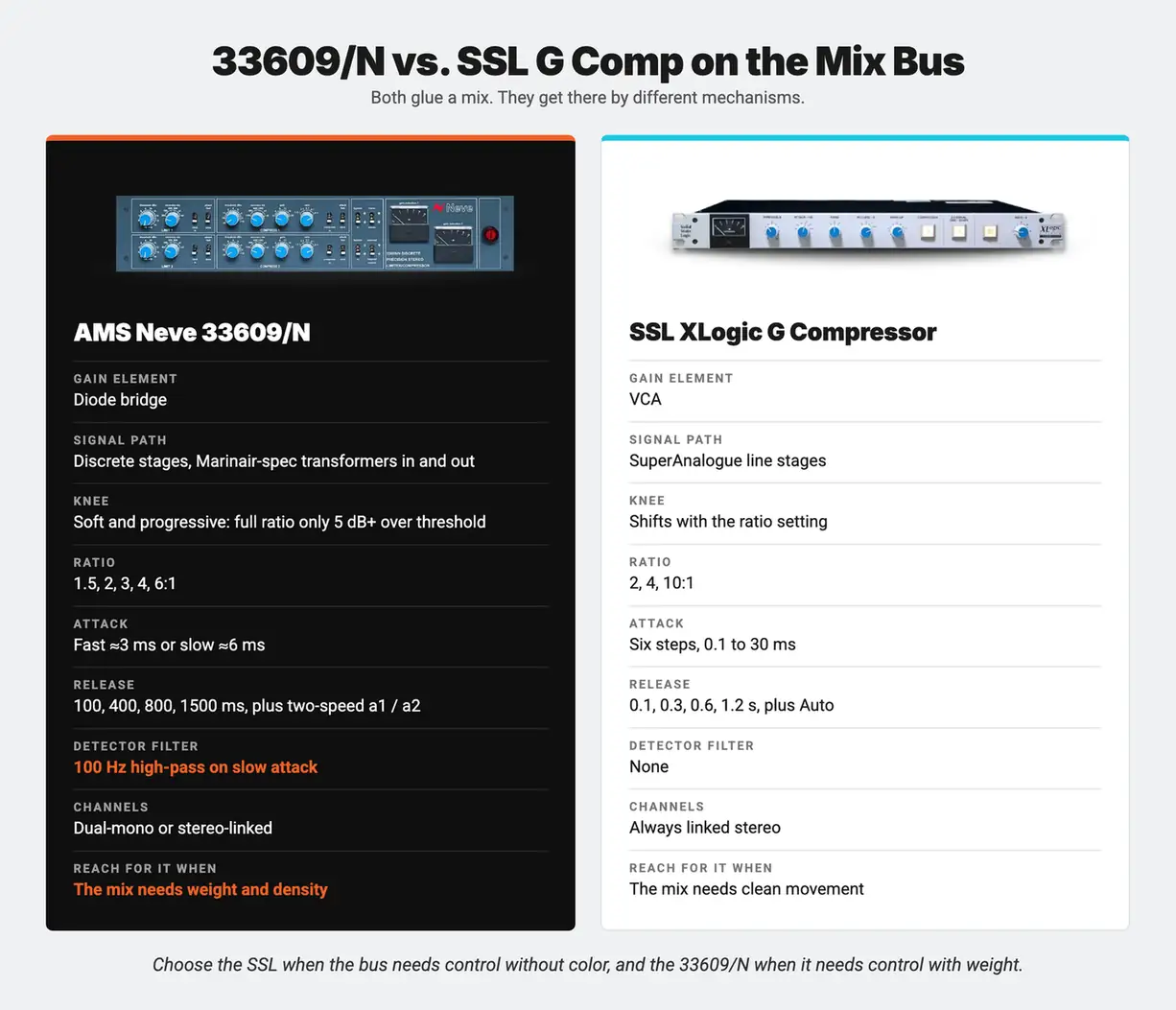
Both units glue a mix, but for different physical reasons. The SSL moves everything together and adds almost nothing. The 33609/N moves everything together and leaves a fingerprint.
The SSL XLogic G Compressor is also in our racks, and it's the reference point most engineers measure a bus compressor against. Understanding what each unit does differently is more useful than asking which is better, because an engineer who reaches for the wrong one can set it perfectly and still not get the result they're after.
The SSL uses a VCA (voltage-controlled amplifier) gain cell inside SSL's SuperAnalogue circuitry, designed to color as little as possible. Its channels are always fully linked, its attack goes from 0.1 to 30 ms, and its Auto release adapts to the program. Whatever you hear from the SSL is mostly envelope: level moving together in a way that makes the mix cohere. We compared it against the API 2500 in detail in SSL G Bus vs API 2500: Glue or Punch?.
The 33609/N gets to cohesion by a different route. Its feedback detector and soft knee give a slower-feeling, rounder onset. Its slow-attack mode filters the low end out of the detector, which the SSL G has no way to do. And its diode bridge and transformers add a small, level-dependent layer of harmonic density that rises as you work it.
How to choose, session by session:
Neither is universally right, which is exactly why we rack both. With Access Analog you can run the same mix through each in the same session and let the song decide.
Choose the SSL when the bus needs control without color, and the 33609/N when it needs control with weight.
The 33609/N shares a design house and a set of habits with vintage Neve console modules. It isn't a channel strip in a box, and its Neve character comes from specific parts you can point to.
Access Analog racks several vintage Neve console modules: the Neve 1064, the 1057, the 1058 and the 2057. These are channel modules (mic/line amplifiers and EQs) from the classic Neve console era. Our guide to the Neve 1064 and its vintage siblings covers what each one does. What the 33609/N has in common with them isn't a shared circuit. It's a shared approach: discrete amplifier stages, and transformer coupling on the way in and out. When engineers say something "sounds like a Neve," they're partly hearing iron and discrete gain stages interacting with level, and the 33609/N keeps both.
What makes the 33609/N sound specifically like itself is the diode bridge plus the feedback side-chain. You can't separate the bridge's contribution from the transformers' contribution by ear. They arrive together, and the combination is the 33609/N signature.
If you want to hear the same idea from a different design team, the Rupert Neve Designs Shelford Diode Bridge Compressor (5254) is in our racks too. Robjohns, reviewing it for Sound On Sound, found it cleaner and quieter than a vintage 2254 at gentle settings, with far more timing options and a parallel Blend control. The 33609/N is the classic take: fewer choices, every one of them voiced.
The 33609/N earns the Neve name through its parts: discrete amplifier stages, transformers on the way in and out, and a gain cell that adds a little character of its own.
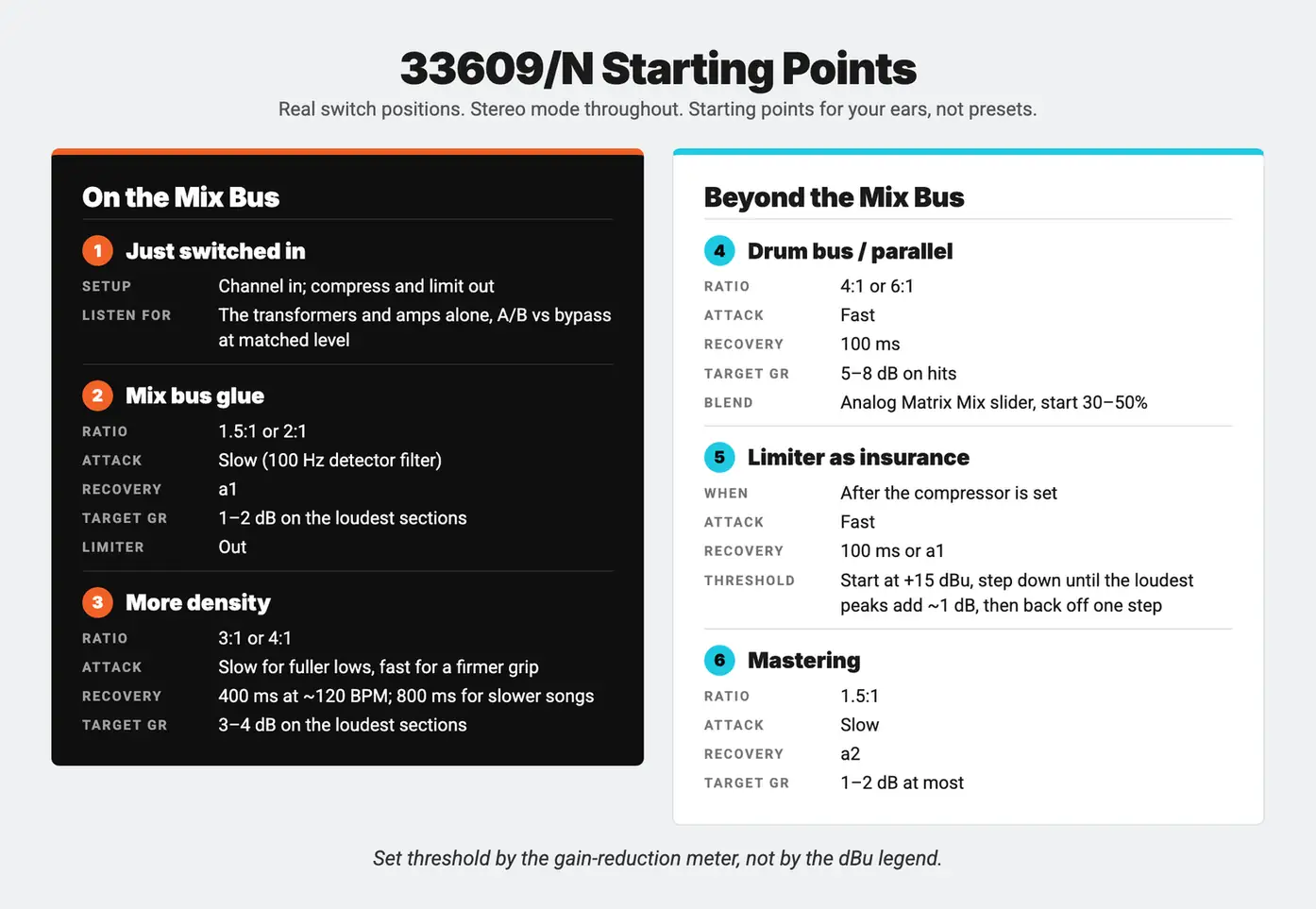
Start with less than you think. On a mix bus the 33609/N does its best work at one to three dB of gain reduction, where you hear density and cohesion before you hear compression.
These are starting points for your ears, not presets. They use the real switch positions. One Access Analog-specific note first: threshold is marked in dBu, but the level you send from your DAW is what the hardware sees, and it's also a tone decision. So set threshold by the gain-reduction meter, not by the dBu legend. Every recipe below assumes stereo mode.
This is the setting the mixers quoted earlier describe: the needle barely moves, and the mix still changes.
Stepped controls matter most here: both channels land on identical positions, and you can recall the exact setting for a revision months later.
These aren't only bus settings, either. Recording engineer Ebonie Smith has described using a 33609/N on drum overheads and on the master bus in an interview with AMS Neve.
How to judge it. Match levels, then A/B the 33609/N against bypass at your chosen setting. At two dB of gain reduction the difference is mostly tonal, not dynamic. If the mix sounds denser and more of a piece, the unit is doing its job. If it sounds compressed, go back to the attack switch and recovery position before you blame the threshold.
On the 33609/N the recovery switch shapes the feel more than the ratio: pick a1 for invisible glue, a2 for mastering, and a fixed position when you want the bus to breathe with the tempo.


The AMS Neve 33609/N on Access Analog is a physical unit in our Colorado facility, controlled robotically from the Analog Matrix plugin in your DAW. It's not an emulation, and there's no model in between: your audio is converted, passes through the real transformers and diode bridge, and comes back into your session. The Analog Matrix exposes every front-panel control, including the stepped thresholds, both attack switches, the a1/a2 recovery positions, bypass and mono/stereo. It adds two things the hardware doesn't have: a wet/dry Mix slider, and settings that are saved with your session and restored exactly.
Our gear is powered all the time, so the 33609/N is at stable operating temperature before your session starts, not warming up during your first pass.
A few workflows only a shared rack makes easy:
There are two ways in. Reserve a session on the 33609/N outright from the reservation calendar, or use it as part of the Elite tier of the Access Analog Subscription. Every new account starts with free credits, enough for roughly an hour on the 33609/N. Current rates are on the gear prices page. If you're choosing a compressor for the final stage of a master, our Manley Variable Mu deep-dive covers the all-tube alternative. For a wider view, see our ultimate guide to bus compressors.
The 33609/N's character doesn't survive a description. Put your own mix bus through the real unit at two dB of gain reduction, match the level, and listen.
The 33609/N has outlasted several generations of bus compressors for a reason you can trace on a schematic. Its diode bridge works inside a narrow window and leaves a small, rising layer of harmonics. Its feedback detector and soft knee never quite clamp. Its slow attack keeps the kick from running the mix, and its transformers add weight on the way through. None of that is magic, and none of it is easy to fake.
Set it to a dB or two, match the level, and hear your mix turn into a record.
What is the AMS Neve 33609/N?
The AMS Neve 33609/N (33609/N) is a two-channel diode-bridge compressor/limiter in a 2U rack unit, built by AMS Neve and in production in various versions since the early 1980s. Each channel has an independent compressor and limiter, and the two channels can run independently or linked for stereo. All controls are stepped. It's used widely on the stereo mix bus, in mastering, and on drums.
What does diode-bridge compression sound like?
Diode-bridge compression is generally described as dense, weighty and forward, with a rounded onset. In the 33609/N, four diodes act as a variable attenuator steered by the side-chain. Because diodes are non-linear, the bridge adds low-level distortion (mostly odd-order, per Sound On Sound's Hugh Robjohns) that grows as you compress harder. Combined with the unit's transformers and feedback detector, this is the source of its "glue plus weight" reputation.
Is the 33609/N good for mastering?
Yes. AMS Neve lists mastering among its main applications, and the stepped controls make it easy to match both channels exactly and recall a setting later. For mastering, keep it gentle: 1.5:1, slow attack, a2 recovery, and no more than 1 to 2 dB of gain reduction.
What are good 33609/N settings for the mix bus?
A strong starting point is stereo mode, compressor in, ratio 1.5:1 or 2:1, attack on slow, recovery on a1, and threshold stepped down until the meter reads 1 to 2 dB on the loudest sections. Make up the lost level with the stepped Gain control, and A/B against bypass at matched level.
What do the a1 and a2 recovery settings do?
Both are two-speed automatic recovery positions. After a brief transient the gain recovers quickly, and after a sustained loud passage it recovers slowly, so short peaks don't leave audible dips. On the 33609/N, a1 recovers in about 100 ms from transients and 2 seconds from sustained levels, and a2 in about 50 ms and 5 seconds.
Why use slow attack on the 33609/N's mix bus setting?
On the 33609/N, the slow compressor attack (about 6 ms) also switches a first-order 100 Hz high-pass filter into the side-chain. The compressor then reacts less to kick and bass, so the low end doesn't pump the rest of the mix. On a full mix, that usually matters more than the 3 ms difference in attack time.
Do the 33609/N's compressor and limiter work in series?
Not as two separate gain stages. According to AMS Neve's technical documentation, each channel has one diode bridge shared by both sections, and each section has its own side-chain. Whichever section asks for more gain reduction controls the bridge. The limiter senses the output after make-up gain, so changing the Gain control also changes how hard the limiter works.
Does the 33609/N color the sound when it isn't compressing?
Yes. With a channel switched in but both the compressor and limiter out, the audio still passes through the unit's Marinair-specification transformers and amplifier stages. Several well-known mix engineers use the 33609 largely for this, with the meter barely moving. Switch the channel to bypass for a true hard-wired bypass.
How can I use a real Neve 33609/N without buying one?
Access Analog racks a real AMS Neve 33609/N that you control robotically from your DAW through the Analog Matrix plugin, with every front-panel control plus a wet/dry Mix slider. You can reserve a session on it outright from the reservation calendar or use it through the Elite tier of the Access Analog Subscription, and new accounts start with free credits to try it.