
Almost every engineer knows the Neve 1073. Fewer have spent time with the modules around it, and some of them are the ones the 1073's biggest fans quietly reach for first.
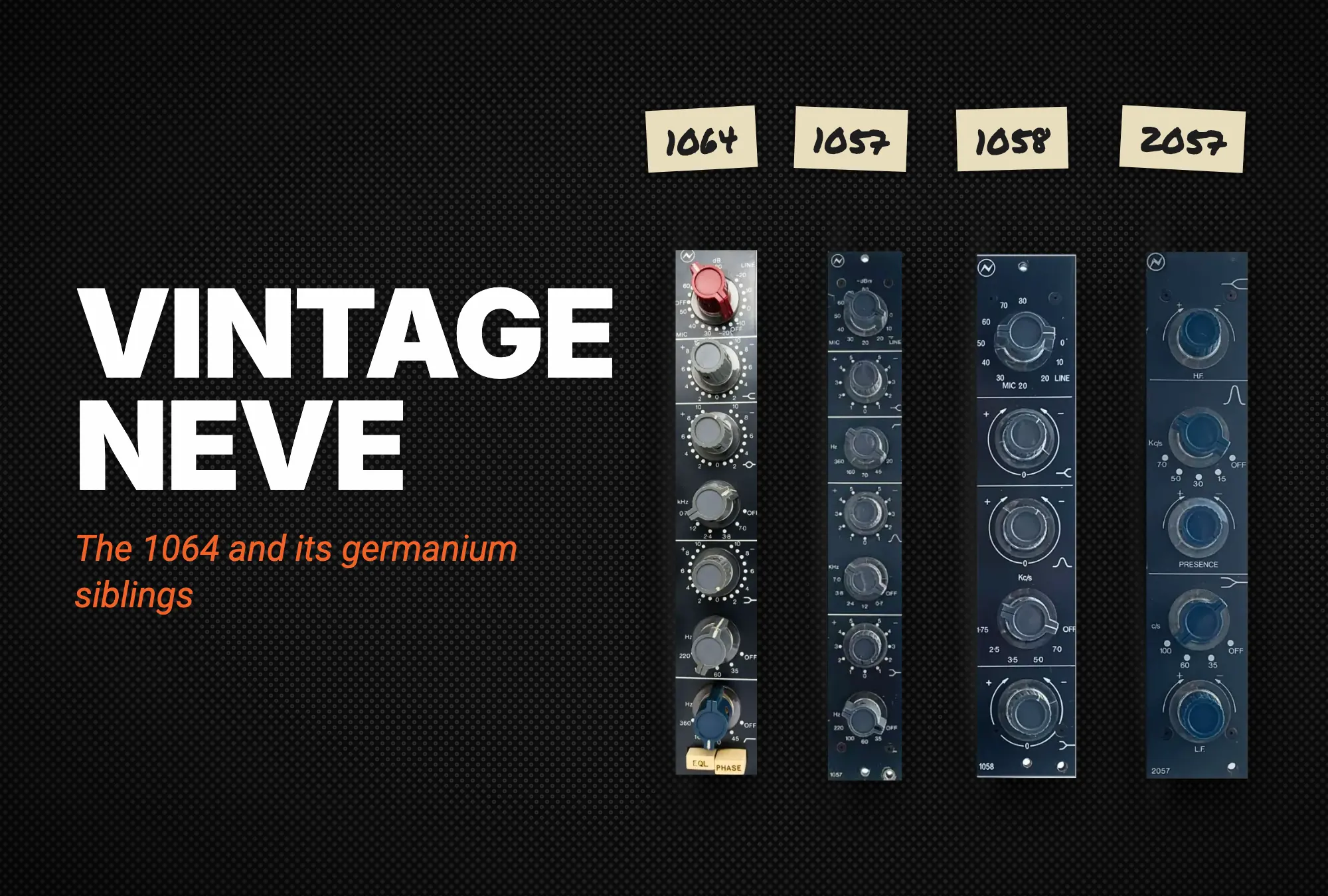
Access Analog racks four vintage Neve console modules: the Neve 1064, the 1057, the 1058, and the 2057. We have two of each, so you can run any of them in stereo. They span two generations of Rupert Neve's design work, from the germanium modules of 1966–68 to the silicon Class A module of 1969. This guide covers what each one is, why they sound the way they do, and where to use them. The settings come from the engineer who owns them.
Our vintage Neve units are from the personal collection of F. Reid Shippen.
"Neve" can mean three different things: the vintage modules Rupert Neve designed in the 1960s and '70s, the company that carries the Neve name today, and the company Rupert Neve founded later in his career.
Rupert Neve started building mixing consoles in the early 1960s. Each channel of a Neve console was a self-contained module: a microphone amplifier, an equalizer, and an output stage, built with discrete transistors and transformer-coupled at both ends. Studios ordered desks loaded with whichever modules suited their work, and module numbers multiplied quickly. The Neve 1073 is the most famous of them. It's the benchmark engineers still measure mic pres against, and it's the reason most people know the name.
The other two meanings come later:
The four modules in this guide are the originals: hardware Rupert Neve designed and his company built, now more than half a century old. AMS Neve's history of the 1073 is a good primer on the era.
When engineers say "vintage Neve," they mean console modules from the 1960s and '70s. That's what's on our rack.
Two design choices do most of the work: transformers at the input and output, and Class A amplifier stages in between. Both change their behavior with level, which is why a Neve sounds different depending on how hard you push it.
Transformers. A transformer passes audio magnetically, through an iron core, from one winding to another. The core can only carry so much magnetism. Think of it as a sponge: a bass note pours a bucket into it on every cycle, and a cymbal pours a teaspoon. Push the level up and the bass fills the sponge first. That's why transformer saturation is always greatest at low frequencies. When the core saturates, it softens the peaks and adds harmonics, and because the effect is symmetrical those harmonics are mostly odd-order, chiefly the third. Hugh Robjohns covers this in his Sound On Sound article on analogue warmth. He also notes that distortion rises again at very low levels (hysteresis), and that every transformer design behaves differently. "Transformer sound" isn't one effect; it's the sound of that particular piece of iron.
Class A. In a Class A stage, the transistor conducts through the entire waveform, never switching off. That avoids the crossover distortion that happens when one device hands the waveform to another, as in Class B designs. The 1064's output stage is single-ended Class A, which tends to add mostly low-order, even harmonics as it approaches its limits. Rupert Neve's germanium modules were Class A as well.
The part plugins struggle with. Neither mechanism is fixed. How much harmonic content you get depends on the level, the frequency content, the source and load impedances, and on components that have been aging since the late 1960s. Good emulations capture a snapshot of that behavior. The hardware gives you the whole thing, reacting to your material.
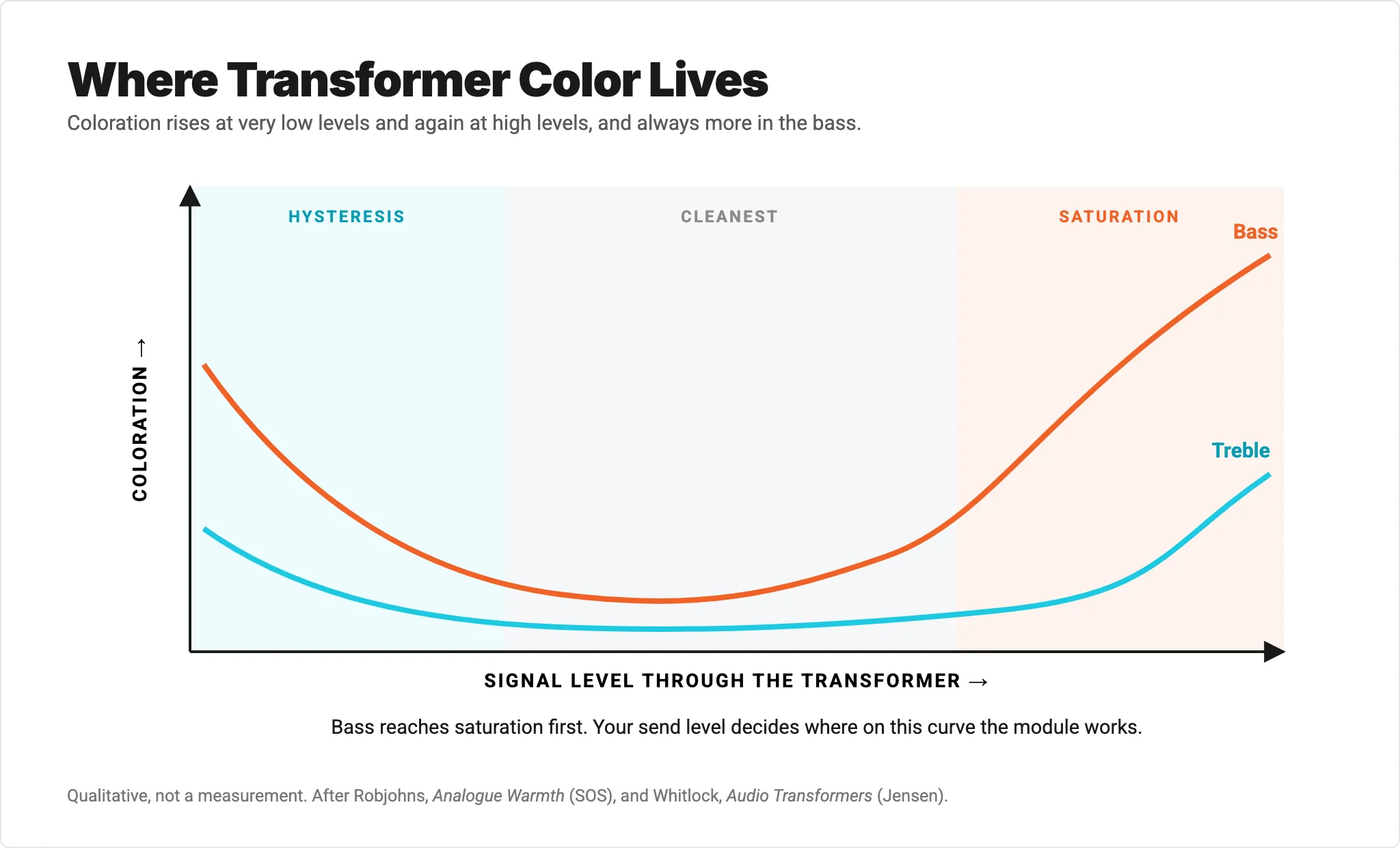
For a wider view of how saturation works across tubes, tape, and transformers, see our guide to analog saturation in modern music production.
The "Neve sound" comes from transformers and Class A stages reacting to your level. That's why the same settings can sound polite at one send level and thick at another.
The Neve 1064 is a 1969 Class A mic preamp and three-band EQ. Its preamp and EQ are the ones used in the 1066, the module the 1073 was developed from, in a longer 12-inch module.
The Neve 1064 comes from the same design generation as the 1066 and shares its preamp and EQ circuit. The 1073, which is essentially the 1066 with different EQ frequencies, followed about a year later. The 1064 went on to fill the channels of Neve 80 Series consoles such as the 8016 and 8038. It's built on discrete silicon amplifier cards, with a single-ended Class A output stage driving a gapped Marinair LO1166 output transformer. Engineers who know the 1073 will recognize the family resemblance. The EQ points are its own.

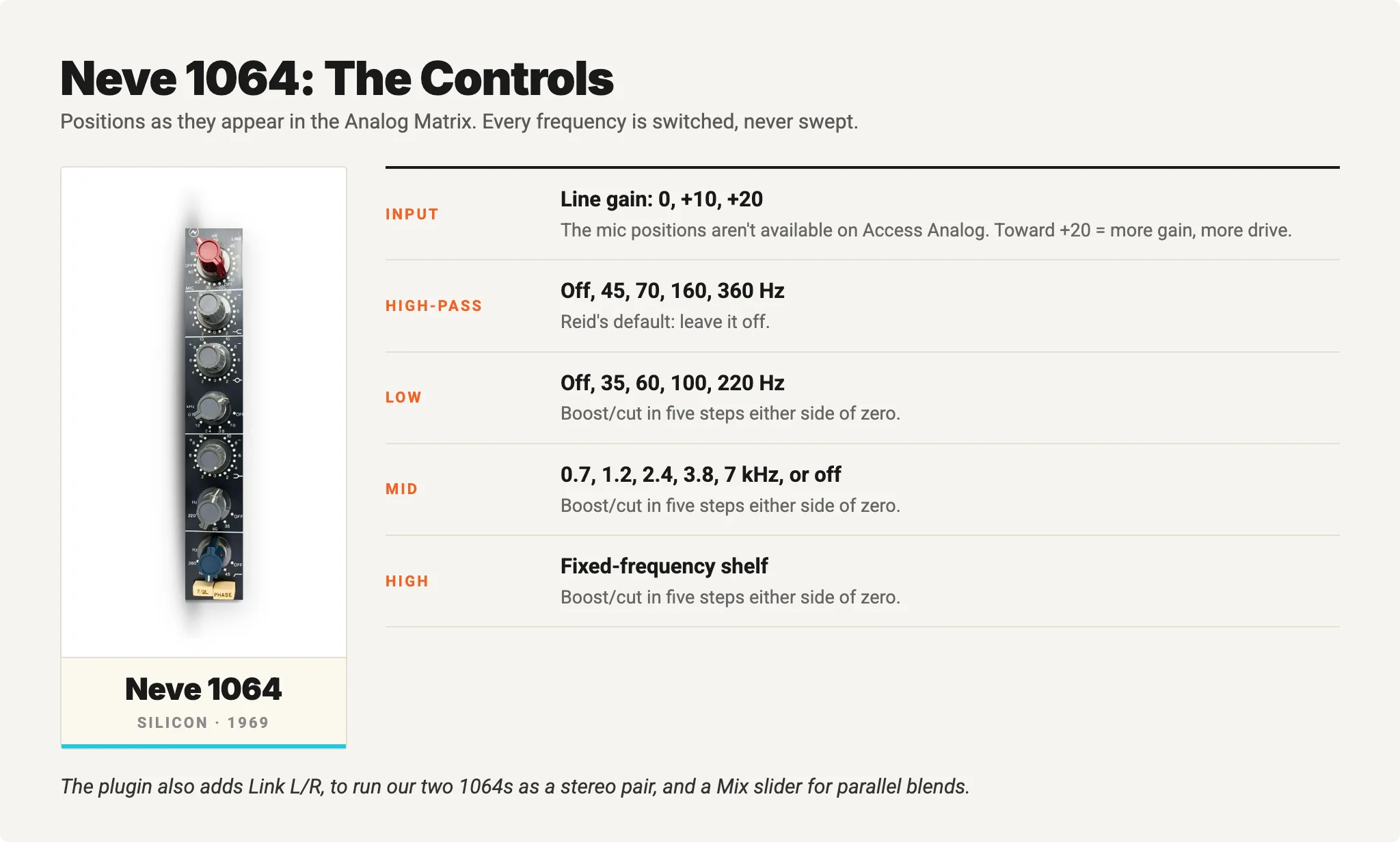
The controls:
F. Reid Shippen on the 1064: "IMHO the best of all the Class-A Neve modules. Better low end and silkier highs than the 1073. Rupert picks the frequencies for you and really nailed this one. Classic Neve 80 Series 3-band EQ. Amazing vintage transformers. Everything sounds better through these things, even with the EQ flat."
Take the last line literally. Put a 1064 on a track with the EQ flat, level-match it against bypass, and listen to what the transformers and output stage are doing on their own. Then reach for the EQ.
The 1057, 1058, and 2057 are germanium-era Neve modules from 1966–68, a generation before the 1064. They're rarer, less consistent, and usually described as grittier and more forward.
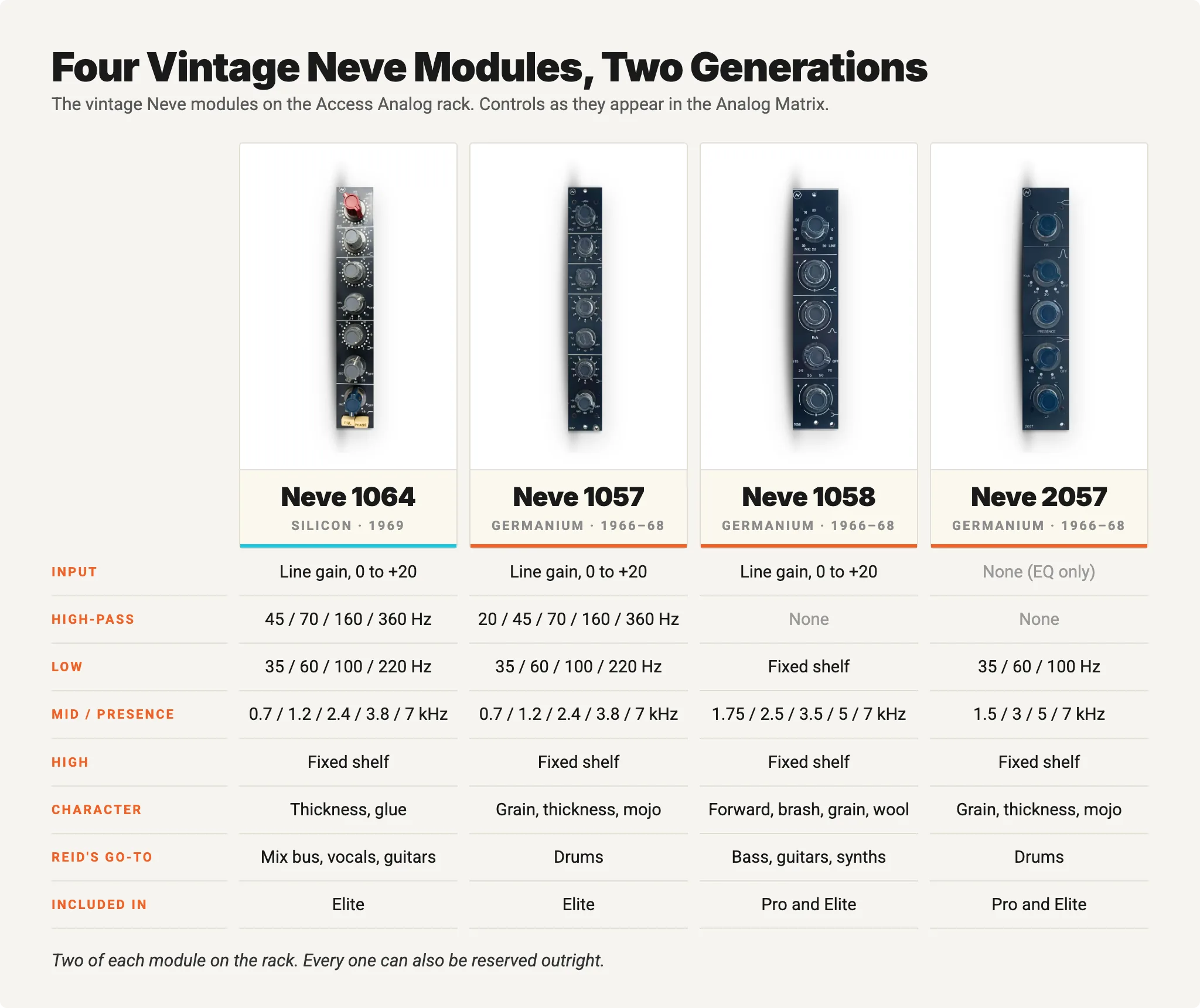
Germanium transistors were the first generation of solid-state audio. Compared with the silicon parts that replaced them, they're leakier, more sensitive to temperature, and less consistent from one device to the next. The character words on each product page tell the story: the 1064 is "Thickness. Glue." The 1057 and 2057 are "Grain, Thickness, Mojo." The 1058 is "Forward, Brash, Grain, Wool."
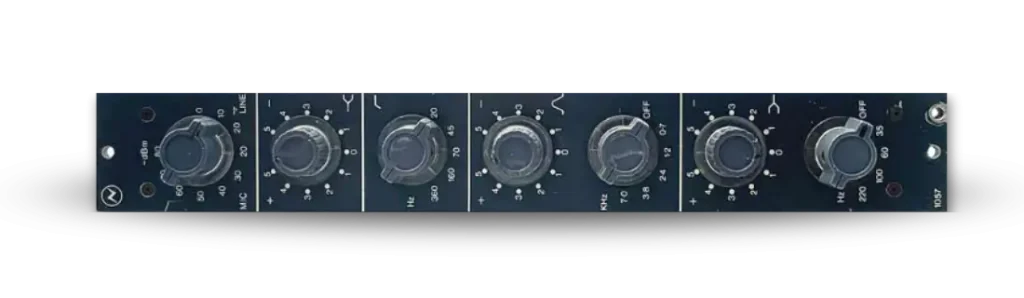
One of Rupert Neve's first combination mic pre/EQ designs, and in one famous producer's opinion the best drum EQ there is.
The Neve 1057 is a full channel: a mic/line gain switch (line positions 0, +10, +20 on our rack), a high-pass filter (20, 45, 70, 160, or 360 Hz), a low band (35/60/100/220 Hz), a mid band (0.7/1.2/2.4/3.8/7 kHz), and a fixed high shelf. The frequencies will look familiar from the 1064, but the amplifier behind them is germanium.
F. Reid Shippen: "The 1057 was one of Rupert Neve's first generation of combination mic pre/eq designs. These modules incorporated germanium transistors and the legendary St. Ives input/output transformers. Michael Beinhorn was a massive fan of these, and you've heard them, famously, on his seminal records including 'Superunknown', 'Celebrity Skin', and 'Mechanical Animals'. These are, in his opinion, the best drum EQ's on the planet."
(Beinhorn's own modules came from a 1968 Chicago console, as Sound On Sound reported when they went up for sale. Ours are the same model, not the same units.)
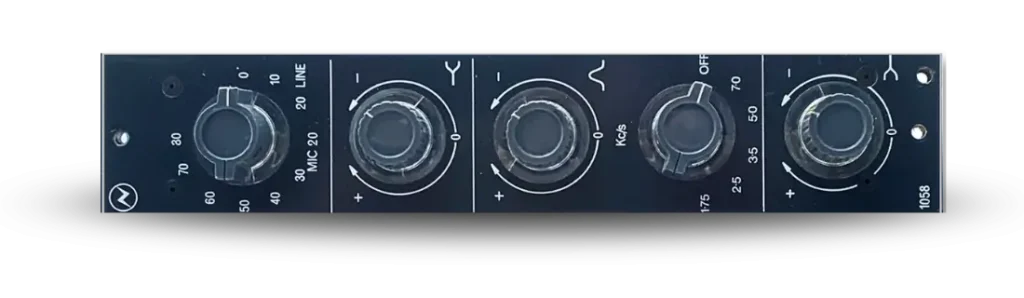
An early germanium mic pre/EQ, and our units are unusual even by 1058 standards.
The Neve 1058 has fixed-frequency low and high bands and a switched presence band at 1.75, 2.5, 3.5, 5, or 7 kHz. There's no high-pass filter. Those presence points sit in different places from the 1057 and 1064, which is part of why it sounds so different.
F. Reid Shippen: "What makes these unique is that they have no input transformers and the output transformers are Marinairs, which were designed for later modules like the 1073. This weirdness gives them a completely different sonic character than the usual 1058 (which sound similar to the 1057). Due to their gritty, dark coloration and unusual midrange presence, they are perfect for bass and guitar. Beinhorn, again, used these exclusively on the bass and guitars for Soundgarden's 'Superunknown' album."
The missing input transformer isn't a fault. The original 1058 was designed around external plug-in input transformers, so a module running without one is a documented configuration, not a hack.
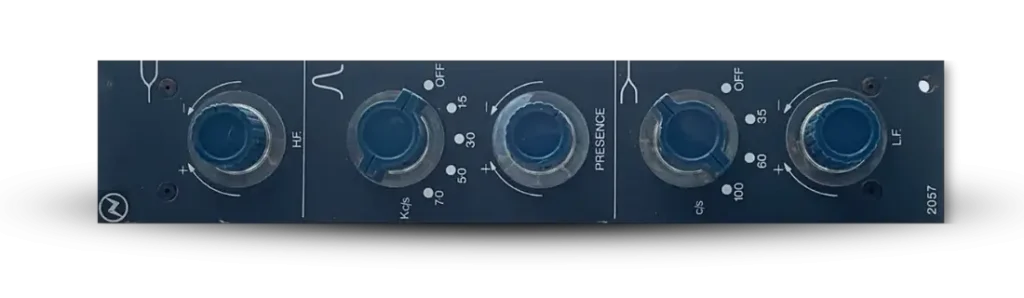
From the same first generation of Neve combination designs as the 1057: the line-only member of the family, with big, simple controls.
F. Reid Shippen: "The 2057 was one of Rupert Neve's first generation of combination mic pre/eq designs. These modules incorporated germanium transistors and the legendary St. Ives input/output transformers. … The 2057 is just a line-only version of the 1057. Same great tone. So good we have 2 of each."
On our rack, the Neve 2057 runs as a three-band EQ: a low band at 35, 60, or 100 Hz, a presence band at 1.5, 3, 5, or 7 kHz, and a fixed high shelf. There's no gain switch or high-pass filter on its panel, and its frequency points differ from the 1057's. Of the four modules, it's the most direct way to put first-generation Neve germanium on a track.
Same family, different generation: the 1064 is the refined silicon voice, and the 1057, 1058, and 2057 are its germanium elders.
Reid's notes answer this better than any theory: 1064s on the mix bus and vocals, 1057s and 2057s on drums, 1058s on bass, guitars, and synths.
These are Reid's settings, in his words.
A linked pair of 1064s. "Run your mix through a pair of these. +1 @ 60, +1 @ 10k. Sometimes 35 is the magic tho." Pair it with the 33609/N in the next slot of your chain if the mix also needs glue.
Individual drums or the bus, through a 1057 or 2057: "Did you not read the above? Unbelievable. For drums." On the drum bus, a pair of 1064s: "These into your drum buss, you're welcome."
The 1058: "Growl and punch. Dime the low and the 1.75k. Watch your levels." Take the last part seriously. Maxing out two bands adds a lot of level, and on Access Analog that level is also driving the transformers.
The 1058: "These make analog synths SING."
On the 1064, Reid's default is "Leave this off (unless you're making a telephone eq fx)."
"It's Neve transformer gooey goodness" (the 1064). "This is Neve Class-A with a little more FU" (the 1057 and 2057).
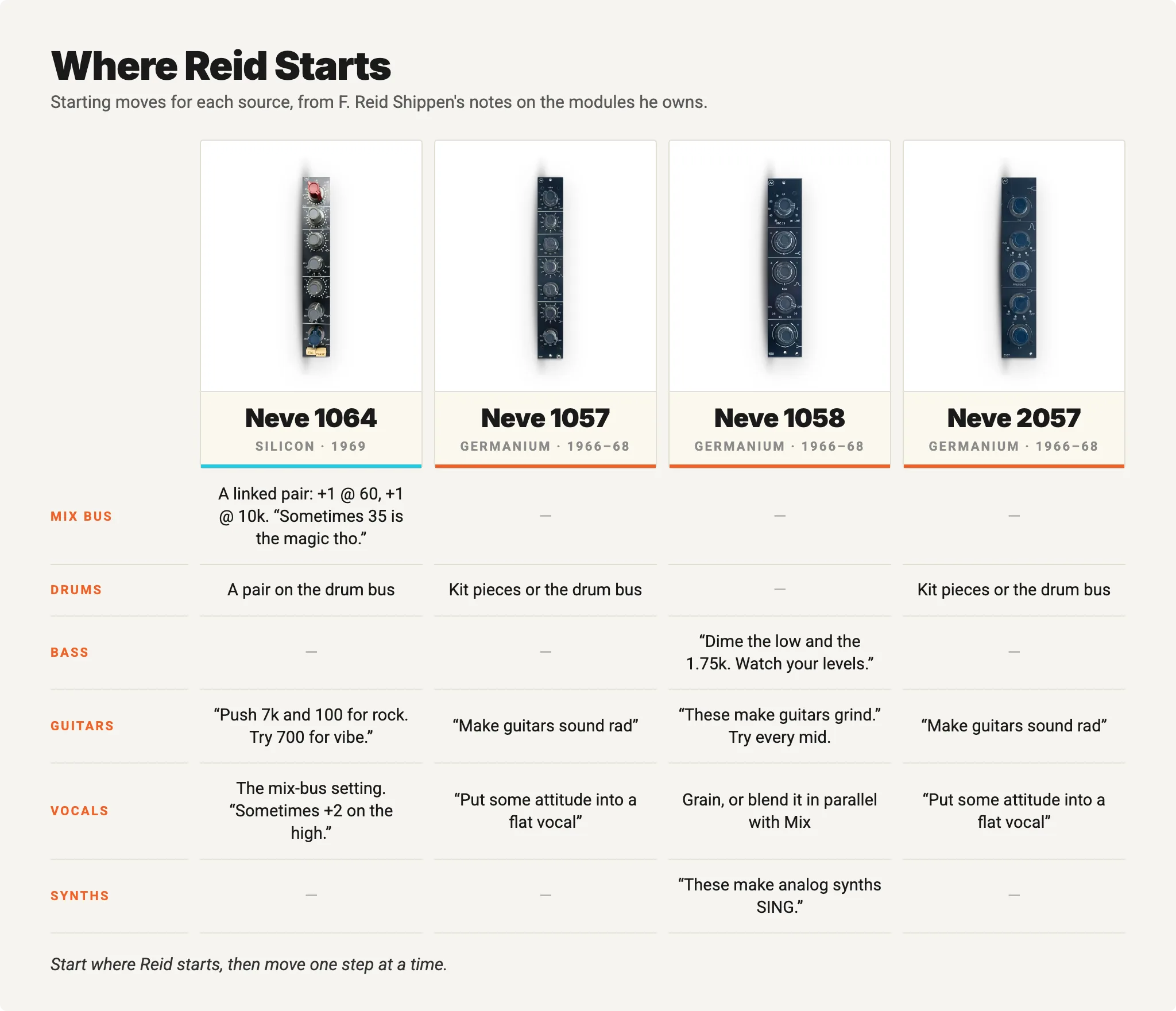
Reid's settings are starting points, not rules. With switched frequencies and robotic recall, any move you like is one you can repeat.
Load the Analog Matrix plugin, add a Neve module to your chain, and your audio goes through the real module and back into your session. Its gain and EQ controls are set robotically and recalled with your session.

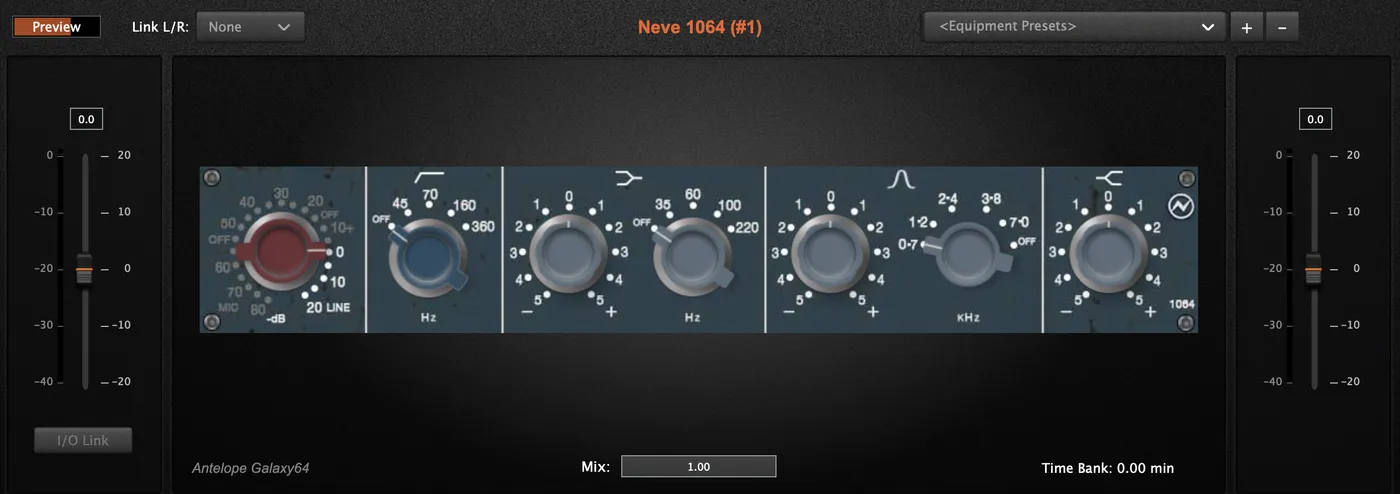
These are physical modules in our facility, controlled from the Analog Matrix plugin. Your track leaves the DAW through our converters, passes through the module's amplifiers and transformers, and returns to your session. There's no model in between. The plugin lays the module's gain and EQ controls out horizontally (in the rack the module stands vertically) and saves every setting with your session.
A few things to know:
You're sending recorded audio from your DAW, not a live microphone.
There's no single "correct" level to send. The level you send is the level the module's transformers see, so the same EQ settings sound cleaner at a modest level and thicker as you push. Match the output level when you compare against bypass, or louder will always win.
On the 1064, 1057, and 1058, only the line positions are available in the plugin (0, +10, +20). Stepping up from 0 toward +20 adds gain inside the module: a hotter signal through its amplifier and output transformer, and a louder return. Move one step at a time and match levels before you judge.
We have two of each module. Use Link L/R to run them as a matched pair on a stereo bus.
The Mix slider blends the processed signal with your dry track, which is how you get Reid's "parallel option" on the 1058.
Add a Neve module to a chain with other gear. A classic vocal chain is a Neve module into an 1176 and then an LA-2A. Karl Barnes of Loom Sound Studio summed it up as "Neve Preamp/UA 1176 into LA-2A for easy vocals, come on!" Our 1176 vs. LA-2A guide covers the compressor half.
Access. The 1064 and 1057 are included in the Elite tier of the Access Analog Subscription. The 1058 and 2057 are included from the Pro tier up. You can also reserve any of them outright from the reservation calendar on its product page. New accounts start with free credits to try them.
A vintage Neve pair on the mix bus used to mean owning, maintaining, and matching two modules approaching sixty years old. Now you can connect to the real thing right from your DAW.
The 1064 is the reason most people come to this corner of our rack. It's the refined silicon voice: Class A gain, a Marinair output transformer, and EQ points Rupert Neve picked so you don't have to. The 1057, 1058, and 2057 are its germanium elders, rougher and louder in personality, and in the right hands the sound of some very famous records. All four respond to how hard you drive them, and all four sound like hardware that has been doing this job for more than fifty years.
Start with a pair of 1064s on your mix bus at +1 @ 60 and +1 @ 10k, match the level, and hear what Reid hears.
What is the Neve 1064?
The Neve 1064 is a vintage Class A mic preamp and three-band EQ module from 1969. It shares its preamp and EQ circuit with the Neve 1066 in a longer 12-inch module, and was later fitted to Neve 80 Series consoles. Its EQ has a high-pass filter (45/70/160/360 Hz), a switched low band (35/60/100/220 Hz), a switched mid band (0.7/1.2/2.4/3.8/7 kHz), and a fixed high shelf.
Is the Neve 1064 the same as a Neve 1073?
No, but they're close relatives. The 1064 shares its preamp and EQ with the 1066, and the 1073 is essentially the 1066 with different EQ frequencies. So the 1064 and 1073 share a design approach (Class A amplifier stages and transformers in and out) but have different EQ points. F. Reid Shippen, who owns 24 channels of 1064s, prefers it: "Better low end and silkier highs than the 1073."
What's the difference between germanium and silicon Neve modules?
Neve's earliest modules, including the 1057, 1058, and 2057, used germanium transistors. By 1969, modules like the 1064 used silicon. Germanium devices are leakier, more temperature-sensitive, and less consistent than silicon, and the germanium modules are usually described as grittier and more forward. The silicon 1064 is typically heard as thicker and smoother.
Which vintage Neve module is best for drums?
The Neve 1057 and 2057. Michael Beinhorn, who used them on Superunknown, Celebrity Skin, and Mechanical Animals, considers them the best drum EQs there are, according to F. Reid Shippen. For the drum bus, Reid also recommends a pair of Neve 1064s.
Can I track a microphone through the Neve modules on Access Analog?
No. On Access Analog you process audio that's already in your DAW. It leaves through our converters at line level, passes through the real Neve module, and returns to your session. The modules act as EQ and color boxes for recorded tracks, buses, and mixes.
Does the level I send change the sound?
Yes. The level you send from your DAW is the level the module's transformers and amplifier stages see. Transformers saturate most at high levels and low frequencies, so pushing harder adds weight and harmonic density, especially in the bass. There's no single correct send level: treat it as part of the sound, and match output levels when you compare.
Can I use a vintage Neve module in stereo?
Yes. Access Analog has two of each module (1064, 1057, 1058, and 2057). Use the Analog Matrix's Link L/R setting to run a pair as a matched stereo unit on a bus or a full mix.
Who owns the vintage Neve modules on Access Analog?
Our vintage Neve units are from the personal collection of F. Reid Shippen. His notes on each module, including the settings quoted in this guide, are on each unit's product page.