
Ask a room full of engineers to name two passive tube EQs and you'll hear the same pair almost every time: the Pultec EQP-1A and the Manley Massive Passive.

They're often mentioned in the same breath for a good reason. The Massive Passive exists because studios kept asking Manley Labs for a "Super-Pultec." So it's fair to wonder whether the Manley is simply a bigger, better Pultec, and whether you need both. The short answer is that they're family, not twins.
The Massive Passive can do the Pultec's famous trick. That doesn't make it a better Pultec. It makes it a Pultec idea stretched across a whole mix.
Below, you'll meet the family, see the famous low-end trick done three ways, and find out which EQ to reach for on bass, vocals, the mix bus and a master, plus how to run both real units from your DAW with Access Analog.
Yes, by inspiration rather than by circuit. The Massive Passive grew out of studio requests for a "Super-Pultec," but Manley chose to design it from scratch instead of copying any part of the original.
Start with the parent. Pulse Techniques was founded in New Jersey by Gene Shenk and Ollie Summerlin, and the company's name was shortened to the trademark everyone knows: Pultec. Here's the twist most people miss. According to Hugh Robjohns' history in Sound On Sound, the first Pultec program equalizer came about because a former colleague of Summerlin's, who was building a mastering facility at MGM, encouraged them to make an EQ for professional recording and mastering. The EQP-1 followed in the early 1950s, and the Pultec EQP-1A arrived around the start of the 1960s. The original company closed in 1981, and Pulse Techniques builds the EQP-1A new again today.
Now the kid. Manley Labs had built Pultec-style equalizers for years (it still does), and engineers loved them. But studios kept asking for two things: a tube parametric EQ with modern features, and a "Super-Pultec." Manley considered combining the best bits of different Pultecs into one box, then decided that only made sense for a vintage re-creation. Instead, designer Craig "Hutch" Hutchison started from a blank page, and the Manley Massive Passive appeared in the late 1990s. It has been in production ever since.
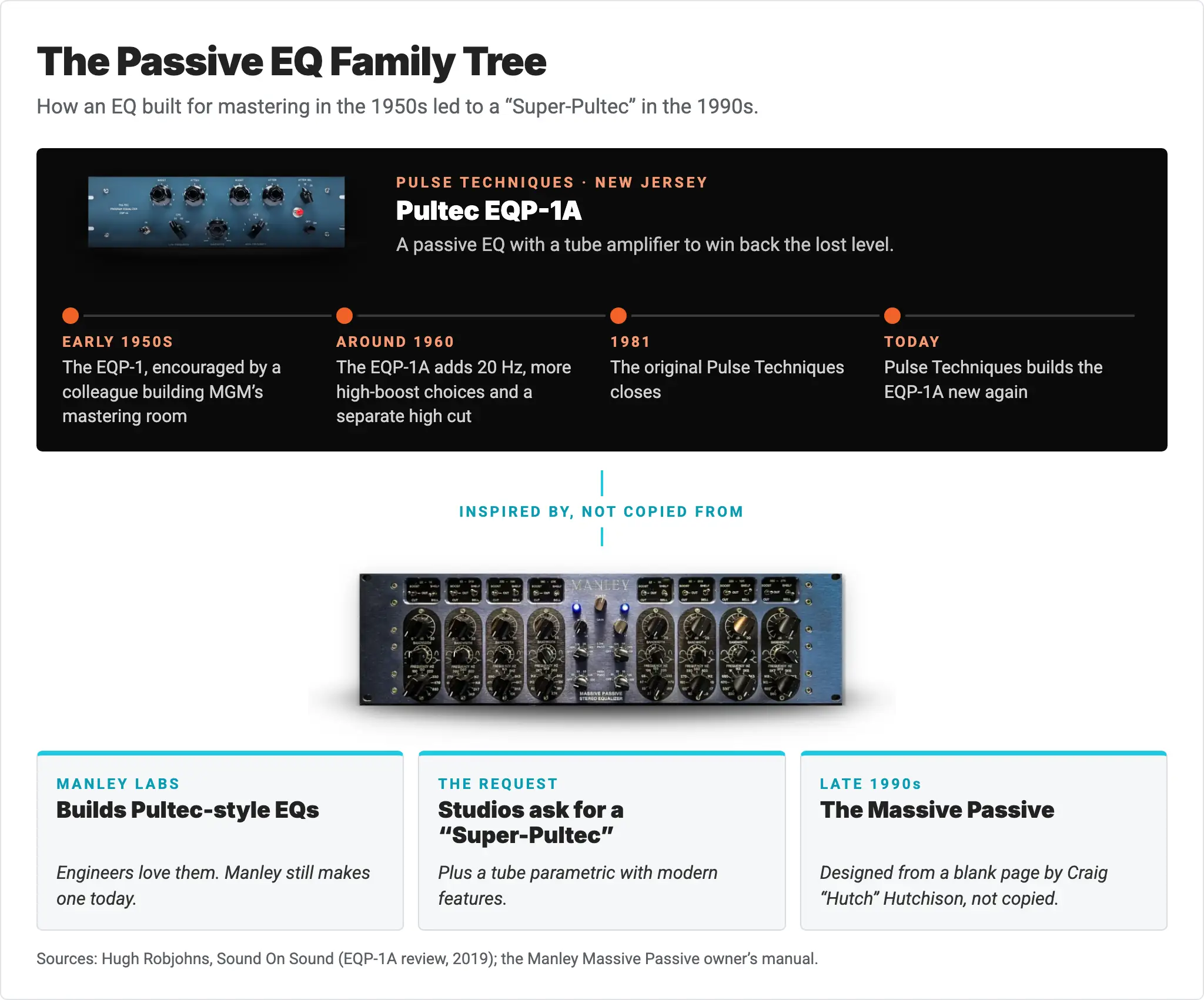
The Pultec was born for mastering. The Massive Passive was born from wanting more Pultec.
Both are passive equalizers with tube make-up gain. That one fact explains most of the family resemblance.
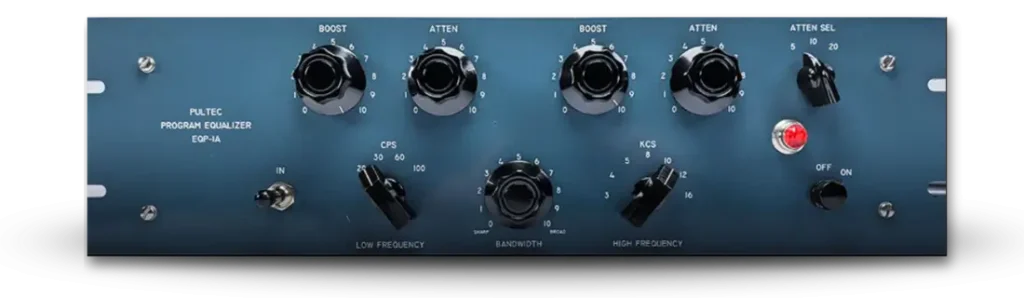
Two low knobs on one switch, and the curve that made it famous.
The Pultec EQP-1A is a mono program equalizer with three sections: low Boost and Atten sharing one frequency switch, a high boost with a Bandwidth knob, and a separate high cut. A tube amplifier after the passive network wins back the level the network loses.
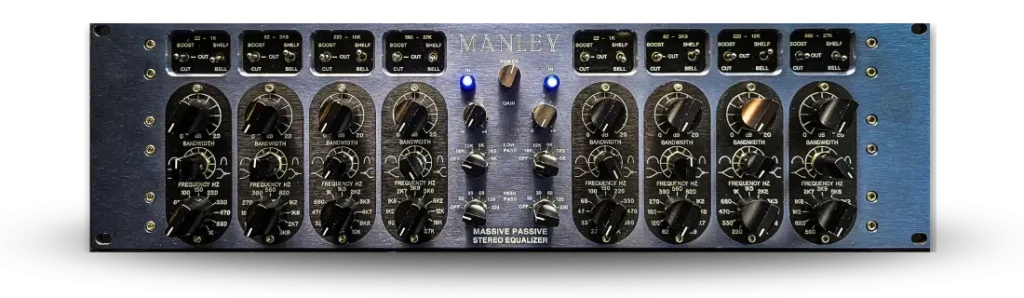
Four bands, and every one can be a shelf or a bell, a boost or a cut.
The Manley Massive Passive is a two-channel passive equalizer with tube make-up gain. Each channel has four bands with Gain, Bandwidth and an 11-position frequency switch, plus high-pass and low-pass filters.
A passive EQ network is built from inductors (coils), capacitors and resistors. It can't create gain. It can only take away less level in some places than in others. So a passive EQ always comes out quieter than it went in, and both units add a tube amplifier to give that level back. On the Pultec, the network costs roughly 20 dB. On the Massive Passive, which has four bands to feed, Manley puts the total loss at about 50 dB.
Think of it like a sculptor and a bricklayer. An active EQ adds bricks wherever you ask for them. A passive EQ only ever carves away, then the tube stage lifts the whole sculpture back up to size. Manley credits the natural interaction between those passive parts for an EQ that feels natural rather than contrived, and it's a big part of why engineers call both boxes "musical" rather than "surgical."
A few more family traits you'll notice the moment you touch either one:
Flat is fully counter-clockwise. There's no centre detent, and Manley's manual draws the Pultec comparison itself.
The numbers aren't decibels. On both units, the markings around a knob tell you where you are, not how many dB you're boosting. Set them by ear.
The curves are broad and forgiving. Neither box is built for notching out a single ringing frequency. They're built for big, smooth tonal moves that still sound natural.
If you want the full control-by-control tour, we've covered each unit on its own: our guide to the Pultec EQP-1A and our Massive Passive settings guide.
The Pultec trick is turning up both the low Boost and the low Atten knobs at the same frequency. It doesn't cancel out, because the two curves start in different places.
The Pultec's low section gives you one frequency switch (20, 30, 60 or 100 Hz) and two knobs. Boost lifts a shelf. Atten cuts one. You'd expect equal amounts to land you back at flat, and the original manual actually discouraged using both at once. Engineers did it anyway, and found something lovely. The cut begins turning in a little higher up the spectrum than the boost does. So when you add them together, you get a lift in the deep lows and a small dip just above it.
In practice, that means more weight under the kick or bass, with a little less of the boxy, muddy region that usually comes along for the ride. When Sound On Sound measured the curve with both knobs around 2.5, it showed roughly a 3 dB lift in the lows and a 2 dB dip in the low mids. Small numbers, big feel.
Where to start. In Sound On Sound's EQP-1A review, the measured sweet spots were 20 Hz for kick and 30 Hz for bass guitar, with modest amounts of both Boost and Atten. Those settings look too low on paper. They aren't, because the curves are broad and reach well above the number on the switch.
The Pultec trick isn't magic. It's two simple curves that start in slightly different places, and that small gap is where the "weight without mud" lives.
Yes, and it can do it three ways. This is where the "Super-Pultec" idea really pays off.
Route 1: one band, one extra knob. Manley's manual points out that the Pultec curve is "officially a shelf," and shelves don't normally have a bandwidth control. So Manley gave its shelves one. Switch a Massive Passive low band to shelf and boost, then turn its Bandwidth knob clockwise. The shelf grows a dip next to it, just like the Pultec's, and at fully clockwise that dip sits about 6 dB down at the marked frequency. Manley says these curves were modelled on the EQP-1A. One band now does what takes two knobs on a Pultec.
Route 2: two bands, the "on steroids" way. Because each of the four bands can boost or cut, you can also build the trick the long way: boost one low band, then cut the band above it. Karl Barnes built exactly this into our "Mix Bus – Clean Bass and Smooth Top" preset for the Analog Matrix, with a big boost at 100 Hz and an equal cut at 180 Hz. His note on it: "a Pultec trick on steroids." You'll find it, and the rest of his set, in our Massive Passive presets.
Route 3: upside down, on the top end. Here's the move a Pultec's low section simply can't make. Turn a Massive Passive high shelf's Bandwidth clockwise and you get the same shape, flipped: a lift in the air with a dip just below it. On the 16 kHz and 27 kHz shelves, that dip lands around 8 kHz, so you can open up the top while easing off the harsh, splashy region. Manley wrote that a curve like this had never been available on an analog high shelf before.
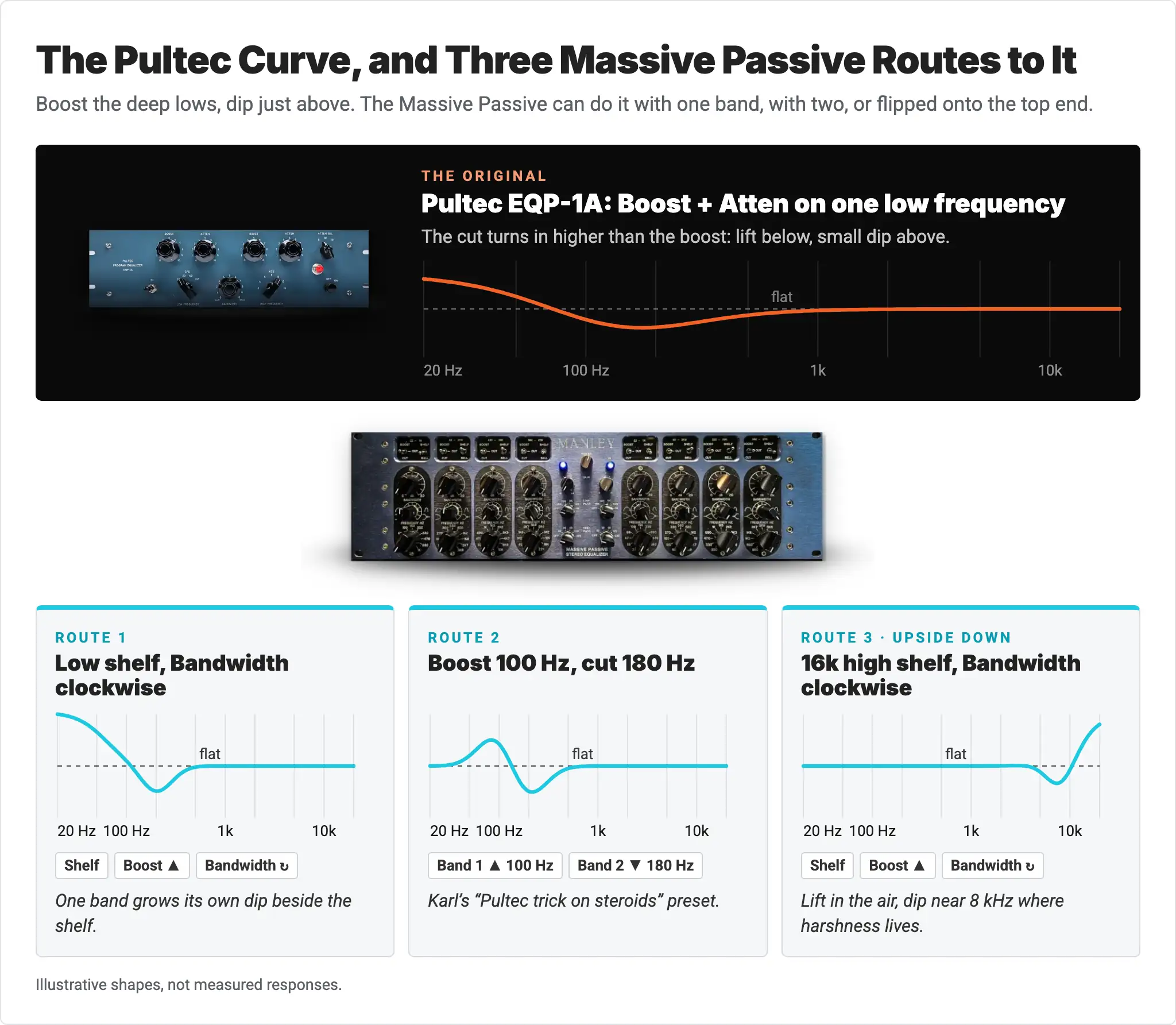
The Pultec found the curve by accident. The Massive Passive gives it its own knob and lets you point it at either end of the spectrum.
Past the shared trick, they're built for different-sized jobs. The Pultec is a mono unit with a few big, fixed moves. The Massive Passive is a stereo, four-band EQ where every band can do almost anything (the full spec is on Manley's Massive Passive page).
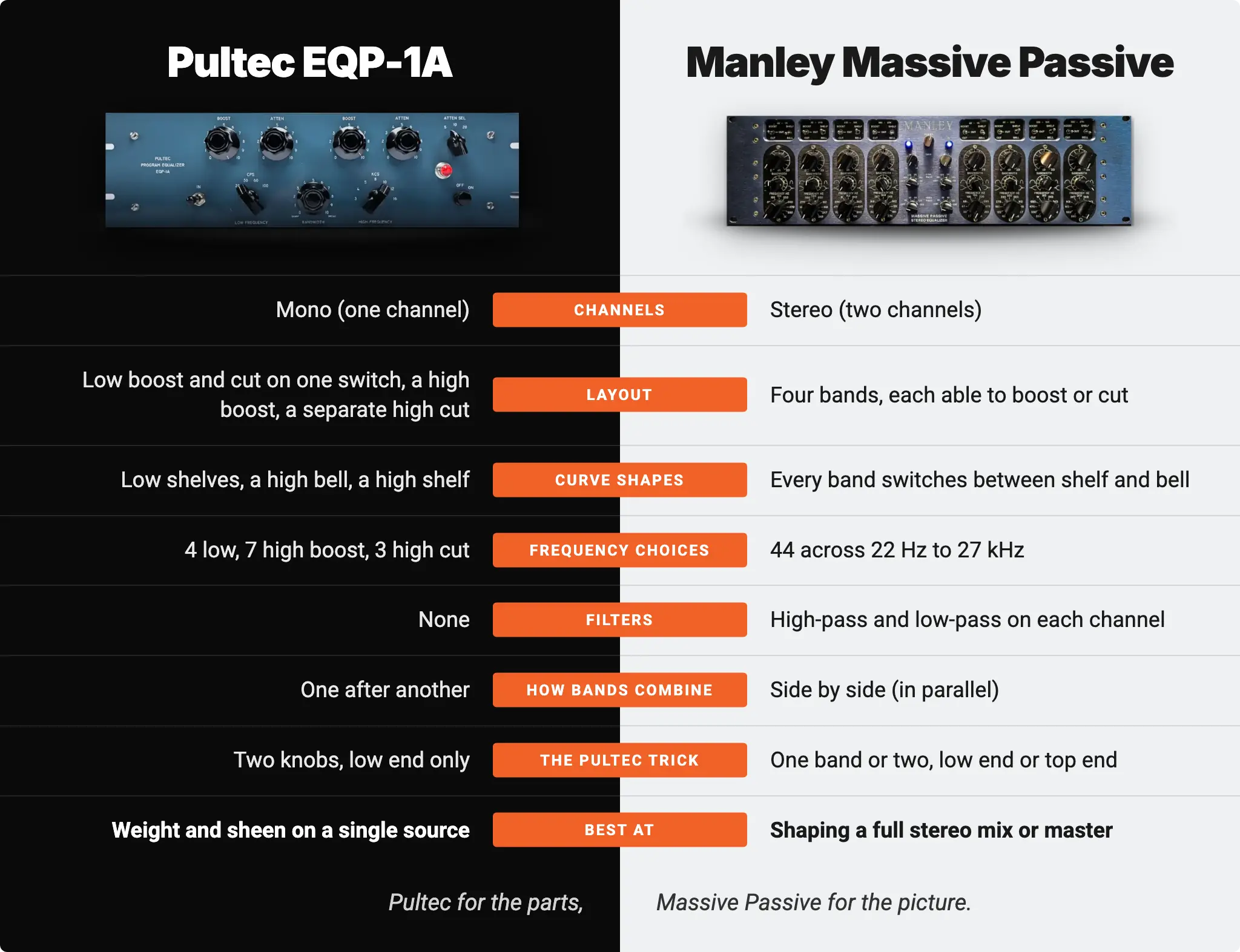
Two of those rows deserve a closer look.
Side by side, not one after another. On most EQs, including the Pultec, each section processes the output of the one before it. The Massive Passive's four bands sit next to each other instead. Manley says it chose that design partly because it sounds more natural, and partly to keep the level lost in the circuit manageable. The practical upshot: boosting two bands at the same frequency doesn't simply double the boost, so the Massive Passive rewards ears over habits.
Mono vs stereo. One Pultec is one channel. That's perfect for a bass track and useless on a stereo bus unless you have a second, matched unit. The Massive Passive is two channels out of the box.
Use the Pultec when one source needs more weight or sheen, and the Massive Passive when a whole stereo mix needs shaping. Here's how that plays out source by source.
Kick and bass: the Pultec. This is home turf. Low switch at 20 Hz for kick or 30 Hz for bass, a little Boost, a little less Atten, and the low end gets bigger and clearer in about ten seconds. It's hard to beat for speed.
Vocals: either, for different reasons. The Pultec's high boost is a broad bell between 3 and 16 kHz, and a gentle lift around 10 or 12 kHz is a classic way to add air and sheen without much effort. The Massive Passive gives you finer steering: body in one band, presence in another, air in a third. Karl's "Vox – Chesty Sparkly Magick" preset is a good place to start.
Mix bus: the Massive Passive. It's stereo, its moves stay smooth even when they're big, and it can clean up and flatter at the same time. A low shelf with a little Bandwidth, a gentle cut in the boxy mids, and an air shelf on top is a good mix-bus shape to start from.
Mastering: the Massive Passive, by tradition. Its high-pass filter even has a 22 Hz setting that Manley added at mastering engineers' request, to clear out subsonic rumble you might not hear but your meters will. It's also part of our Infrasonic Mastering Chain, which mirrors Pete Lyman's mastering console at Infrasonic Sound. For how EQ fits into a full analog master, see mastering with analog gear.
There's a nice irony here. The Pultec was built for mastering, and a matched pair is still a lovely way to warm up a master. But for most engineers today, the precision and stereo layout of the Massive Passive make it the mastering pick, and the Pultec has become the go-to for individual tracks.
Pultec for the parts, Massive Passive for the picture.
No. It's one of the most asked questions on the forums, and the answer comes straight out of everything above: they overlap on one famous curve and diverge almost everywhere else.
Pultecs give you the fastest route to a big, clean low end on a single source. They don't give you four bands of shelf-or-bell control, a top-end version of the trick, filters, or a stereo EQ for the bus. Go the other way and the Massive Passive can recreate the Pultec curve, but you'll miss the speed of two knobs and the Pultec's own sound.
Plenty of engineers use both in the same mix, and it makes sense. Put a Pultec on the bass to give it weight, then a Massive Passive on the mix bus to shape the whole picture.
Run the same track through each one, in the same session, at matched levels. That's the only comparison that really settles it, and it's exactly what Access Analog is built for.
Access Analog racks the real hardware in our Colorado facility and controls it robotically from your DAW through the Analog Matrix plugin. This isn't an emulation. Your settings save with your session, so recall is exact. On the Pultec side there are two EQP-1As, Pulse Techniques reissues, which run as a linked stereo pair. That makes a stereo Pultec pass on a mix bus or master possible without sourcing and matching two units yourself. We also rack a Warm Audio EQP-WA, a modern take on the same design, if you want a third opinion.
The Massive Passive is also on our Analog Switch, so it can link to other units on the switch without leaving the analog domain: one D/A in, one A/D out. Read more in Introducing Analog Switching.
Both the Pultecs and the Massive Passive are included with the Elite tier of the Access Analog Subscription. You can also reserve a session on either one, or use credits, and every new account gets 12 free credits to try them.
A simple A/B to start with: bounce the same bass-heavy section of your mix. Print it once through the Pultecs using the low-end trick, and once through the Massive Passive using a low shelf with Bandwidth turned clockwise. Level-match the two prints and listen to the bass and the low mids. You'll hear the family resemblance, and you'll hear exactly where it ends.
The Pultec EQP-1A gave the world a curve so good that engineers broke the manual's rules to use it. Decades later, studios asked Manley for more of that, and Manley answered with an EQ that does the Pultec's trick in one band, flips it for the top end, and adds three more bands, filters and a second channel.
So "Super-Pultec" fits, just not the way people mean it. The Massive Passive didn't replace the Pultec. It took one great idea and built a mastering toolbox around it, while the Pultec stays the fastest way to give one sound a bigger, cleaner bottom.
Put the parent on the bass and the kid on the bus. Then hear both on your own mix and decide for yourself.
Is the Manley Massive Passive a Pultec clone?
No. The Massive Passive grew out of studio requests for a "Super-Pultec," but Manley designed it from the ground up rather than copying any part of the Pultec circuit. It's a two-channel, four-band passive EQ with tube make-up gain, and each band can switch between shelf and bell and between boost and cut. It can reproduce the Pultec's signature low-end curve, but it's a very different instrument overall.
Can the Massive Passive do the Pultec low-end trick?
Yes. Set a low band to shelf and boost, then turn its Bandwidth control clockwise, and the shelf gains a dip beside it, which is the Pultec's boost-plus-dip shape. Manley says these shelf curves were modelled on the Pultec EQP-1A. You can also boost one band and cut the next band up, or apply the same shape to a high shelf for extra air with the harsh region pulled back.
Which is better for mastering, the Pultec or the Massive Passive?
Most engineers reach for the Manley Massive Passive for mastering today, because it's stereo, has four flexible bands, and has high-pass and low-pass filters, including a 22 Hz high-pass added at mastering engineers' request. The Pultec EQP-1A was originally created for mastering and still sounds wonderful on a master, but it's mono, so it needs a matched pair. Access Analog offers both, including a linked stereo pair of Pultecs.
Is the Pultec EQP-1A stereo?
No. The Pultec EQP-1A is a single-channel (mono) equalizer, so stereo work needs two units matched to each other. Access Analog racks two Pultec EQP-1A units that run as a linked stereo pair, so you can use them on a mix bus or master without sourcing a pair yourself.
What frequency should I use for the Pultec trick on kick and bass?
A good starting point is 20 Hz for kick drum and 30 Hz for bass guitar, with modest amounts of both Boost and Atten. These settings come from Sound On Sound's measured review of the EQP-1A. They look low, but the Pultec's curves are broad and affect frequencies well above the number on the switch.
Do I need both a Pultec and a Massive Passive?
You don't need both, but they do different jobs well. The Pultec is the fastest way to add weight and clarity to a single source like a kick, bass or vocal. The Massive Passive is better for shaping a full stereo mix or master with precision. Many engineers use a Pultec on individual tracks and a Massive Passive on the mix bus.
How can I try a real Pultec and Massive Passive without buying them?
Access Analog racks real Pultec EQP-1A units and a real Manley Massive Passive, controlled robotically from your DAW through the Analog Matrix plugin. Both are included with the Elite tier of the Access Analog Subscription, and you can also reserve sessions or use credits. New accounts get 12 free credits to try them on your own mix.