
Push an ordinary EQ hard and you can hear the moment it turns on you. The top end gets glassy, the esses jump out, and the low end swells into mud.
The Manley Massive Passive is famous for doing the opposite. Engineers dial in settings that look reckless on the panel and hear something that sounds natural, open, and finished. That isn't magic, and it isn't luck. It comes from a handful of unusual design decisions, and once you understand them the box stops being mysterious and starts being fast. This guide covers how the Massive Passive works, why its knobs don't "read" like other EQs, what every control does, six starting settings, and how to run the real unit from your DAW with Access Analog.
Set the Massive Passive by ear, not by eye. The panel will lie to you; the speakers won't.
The Manley Massive Passive is a two-channel, four-band tube equalizer built by Manley Laboratories in California. Its tone-shaping network is entirely passive: metal-film resistors, film capacitors, and hand-wound inductors. Each band can switch between shelf and bell, the four bands cover 22 Hz to 27 kHz across 44 frequency choices, and each channel adds passive high-pass and low-pass filters.
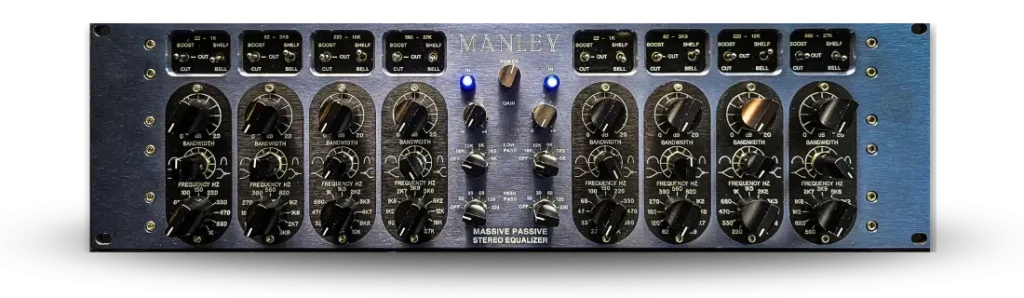
It started as a request. Manley had built Pultec-style EQs for years, and studios kept asking for a tube parametric and a "Super-Pultec," with switched frequencies and character rather than clinical precision. The design came from Craig "Hutch" Hutchison, Manley's chief designer from 1996, and it has stayed in production ever since: Manley marked its 25th year with the limited XXV edition in 2023, circuit unchanged.
A note on versions. Manley also builds a Mastering Version with detented controls, an 11 dB maximum boost or cut, and mastering-specific filters. Our rack has the standard Massive Passive, and every setting in this guide describes that version. For a quick primer, see our five reasons to use the Massive Passive.
Manley set out to build a Super-Pultec and ended up with something that isn't a Pultec at all.
A passive EQ shapes tone with components that need no power (resistors, capacitors, and inductors) and can only take level away; an active EQ builds its curves with amplifying circuits, usually op-amps in a feedback loop. In a passive design, a "boost" is really less cut, so the network loses level and a separate amplifier has to restore it.
On the Massive Passive that loss is large. Manley's manual puts it at about 50 dB through the EQ circuit, which is why each channel carries two all-tube gain stages (each pairs half of a 5751 for voltage gain with a 6922 for current drive) to bring the signal back to unity. The boost section and filters feed the first make-up stage, the cut section follows, and the second stage drives the outputs.
Why bother? As Manley tells it, almost every EQ since the mid-1970s swapped real inductors for op-amp circuits that imitate them, because chips got cheaper than coils. Manley went the other way, and kept the EQ out of a negative-feedback loop too. That's why flat is fully counter-clockwise on every Gain knob, as on a Pultec EQP-1A, not at 12 o'clock.
One myth: passive EQs have no special "no phase shift" property. Any analog EQ (and most digital ones) shifts phase in step with its curve shape, as Manley's manual says plainly. The audible differences come from Q, topology, headroom, and how the inductors behave under real signal.
A passive EQ doesn't push your signal into a new shape. It takes away what you don't want, then tube stages give the level back.
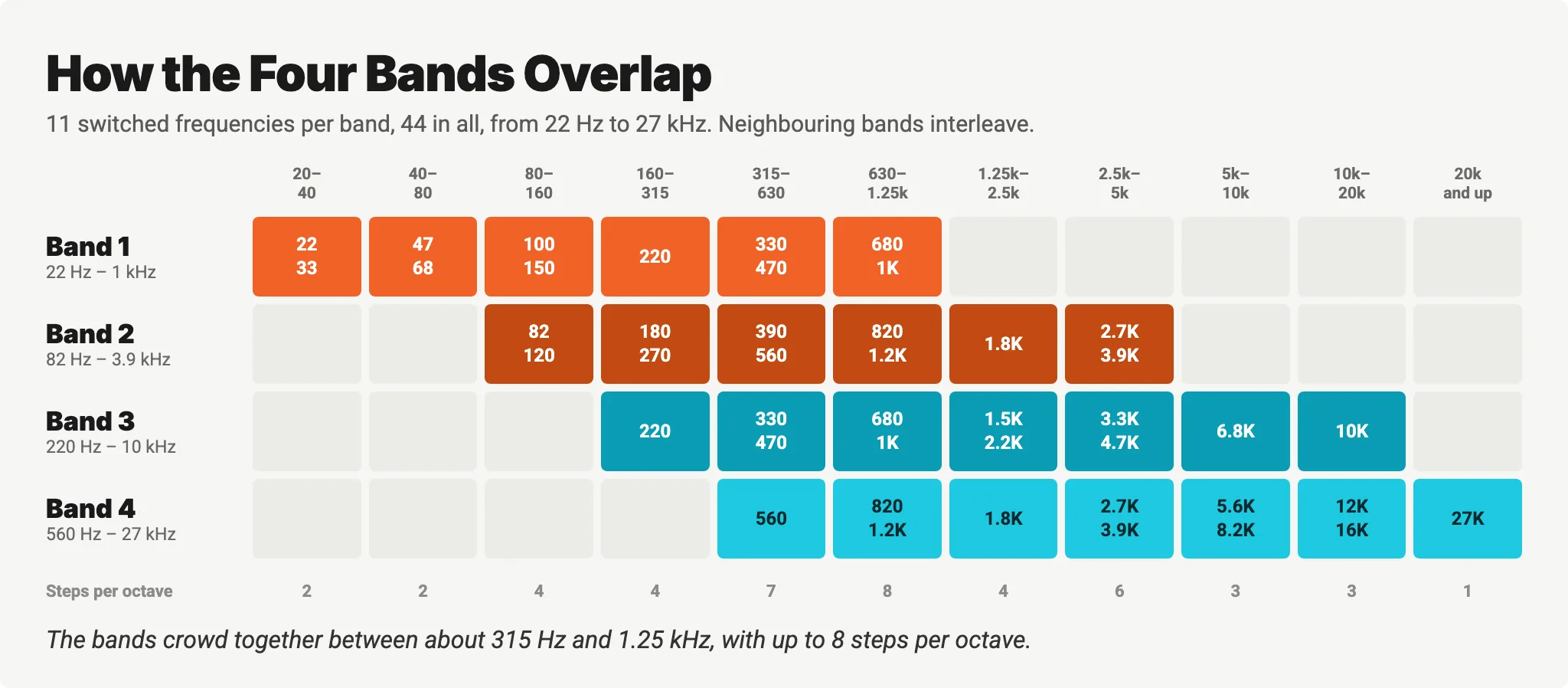
Each band has an 11-position frequency switch, and the ranges deliberately overlap and interleave so you can put two bands near the same region without landing on the same frequency.
Every band has two toggles above its knobs. Shelf/Bell sets the curve shape: the two left bands shelve the lows, the two right bands shelve the highs, and any band can be a bell. Boost/Out/Cut sets direction, and Out is a hard bypass for that band alone.
That toggle is one of the most useful things on the panel. Because Gain only sets depth, you can flip a band from Boost to Cut without losing its setting, which suits the classic hunting technique Bob Katz describes in Mastering Audio: exaggerate a problem with a boost, find it, then cut. And Out is a true zero, which a center-detented pot rarely is.
Overlapping bands mean you can stack two gentle moves instead of one heavy-handed one.
Because the four bands run in parallel and the Gain and Bandwidth controls interact by design, so a knob position never maps to a fixed number of dB. This is the single most important thing to understand about the box (the Manley owner's manual spends pages on it), and it's why the presets built for our rack can look so extreme on screen and sound so restrained.
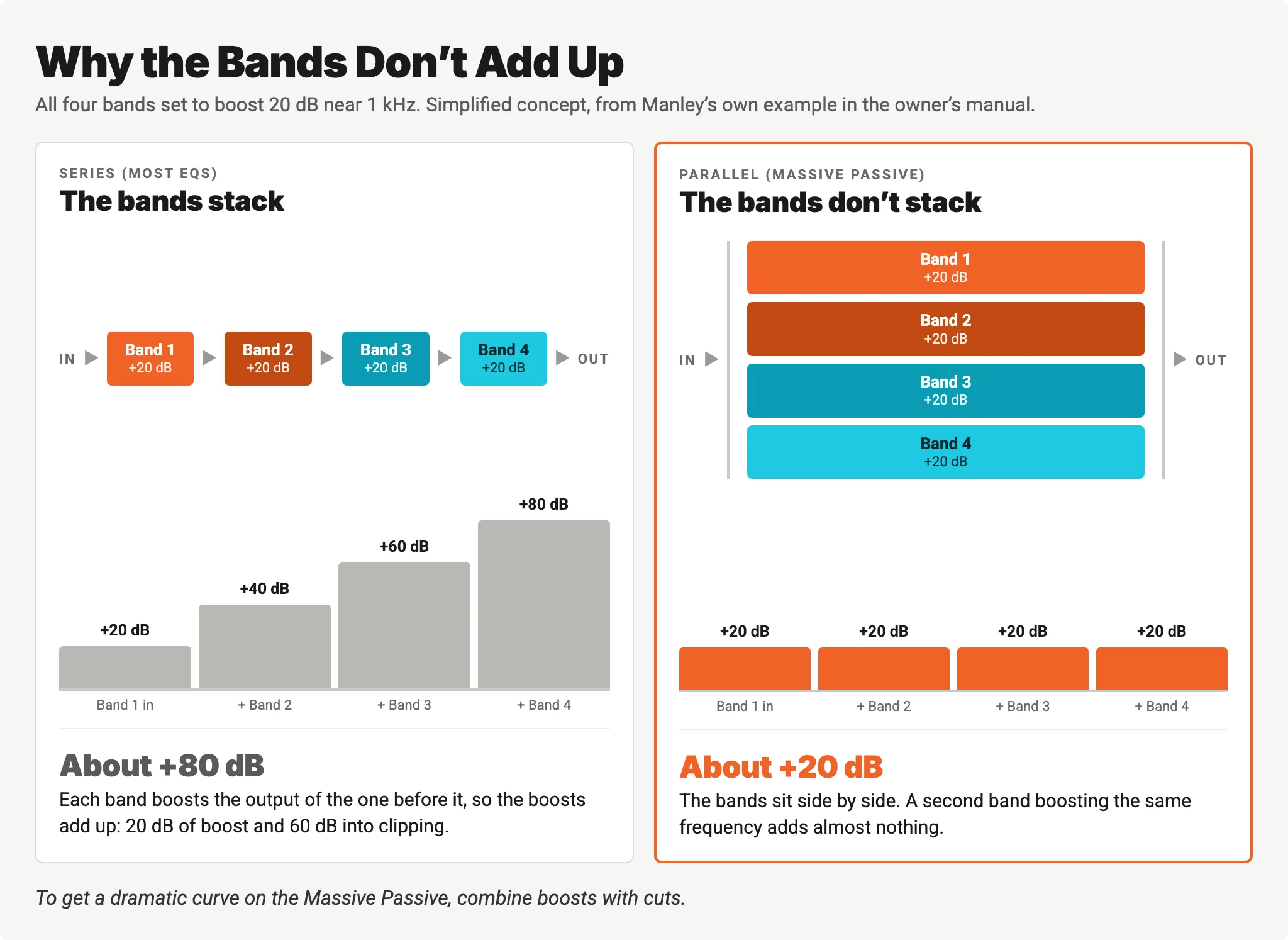
The bands don't add up. On a conventional series EQ, each band processes the output of the previous one, so three bands boosting the same frequency by 15 dB give you 45 dB and a distorted mess. The Massive Passive's bands sit side by side. Set all four to boost 20 dB near 1 kHz and the total is still about 20 dB. Boost four widely spaced frequencies and you mostly get the same tone, louder, and a second band boosting near the first will seem to do very little. To get a dramatic curve, you combine boosts and cuts, which nudges you toward how good engineers already EQ: gently, with more cutting than boosting.
Bandwidth changes how far Gain can go. In bell mode, the full 20 dB of boost or cut is only available at the narrowest Bandwidth (fully clockwise); at the widest it's about 6 dB. So a wide bell with the Gain cranked can be a gentler move than it looks. On the bells, the widest setting is roughly Q 1 on Band 1 and Q 1.5 on the others; the narrowest is about Q 2.5 to 3. Nothing on the Massive Passive is surgical, by design.
A shelf's frequency is its halfway point. Manley labels a shelf at the point where it reaches half its boost. A 20 dB shelf at 100 Hz is boosting about 10 dB at 100 Hz and doesn't reach the full 20 dB until below about 30 Hz. So you'll often pick shelf frequencies closer to the mids than you expect.
Bandwidth reshapes the shelves. This is the Massive Passive's signature. Fully counter-clockwise, a shelf looks like almost any other EQ's shelf and can reach the full 20 dB. Turn Bandwidth clockwise and the shelf picks up a bell in the opposite direction: a boost gains a dip on its midrange side and a steeper slope. At fully clockwise the dip is about 6 dB at the marked frequency and the shelf peaks around 12 dB. That's the Pultec boost-and-attenuate shape from one band, on the highs as well as the lows. Katz singles out this "resonant shelf" in Mastering Audio as a useful mastering curve, a shape he traces to psychoacoustician Michael Gerzon. Manley suggests starting shelf Bandwidth between 11 and 1 o'clock.
The extremes are voiced differently. The 22 Hz and 33 Hz low shelves turn the Bandwidth control into a high-pass as you turn it clockwise, so you can't accidentally boost useless subsonic energy. The 16 kHz and 27 kHz high shelves move their Bandwidth dip down to around 8 kHz, which gives you a lot of air while pulling back the sibilance region. One warning: at high Bandwidth settings, a big 10k or 12k shelf boost can sound duller, because you hear the dip while the boost sits at the edge of hearing. If a boost sounds like a cut, turn the Bandwidth back.
On the Massive Passive, big-looking settings can be gentle moves. Trust what you hear, not where the knobs point.
Each band has three knobs and two toggles; the center section adds filters, gain trims, and the EQ In switch.
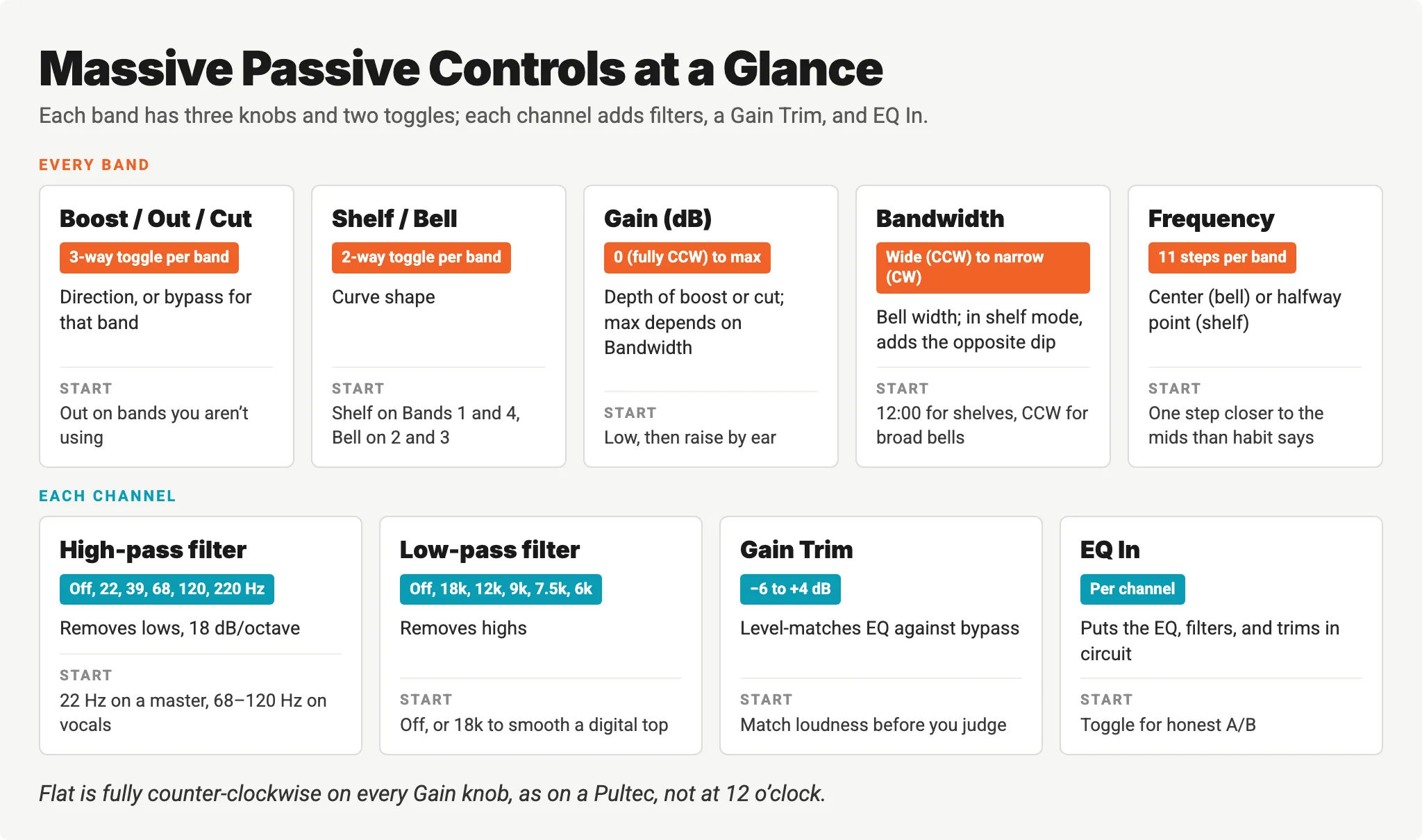
The panel's Gain scale reads 0 to 20, but treat it as a scale, not a promise (see above). The Gain Trims have a deliberately small range so they're easy to set precisely, and their whole job is honest comparison: an EQ that makes things louder almost always wins a quick A/B.
If the EQ only sounds better when it's louder, it isn't better.
The filters are passive too, and Manley tuned each position for a specific job.
High-pass (18 dB/octave, no bumps, no resonances).
Low-pass.
The filter-plus-shelf low end. One of the best tips in the manual: set the high-pass somewhere between 25 and 50 Hz (39 Hz on this unit) and add a low shelf boost between 100 and 200 Hz. The result is close to a bell boost in shape, but it sounds drier, tighter, and still huge, because the shelf rings less than a bell and the filter keeps the very bottom under control.
A filter and a shelf together can give you a bigger low end than a boost alone, and a cleaner one.
These are starting points for your ears, built from Manley's own technique notes and the presets Karl Barnes, mixing and mastering engineer at Loom Sound Studio, made for our rack. They're written as band, shape, frequency, and direction rather than dB, because on this EQ the dB depends on everything else.
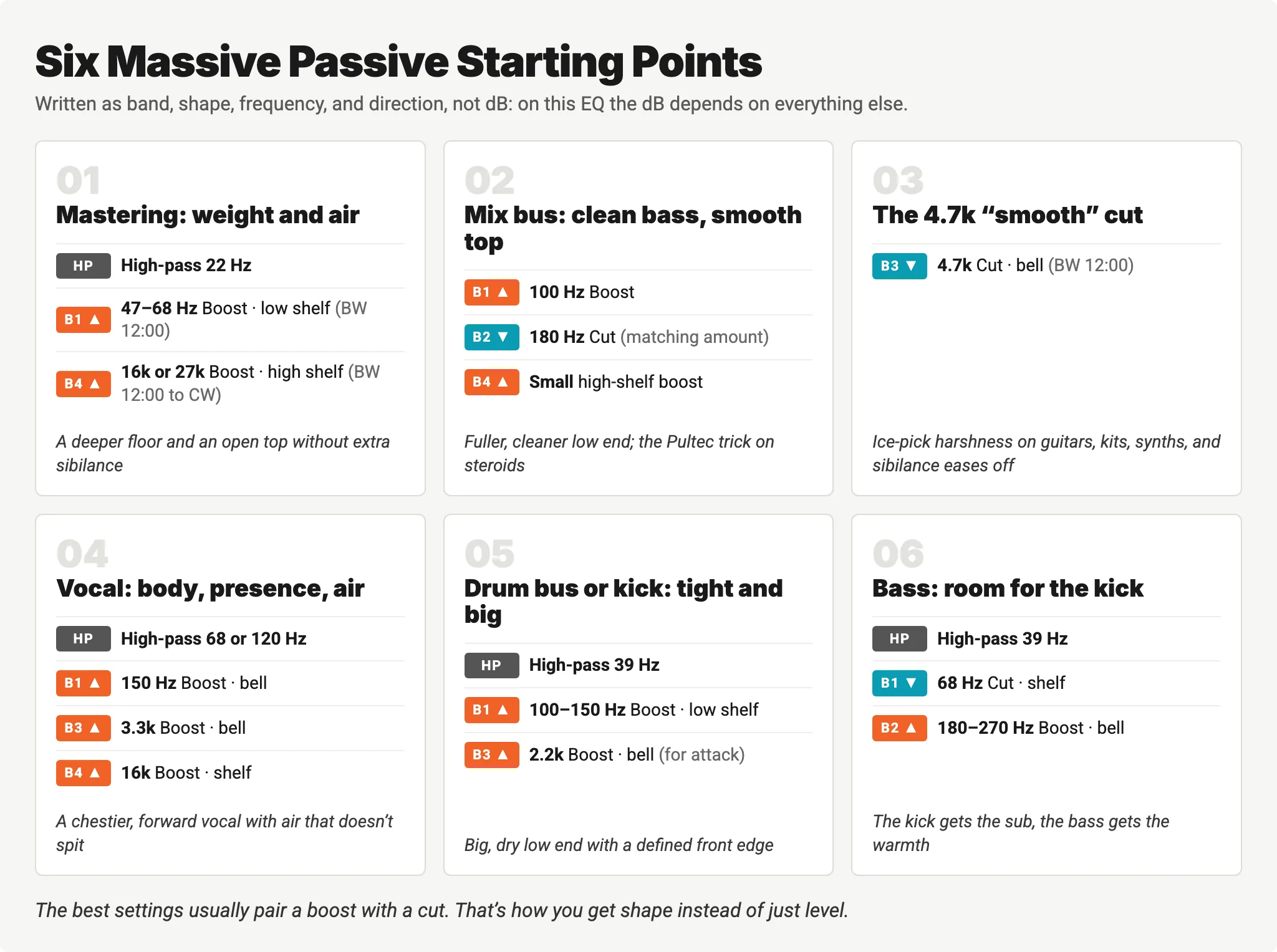
1. Mastering: weight and air. Bring the Band 1 shelf up slowly until the bottom feels settled, not bigger. The 16k and 27k shelves are the ones voiced with a dip near 8 kHz, so turning their Bandwidth toward clockwise trades sibilance for air. If the mix is a touch thick, add a small bell cut between 220 and 470 Hz. Manley says engineers can apply more EQ on this box before it sounds processed; on a master, treat that as a safety margin, not a target.
2. Mix bus: clean bass, smooth top. Our "Mix Bus – Clean Bass and Smooth Top" preset boosts 100 Hz hard and cuts 180 Hz by the same amount. The two curves interact into a fuller, cleaner low end, much like a Pultec's simultaneous boost and attenuate. Experiment with the depth, keeping the two amounts equal.
3. The 4.7k "smooth" cut. A Band 3 cut at 4.7 kHz is the golden cut on this box, the fastest way to soften ice-picky harshness. Start modest.
4. Vocal: body, presence, air. This follows our preset "Vox – Chesty Sparkly Magick": 150 Hz for body, 3.3 kHz to bring the vocal forward, a touch of top. Turn the 16k shelf's Bandwidth toward clockwise for air without esses. And Manley's advice: if you're boosting a lot of highs, try dipping the mids and boosting the highs less.
5. Drum bus or kick: tight and big. This is the filter-plus-shelf trick, with Manley's 2.2 kHz boost for attack. Our "Drum Kit" preset is an alternative for a full kit: a fairly narrow 150 Hz boost for the kick, 1k and 1.2k for snare life, and a lift around 8 kHz for the hats. Avoid big narrow bells on drums; transients excite ringing and the EQ becomes obvious.
6. Bass: room for the kick. Decide which instrument owns the sub. If it's the kick, a shelf cut below 68 Hz is smoother than a filter. If the bass sounds tubby, Manley points to cutting somewhere between 82 and 220 Hz.
On the Massive Passive, the best settings usually pair a boost with a cut. That's how you get shape instead of just level.
Yes, and its odd shelf behavior is what makes it good at it.
Every rule on this EQ has a creative flip side. The settings that misbehave on a master are the ones that make a guitar sing.
Less than its reputation suggests. On Manley's published spec sheet, the Massive Passive measures 0.006% THD+N at +4 dBu, with a maximum output of +35 dBu and 31 dB of headroom. Manley says plainly that it doesn't use tubes for distortion. The tube stages run from 300 V rails for one reason: so an engineer can boost 20 dB at 100 Hz and the circuit can still deliver it cleanly.
So where does the character people hear come from? Three places, all from the passive parts rather than the tubes.
Inductor saturation in the low shelf. On a heavy low-shelf boost with loud bass, the inductor starts to saturate and loses inductance, so the boost eases off, a little like a low-frequency limiter built into the EQ. Manley designed the coils to do this at the right point.
A slight frequency shift in the bells. In the mid bands, the center frequency moves slightly with the waveform and envelope of the signal. Manley describes it as a subtle modulation rather than harmonic distortion, and as the recognizable signature of vintage inductor EQs.
The output transformer. Manley credits transformers for much of why vintage gear sounds "warm": a little odd-harmonic content on very low frequencies makes bass read as richer on small speakers while still measuring flat. The Massive Passive's custom output transformer uses a feedback winding to keep that coloration minimal, so it's a seasoning, not a sauce.
Manley's manual makes the point with an acoustic guitar: the string drives the bridge, the bridge drives the soundboard, the body resonates back into the string, and nothing is isolated from anything else. Nobody calls that interaction a flaw; it's why the instrument sounds alive. The Massive Passive's interacting bands and working inductors are the electronic version of that. If you want obvious tube harmonics, that's a job for a dedicated saturation box like the Black Box HG-2. You can drive the Massive Passive harder on purpose (Manley suggests a boost and a cut on the two low bands to work the EQ section hard), but its default is clean. For what plugins model and what they miss, see Analog Hardware vs. Plugins.
The Massive Passive's character lives in its coils, not its tubes.
The Massive Passive has been a mastering staple for more than two decades, and a few habits come up again and again.
Broad strokes first. Nothing on the box is narrow, so it's built for tonal balance, not notching. Manley's advice is to use the Massive Passive for the bulk of the EQ and a more surgical EQ for narrow touch-ups.
Resonant shelves for low-end control. The resonant shelf adds weight below a frequency without thickening the low mids above it. Start the Bandwidth at 12 o'clock and listen just above the shelf frequency as you turn it.
EQ before the compressor. EQ-then-compress is common practice in mastering (not the only valid order). The classic Manley pairing is the Massive Passive into a Manley Variable Mu: shape the tone, then let the vari-mu glue it. For the bigger picture of building a chain, see Mastering with Analog Gear.
Mid/side. Manley pitches the Massive Passive for mid/side work because its mid bands stay smooth when pushed: one channel EQs the mid, the other the sides. If M/S is new to you, start with Demystifying Mid/Side Processing.
In mastering, the Massive Passive does the big, musical moves. Let something surgical do the small ones.
Access Analog racks a real Manley Massive Passive in Colorado that you control from your DAW:
The Massive Passive is also on our Analog Switch, so it can link to other switch units, such as the Variable Mu, without leaving analog: one D/A in, one A/D out. On an analog hop the plugin's gain, Mix, bypass, and Mid/Side controls are off, so use the unit's own EQ In and Gain Trims. Introducing Analog Switching explains how it works.
The Massive Passive is included in the Elite tier of the Access Analog Subscription, and plans start at $9.98 a month. Not subscribed? You can reserve a session on the unit or use credits, and every new account gets 12 free credits to try it.
The Massive Passive was built for engineers who trust their ears. Now you can put yours on the real one.
The Massive Passive asks you to forget some habits. The knobs don't read in dB, the bands don't stack, and the shelves bend in ways no other EQ's do. Once you stop fighting that, it gives back something rare: big moves that still sound natural, low end that grows without going to mud, and highs that open up without spitting. That comes from hand-wound coils, a parallel topology, and tube stages built for headroom, not from a preset or a mystery.
Put your next mix through the real Massive Passive, and let your ears set the knobs.
Is the Manley Massive Passive good for mastering?
Yes. The Massive Passive has been a mastering staple for more than two decades because its broad, interacting curves suit overall tonal balance and its parallel bands let you apply more EQ before a master sounds processed. Access Analog racks the standard version and handles recall through the Analog Matrix plugin.
Why don't the Massive Passive's knob settings match the dB I hear?
The Massive Passive's four bands run in parallel, so they don't add together, and its Gain and Bandwidth controls interact: a wide bell maxes out around 6 dB, and the full 20 dB only appears at the narrowest Bandwidth. Shelf frequencies are marked at the halfway point of the boost. Set it by ear and level-match with the Gain Trims.
Is the Massive Passive just a Pultec?
No. It grew out of studio requests for a "Super-Pultec," and it can produce the Pultec's boost-plus-dip low-end curve from a single band using the Bandwidth control in shelf mode, on the highs as well as the lows. But it has four bands, each switchable between shelf and bell and between boost and cut, plus high-pass and low-pass filters, and its bands run in parallel rather than in series. We compare the two head to head in Pultec EQP-1A vs Massive Passive.
Does the Manley Massive Passive add tube saturation?
Not much by default. Manley specifies 0.006% THD+N and up to +35 dBu of output, and uses the tubes for headroom rather than distortion. Its character comes mainly from the passive parts: low-shelf inductors that saturate gently on heavy boosts, a slight bell frequency shift with the signal, and the output transformer.
What's the difference between the standard and Mastering Version Massive Passive?
The Mastering Version has detented Gain and Bandwidth controls, an 11 dB maximum boost or cut instead of 20 dB, mastering filters (high-pass 12 to 39 Hz, low-pass 15 to 52 kHz), and stepped half-dB gain trims. The standard version, which Access Analog racks, has continuous controls and filters that reach into the mids for mixing and creative work.
Can I use a Manley Massive Passive without buying one?
Yes. Access Analog racks a real Manley Massive Passive that you control from your DAW through the Analog Matrix plugin, with robotic recall of every setting. It's included in the Elite tier of the Access Analog Subscription, and you can also reserve sessions or use credits; new accounts get 12 free credits.