
A passive equalizer cannot make anything louder. That single limitation is the reason the Pultec EQP-1A sounds the way it does.
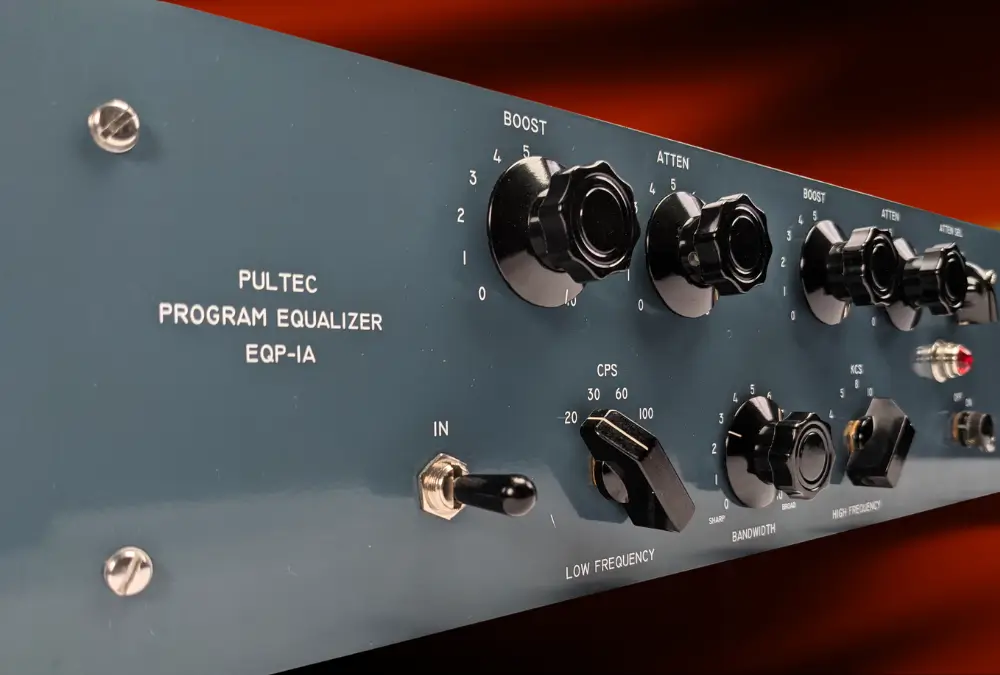
The EQP-1A shapes tone with nothing but coils, capacitors and resistors. No amplifier is involved in the filtering. But a network like that cannot create gain, only remove less of it in some places than others, so the whole unit loses roughly 20 dB going through the filter. Pulse Techniques put a valve amplifier after the network to give that 20 dB back. The result is that every EQ move you make on an EQP-1A arrives at the output having also passed through two triodes and three transformers, and there is no setting that takes them out of the path.
This guide covers what the passive L-C network actually does, why boosting and cutting the same frequency produces a useful curve instead of silence, what all eight controls do (including the two most articles forget), and where to start on kick, bass and vocals. The Pultec EQP-1A and the Warm Audio EQP-WA are both on the Access Analog rack, so you can run these settings on your own material today.
Key Takeaways
The EQP-1A does not compute a curve and apply it. An inductor and a capacitor present different impedances at different frequencies, and the filter shape is whatever falls out of that arrangement.
Start with the component behaviour, because everything else follows from it. An inductor is a coil of wire around a magnetic core, and it passes low frequencies easily while opposing high ones. A capacitor does the opposite. Wire them into a network with some resistors and you have a circuit whose impedance, meaning its opposition to current, is different at every frequency on the dial. Feed audio through it and some frequencies get through more easily than others. That is the entire filtering mechanism. Nothing is amplified, nothing is measured, nothing decides anything.
Here is the consequence that defines the unit. A passive network can only attenuate. When you turn up the Boost control on an EQP-1A you are not adding level at 60 Hz. You are arranging the network so that 60 Hz is attenuated less than everything around it. Manley's engineers put it plainly when they designed the Massive Passive: a passive EQ circuit of that kind eats gain, and without an amplifier to follow it you would have to return the signal to a mic preamp just to get back to line level.
The original Pultec network loses about 20 dB. That loss has to come back, so the EQP-1A includes a valve make-up amplifier: a 12AX7/ECC83 for voltage gain, a 12AU7/ECC82 driving the output stage in push-pull, and a 6X4 valve rectifier in the power supply. Three transformers sit in the path as well: a Triad HS-5G input transformer for balanced interfacing, a Triad HS-29 coupling the filter into the amplifier, and a Peerless S-217-D output transformer that drives the line and forms part of the negative-feedback loop.
Pultec's own installation instructions put it in one sentence. The EQP-1A consists of a passive equalizer, an amplifier and a self-contained power supply, and the amplifier restores the insertion loss of the equalizing network, "thus providing a no loss, no gain unit." The original spec sheet is blunter still. It lists the unit under the heading NO LOSS: Passive equalizer plus push-pull amplifier.
One more detail, because it explains why the two ends of the unit behave so differently. The inductors live in the high-frequency boost section, where they form the resonant circuits that give that band its peak: 150 mH at 3 kHz down to 27 mH at 16 kHz. The low-frequency boost and attenuate sections are capacitor and resistor networks with no coil in them at all. That is why the high boost is a tunable resonance with a bandwidth control, and the low band is a pair of broad shelves with no Q control anywhere in sight.
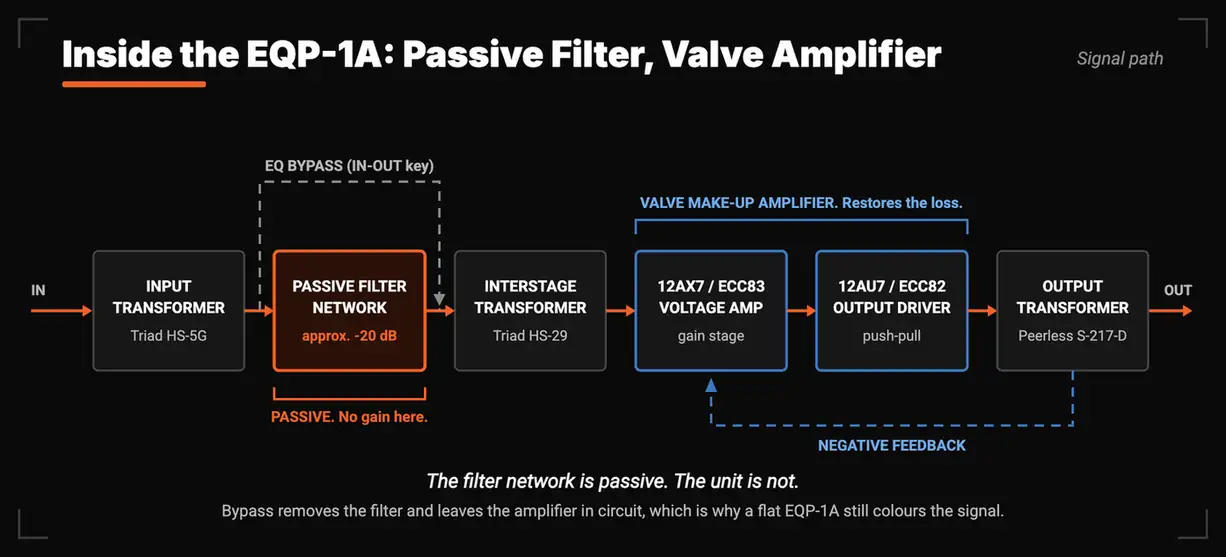
This is why an EQP-1A sounds like something even when it is doing nothing.
The bypass switch is the proof, and again the factory documentation is unambiguous. Throwing the IN-OUT key out of the IN position is equivalent to returning every boost and attenuate control to zero, and "the amplifier remains in the circuit." A bypassed EQP-1A is still a valve and transformer line amp, which is why plenty of engineers patch one in flat and never touch a knob.
The measured distortion behaviour explains the appeal. As input level rises, second-harmonic content climbs steadily while the other harmonics stay roughly put, so driving it harder buys you more even-order warmth rather than an abrupt turn into something harsh. Pultec specified an optimum input range of −15 to +8 dBm and a maximum peak output of +21 dBm, so there is real room to push before anything protests.
The Boost and Atten curves are both shelves sharing one frequency selector, but the attenuation turnover begins about half an octave higher than the boost turnover. Sum two offset shelves and you get a low lift with a dip sitting above it.
This is the technique everyone knows the Pultec for, and it is worth being precise about the mechanism, because the usual explanation is wrong.
You will often read that the two sections "interact" or "load each other" so the result is not a simple sum. That is not what the measurements show. The low-frequency Boost and Atten controls both produce shelving curves, and they share one frequency selector, but they are not mirror images. Sound On Sound's Audio Precision plots of the EQP-1A show the attenuation turnovers beginning roughly half an octave higher than the corresponding boost turnovers. Add those two curves together and the boost wins below the crossover point while the attenuation wins above it.
So the sum is perfectly linear. The curves just are not opposites.
The factory schematic shows exactly why not. The LOW FREQUENCY selector is ganged: one switch position sets both the boost network and the cut network, but each network gets its own capacitor, and the two sets of values are nothing alike. At the 30 Hz position the boost side switches in 0.82 µF while the cut side switches in 0.027 µF. The controls differ too. Low Boost is a 10 kΩ audio-taper potentiometer and Low Atten is a 100 kΩ audio-taper potentiometer. Two separate networks, driven from one switch, sharing one printed frequency. They were never going to cancel.
Manley's engineers arrived at the same description from the other direction while modelling the behaviour for the Massive Passive, and they named it the Pultec Curve: the deep lows are boosted, the slope back toward flat becomes steeper, and a few dB of dip appears in the low mids. They also settle a common confusion: the Pultec curve is officially a shelf, not a bell.
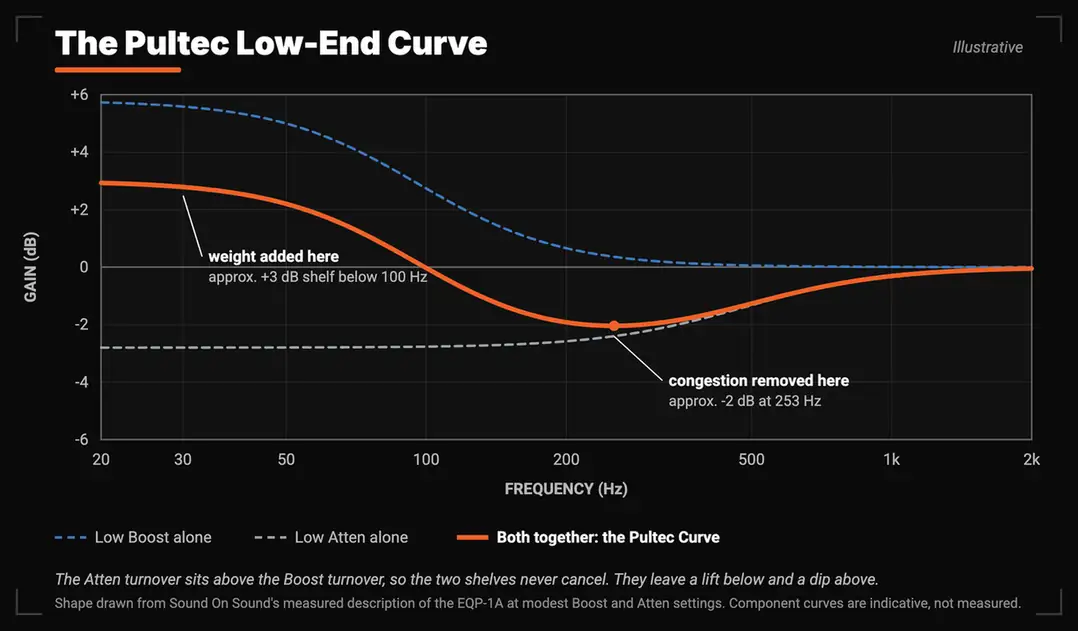
With both controls set around 2.5 on their scales, the measured result is approximately a +3 dB low shelf with about 2 dB of mid-bass cut. Moving the frequency selector slides the whole contour: the dip centre travels somewhere between roughly 250 Hz and 2 kHz, and the shelf corner between roughly 100 Hz and 750 Hz.
Note how far those numbers sit from the marked frequency. This is the part that trips people up. The curves are broad and reach well above the value printed on the selector, which is why the review's recommended kick setting is 20 Hz rather than the 60 Hz that folk wisdom suggests. You are not boosting 20 Hz. You are placing the corner of a wide shelf at 20 Hz and letting its skirt do the work an octave or two higher.
One honest note on what this does and does not buy you. The Pultec is often credited with adding weight without adding level, which is not quite physical. Boosting the bottom does add level. What actually happens is that the dip removes energy from the low mids, the most congested region in most mixes, at the same time as the shelf adds it lower down. The mix reads as bigger without gaining the density that would otherwise push a limiter around.
Pultec knew, and told people not to do it. The installation instructions are explicit: "Do not attempt to boost and attenuate simultaneously on the low frequencies." Engineers did it anyway.
The manual called it a mistake. The mistake is why the unit is still in production.
The EQP-1A has three sections, not two: a low shelf pair sharing one frequency selector, a peaking high boost with variable bandwidth, and a separate high shelf attenuator with its own frequency selector.
Most write-ups cover the low band and the air band and quietly skip the third section. Eight rotary controls, plus the IN-OUT key and the power switch. Here is the whole panel.
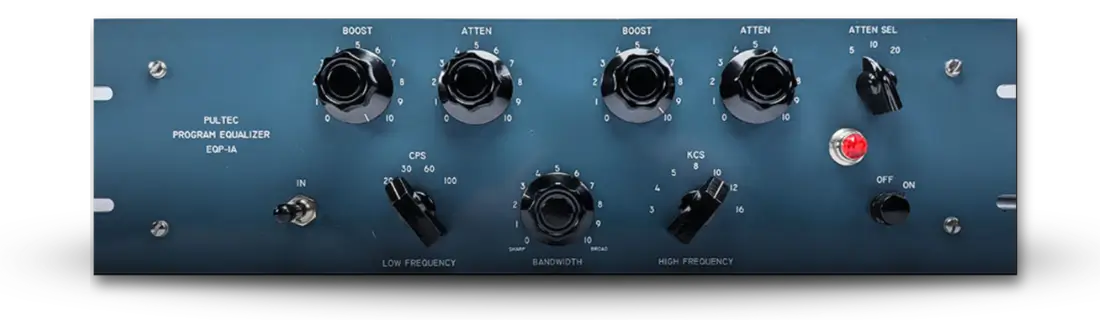
Low Frequency selector. Four positions: 20, 30, 60 and 100 Hz. It sets the frequency for both the Boost and the Atten control, which is what makes the simultaneous technique so easy to fall into.
Low Frequency Boost. A shelving lift, continuously variable, maximum around +13.5 dB.
Low Frequency Atten. A shelving cut, maximum around −17.5 dB, with its turnover about half an octave above the boost.
High Frequency selector. Seven positions: 3, 4, 5, 8, 10, 12 and 16 kHz.
High Frequency Boost. A peaking curve, not a shelf, maximum around +18 dB depending on bandwidth.
Bandwidth. Effectively a Q control, continuously variable from sharp to broad. It changes the maximum available boost as well as the shape: the narrowest setting yields roughly 9 dB more gain than the broadest. Sharp gives you a focused resonant peak, broad affects a much wider region.
High Frequency Atten. A shelving cut of up to about −16 dB.
Atten Sel. The eighth control, and the one that makes the high end genuinely flexible. It is a second high-frequency selector offering 5, 10 and 20 kHz, and it sets the frequency for the High Frequency Atten alone. That is the asymmetry at the heart of the panel. Down in the low band one selector serves both Boost and Atten, while up top the boost and the cut each get their own. So you can boost broadly at 12 kHz while shelving down from 5 kHz, which gives you contours a single shelf cannot produce. That is a real tool, not a curiosity: presence with a softened extreme top, or air without the hiss that comes with it.
Pultec recommended this one. The same instruction sheet that forbids simultaneous boost and cut on the low band calls the high-frequency equivalent "possible, and sometimes very desirable," and gives the example of rolling off on the 20 kHz attenuate curve while brightening at a lower frequency with the boost control. The low-band trick was an accident. The high-band version was the design intent.
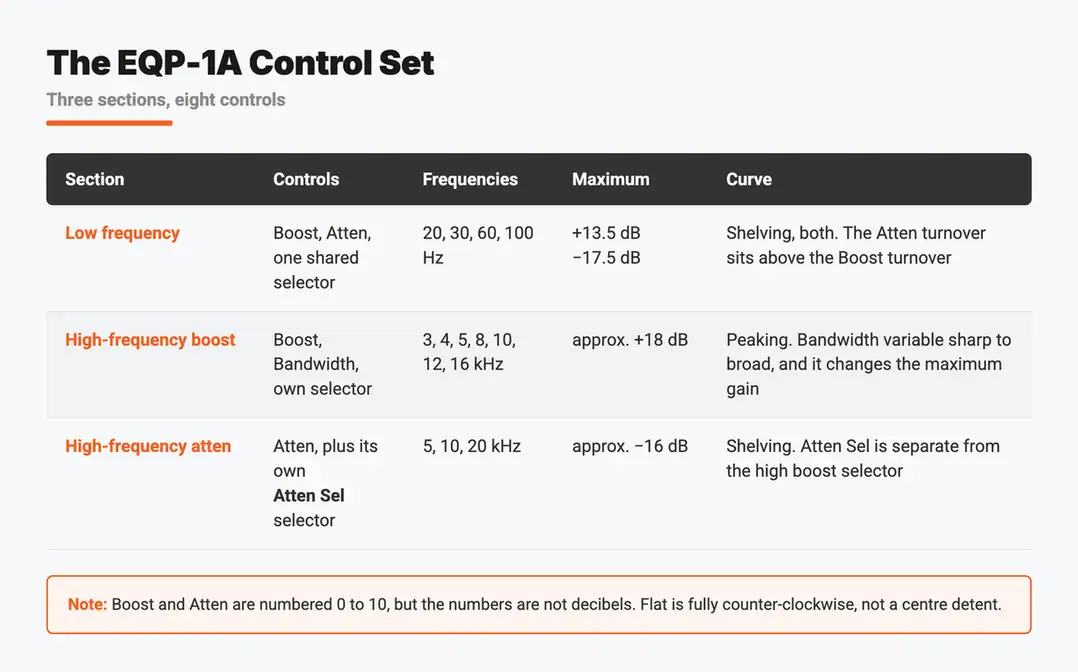
One thing worth internalising before you touch it: the Boost and Atten dials are numbered, but not in decibels. They run 0 to 10, and flat is fully counter-clockwise rather than at twelve o'clock. A "3" is a dial position, not three decibels. Passive designs of this type also behave as constant-bandwidth rather than constant-Q circuits, so the curve widens as you approach flat and narrows as you push. Set it by ear and ignore the numbers.
Broad frequency region first, then raise Boost and Atten together until the fundamental grows and the congestion recedes. Judge the result, not the panel.
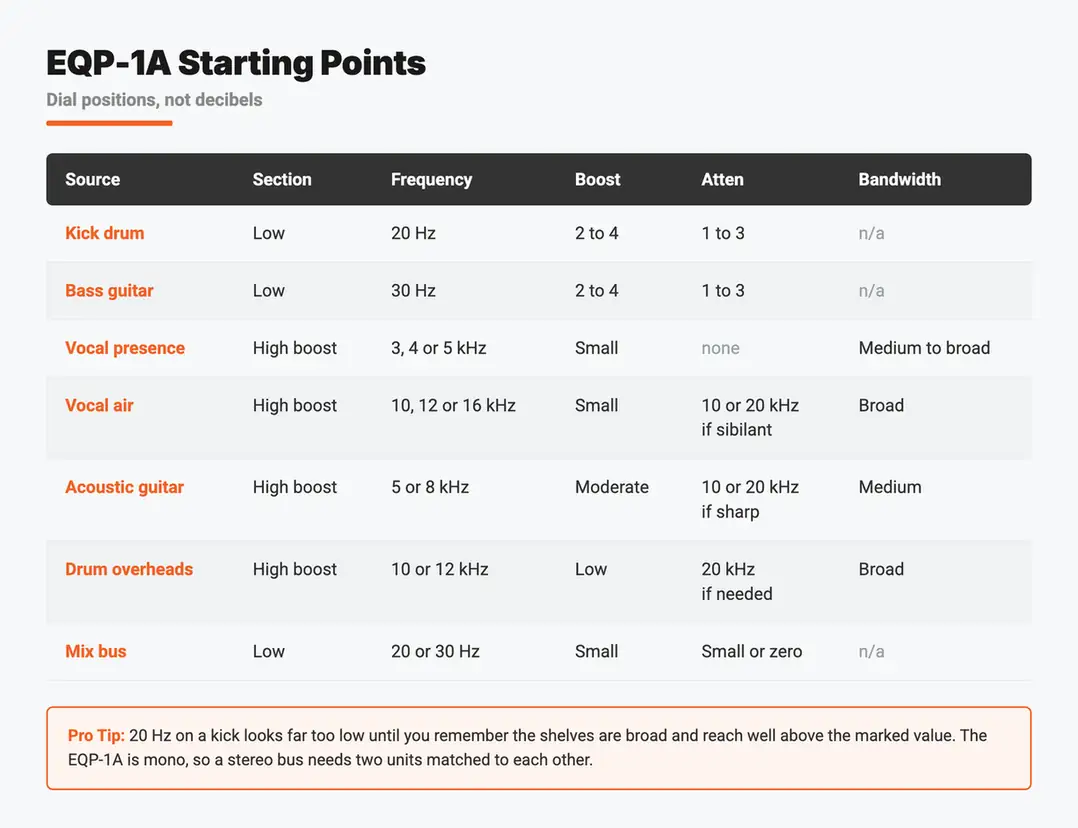
Kick drum. Low frequency selector at 20 Hz, Boost around 2 to 4, Atten around 1 to 3. Twenty hertz looks absurdly low for a kick until you remember the shelf is wide and its skirt is doing work well above the marked value. Bring both up together and listen for two things at once: the fundamental growing, and the upper-bass thickness around 80 to 200 Hz stepping back. That second half is what keeps the kick from turning to mud as it gets bigger.
Bass guitar. Selector at 30 Hz, Boost 2 to 4, Atten 1 to 3. Same move, slightly higher corner. The dip is what buys separation from the kick, so if the bass is spreading and clouding the low mids, add Atten before you reduce Boost.
Vocals. Use the high-frequency section. For presence, boost at 3, 4 or 5 kHz with Bandwidth medium to broad and a small amount of gain. For air, boost at 10, 12 or 16 kHz with Bandwidth broad. Because it is a peaking curve with a wide skirt rather than a narrow parametric lift, it opens the top without the pinched quality a tight boost produces in the same region. If sibilance or hiss comes up with it, bring in the high-frequency Atten at 10 or 20 kHz. That combination, broad boost plus a shelf above it, is the move the independent selectors exist for. For everything around the EQ, see the full vocal chain, from room to rack.
Acoustic guitar. Boost at 5 or 8 kHz, Bandwidth medium, for pick definition and string detail. Shelve down from 10 or 20 kHz if it turns sharp.
Drum overheads. Boost at 10 or 12 kHz, Bandwidth broad, small amount. Attenuate from 20 kHz if the extreme top needs softening.
Mix bus. Low selector at 20 or 30 Hz, a small Boost, a little Atten or none. Go gently here, because the curves reach much further than the panel suggests. Worth repeating: the EQP-1A is mono, so a stereo bus needs two units matched to each other. After the Pultec, the Manley Variable Mu is a classic way to finish a mastering chain.
For the compression side of a vocal chain, the 1176 deep-dive and the LA-2A deep-dive cover the units that most often sit either side of a Pultec.
Both units on the Access Analog rack are current-production builds of the same architecture. What separates them is how far each one goes to reproduce the original's wound components.
Worth being precise about what is on the rack, because "Pultec" gets used loosely. Access Analog's EQP-1A units are Pulse Techniques reissues, not 1960s originals. That is a better starting point than it sounds. When Steve Jackson revived the name he spent roughly a decade reproducing the parts most recreations cannot match, the three transformers and the multi-tapped inductor, consulting original designer Gene Shenk along the way.
The Warm Audio EQP-WA comes at the same architecture from the accessible end: a passive CineMag inductor EQ section, CineMag input and output transformers, and a tube make-up stage using 12AX7 and 12AU7 valves (Warm Audio's published specification). Same topology, so the boost-and-cut behaviour is there.
That makes the honest comparison narrower than the marketing on either side suggests. Both are passive filter networks with valve gain make-up, and both give you the offset-shelf curve, because that curve is a property of the component values rather than of the badge on the panel. What separates them is how closely the wound components track the original, and what that fidelity costs.
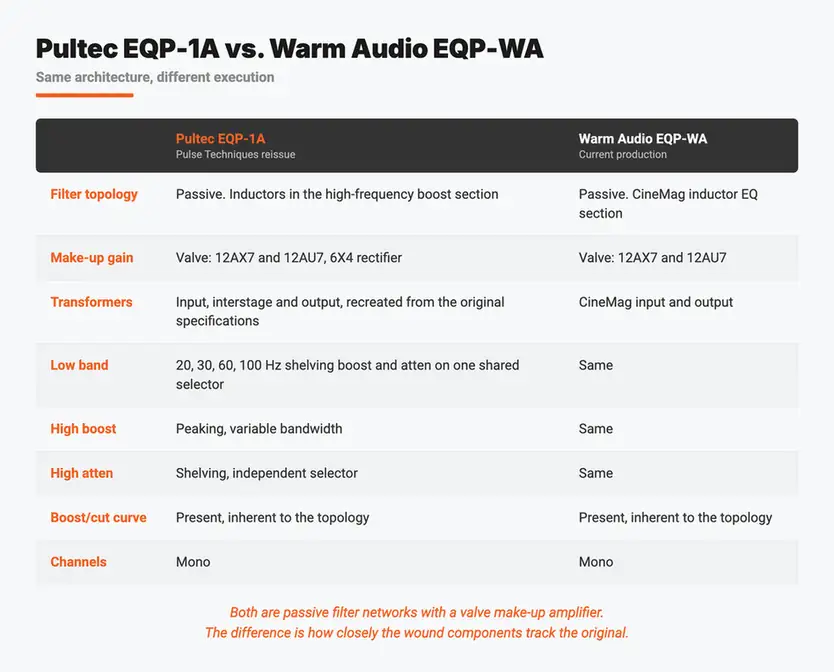
The technique is a property of the topology. What you pay for above that is how faithfully the transformers and inductors behave.
One note on the name, since it gets muddled often enough to be worth correcting. Pultec is the trademark of Pulse Techniques, founded in New Jersey by Gene Shenk and Ollie Summerlin. The EQP-1 dates to the early 1950s. The EQP-1A arrived around the beginning of the 1960s, adding 20 Hz to the low band, 4 kHz and 16 kHz to the high boost, and the separate attenuation selector. The company closed in 1981, and Pulse Techniques LLC is why the unit is buyable new again. The brand changed hands once more in September 2025, when Steve Jackson, preparing for retirement, sold Pulse Techniques to Paul Wolff of Wolff Audio. Pulse continues to operate as a separate entity and production stays in Fort Collins, Colorado, which puts the current EQP-1A and our own racks in the same state. (Some references credit the Pultec to Western Electric. They are wrong, though original panels do carry a Western Electric patent licence covering part of the amplifier's feedback architecture.)
Two EQP-1A units and a Warm Audio EQP-WA are on the rack. Because the EQP-1A is mono, having two of them is what makes a stereo Pultec pass possible at all.
Access Analog racks two Pultec EQP-1A units, unit one and unit two, along with the Warm Audio EQP-WA. All three are real hardware. Servos turn the actual knobs and the actual frequency selectors, and the audio runs through the actual filter network and valve amplifier on its way back to your session through the Analog Matrix plugin.
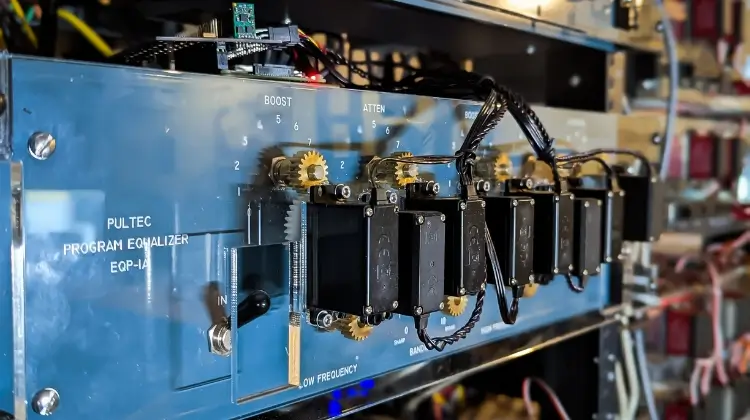
That pair of EQP-1As is the detail worth dwelling on, because the mono limitation is the practical barrier to using one of these at the mix or master stage. A single unit shapes a kick or a bass beautifully and cannot touch a stereo bus. Getting two matched units into one room is a real expense and a real hunt. On the rack they are simply both there, and because the settings save with your DAW project, a recall is exact rather than a photograph of a front panel and a good memory.
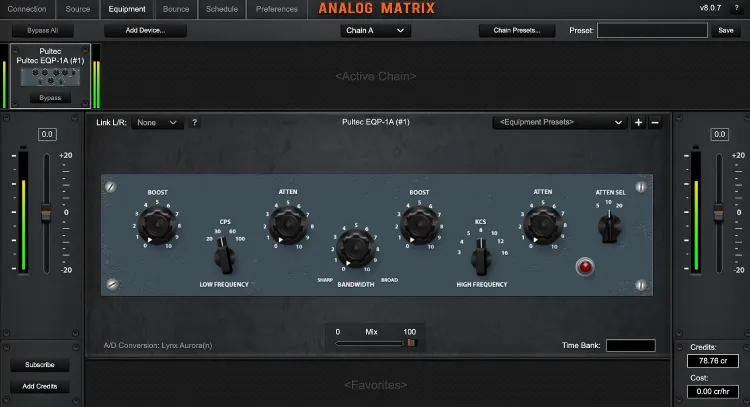
The comparison is worth running for its own sake. Put the same kick through the EQP-1A and the EQP-WA at matched settings and hear what the wound components actually contribute, on your material rather than on a demo. That is a genuinely hard test to arrange any other way and it takes about a minute here.
Both Pultecs are included with the Elite tier of the Access Analog Subscription, and you can also reserve a session on them without a subscription. Browse the Pultec units or the full equalizer selection to see what else is on the rack.
The passive network, the valve make-up stage and the three transformers are all doing their part. Nothing here is modelled, so nothing here is approximated.
Is the Pultec EQP-1A a passive EQ?
The filter network is passive, built from inductors, capacitors and resistors with no amplification inside it. The unit as a whole is not passive. Because a passive network cannot create gain, the EQP-1A's filter loses roughly 20 dB, and a valve make-up amplifier built around a 12AX7 and a 12AU7 restores it. The correct description is a passive L-C equalizer with a valve make-up amplifier.
Why does the Pultec boost and cut trick not cancel out?
Because the two curves are not mirror images. The low-frequency Boost and Atten are both shelving curves that share one frequency selector, but that selector is ganged: it switches a different capacitor into the boost network than into the cut network. At the 30 Hz position the boost side uses 0.82 µF and the cut side uses 0.027 µF, so the attenuation turnover lands about half an octave above the boost turnover. Add the two curves together and the boost dominates below the crossover point while the attenuation dominates above it, leaving a low shelf lift with a dip in the low mids. The sum is entirely linear. The curves simply are not opposites.
What does the Pultec low-end curve actually look like?
A shelf plus a dip, not a bump. With both the Boost and Atten controls around 2.5 on their scales, measurements show roughly a +3 dB low shelf and about 2 dB of mid-bass cut. Changing the frequency selector slides the whole contour, moving the dip centre between roughly 250 Hz and 2 kHz and the shelf corner between roughly 100 Hz and 750 Hz.
What are good Pultec settings for kick drum and bass?
For kick drum, set the low-frequency selector to 20 Hz with Boost around 2 to 4 and Atten around 1 to 3. For bass guitar, use 30 Hz with the same ranges. Those frequencies look too low because the shelves are broad and reach well above the marked value. Note that the Boost and Atten controls are numbered 0 to 10 rather than in decibels, and flat is fully counter-clockwise.
Is the Pultec high-frequency boost a shelf?
No. The high-frequency Boost is a peaking curve with a variable Bandwidth control that runs from sharp to broad, and the Bandwidth setting changes the maximum available gain as well as the shape, by roughly 9 dB between the extremes. The shelf in the high end is the separate high-frequency Atten section, which offers 5, 10 and 20 kHz on its own frequency selector, independent of the boost selector.
Can a plugin do the Pultec trick?
The amplitude curve itself is a sum of two shelves with offset turnovers, so any EQ that can produce both curves can reproduce the response, and good emulations do. What the hardware adds is the rest of the signal path. Every move you make passes through two triodes and three transformers whose harmonic behaviour changes with level, and the passive network's insertion loss is what puts them there in the first place. The bypass switch removes the filter but keeps the amplifier, which is why engineers patch Pultecs in flat.
Is the Pultec EQP-1A mono or stereo?
The EQP-1A is a single-channel unit, so stereo work requires two units matched to each other. Access Analog racks two Pultec EQP-1A units, which is what makes a stereo pass possible without sourcing and matching a pair yourself.
Are Pultec reissues the same as the originals?
Pulse Techniques LLC builds the current EQP-1A to reproduce the original as closely as possible, and the difficult part was never the schematic. Circuit diagrams have circulated for decades. The hard part is the wound components, because a transformer's core alloy, winding pattern, wire gauge and insulation all change how it behaves in circuit even when the published specification matches. Steve Jackson spent roughly a decade on that problem, consulting original designer Gene Shenk, before the reissue went into production. Access Analog's two EQP-1A units are these reissues.
How can I use a real Pultec without owning one?
Access Analog racks two Pultec EQP-1A units, both Pulse Techniques reissues, alongside a Warm Audio EQP-WA. All three are real hardware controlled by servos and patched into your session through the Analog Matrix plugin, not emulations. Your settings save with the DAW project, so a recall is exact rather than approximate. Both Pultecs are included with the Elite subscription tier, and they can also be reserved for a single session without a subscription.