
Lo-fi, chillhop, and ambient live or die on texture: warmth, gentle movement, and a worn-in imperfection that makes a track feel human.
Most of that character used to come from tape, tubes, and transformers. Plugins get close, but a fixed algorithm applies the same math to every sample, the way a machine browns every slice of toast to the identical shade. Real analog circuits add harmonics that shift with level, a soft compression that rounds transients, and small non-linearities that keep the sound moving. With Access Analog, you can run pro saturation chains on that real hardware from inside your DAW.
Analog saturation is what gives lo-fi and ambient their emotional depth: harmonic warmth, natural compression, and a worn-in imperfection a fixed plugin algorithm struggles to fully capture.
Saturation adds new harmonic content and gently compresses the signal. On lo-fi and ambient material, that shows up as warmth, glue, and softened edges. Here is what is happening underneath.
Harmonic warmth. When a signal passes through a tube, a transformer, or a saturating circuit, the gear generates harmonics that weren't in the original. Even-order harmonics tend to sound warm and consonant, while odd-order harmonics add edge and grit, and real analog circuits produce a complex, level-dependent mix of both. That harmonic bloom is what "warmth" actually is.
Natural compression. Saturation is a soft form of level control. As the signal drives harder into the circuit, the peaks round off before the body does, which behaves like a fast, gentle compressor with no threshold or attack knob in sight. On drums and plucky synths, that rounding tames spikes and pulls the sound forward.
Softened transients. Digital recordings can feel sharp at the leading edge of every hit. Tape-style saturation slews those transients slightly, blunting the click and letting the tone breathe. That is a lot of what people mean when they say a track sounds "tape-warmed."
Movement and imperfection. Real gear drifts. Bias, tube state, and transformer behavior all vary a little with the signal, so the coloration is never identical twice. That subtle variation is the opposite of a static plugin, and it is a big part of why an analog-processed loop feels alive on repeat.
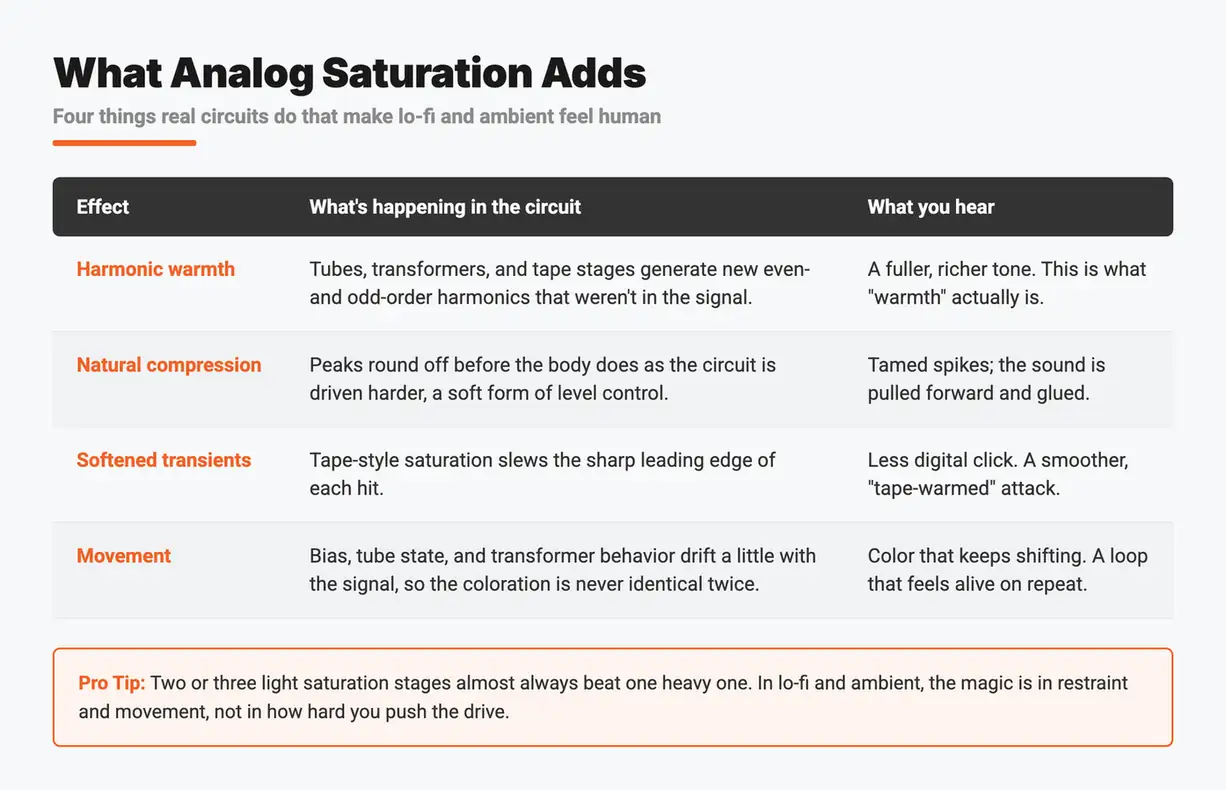
Warmth, glue, and "vibe" aren't magic. They're harmonics, soft compression, and non-linear movement you can point to on a scope.
A great saturation chain layers complementary flavors: a tape stage for warmth and compression, a harmonic stage for richness, and an EQ stage to shape the result. Below are three chains built entirely from gear in the Access Analog rack, one each for classic lo-fi, ambient, and drums. Treat the orders as strong starting points, not laws. Running saturation before EQ lets you shape the harmonics you just added, but moving the EQ earlier to pre-shape what hits the saturation is a legitimate choice too.
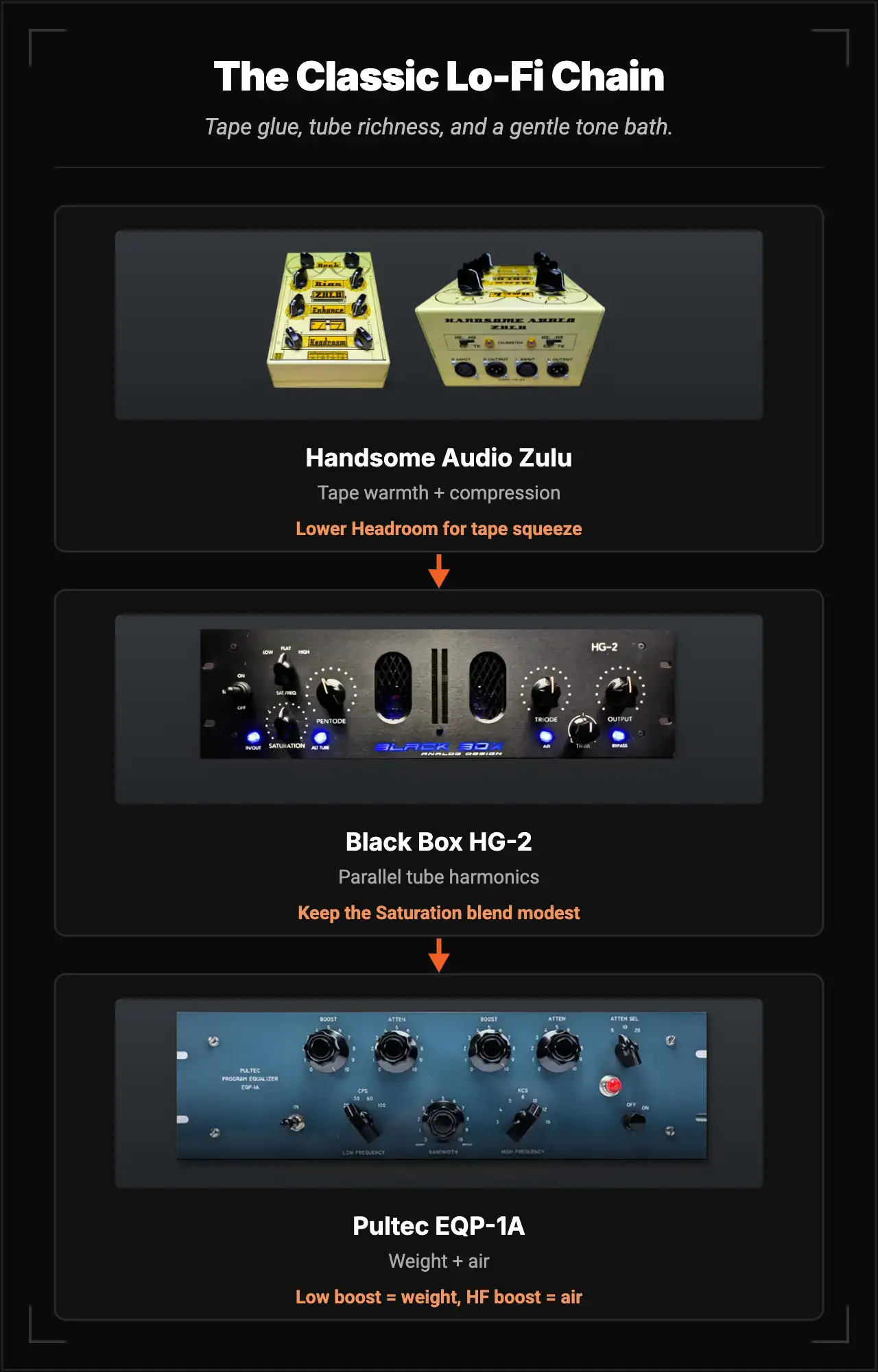
The desert-island lo-fi bus: tape glue, tube richness, and a gentle tone bath.
The Handsome Audio Zulu goes first. It is the world's first fully passive analog tape simulator, and its Deck switch models three machines: a cassette 4-track, a Japanese professional deck, and a Swiss professional deck, each with its own saturation and compression character. Lower the Headroom setting to lean into tape compression, and the Zulu rounds transients and adds that worn cassette weight.
Next, the Black Box Analog Design HG-2 stacks tube harmonics on top. Its Pentode and Triode tube stages color the signal, and a dedicated Saturation control blends a parallel 12AX7 tube circuit back in, so you can stack harmonic richness while the dry core stays intact. A little goes a long way here: enough to thicken, not enough to fuzz.
The Pultec EQP-1A shapes tone last. Its passive low-frequency section can boost and attenuate the same band at once for a resonant low shelf that adds weight without mud, and its separate high-frequency boost brings back a touch of air the tape rolled off.
The result: a cohesive, tape-warmed loop that sounds like it was bounced to cassette and back.
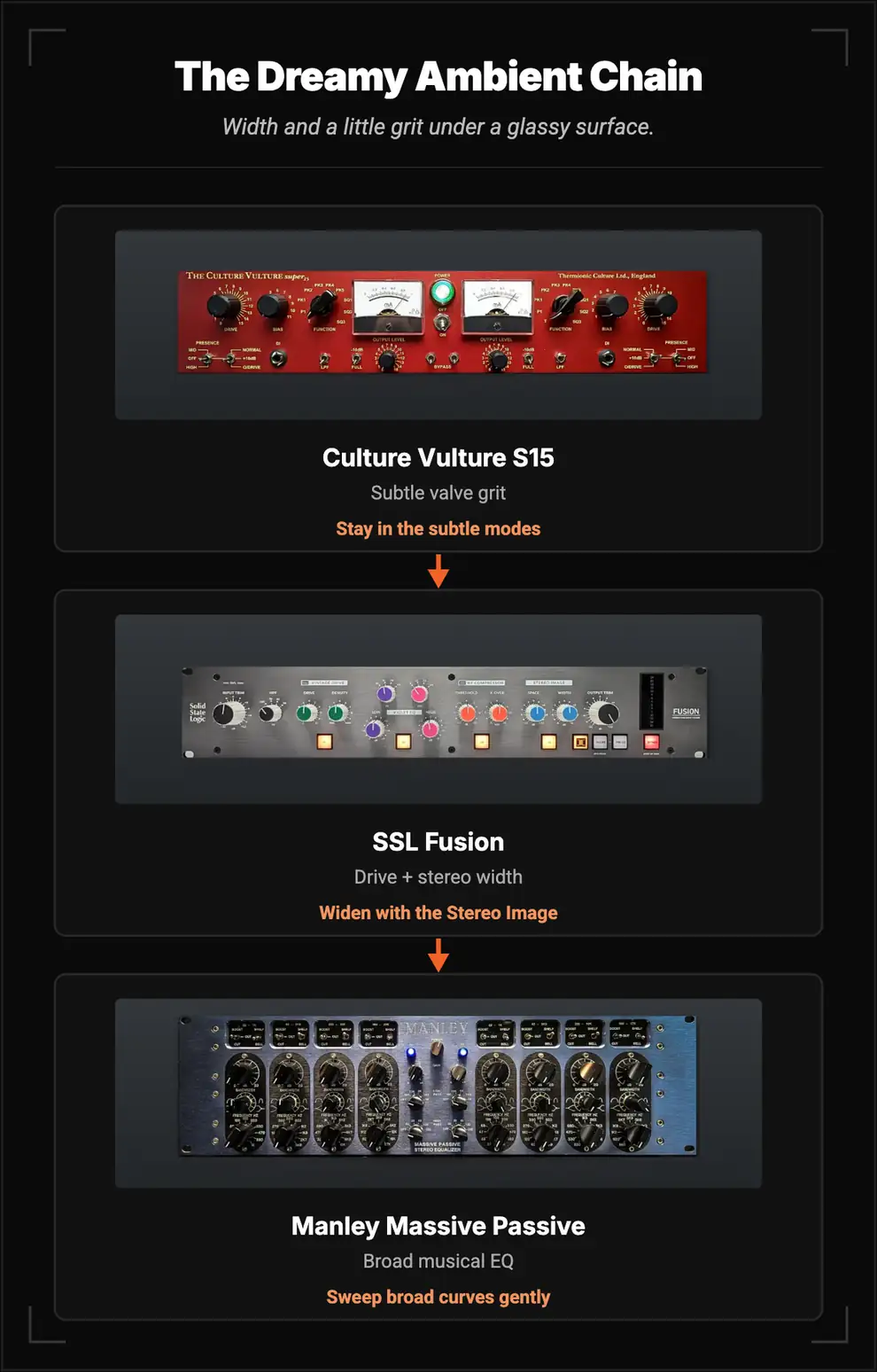
For pads and textures that need width and a little grit under the glassy surface.
Access Analog racks the Thermionic Culture Vulture Super 15, an all-valve distortion unit with 15 selectable saturation modes, a Drive control, and a switchable +10 dB input boost. For ambient, stay in the subtle modes and keep the Drive low: just enough valve harmonics to give a pad body and a hint of age, nowhere near its demonic end.
The SSL Fusion then adds space. Its Vintage Drive stage brings harmonic saturation, the Violet EQ shelves in gentle low weight and high sheen, and the Stereo Image section widens the field, which is exactly what ambient beds want. The output Transformer stage lays a final coat of iron-flavored color over the whole thing.
The Manley Massive Passive finishes with broad, musical EQ curves. It is a 4-band passive EQ with all-tube makeup gain, often called a "Pultec on steroids," and its wide bell and shelf shapes are built for the slow, sweeping tone moves ambient thrives on.
The result: a wide, glowing bed with harmonic depth you feel more than hear.
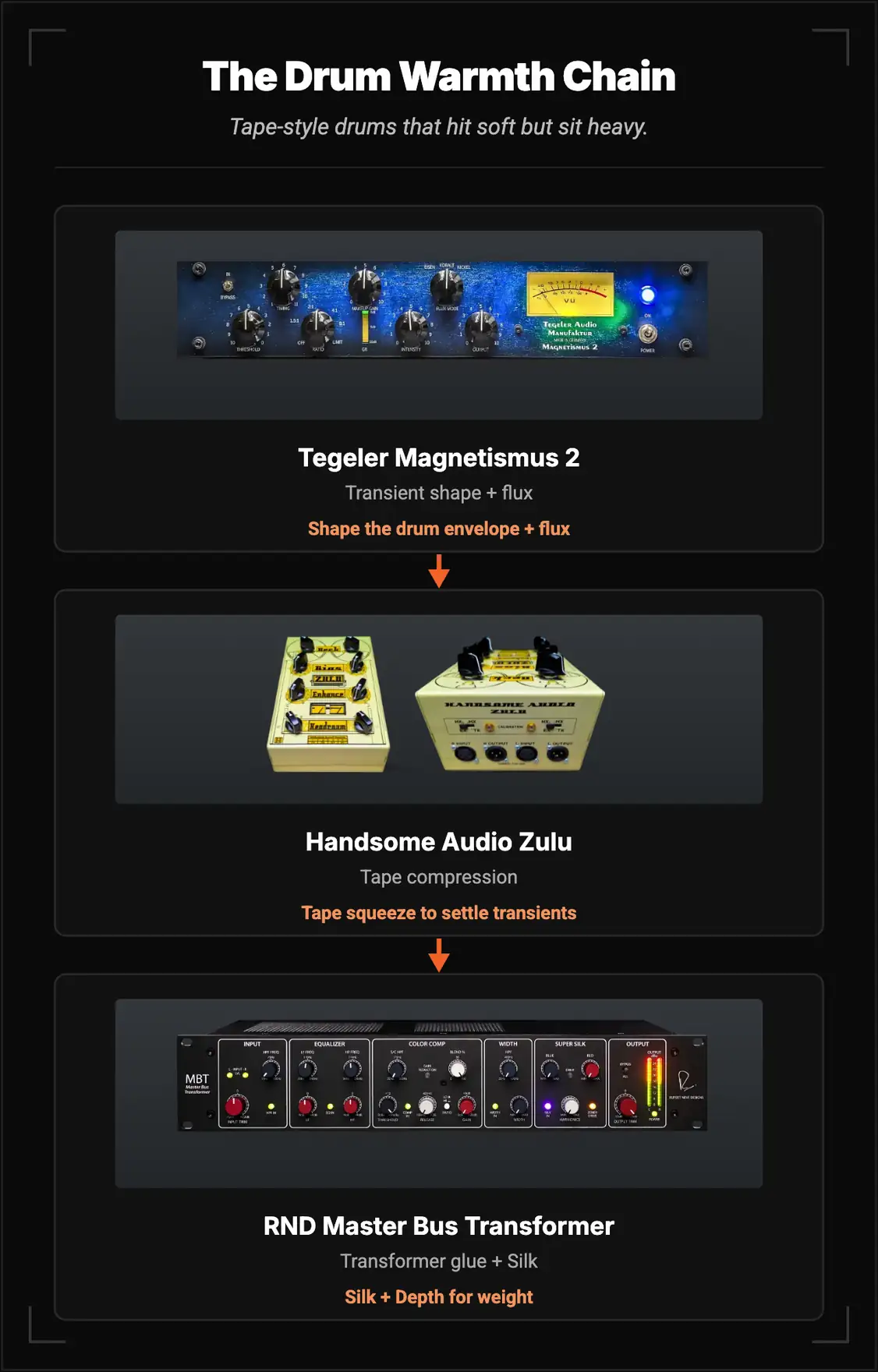
Tape-style drums with punch, weight, and glue for lo-fi beats.
The Tegeler Magnetismus 2 leads. Much like a tape machine, it rounds out the transients. It is a hardware transient shaper and dynamics unit with switchable "Flux" tape-character modes (iron, cobalt, and nickel) and an output transformer, so you can reshape the drum envelope and print tape-style flux color right at the source.
The Handsome Audio Zulu returns for the tape stage, compressing and saturating the kit so the transients settle into the groove. Its Bias control lets you tilt the harmonic balance toward the low or high end to taste.
The Rupert Neve Designs Master Bus Transformer glues the kit together with transformer saturation, plus Silk Red and Blue to emphasize higher or lower harmonics and a Depth control for low-end weight.
The result: lo-fi drums that hit soft but sit heavy, warmed end to end.
You load the Access Analog Analog Matrix plugin in your DAW, build or recall the chain, and stream your audio through the real hardware in real time. The gear is physical and robotically controlled, not modeled.
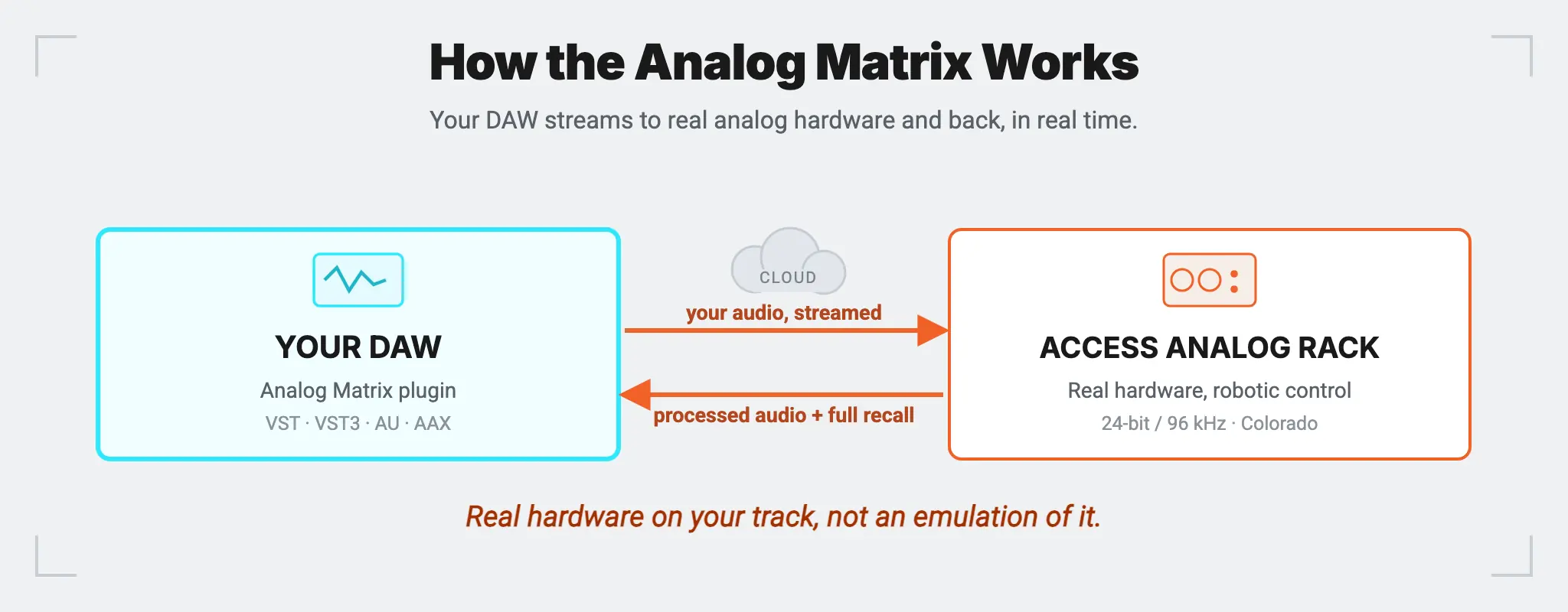
Load the Analog Matrix plugin. It installs as a VST, VST3, AU, or AAX plugin in Pro Tools, Ableton Live, Logic Pro, Reaper, Cubase, and other major DAWs on Mac or Windows. Insert it on the track or bus you want to process.
Choose your chain or a preset. Route through the units in order, or start from a saved chain. Access Analog's gear runs 24/7 in the company's Colorado facility, so it stays at a stable operating temperature and is ready the moment you connect. Audio is converted at 24-bit / 96 kHz.
Stream, tweak, and automate in real time. Turn the hardware's controls from the plugin, compare two versions with the Analog Matrix's dual A/B chains, and automate moves from your DAW. Because every setting is recalled with your session, you can reopen the project weeks later and the physical knobs return to exactly where you left them, which solves the recall problem analog gear has always had.
This is real hardware on your lo-fi loop, not an emulation of it, with none of the racking, maintenance, or five-figure buy-in.
New accounts get 12 free credits (about an hour on an average device), so you can hear a chain like Zulu into HG-2 into Pultec on your own material before committing to anything.
Keep it subtle, build in stages, and use each unit's signature control to add motion rather than just static color. A few starting points:
Step the Zulu's Bias for evolving saturation. The Zulu's controls are stepped switches, so automating the Bias moves in discrete steps rather than a smooth sweep. Ride it across a section to shift the harmonic balance between lows and highs and you get an evolving, hand-driven texture instead of a set-and-forget tone. Switching the Deck between machines part way through an arrangement is another easy way to change character.
Blend in the HG-2's parallel Saturation. The Pentode and Triode stages drive the main path, but the HG-2's Saturation control blends a parallel tube circuit back in, so you can add real grit underneath while the dry signal keeps its transients up top. That contrast keeps a loop dynamic instead of uniformly crushed.
Use the Pultec low trick for weight, and the HF boost for air. The Pultec's simultaneous low boost and attenuation creates a resonant low shelf that adds body without muddying the low-mids, which is ideal for warming a lo-fi bass or kick. For air, reach for the separate high-frequency boost, the shelf up around 10 kHz to 16 kHz, which opens the top without the brittleness of a digital high shelf.
Print in passes, gently. Saturation stacks. Two or three light stages almost always sound better than one heavy one, and they preserve the soft, natural feel the genre depends on. When in doubt, back off the drive and let the harmonics do the work.
Saturation is seasoning, not sauce. The lo-fi magic is in restraint and movement, not in how hard you can push the drive.
Lo-fi, chill, and ambient are genres of feeling, and feeling comes from texture: harmonics that bloom, transients that soften, and a coloration that never sits perfectly still. Plugins get you most of the way there. Real analog circuits, with their level-dependent harmonics and gentle non-linear movement, add the final layer that makes a loop feel lived-in.
Access Analog puts that layer within reach. The same Handsome Audio Zulu, Black Box HG-2, Culture Vulture, and Pultec that shape professional records are a plugin away, running on your tracks and recalled with your session.
Give your mix real analog warmth, and let the imperfections make it human.
What is analog saturation, and why does it suit lo-fi and ambient music?
Analog saturation is the harmonic coloration and soft compression that happen when audio passes through real circuits like tubes, transformers, and tape-style stages. It adds warmth, rounds transients, and introduces subtle level-dependent movement. Those are exactly the qualities lo-fi, chillhop, and ambient rely on, which is why analog processing suits the genre so naturally.
Can't I just use a saturation plugin?
Plugins are useful and can get close, especially for broad coloration. The gap is in the fine detail. Real hardware generates a complex harmonic response that shifts with level and never repeats identically, where a plugin applies fixed math to every sample. On textural genres that live on subtle movement, that difference is audible. Access Analog lets you use the real hardware without buying it.
What is the best analog saturation chain for lo-fi?
A reliable starting chain is Handsome Audio Zulu into Black Box HG-2 into a Pultec EQP-1A: tape compression and warmth first, tube harmonics second, musical EQ last. For ambient, try the Thermionic Culture Vulture Super 15 into an SSL Fusion into a Manley Massive Passive for grit, width, and broad tone shaping. Adjust to taste, since chain order is a starting point rather than a rule.
How do I get analog saturation without a tape machine?
You have two routes. Buy a saturation box such as the Handsome Audio Zulu, which is a passive tape simulator rather than a tape deck, or access real hardware remotely. Access Analog's Analog Matrix plugin streams your audio through physical units in real time from inside your DAW, so you get authentic tape-style and tube saturation with no machine to maintain.
What are the differences between tape saturation and tube saturation?
They color sound in different ways. In broad terms, tape saturation leans toward odd-order harmonics (notably the third), while single-ended tube stages emphasize even-order harmonics (notably the second). Both soft-compress, but tape smooths transients more, where tube saturation tends to keep more of the transient punch. Tape also rolls off the extreme highs and adds a low-end bump, so a lot of its "warmth" comes from that frequency shaping and transient smoothing as much as from harmonics; tube saturation adds warmth and richness without much high-frequency rolloff. In practice, engineers reach for tape-style saturation to glue and add vintage warmth across drums, guitars, and mix buses, and for tube saturation to add body to vocals, bass, and lead instruments. Neither is better, and the right call depends on the source and the tone you want. In the chains above, the Handsome Audio Zulu covers the tape side while the HG-2 and Culture Vulture cover the tube side, so you can blend both.
Does Access Analog use real hardware or emulations?
Real hardware. The Analog Matrix plugin is a portal that connects your DAW to physical gear in Access Analog's Colorado facility, controlled by robotics and streamed in real time. It is not a model or an emulation. Settings are recalled with your session, and audio is converted at 24-bit / 96 kHz.
Where should saturation go in my signal chain?
A common order is dynamics and transient shaping first, then saturation, then EQ, so you shape the harmonics you just added. That is how the drum chain here is built, with Magnetismus 2 into Zulu into the MBT. It is not the only valid order, though. Moving EQ ahead of saturation to pre-shape the input is a legitimate choice and worth trying when a source calls for it.