Control real analog gear straight from your DAW with the Analog Matrix. The Analog Matrix is not an emulation! It acts as a portal, connecting your digital audio workstation to actual physical gear in real time.
Reserve a session using the calendar below, or jump straight into the Analog Matrix plugin and use equipment on demand as it is available. Note: on-demand access requires credits or an active subscription.


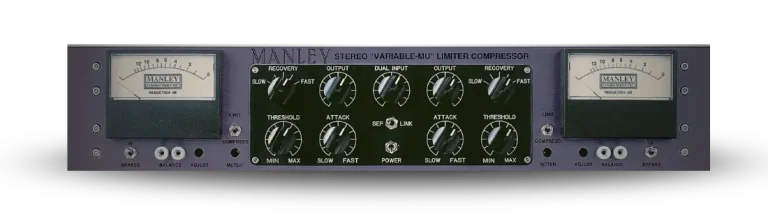
Manley’s best selling modern day masterpiece gives you control of your sound like nothing else. Known for it’s sweet sounding color courtesy of all tube circuitry and custom Manley input/output transformers, glue your tracks together with this compressor/limiter. The Variable Mu can kiss your audio with a touch of light 1.5:1 compression or smash unruly transients using the 20:1 limiting.
You’ve heard the Manley Variable Mu on thousands of songs, now hear it on yours!
Our unit is specifically the version 4 model with the added T-bar modification.
New to the Variable Mu? Read The Manley Variable Mu Explained: Vari-Mu Compression, v4 vs. v9, and Three Chains That Finish With It: how vari-mu compression works, what the T-Bar modification on this v4 changes, and mastering chains that end with it.
The Manley Variable Mu is an all-tube stereo compressor/limiter prized for the “glue” it adds to mixes and masters. It uses the remote cut-off (variable-gain) tube technique (the same principle behind the legendary Fairchild 670) to deliver smooth, musical gain reduction with rich tube warmth. Custom Manley input and output transformers give it its signature weight and color. The unit at Access Analog is the version 4 model with the T-Bar modification.
The Variable Mu shines on the stereo mix bus and in mastering, where it glues a mix together and adds cohesion without obvious artifacts. It is equally at home on subgroups and individual tracks – drum bus, vocals, bass, guitars, and piano all benefit from its warmth and gentle dynamic control. Engineers reach for it when they want a track to sound finished, fuller, and more “produced.”
Yes. The Variable Mu is an excellent vocal compressor. A few dB of gain reduction holds a vocal steady with almost no tonal change, adding a smooth, professional sheen and tube warmth while keeping the performance intact. Its program-dependent, soft-knee compression sits a voice forward without choking it or pumping.
The Variable Mu has two modes that change how firmly it grabs the signal. Compress is a gentle soft-knee ratio starting around 1.5:1, ideal for subtle glue and warmth across a mix or subgroup. Limit is a harder knee that climbs up to 20:1, reining in unruly transients and peaks much more firmly. Both modes share the same musical, all-tube character.
Variable-mu compression uses a vacuum tube itself as the gain-control element. The tube is continuously re-biased so its gain changes with the signal. “Mu” is tube-speak for gain, which is where the name comes from. It’s the same technique behind classic units like the Fairchild 670, and it’s what gives the Variable Mu its smooth, program-dependent, naturally musical sound.
The T-Bar mod is a factory modification that swaps the standard variable-gain dual triode for a pair of 6BA6 pentodes wired as triodes. It recreates the smoother sound of the original 6386-tube units, staying cleaner and more natural when pushed past about 6 dB of compression. The Access Analog unit is the version 4 Variable Mu with this T-Bar modification.
It comes down to character. The Variable Mu adds warm, tube-and-transformer “glue” and weight, while an SSL-style bus compressor delivers a tighter, punchier, more aggressive grip. Reach for the Variable Mu when you want a mix to sound rich, cohesive, and finished; reach for the SSL sound when you want snap and forward energy. Both are real stereo bus compressors at Access Analog, so you can A/B them on your own mix and decide.
This is the actual Manley Variable Mu hardware, real tubes, real Manley transformers, and a real all-tube signal path processing your audio in real time. Real Gear. No Emulations. Access Analog’s robotics physically turn the knobs on the unit while it streams your audio through the box and back to your DAW. You’re hearing the genuine version 4 Variable Mu with the T-Bar mod, not a model of it.
Yes. Access Analog lets you save and robotically recall your Variable Mu settings, so every knob, switch, and selector returns exactly where you left it. You can store individual device settings or whole signal chains and bring them back in a later session. Because the controls are set by robotics through the Analog Matrix plugin, your settings are fully repeatable from one session to the next.
Reserve From: $5.33. You can reserve a session in advance or use the Variable Mu on demand through the Analog Matrix plugin, paying only for the time you actually use it with credits or an active subscription. Every new account gets one free hour of access (about 12 credits) to try it out.