
At the end of a mastering chain, every decision is permanent. The mix is finished, the EQ is committed, and whatever touches the signal last is what the listener gets. For thirty years, the unit that keeps landing in that last slot is the Manley Variable Mu. Not because it is fashionable. Because of what a re-biased tube does to a finished record that no other gain-control element quite does.
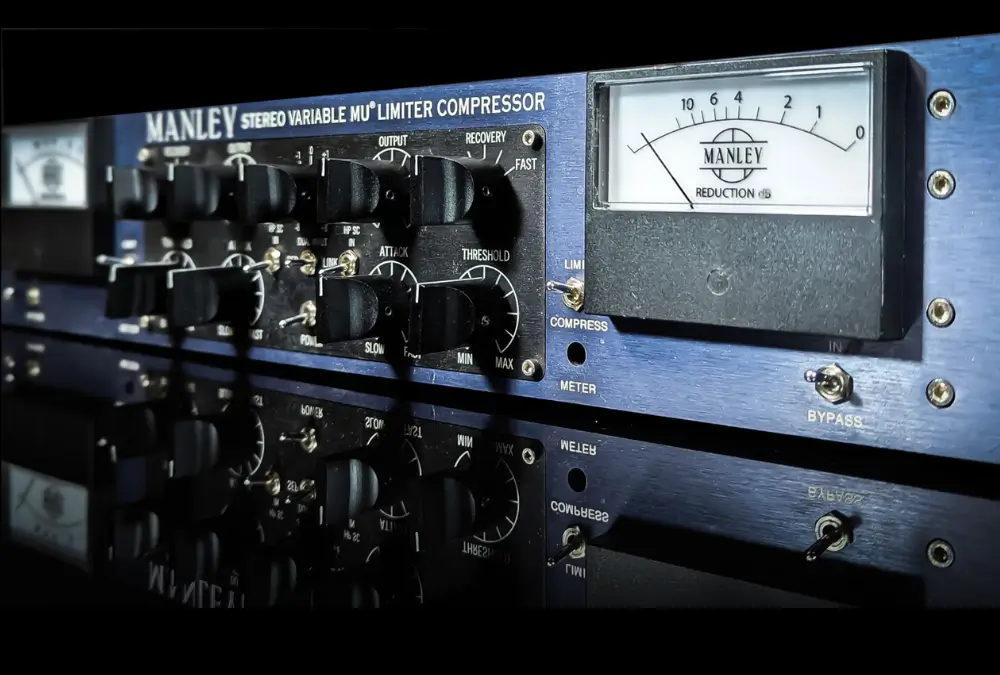
This guide covers what the tube is actually doing when a vari-mu compresses, what is inside the Manley Variable Mu and where its weight comes from, the real difference between the v4 and v9 units on the Access Analog rack, a starting point for a stereo-bus mastering pass, and three chains that finish with it.
The Variable Mu does not have a ratio. It has a tube, and the tube has a curve.
A vari-mu compressor reduces gain by changing the operating point of the amplifying tube itself. Every other compressor topology puts a dedicated gain-control element in the path (a FET, a VCA, a photoresistor, a diode bridge) and then amplifies around it. A vari-mu skips the middleman.
The tube at the heart of the circuit is a remote cut-off type, built so that its gain falls smoothly and progressively as its grid bias goes more negative. That family of tubes was manufactured in huge quantities for automatic gain control in radio receivers, which is exactly the job it does here. The Variable Mu's side-chain rectifies the audio through a pair of 12AL5 vacuum-tube diodes, turns it into a DC control voltage, and applies that voltage as bias to the variable-gain stage. Louder input, more negative bias, less gain. The tube never switches or clamps. It just amplifies a little less.
Think of a dimmer rather than a light switch. A VCA is a switch with a very fast hand on it: it decides how much to attenuate and applies that number. A remote cut-off tube is a dimmer whose travel is built into the glass. Push it harder and it dims faster, then faster still, because the curve of the tube is not a straight line.
That curve is why the Variable Mu has no ratio control. Manley's manual describes the gain-control chain as a feedback circuit: the detector listens to the output of the variable-gain stage, not the input. The ratio is a property of the tube's transfer curve at the current bias, and it rises as the signal pushes the tube further down that curve. In Compress mode the knee is soft and the ratio starts at roughly 1.5:1. In Limit mode the knee is sharper, the ratio starts near 4:1, and past about 12 dB of limiting it rises toward a 20:1 maximum. Manley also notes that the knee softens as more limiting is applied, so the unit behaves like a gentle compressor followed by a limiter, in one gain stage.
Bobby Owsinski, in The Mixing Engineer's Handbook, files the Fairchild 670 and the Manley Variable Mu together as "vari-gain" compressors and makes the same point from the user's side: the ratio increases with gain reduction, so the louder the transient, the harder it is compressed, and the slow reaction is what people hear as glue. Bob Katz, in Mastering Audio, reports mastering engineers using the Manley for punch and fatness on modern rhythmic music and treating it as the working replacement for the Fairchild, which used the same variable-mu principle.
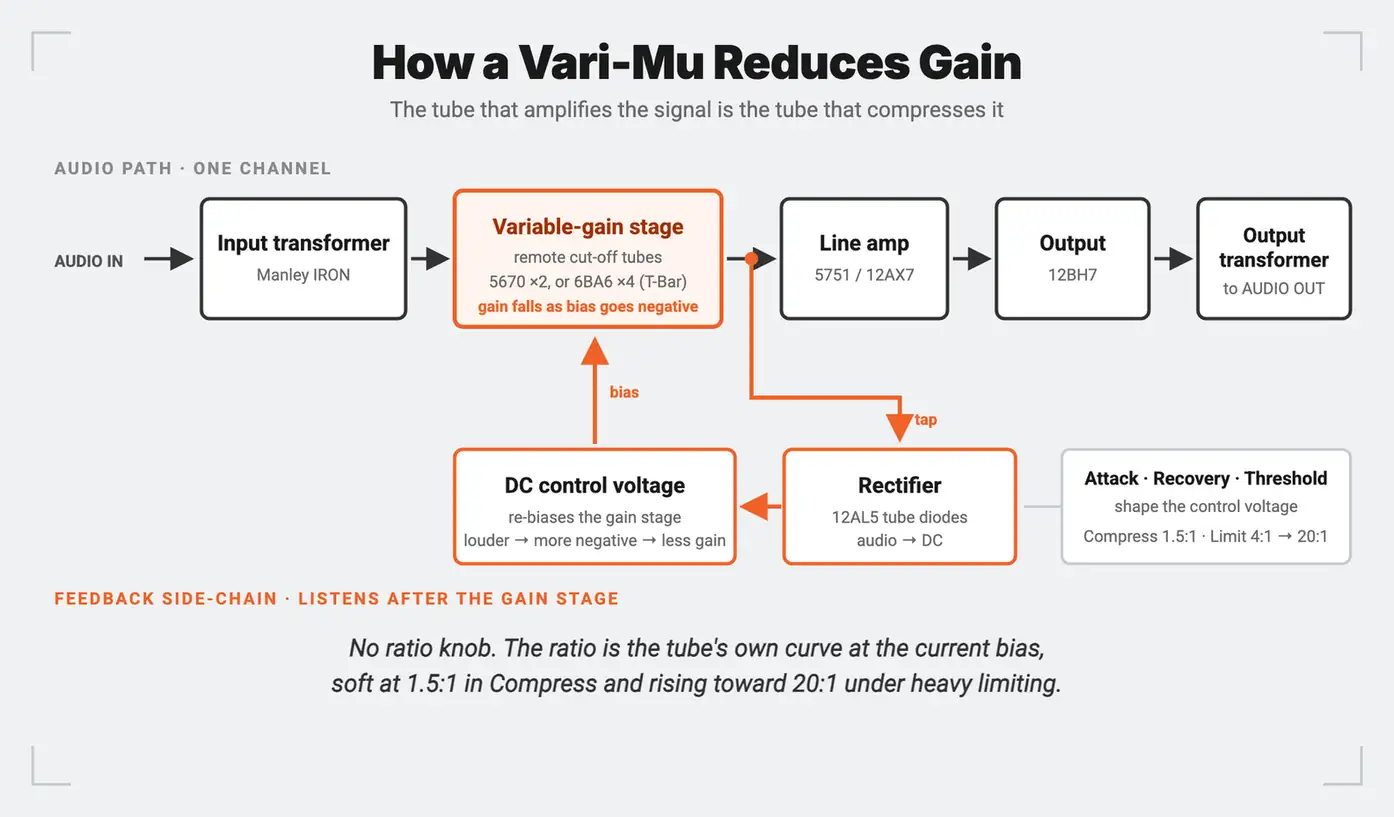
A quiet passage gets almost nothing. A loud peak gets held. Nobody set a ratio.
The Manley Variable Mu is an all-tube, transformer-in, transformer-out stereo limiter-compressor that has been in production since 1994, hand-assembled in California. Every stage in it is level-dependent, and mastering engineers describing "weight" are hearing the sum of those stages.
The signal path. Per channel: a Manley IRON input transformer (nickel laminations in a mu-metal case), the variable-gain stage, a line amplifier stage on a 5751 or 12AX7, and a 12BH7 output stage driving a Manley IRON output transformer. Manley's published specification lists the current unit as flat from 20 Hz to 25 kHz, with a maximum output of +30 dBu (26 V RMS) and 26 dB of headroom, up to 35 dB of gain, less than 0.1 % THD at 1 kHz, and a noise floor around −85 dB. Inputs and outputs are 600-ohm balanced. The input attenuator sits before the input transformer and the output attenuator is a T-pad after the output transformer, which matters later when we talk about drive.
Fully differential. The whole audio path is balanced and symmetrical, which Manley chose to cancel distortion and hum. That is also why the Variable Mu is not a big even-harmonic generator the way a single-ended triode stage is. Hugh Robjohns, in Sound On Sound's Analogue Warmth, points out that push-pull stages cancel much of the even-order content and leave a different harmonic balance. What the Variable Mu adds is subtler than a saturation box: level-dependent transformer behavior, the gentle compression of the tube curve itself, and a little transformer core saturation on low-frequency peaks. Manley designed it so that it handles a wide range of levels without adding audible harmonic distortion unless you drive it on purpose.
The tubes that reduce gain. The original Variable Mu used the 6386, the same remote cut-off dual triode found in the Fairchild and the Gates limiters. When 6386s became too rare, Manley moved to the 5670 dual triode. The 5670 units were well received, but Manley's own notes say they sounded different from the original once pushed past about 6 dB of limiting. That gap is what the T-Bar modification closes, and it is the single most important difference between the two units on our rack.
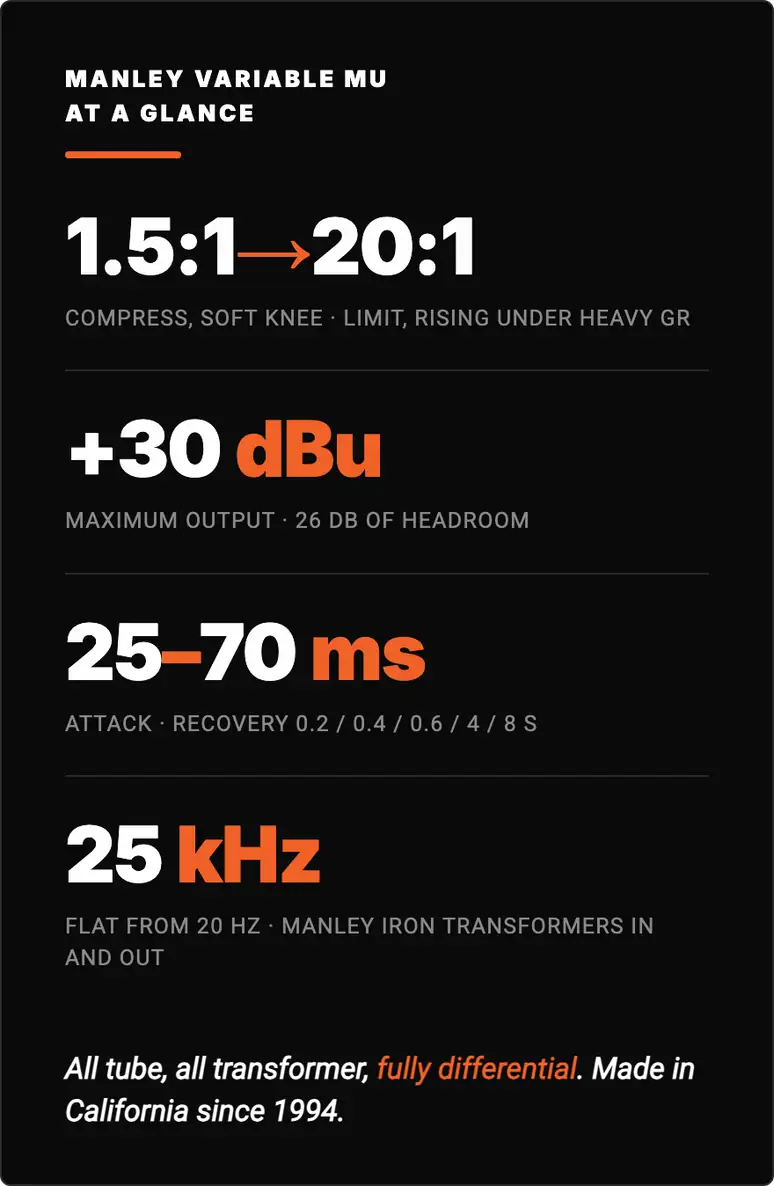
Access Analog racks two Manley Variable Mus, and they are not interchangeable. The Manley Variable Mu (v4) is a version 4 unit with Manley's T-Bar modification. The Manley Variable Mu (v9) is a later, version 9 unit with the high-pass side-chain filter and a stepped input switch, on the standard 5670 gain stage. Same circuit, same controls, two different personalities under gain reduction.
What the T-Bar mod is. Manley wanted the original 6386 sound back without depending on a tube nobody makes. Other remote cut-off dual triodes were not close enough. The answer was the 6BA6 (or 12BA6), a remote cut-off pentode that, wired as a triode, traces almost the same curve as the 6386. The hitch is that the 6BA6 is a single-section tube and the 6386 is a dual, so Manley built a small board that fits two 6BA6s where one 5670 went, four per stereo unit. The bonus is matching: two single tubes can be selected as a matched pair for each channel's two phase halves, and across both channels, which a sealed dual triode never allowed.
What Manley says it sounds like. In Manley's direct A/B, the T-Bar version sounds nearly identical to the 6386. Against the 5670 it sounds less "squashed" as limiting increases, so you can take more gain reduction with fewer artifacts, and it behaves better at faster attack settings because the tubes are better matched. Our v4 also runs 7119 output tubes in place of the original 7044s, a pin-compatible premium variant from the same family; in our rack we hear it as a touch more warmth and a more even response across the spectrum.
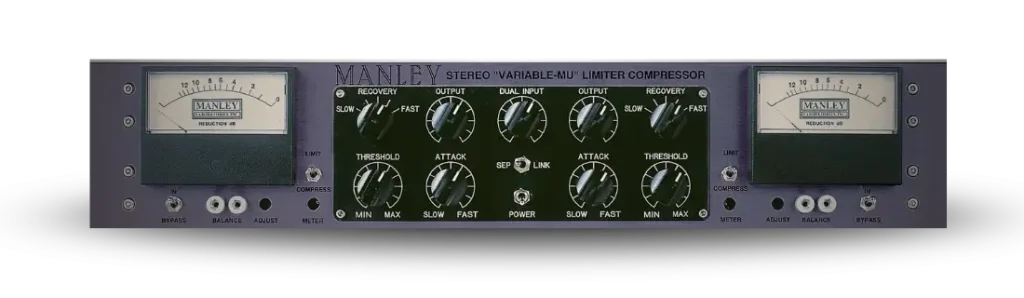
What the v9 adds. The version 9 unit is the modern production Variable Mu: a stepped Input Level switch (−8, −4, −2, −1, 0, +1, +2, +4, +8 dB) for repeatable drive, and the HP SC switch, a 6 dB-per-octave high-pass filter on the side-chain only. With it in, the detector stops reacting to the lowest octave, so a heavy kick or an 808 no longer drags the whole mix down with every hit. Manley specifies the filter at −3 dB at 100 Hz. The audio path is untouched either way; only what the detector hears changes.
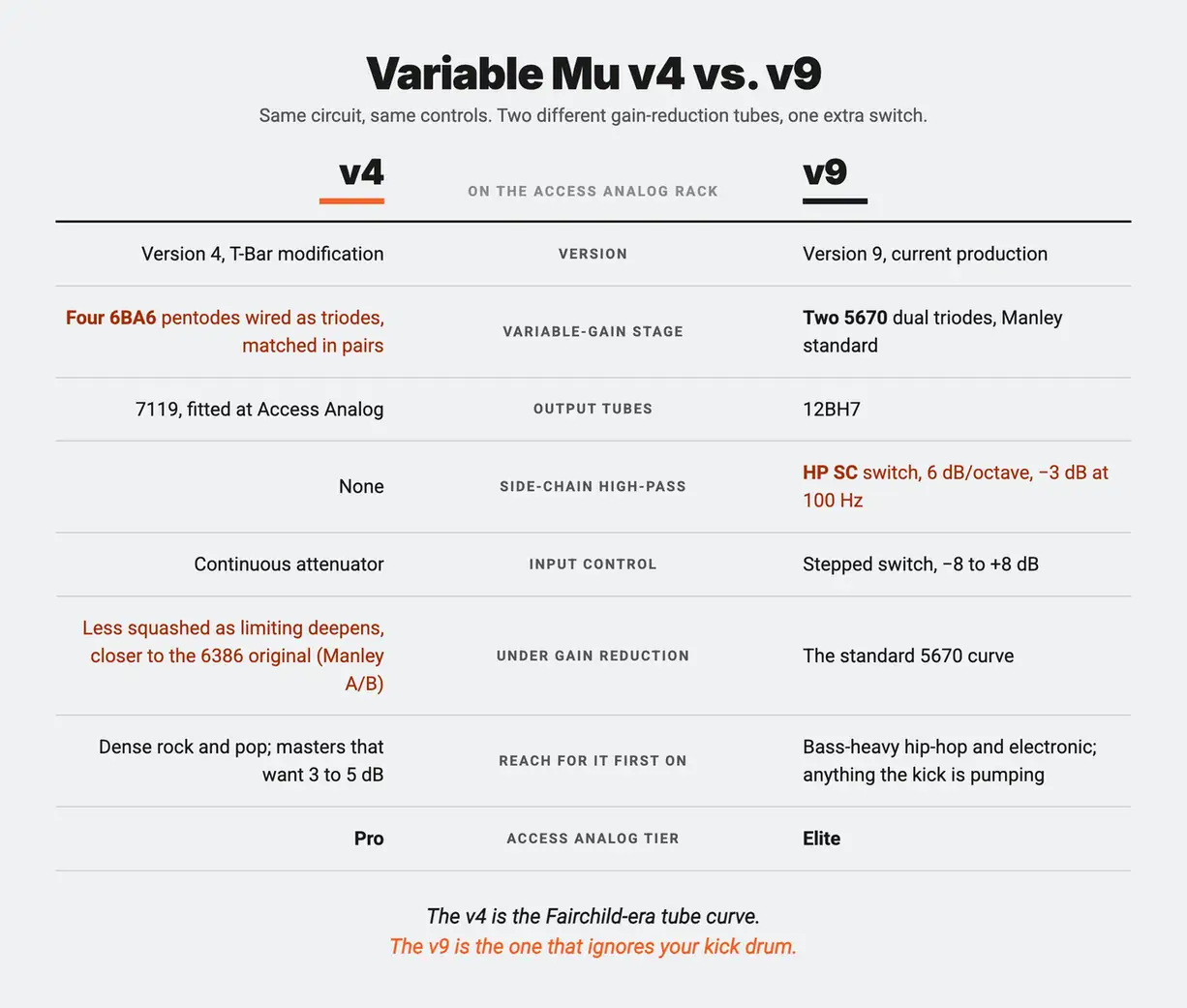
Which one to reach for. Start with the v4 when the master needs to sit into the compressor: dense rock and pop, anything where you may want 3 to 5 dB and the tube curve doing real work. Start with the v9 when the low end is the problem: bass-heavy hip-hop, electronic, or any mix where the kick is triggering the gain reduction and you want the compressor to listen from about 100 Hz up. Both are on the same rack, so the honest answer is to run the same section through each in one session and print what wins.
The v4 is the Fairchild-era tube curve. The v9 is the one that ignores your kick drum.
Set the Variable Mu so the tube is working, not driven: 1 to 3 dB of gain reduction on the loudest sections, a slow Recovery, and Link engaged. Then adjust by ear against Bypass. Everything below is a starting point, not a law; Manley's own guidance for typical use is 2 to 6 dB on the meter, and the manual's advice for mixes is "slow Recovery and less than 5 dB."
The unit has more controls than the "two-knob tube compressor" reputation suggests, and they interact. Here is what each one does and where to put it for a first mastering pass.
Input. On the v4 a continuous attenuator, on the v9 a stepped switch. This is your drive control and, in Compress mode, the practical way to get gain reduction: Manley points out that Compress and Limit share the same threshold, so at low ratios you often "turn up the Input" rather than lowering the threshold. Because the input attenuator sits before the input transformer, drive here is a tone decision, not housekeeping. There is no universal send level on Access Analog; the level you leave the DAW at is the level the transformer sees.
Threshold. Continuously variable. Most extreme at MIN (fully counter-clockwise). Set it so the GR meter peaks at 1 to 3 dB on the loudest chorus. If it is touching 4 or 5 dB on every bar, you are mixing, not mastering.
Attack. Continuously variable from 25 ms (fast) through 50 ms at 12 o'clock to 70 ms (slow). Start at 12 o'clock or a little slower. Manley set the unit up so medium settings of both time controls "provide good gain control and little change in mix values." Slower attack lets the snare and kick transients through and reacts to the vocal and bass instead. Fully counter-clockwise will ignore most percussive material entirely.
Recovery. A five-position switch: 0.2 s, 0.4 s, 0.6 s, 4 s, 8 s. Start at 0.6 s. If the meter is bouncing with the beat, go to 4 s. Manley's manual is blunt about this: the slower settings are the most inaudible, and the more the needle bounces, the more likely the limiting is audible and regrettable. The two slow positions are what let the Variable Mu track the song's overall level instead of individual beats.
Compress / Limit. Compress (1.5:1, soft knee) for a mastering pass. Switch to Limit only when you want peak control in the 2 to 4 dB range and are willing to hear the sharper knee. In Link mode both channels must be in the same mode or the link stops working correctly.
Link. Engage it for stereo. In Link, both channels are reduced by the same number of dB, so a sound in the center stays in the center. Manley combines the two channels' DC control signals, not the audio, and the meters stay independent so you can still see each side. One Access Analog detail from the product page: set the hardware Sep/Link to Link, set the plugin's robotic L/R link to "Absolute" while you get close, then uncheck it and balance the two sides by ear.
Output. A T-pad after the output transformer; it does the job called "makeup gain" elsewhere. Match the processed level to Bypass so you are judging the compression, not a level jump.
HP SC (v9 only). In, for anything with sustained low-frequency energy. Out if the low end is sparse and you want the compressor to feel every note.
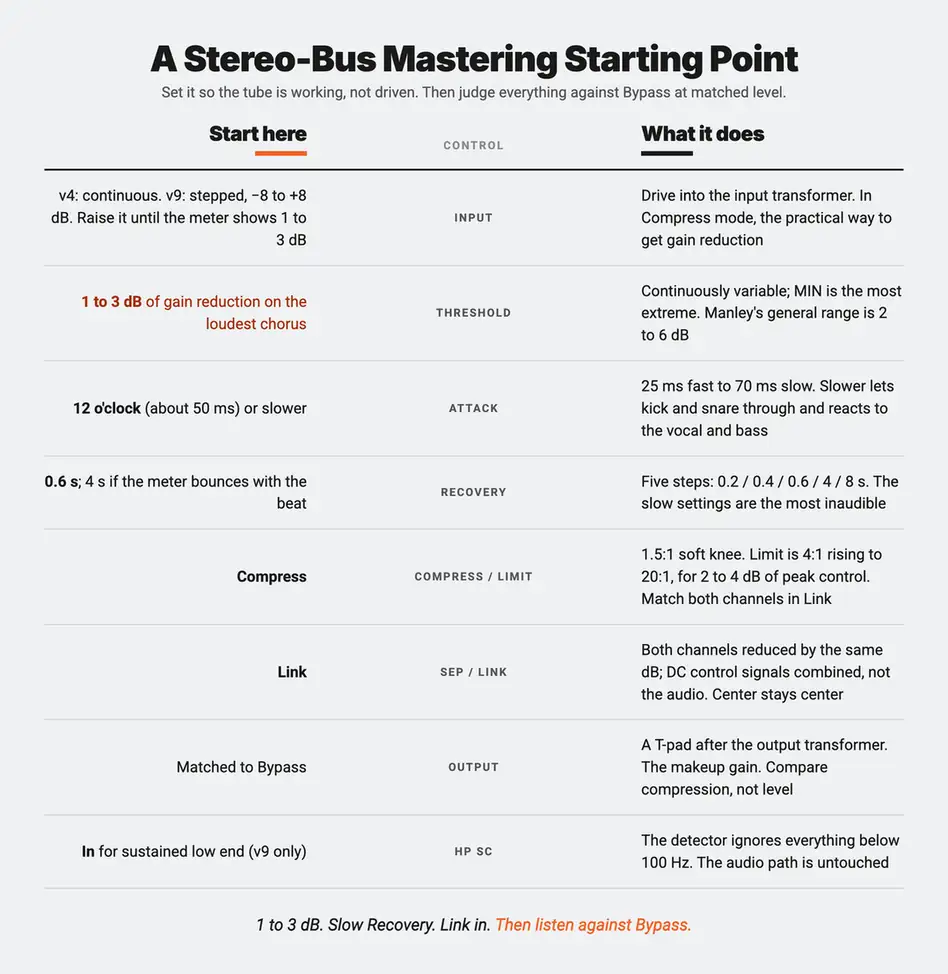
The manual closes its setup notes with three words worth pinning above the rack: "Music before spec sheets." Compare IN against BYPASS at matched level, and if you cannot hear an improvement, turn it down until you can.
For mastering, the Variable Mu earns its place at 1 to 3 dB. Past that, you are making a different record.
The Variable Mu belongs last for a mechanical reason: its ratio and knee respond to whatever is already in the signal, so it should hear the finished tonal balance, not shape it. That makes it the natural closer for a chain that does its coloring or EQ first, the same order we walk through in Mastering with Analog Gear: What You Really Need to Know. Here are three we run on the rack, each with the reason for the order and a starting point.
Each chain is built inside the Analog Matrix as a sequence of units, each unit a real box in our Colorado facility taking its own pass through the converters, with every setting saved to your session and recalled robotically. You can audition the chain in real time, or upload the master and bounce through it.
The idea. Excite, then smooth. The Thermionic Culture Vulture Super 15 is an all-valve harmonic distortion unit with 15 saturation modes, a Triode/Pentode choice, Drive, Bias, and a low-pass filter for taming the fizz. In Triode mode at conservative Drive it adds even-order harmonics: the warm, octave-and-fifth kind that thicken an in-the-box master and soften digital top end. Put it before the Variable Mu and the compressor hears a denser, more harmonic signal and levels it rather than the Vulture exaggerating the compressor's peaks. We paired these two on our own Instagram for exactly that reason: valve punch in, smoothed dynamic range out.
Why v4 here. Both units are in the Pro tier, and the T-Bar stage stays cleaner as the gain reduction climbs, which is what you want after a saturator that has already raised the average level.
Starting point. Culture Vulture: Triode, Drive at Normal, Bias around the middle, low-pass in if the highs get fizzy, output level matched. Variable Mu v4: Compress, Link, Attack 12 o'clock, Recovery 0.6 s, 1 to 2 dB of gain reduction. If the Vulture is doing its job, the compressor will need less input drive than it did on the dry mix.
The idea. The Manley mastering pair. The Manley Massive Passive is a four-band, passive, parallel tube EQ (Manley's spec page has the full band map): only capacitors, inductors, and resistors shape the tone, the bands interact on purpose, and each band can be a bell or a shelf with up to 20 dB of range. Its high-pass filters at 22, 39, 68, 120, and 220 Hz are 18 dB per octave with no resonance, and Manley added the 22 and 39 Hz positions specifically at mastering engineers' request, to clean up subsonics before the compressor sees them. Manley's own Massive Passive manual suggests the combination with the Variable Mu may be "the killer combination for music." We are not going to argue.
Why EQ first. Katz describes patching his equalizer before the compressor most of the time and adjusting the threshold as the EQ changes, and the Variable Mu's feedback detector makes the case on its own: it should react to the balance you are going to ship. The Massive Passive is Elite tier; pair it with the v9 for an all-Elite chain, or with the v4 if you want the T-Bar curve behind it. With the v9, both units sit on the Analog Switch, so this pair can run with analog links between units and a single conversion. We covered the EQ in depth in 5 Reasons To Use the Manley Massive Passive.
Starting point. Massive Passive: 22 Hz high-pass in, a broad low shelf and a broad high shelf of a dB or two rather than any bell, gain trims matched to bypass. Variable Mu: Compress, Link, Attack 12 o'clock, Recovery 0.6 s or 4 s, 1 to 3 dB. Because the Massive Passive is parallel and passive, big-looking knob positions are gentler than they read; let the compressor tell you whether you overdid the low shelf.
The idea. The low-end trick, then glue. The Pultec EQP-1A is a passive filter network with a tube gain-makeup stage, and its famous move is to boost and attenuate the same low frequency (20, 30, 60, or 100 Hz) at once. The boost and the cut have different shapes, so instead of canceling you get deep lows lifted, a steeper return to flat, and a slight dip in the low mids: the curve Manley's own engineers call the "Pultec Curve" and credit for the EQ's fatness. It is one of the best things you can do to a thin master. It is also exactly the kind of energy that makes a vari-mu pump.
Why the v9. This chain is the reason to own a side-chain high-pass filter. With HP SC in, the v9's detector stops listening below 100 Hz, so the lows you just added with the Pultec pass through the compressor without triggering it, and the Variable Mu glues the midrange and top instead of ducking the whole mix on every kick. Both units are Elite tier. The EQ has its own deep dive in The Pultec EQP-1A: Why Engineers Still Reach for a Passive Filter Network.
Starting point. Pultec: 30 or 60 Hz, boost at 2 to 3 and attenuate at 2 to 3, high boost off or a touch at 10 or 12 kHz. Variable Mu v9: HP SC in, Compress, Link, Attack 12 o'clock or slower, Recovery 0.6 s, 1 to 3 dB. Flip HP SC out for a moment and watch the meter: the difference is the kick drum.
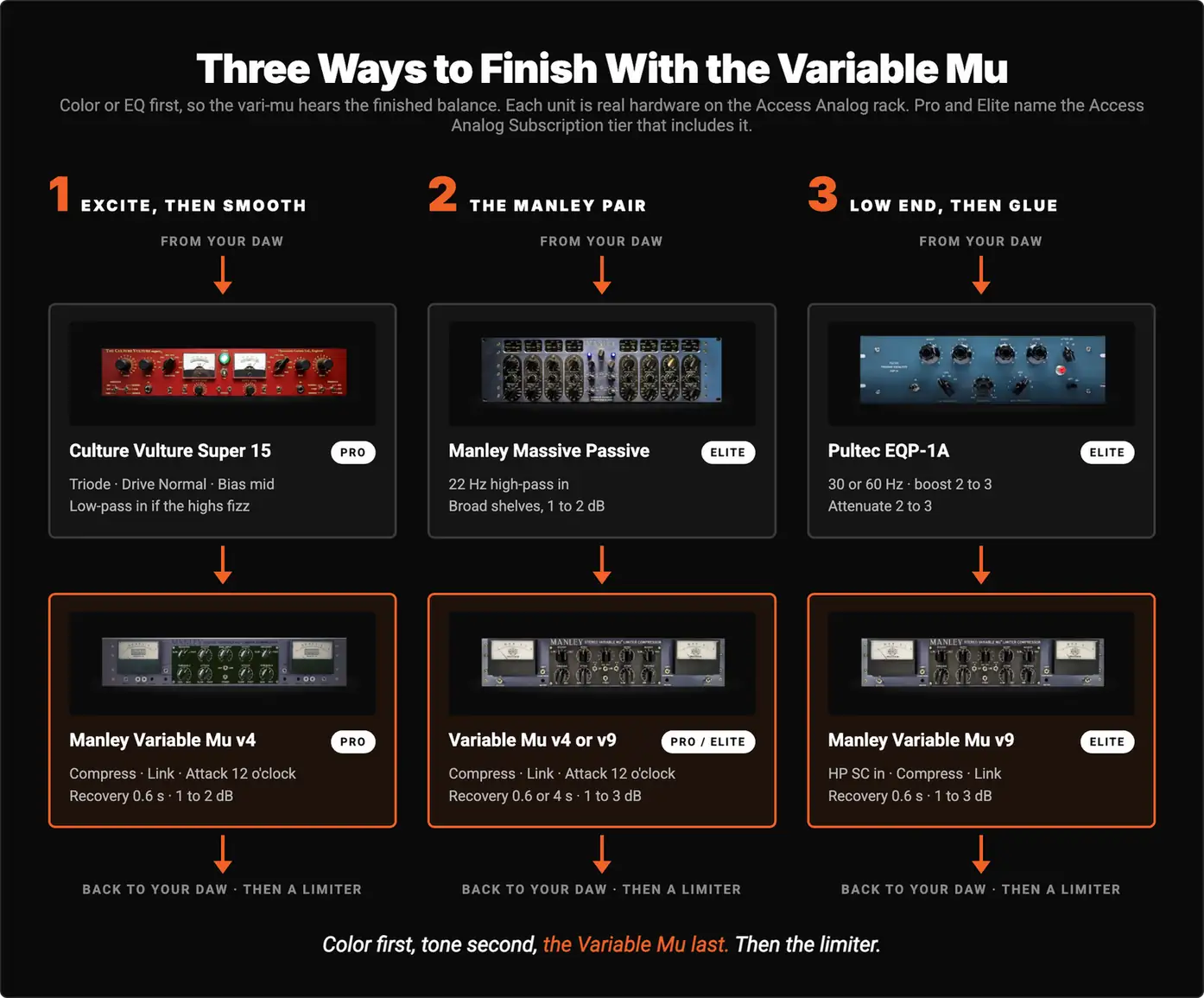
What still comes after. None of these chains ends at the loudness target. The Variable Mu is a level and density tool, not a brick wall, and Manley's own manual assumes the mastering engineer will follow it with a state-of-the-art digital limiter. If you want the ceiling stage in analog as well, we wrote up how the Bettermaker Limiter 2.0 handles it.
Color first, tone second, the Variable Mu last. Then the limiter.
Both Manley Variable Mus are on the Access Analog rack, controlled robotically from inside your DAW through the Analog Matrix plugin. Your audio streams to the real unit in our Colorado facility, the robotics set the actual knobs and switches, and the processed audio returns to your session. There is no model in the path.
Recall. Every control on the Variable Mu, including Attack, Recovery, Comp/Limit, Link, and on the v9 the HP SC switch, is saved with your session and restored robotically the next time you open it. The recall problem that kept mastering engineers away from continuous-pot compressors is gone.
Access. The Variable Mu (v4) is included in the Pro tier of the Access Analog Subscription, and the Variable Mu (v9) in the Elite tier. Without a subscription you can still reserve either unit by the hour or use it on demand with credits, and every new account starts with 12 free credits, which is about an hour on an average device. To see where each one fits, we built three budget mastering chains, one per subscription tier, with the v4 in the Pro chain and the v9 in the Elite chain.
The comparison you cannot do anywhere else. Two Variable Mus with different gain-reduction tubes, in the same rack, on the same converters, recalled to the same settings. Run the loudest minute of your master through the v4, then the v9, at matched output, and print both. That A/B would cost you two units and a week of setup anywhere else.
Every compressor reacts to the signal. The Variable Mu reacts with it. The tube that carries your master is the tube that decides how much to hold back, and its curve, not a ratio switch, sets how firmly it does so. That is why it has spent three decades at the end of the chain: at a few dB of gain reduction it adds density and control without announcing itself, and it gets gentler, not harsher, as the music pushes into it.
Put your color and your EQ in front of it. Give it a slow Recovery. Ask it for 1 to 3 dB. Then run the same passage through the v4 and the v9 and let the record tell you which tube it wanted.
Feed it a finished mix, and the Variable Mu will finish it.
What is a vari-mu compressor?
A vari-mu (variable-mu) compressor uses a vacuum tube as its gain-control element. A remote cut-off tube's gain falls as its grid bias goes more negative, so the side-chain re-biases the tube to reduce level rather than driving a separate VCA, FET, or optical cell. "Mu" is tube shorthand for amplification factor. The Fairchild 670, the Gates limiters, and the Manley Variable Mu all work this way, which is why they share a soft knee and a ratio that rises with gain reduction.
Does the Manley Variable Mu have attack and release controls?
Yes. Attack is continuously variable from about 25 ms (fast) to 70 ms (slow), with roughly 50 ms at 12 o'clock. Release is called Recovery and is a five-position switch: 0.2, 0.4, 0.6, 4, and 8 seconds. There is no ratio knob; the Compress/Limit switch selects a soft-knee 1.5:1 or a sharper knee that starts near 4:1 and rises toward 20:1 under heavy limiting.
What is the difference between the v4 and v9 Manley Variable Mu at Access Analog?
The v4 is a version 4 unit with Manley's T-Bar modification, which replaces the two 5670 variable-gain tubes with four 6BA6 tubes wired as triodes to recreate the original 6386 curve; Manley describes it as less squashed as limiting increases. The v9 is a later production unit on the standard 5670 stage with a high-pass side-chain filter and a stepped input switch. The v4 is in the Pro tier and the v9 in the Elite tier of the Access Analog Subscription.
How much gain reduction should I use on the Variable Mu for mastering?
For a mastering pass, aim for 1 to 3 dB on the loudest sections with Recovery at 0.6 s or slower. Manley's manual gives 2 to 6 dB as typical general use, recommends slow Recovery and under 5 dB on mixes, and notes that up to about 10 dB can stay mostly inaudible. If a master needs more than 3 or 4 dB from the Variable Mu, the mix may need revisiting before the compressor does.
Should I use Compress or Limit mode on a stereo bus?
Compress for a mastering pass. It is a soft-knee 1.5:1 that adds density without obvious level changes. Limit has a sharper knee and a ratio from about 4:1 to 20:1, which Manley intends for peak control in the 2 to 4 dB range. In Link mode, both channels must be set to the same mode.
What should go before the Variable Mu in a chain?
Color and EQ. Because the Variable Mu's detector is a feedback circuit reacting to the signal passing through it, it works best hearing the finished tonal balance. Three chains we run: the Thermionic Culture Vulture into the Variable Mu v4 for harmonics then control, the Manley Massive Passive into either Variable Mu for the all-Manley mastering pair, and the Pultec EQP-1A into the Variable Mu v9 with its side-chain high-pass engaged so the added lows do not trigger the compressor. A digital limiter still handles the final ceiling.
Is the Variable Mu at Access Analog real hardware?
Yes. Both units are physical Manley Variable Mus in our Colorado facility, with real tubes and real Manley transformers. The Analog Matrix plugin streams your audio to the unit, robotics set the controls, and the processed signal returns to your DAW with every setting saved for recall. Nothing in the path is an emulation.