
If your mix sounds like a collection of great parts that still don't feel like one record, a bus compressor is usually the missing piece. The harder question is which one.
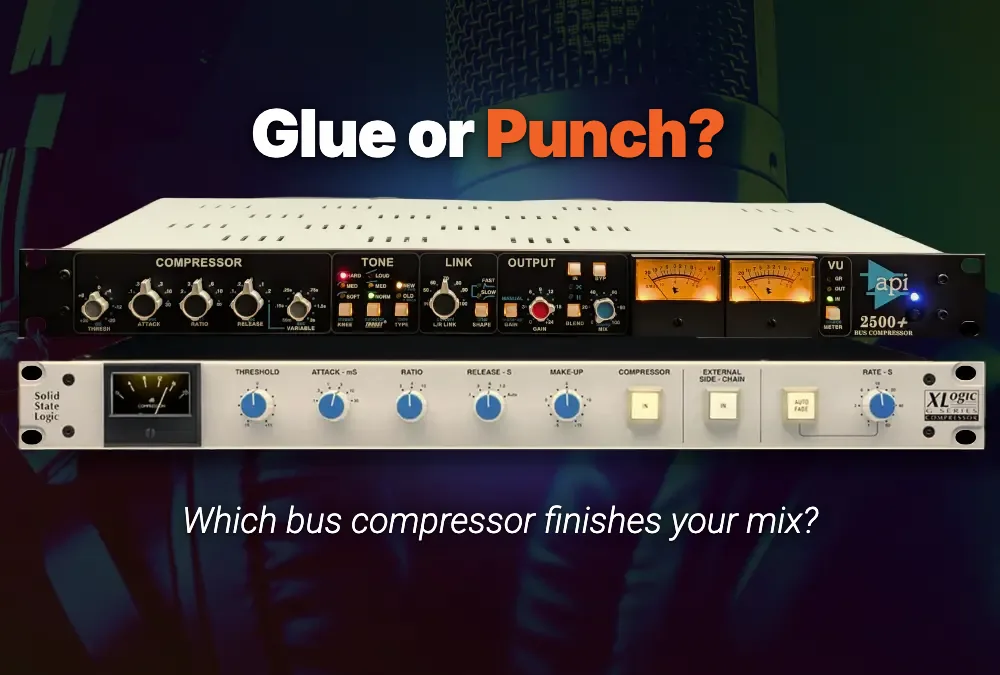
The two most argued-about bus compressors in the world, the SSL G Bus Compressor and the API 2500+, are both stereo VCA designs. On paper they do the same job. In practice they pull a mix in two different directions. The SSL makes everything move together and sound finished while you barely hear it working. The API adds weight and forward transients and keeps the low end hitting no matter how hard you push it.
Reach for the SSL G when you want glue. Reach for the API 2500+ when you want punch. And if you can't decide, the classic answer is both: API on the drum bus, SSL on the mix bus.
In this guide you'll learn what each circuit actually does, the two settings everyone searches for, when to use which, how to chain them, and how to run the real hardware on your own mix from inside your DAW using Access Analog.
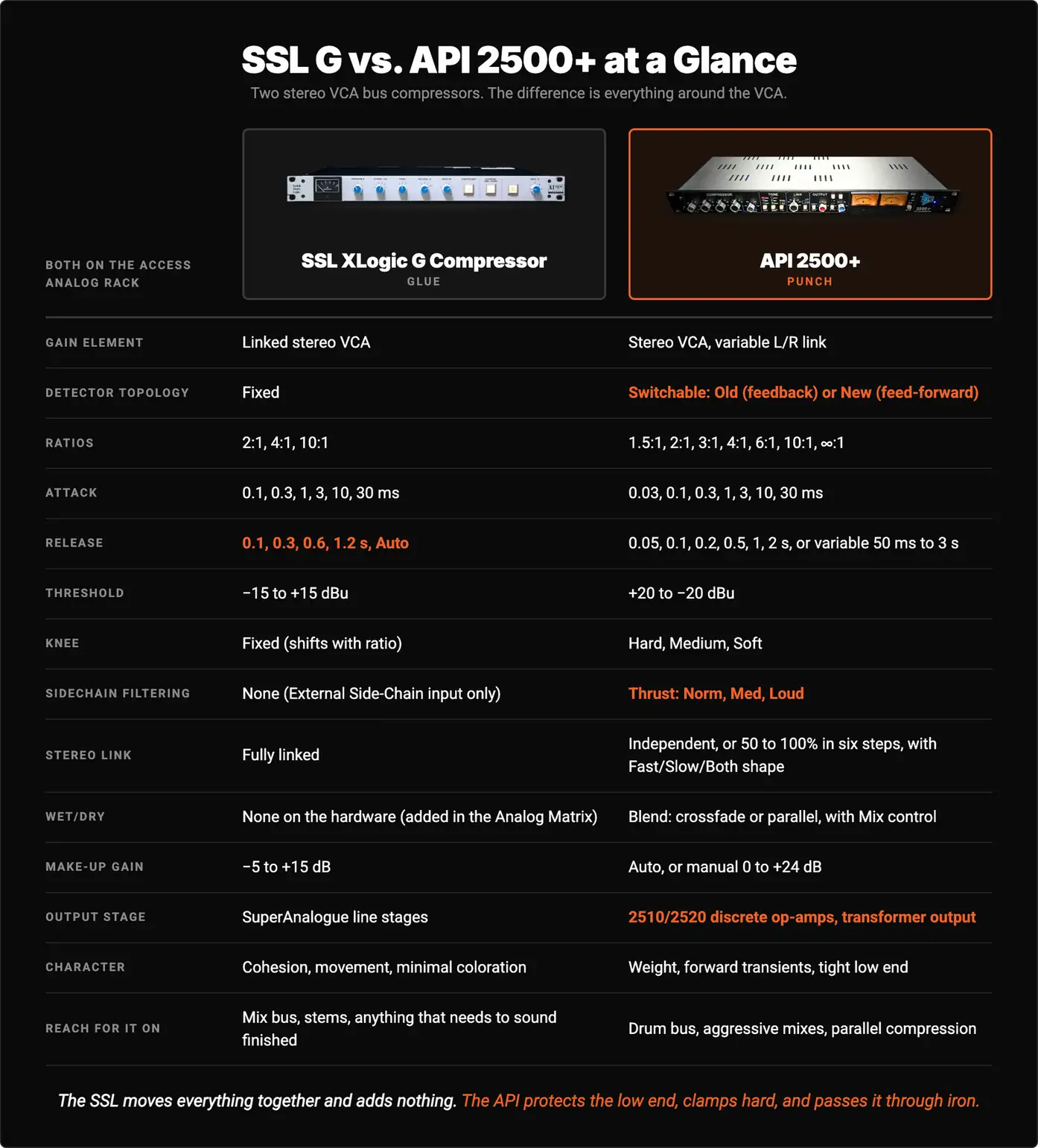
Both are stereo VCA compressors built for a bus, so the difference isn't the gain element. It's everything around it. The SSL G is a fixed-topology design with three ratios, a clean SuperAnalogue signal path, and a program-dependent Auto release, and its character comes almost entirely from envelope and movement rather than tone. The API 2500+ is a compressor with a tone section: a switch that moves the detector before or after the VCA, a three-position knee, a patented sidechain filter called Thrust, a variable stereo link, and an output stage built on API's discrete 2510 and 2520 op-amps and an output transformer.
That is why engineers describe the SSL as "glue" and the API as "punch." The SSL's whole design says don't draw attention to me. The API's whole design says make it hit. We covered the general case in our guide to understanding and using a bus compressor; this post is about choosing between the two units engineers actually argue over.
The SSL G is a linked stereo VCA compressor whose entire design is aimed at making a mix move as one thing without sounding compressed.
The SSL XLogic G Compressor is the center-section bus compressor from SSL's 4000 G console, rebuilt as a 1U rack unit with SSL's SuperAnalogue input, output, and power circuitry around the original gain-reduction concept. The console compressor's envelope was kept exactly; everything around it got quieter and cleaner (noise below roughly −90 dBu, flat within ±0.2 dB from 20 Hz to 20 kHz, headroom beyond +28 dBu). Hugh Robjohns, reviewing it for Sound On Sound, described its character as envelope and movement rather than added saturation.
Ratio is a three-position switch: 2:1 for subtle, transparent control, 4:1 for the recognizable SSL sound, and 10:1, which behaves broadly as a limiter.
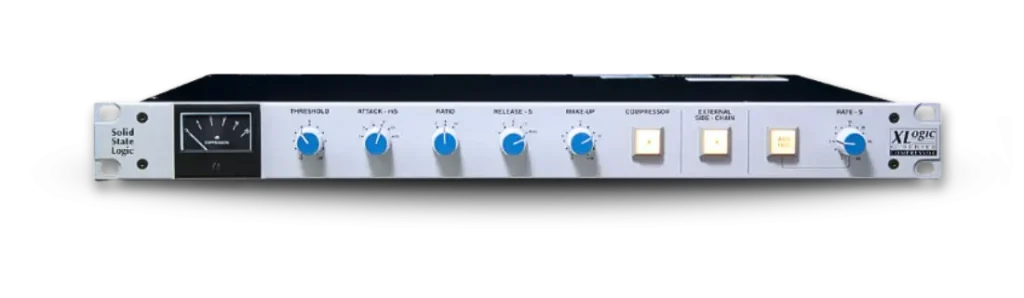
Threshold runs from about −15 to +15 dBu and interacts with the ratio: a lower ratio shifts the effective knee, so the meter can move when you change ratio even if you never touched threshold.
Attack is a six-position switch from 0.1 to 30 ms. The slow end (10 and 30 ms) lets kick and snare through before the VCA clamps, which is the setting behind almost every "SSL on the mix bus" recipe. Release offers 0.1, 0.3, 0.6, and 1.2 seconds plus Auto, and Auto is program-dependent: it adapts to how long the peaks last and how much sustained energy is in the program. Robjohns found it reliable enough to become his default. Make-up spans −5 to +15 dB, and the two channels are always fully linked, so the center image never wanders.
What the unit does not have matters here. The original XLogic G-Series has no sidechain filter (it has an External Side-Chain input for a key signal), no wet/dry control, and no mid/side mode. On Access Analog the External Side-Chain isn't exposed in the Analog Matrix, but we've added a wet/dry mix inside the plugin, so parallel bus compression on the real SSL is a knob rather than a routing exercise.
The SSL glue happens because modest, fully linked gain reduction makes every element of a mix rise and fall together, and the clean path adds almost nothing else.
The API 2500+ is a stereo VCA compressor with a tone section: you choose where the detector listens, how it hears low end, how hard the knee is, and how much the two channels talk to each other.
The API 2500+ runs its audio through API's discrete 2510 and 2520 op-amps into an output transformer, and that output stage is the first half of the punch story: it adds weight and a forward quality the SSL's SuperAnalogue path deliberately avoids.
The compressor section out-configures the SSL in every dimension: seven ratios from 1.5:1 to ∞:1, seven attack times from 0.03 to 30 ms, six fixed release times from 0.05 to 2 seconds plus a variable position from 50 ms to 3 seconds, threshold from +20 to −20 dBu, and a three-position knee (Hard, Medium, or a gradual over-easy Soft). Then comes the tone section, which is where the 2500+ stops being a generic VCA compressor.
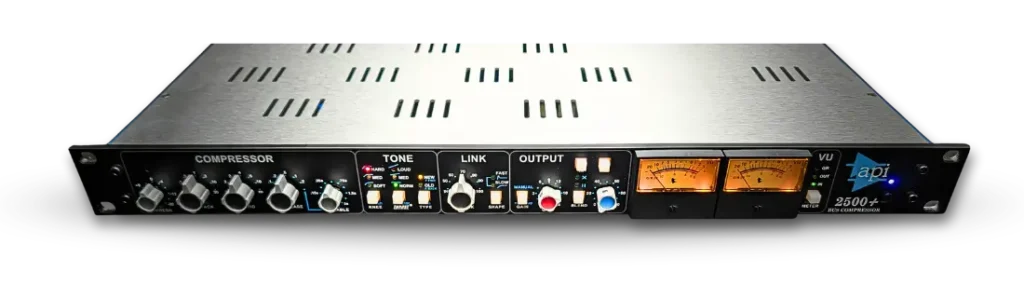
Thrust is API's patented sidechain filter. Norm leaves the detector flat, so the 2500+ compresses like most units on the market. Med applies a slight low cut and high lift to the detector signal. Loud inserts a 10 dB-per-decade filter (about 3 dB per octave) in front of the RMS detector, the inverse of the pink-noise energy curve. In plain terms, Thrust turns the bass down in the compressor's ears: kick and bass stop dominating the gain reduction, so the low end keeps hitting while the rest of the mix is compressed evenly. API calls Loud the "little more punch" function.
Type moves the detector. New is feed-forward: the RMS detector reads the signal before the VCA and applies exactly the gain reduction the ratio demands, which API describes as more aggressive and harder. Old is feedback: the detector reads the signal after the VCA, the way the API 525, the 1176, and the Fairchild 660 work, and because it's always reacting to an already-compressed signal the result is smoother and softer.
Link sets how much each channel influences the other's gain reduction, from Independent through 50 to 100% in six steps, with a Shape switch that lets the link act on peaks (Fast), RMS (Slow), or both. Each side keeps its own detector and the control voltages are summed, so a hard-panned element can't slave the whole mix's gain reduction. Make-up is automatic, so ratio and threshold changes don't jump the level, or manual from 0 to +24 dB. Blend does parallel compression on the unit, either as a wet/dry crossfade or by adding compressed signal under the full dry input with the Mix control.
The API punch is the sum of a transformer output stage, a feed-forward detector that clamps hard, and a sidechain filter that keeps the low end from triggering the compressor. Every piece is switchable, and that flexibility is the 2500+'s real identity.
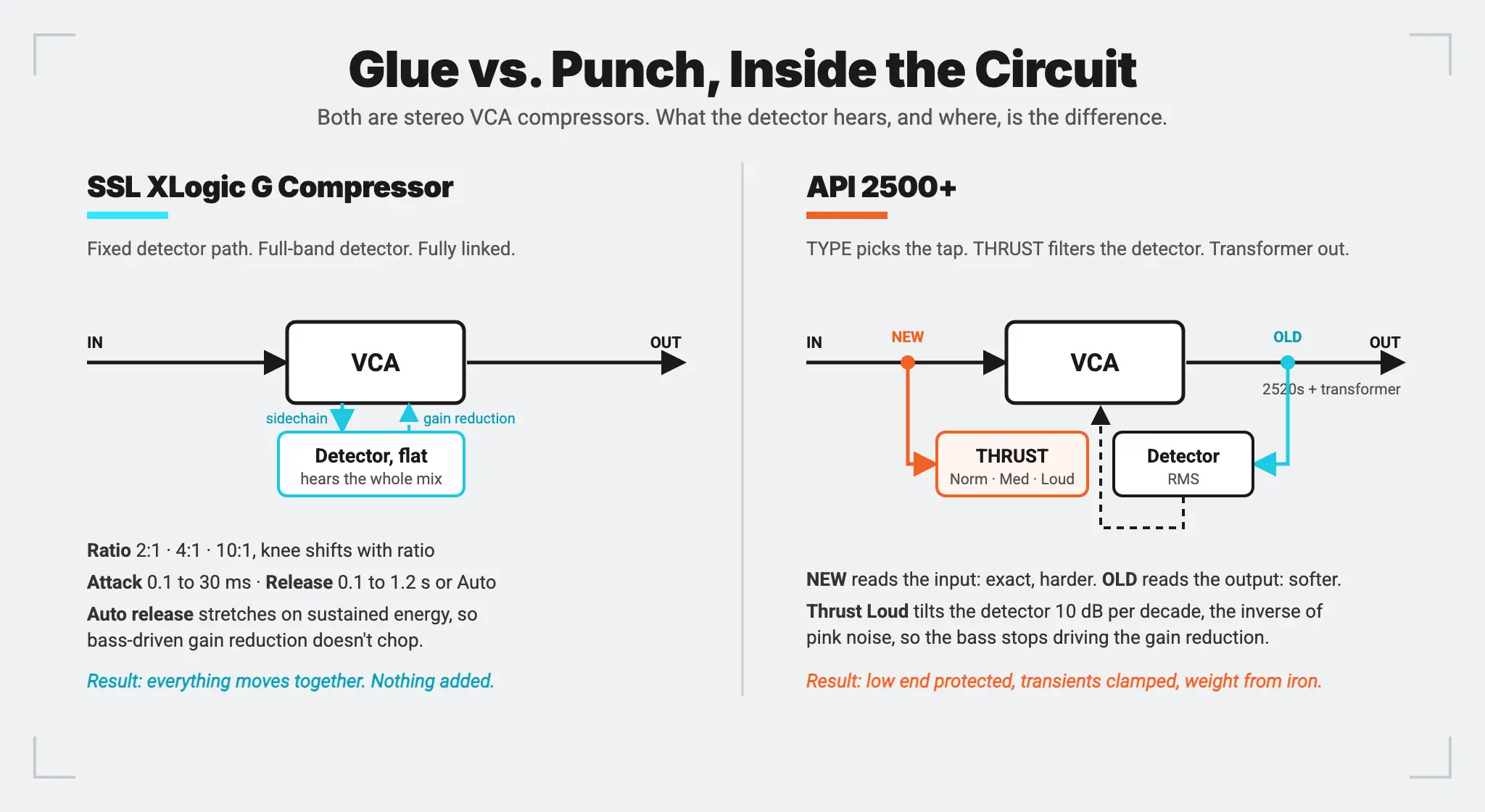
Strip away the branding and three circuit decisions explain most of what you hear.
Where the detector listens. A feed-forward detector sees the raw input and calculates precisely how much gain to remove. Think of a thermostat that reads the forecast and sets the heater before the cold arrives: exact, and sometimes abrupt. A feedback detector reads the output, after the VCA has already acted, and corrects. That's a thermostat reading the room: it always arrives a little late and a little under, which rounds off the onset and makes the compression feel softer. The SSL's topology is fixed. The API lets you pick with a switch, so Old mode is your route to SSL-style smoothness and New mode is your route to slam. (The 1176 uses feedback detection too, which is why API names it as a reference for Old mode.)
What the detector hears. A full mix carries far more energy below 200 Hz than above it. With a flat detector, kick and bass drive most of the gain reduction, and every kick hit pulls the vocal, guitars, and cymbals down with it. That's pumping. The SSL has no sidechain filter and stays musical through its Auto release, which stretches when the program has sustained energy so the bass-driven gain reduction doesn't chop. The API filters the detector instead: with Thrust on Loud it hears the mix at roughly equal energy per octave, the low end passes through less compressed, and that reads as weight and punch.
How the gain is delivered. The SSL's SuperAnalogue line stages are built to color nothing (THD+N below 0.008% at +4 dBu with the compressor out), so whatever you hear from the SSL is envelope. The API delivers gain through discrete op-amps and a transformer, and both behave differently at different levels: drive the output harder and the transformer contributes low-frequency harmonics and a slight softening of the fastest edges, which the ear reads as body. We went deeper on that mechanism in our Black Box HG-2 guide to mix-bus harmonics; the 2500+ does a much subtler version as a side effect of its output stage.
Glue is what you get when a compressor moves everything together and adds nothing. Punch is what you get when a compressor protects the low end, clamps the transients decisively, and passes the result through iron.
Reach for the SSL G when a mix is already balanced and you want it to sound finished: tighter, louder, more like one performance, with no obvious compression artifacts. It's the tool for pop, rock, and anything headed to a mastering engineer who wants to hear the mix, not the compressor.
The mix-bus glue recipe. The setting everyone searches for is real: 2:1 or 4:1 ratio, 10 or 30 ms attack, Auto release, 1 to 3 dB of gain reduction on the loud sections, make-up set so compressed and bypassed match in loudness. The slow attack lets transients through, Auto release tracks the program, and the low gain reduction keeps the effect below the point where you'd call it compression. At 4:1 with 2 to 4 dB you get the recognizable SSL bus sound; at 2:1 with 1 to 2 dB you get transparent leveling.
Mix into it. Insert the SSL early and balance the mix through it, so kick level, bass level, vocal position, and stereo width all get decided in response to the compressor. Switch it on at the end of a finished mix and you'll usually have to compromise, because its envelope shaping changes a balance you'd already settled.
On the drum bus. 4:1, 10 or 30 ms attack, 0.1 or 0.3 s release (or Auto), 2 to 6 dB of gain reduction. The slower attack keeps kick and snare impact, the faster release adds excitement, and more gain reduction brings up room and sustain. Push to 10:1 with a fast attack and it becomes a peak limiter or a deliberate crushing effect.
Set the threshold last and by ear. Ratio and attack define the character; threshold just decides how much of it you get.
Reach for the API 2500+ when a mix or a bus needs energy, weight, and transient impact: drum buses first, then aggressive rock, hip-hop, and modern pop, and any time the low end has to stay solid under heavy compression.
The drum-bus recipe. 4:1, New (feed-forward), Thrust on Loud, Medium or Hard knee, 10 to 30 ms attack so the initial hit gets through, release set to recover with the tempo. Dial the threshold for a few dB of gain reduction on the loudest hits. Thrust on Loud does the heavy lifting: the kick no longer drives the gain reduction, so snare and cymbals get compressed evenly while the kick keeps its weight. For more, engage Blend in parallel mode and bring the compressed signal up under the dry kit with Mix.
The mix-bus and mastering recipe. Type to Old, 1.5:1 or 2:1, Soft knee, Thrust on Med, link at 100% with Shape on Slow. The feedback detector rounds the onset, the soft knee fades into compression, and the slow RMS-acting link keeps the stereo image from twitching. This is where the 2500+ gets closest to the SSL's job, with more low-end weight from the transformer output.
When to break the link. On a wide mix with a hard-panned element, 100% linking means that element's peaks pull both channels down. Back the link off to 70 or 80% and the two sides compress a little independently without the center image shifting.
Old plus Soft plus Med Thrust is glue with weight; New plus Hard plus Loud Thrust is punch. Learn both and the 2500+ becomes two compressors.
Yes, and the assignment most professional mix engineers land on is API 2500+ on the drum bus, SSL G on the mix bus. The API shapes the drums where its strengths matter: Thrust protects the kick, the feed-forward detector clamps the transients, the transformer adds weight. The SSL then receives a mix whose loudest element is already under control and does what it does best, moving the whole thing as one record with 1 to 3 dB of nearly invisible gain reduction.
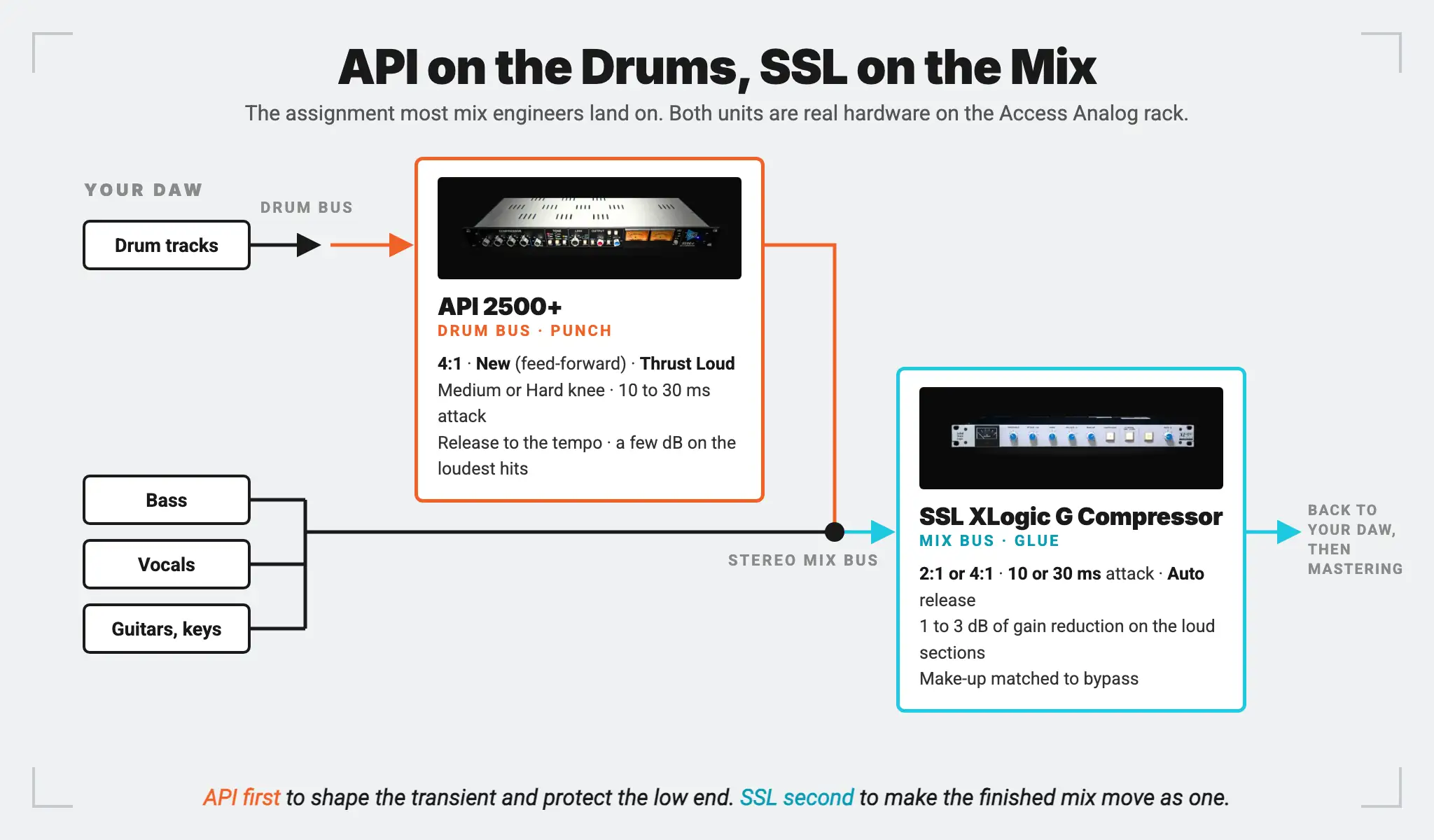
Swap them and the mix still works, but you've swapped the strengths: the SSL tightens the drums without much weight, and the API adds forwardness to a mix that may not want it. That's a legitimate choice for an in-your-face record, just not the default.
Two things to avoid. Don't run both fast and deep; if the API takes 6 dB at 1 ms on the drums and the SSL takes 4 dB at 1 ms on the mix, the transients are gone twice over. Give each stage one job. And don't let the bus compressor become the mastering stage. Bob Katz, in Mastering Audio, cautions that a mix-bus compressor limits what the mastering engineer can do afterward and suggests printing a version with and without it. If the record is headed for a mastering compressor like the Manley Variable Mu or a Neve 33609, leave it room to work. We cover the AMS Neve 33609/N in its own guide.
API first to shape the transient and protect the low end. SSL second to make the finished mix move as one.
No comparison article, including this one, can tell you which compressor suits your mixes. Hearing both on the same material is the only way to know, and until recently that meant owning two units that together cost more than a good pair of monitors.
Access Analog racks both the real SSL XLogic G Compressor and the real API 2500+, and the Analog Matrix plugin connects your DAW to that hardware through robotic control. It is a portal, not an emulation: your audio passes through the actual VCAs, SuperAnalogue stages, 2520s, and output transformer, and comes back at 24-bit/96k. Every knob you move in the plugin moves the physical unit.
That turns this debate into a twenty-minute session. Insert the Analog Matrix on your drum bus and load the API 2500+. Insert another on the mix bus and load the SSL G. Then swap them and listen again. The Analog Matrix's dual chains let you A/B two setups on the same passage, and your settings save with the DAW session and are robotically recalled.
Both units are included in the Elite tier of the Access Analog Subscription, and either can be reserved separately if you're not subscribed, with hourly rates on our gear prices page. New accounts start with 12 free credits, roughly an hour on an average device: enough to settle the glue-or-punch question on your own mix.
Level-match before you judge. Both units make a mix louder, and louder always sounds better for about thirty seconds. Match compressed and bypassed loudness with make-up (the API's auto make-up does this for you) before deciding anything.
Watch what you send. Threshold on both units is calibrated in dBu, so the level you drive into the hardware is part of the sound. On Access Analog the level you set in your DAW is the level the hardware sees, which makes drive a tone decision rather than housekeeping. Our gain staging guide covers how to think about it.
The SSL has no sidechain filter, so give it help. If it pumps on a bass-heavy mix, Auto release is the first fix. If that isn't enough, high-pass the drums or bass slightly. Don't fight it with a faster attack; that removes the transients you were trying to keep.
Thrust on Loud plus a fast attack can thin a mix. Loud Thrust makes the detector more sensitive to highs. Pair it with a 0.03 or 0.1 ms attack on a full mix and the top end gets clamped while the bass sails through. On a drum bus that's often the point; on the 2-bus, try Med.
Don't chase the meter. 2 dB of gain reduction that moves musically beats 6 dB that reads impressive. On the SSL especially, the sweet spot is smaller than the meter suggests.
Print a version without it. If the mix is going to mastering, send a bus-compressed version and a clean one.
The SSL G Bus Compressor and the API 2500+ aren't competitors for the same job. The SSL is a fixed, clean, fully linked compressor whose only ambition is to make a mix move together and sound like a record. The API is a configurable compressor with a tone section, built to add weight, protect the low end, and hit. Glue and punch aren't marketing words; they're the audible results of where the detector sits, what it hears, and what the gain passes through on the way out.
Most working engineers end up wanting both, and the assignment that keeps winning is API on the drum bus, SSL on the mix. That's a starting point, not a rule, and the only way to know what your mixes want is to hear it.
Load the real SSL G and the real API 2500+ on your own mix, in the same session, and let the record tell you which one finishes it.
Is the SSL G or the API 2500 better for the mix bus?
The SSL G Bus Compressor is the more common mix-bus choice because its fully linked VCA design, program-dependent Auto release, and clean SuperAnalogue path add cohesion with almost no coloration. The API 2500+ works on the mix bus too, especially in Old (feedback) mode with a soft knee and a low ratio, and adds more low-end weight from its transformer output. Choose the SSL for invisible glue and the API for a more forward, weighty mix. Both are available as real hardware at Access Analog.
What does the API 2500 Thrust circuit do?
Thrust is API's patented sidechain filter. It inserts a filter with a 10 dB-per-decade slope in front of the compressor's RMS detector, the inverse of the pink-noise energy curve, so low frequencies no longer dominate the gain-reduction decision. The result is less pumping from kick and bass and more apparent punch. Norm is flat, Med is a mild version, and Loud is the full effect.
What is the difference between Old and New mode on the API 2500?
Old mode is a feedback topology: the detector reads the signal after the VCA, the way the API 525, the 1176, and the Fairchild 660 work, which gives a smoother, softer, more transparent compression. New mode is feed-forward: the detector reads the signal before the VCA and applies exactly the gain reduction the ratio demands, which is faster, harder, and more aggressive. Old is the usual choice for mix-bus glue and mastering; New is the usual choice for slamming drums.
What are the classic SSL bus compressor settings?
The classic SSL mix-bus setting is a 2:1 or 4:1 ratio, a 10 or 30 ms attack, Auto release, and 1 to 3 dB of gain reduction in the loudest sections, with make-up gain set so the compressed and bypassed mix match in loudness. The 4:1 version is the recognizable "SSL sound." For a drum bus, keep 4:1, use a 0.1 or 0.3 second release, and allow 2 to 6 dB of gain reduction.
Can I use the API 2500 as a mix bus compressor?
Yes. Set Type to Old, choose a 1.5:1 or 2:1 ratio, use a soft knee, keep Thrust on Norm or Med, and link the channels at 100% with the Slow shape. That configuration gives smooth, program-friendly gain reduction with the added weight of API's transformer-coupled output. It's a heavier-sounding alternative to the SSL rather than a replacement for it.
Does the SSL G Compressor have a sidechain filter or a mix knob?
The original SSL XLogic G-Series Compressor has no built-in sidechain filter and no wet/dry control; it has an External Side-Chain input for a key signal, three ratios, six attack times, and a five-position release including Auto. On Access Analog, the External Side-Chain isn't exposed in the Analog Matrix, but the plugin adds a wet/dry mix control, so you can run parallel bus compression on the real SSL without any extra routing.
How can I compare the real SSL G and API 2500 without buying them?
Access Analog gives you remote access to the real SSL XLogic G Compressor and the real API 2500+ from inside your DAW through the Analog Matrix plugin. Your audio runs through the physical hardware in real time, with every setting saved in your session and robotically recalled. Both units are in the Elite subscription tier and can also be reserved individually, and new accounts get 12 free credits to try them.