
The Universal Audio 1176 has been on more professional vocal tracks than any other single compressor. That consistency is not nostalgia. It is a specific circuit doing specific things to audio that other topologies do not.
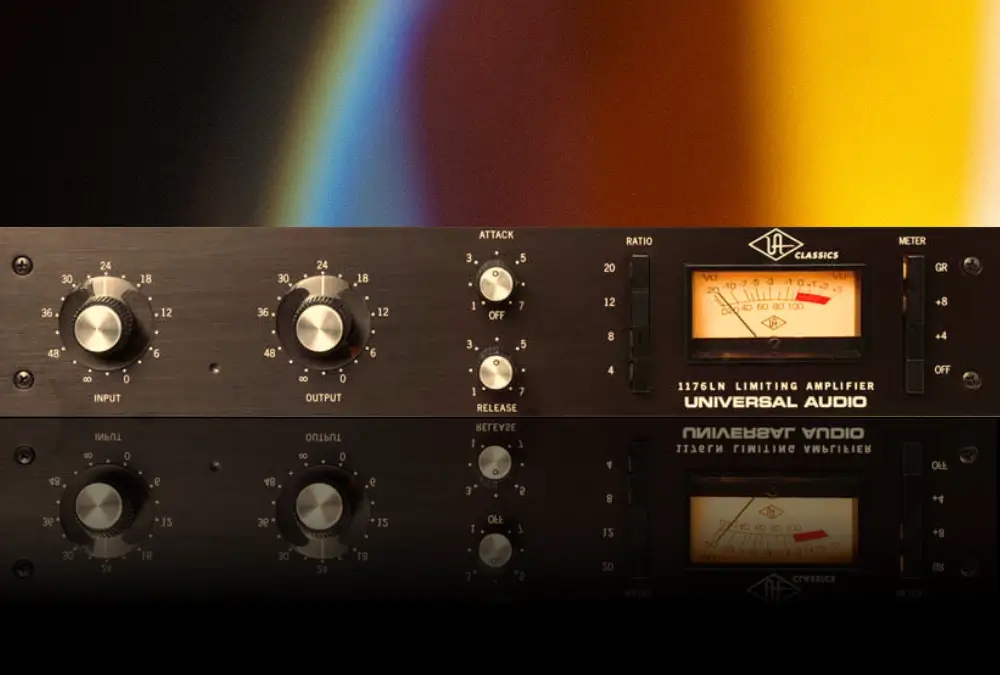
Engineers who work at very different speeds, in very different genres, keep reaching for it. This guide covers the field-effect transistor at the heart of the 1176, why its attack and release controls run backwards from every other compressor you own, what the circuit actually does in all-buttons-in mode, how the dual-channel 2-1176 differs from a pair of mono units, and which sources reward the topology most. Both units run on the Access Analog rack.
Key Takeaways
The 1176 is not a transparent compressor, and it was never trying to be.
The 1176 did not invent compression. It reinvented who gets to control it.
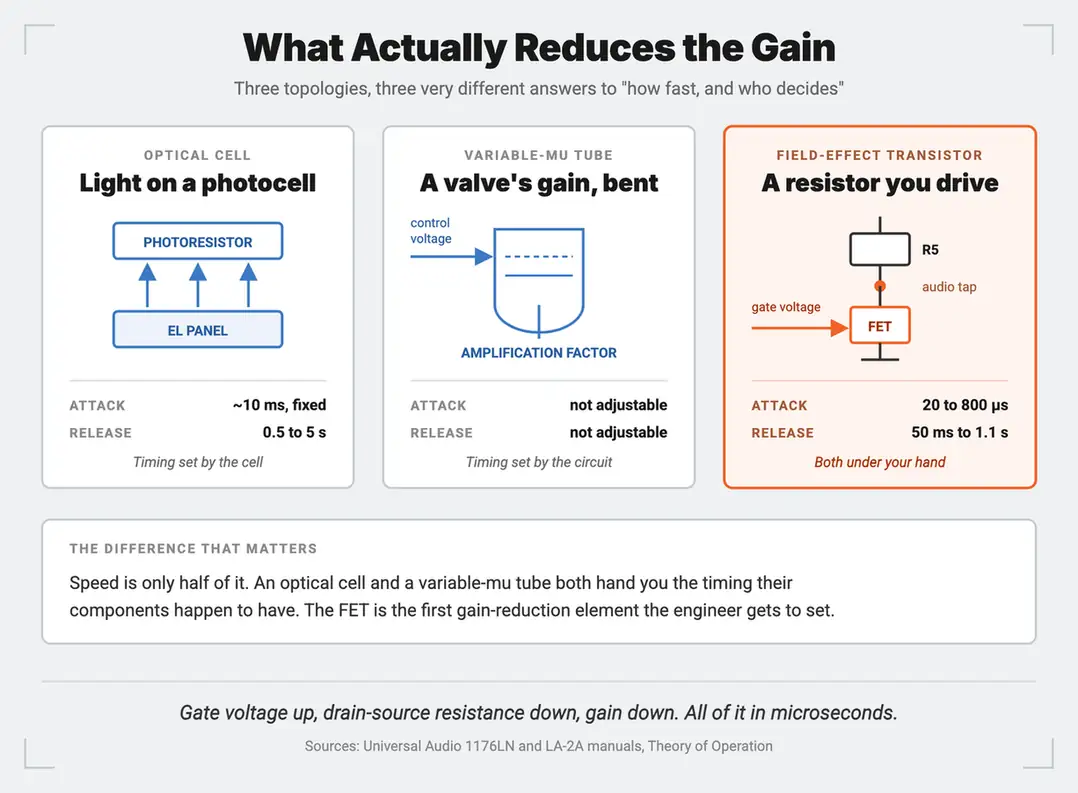
Bill Putnam Sr. began designing the 1176 at Universal Audio in 1966, and the first units, designated 1176A, shipped in 1967. Before that, gain reduction in professional compressors was handled by optical cells or variable-mu tubes. Both are effective. Neither is adjustable, and neither is anywhere near as quick.
An optical cell works by shining a light on a photoresistor. The panel brightens quickly enough, but the photoresistor takes time to change its resistance and considerably longer to recover, and that recovery depends on how long and how brightly it has been lit. A variable-mu tube is a valve whose amplification factor is shifted by a control voltage, a process governed by tube physics. In both cases the timing is a property of the parts, not a setting on the front panel. You get what the component gives you.
Think of it like a tollbooth on a highway. The optical and tube designs are the kind where the gate has to fully raise before the car gets through: graceful, but not quick, and the gate raises at its own pace regardless of what you want. The FET is a different mechanism. The gate responds the instant the trigger fires, and you decide how fast.
A field-effect transistor (FET) can switch its operating point in microseconds. Putnam experimented extensively with the then newly developed device and eventually found a way to use it as the gain-controlling element of a limiter: a voltage-controlled variable resistor forming the bottom half of a voltage divider, with the audio applied across it. Raise the voltage on the FET’s gate and its drain-source resistance falls, which drops the gain. That single design decision is what makes the unit categorically different from its predecessors, and it is why the 1176 can respond to a transient before the ear resolves it as a distinct event.
Rupert Neve Designs paired a FET stage with an optical one in a single unit, the OptoFET.
Here is the part of the FET story that usually gets told backwards. The harmonic distortion the 1176 is famous for was not a design goal. It was the problem.
FETs are inherently non-linear devices, and the fundamental challenge Putnam faced was keeping his FET operating inside its linear region so that distortion stayed low. He solved it well enough to ship. Then in September 1970, revision C introduced a noise-reduction circuit designed by Brad Plunkett, which is where the LN in 1176LN comes from. That circuit exists specifically to hold the FET in its linear region and reduce the distortion it introduces. Universal Audio thought enough of it to consider filing a patent and initially potted it in a sealed module to keep it secret.
So the character engineers prize is what survived two rounds of deliberate suppression, and it scales with how hard you drive the Input. At modest gain reduction, roughly 4 dB or less, the 1176 is close to transparent. Push the Input and the non-linearity comes forward as the density and presence people describe on a vocal or the thickness on a bass. Reviewing the reissue for Sound On Sound, Hugh Robjohns characterised the unit’s brightness as more of a subtle spectral tilt than an obvious treble lift, the kind that helps a source move forward in a mix without reaching for EQ, and noted that the effect grows with input level.
You do not switch the 1176’s character on. You drive it in.
Clockwise is faster. On the 1176, and on almost nothing else you own, turning the knob up speeds the circuit up.
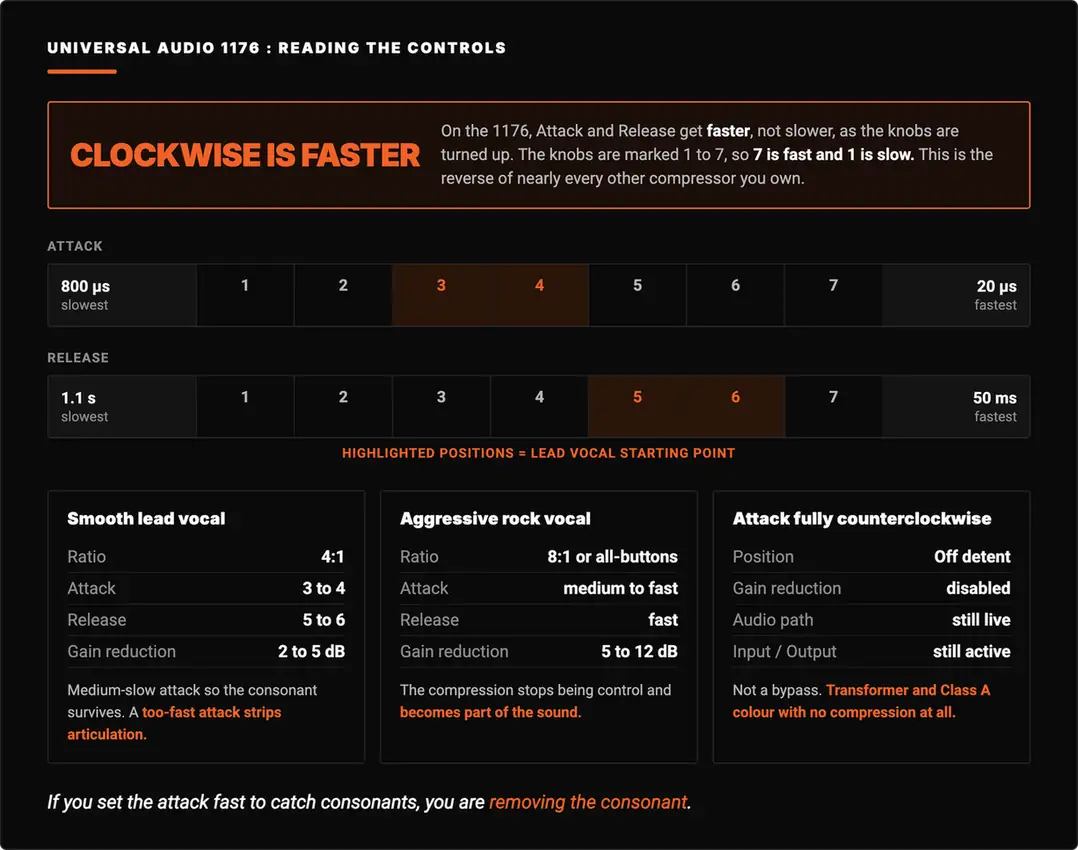
This is the single most misremembered fact about the unit, so it is worth stating plainly. On the 1176, both Attack and Release are fastest fully clockwise and slowest fully counterclockwise. Universal Audio’s own 1176LN manual flags it twice, because it is the reverse of the visual logic most engineers bring to a compressor. The knobs are marked 1 through 7, so 7 is fast and 1 is slow.
Attack is continuously variable from roughly 800 microseconds at position 1 to 20 microseconds at position 7. Both ends are extremely fast. Even the slowest attack the 1176 offers is under a millisecond, which is why the unit stays a fast compressor across its whole range and why it is the wrong tool when you genuinely want a relaxed, slow attack.
Release runs from about 1.1 seconds at position 1 to 50 milliseconds at position 7.
Attack, fully counterclockwise, is an Off detent. Turn it past 1 until it clicks and gain reduction is disabled entirely, but audio keeps running through the input transformer, the Class A output amplifier, and the custom output transformer Putnam designed. Input and Output stay live. This is not a bypass. It is the 1176 as a tone processor, and it is one of the most useful things the unit does: transformer colour, Class A character, and that subtle brightness, with the meter sitting still. It is also how engineers strap a pair across a mix when they want the iron and not the compression.
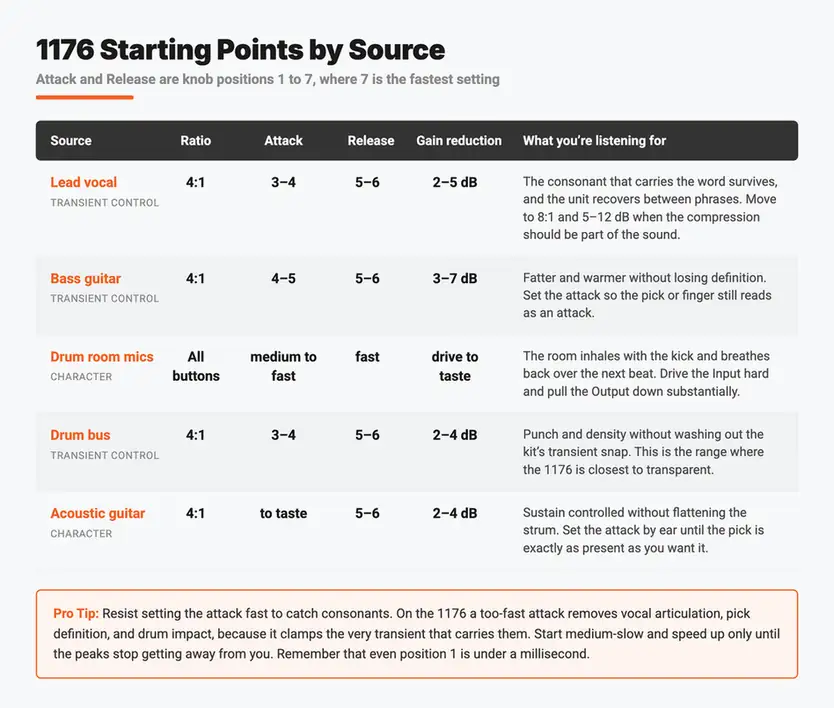
Now the counterintuitive part for vocals. The instinct is to set the attack fast to catch consonants. Do that and you get the opposite of what you want. A too-fast attack strips vocal articulation, punch, and pick definition, because it clamps the transient that carries the intelligibility. A slower attack lets the consonant through and compresses the body of the note behind it.
For a smooth lead vocal, start around 4:1, attack medium-slow (roughly 3 to 4), release medium-fast (roughly 5 to 6), with 2 to 5 dB of gain reduction on peaks. The attack preserves the front edge of each word. The release recovers between phrases, so the track stays alive rather than squashed. For a harder rock vocal, move to 8:1, attack medium to fast, release fast, and let the meter show 5 to 12 dB.
One more thing the ratio buttons do that is easy to miss. They alter the detector bias, which means they move the internal threshold as well as the slope. Higher ratios sit at a higher threshold, so the unit waits for stronger peaks before it acts. That is why changing ratio on an 1176 does not produce the abrupt loudness jump it does on a compressor with an independent threshold control.
For optical compressor applications, where the timing is fixed by the T4 cell rather than set by you, see the LA-2A deep-dive, which covers opto topology in full. The two units are often used together on a vocal chain precisely because their characters are complementary rather than redundant, and we walk through exactly when to reach for each in 1176 vs. LA-2A on vocals.
All-buttons-in was not designed. It was discovered, and the circuit does something specific and repeatable when you push it there.
The 1176 has four ratio buttons: 4:1, 8:1, 12:1, and 20:1. The unit is designed to operate with one ratio engaged at a time. Pressing all four simultaneously puts the circuit into a state it was not engineered to handle. Engineers found it anyway, used it heavily on British records through the 1960s and 70s, and the mode picked up the nickname British mode as a result.
What is actually happening in the circuit is more interesting than “it breaks.” Universal Audio documents it directly. Pressing all four buttons sends the ratio to somewhere between 12:1 and 20:1, and the bias points change all over the circuit, which shifts the attack and release times along with them. Distortion rises radically, and it does so because of a lag on the attack of initial transients, a phenomenon UA describes as a kind of reverse look-ahead. The release becomes markedly more program dependent. The compression curve is constantly shifting rather than sitting at a fixed slope, and the gain reduction meter will swing wildly and often rest at maximum. That is normal, and it does not harm the unit.
Note what that is not. The attack does not become instantaneous, it becomes laggy, and the lag is the source of the distortion. The unit is not clipping, and it is not ratio-less. It is a limiter running at a high, unstable ratio with its bias points shifted out from under it.
On room mics during a drum recording, this produces the dramatic suck and release the mode is famous for. The kick causes a concussion, the rest of the kit ducks in behind it, and the room breathes back over the following beat. Drive the input hard, set the release fast, and reduce the output substantially to compensate. On vocals, all-buttons-in with fast attack and release gives a saturated, in-your-face character that suits heavily distorted rock vocals or any part that has to sit forward in a dense mix. It is not a subtle tool. At lower input levels the same mode adds harmonic density without the dramatic breathing, so how far into the non-linear region you drive it is the real control.
On an original 1176 there is no labelled position for this. You press all four buttons at once, and the front panel looks wrong. That is the point.
A note on our rack. All-buttons-in requires holding four separate buttons in simultaneously, and the robotic control on our 1176LN cannot physically do that. The 2-1176 can, because Universal Audio replaced the four buttons with a six-position Ratio switch that includes ALL as a labelled detent. If you want British mode from the Access Analog rack, reach for the 2-1176.

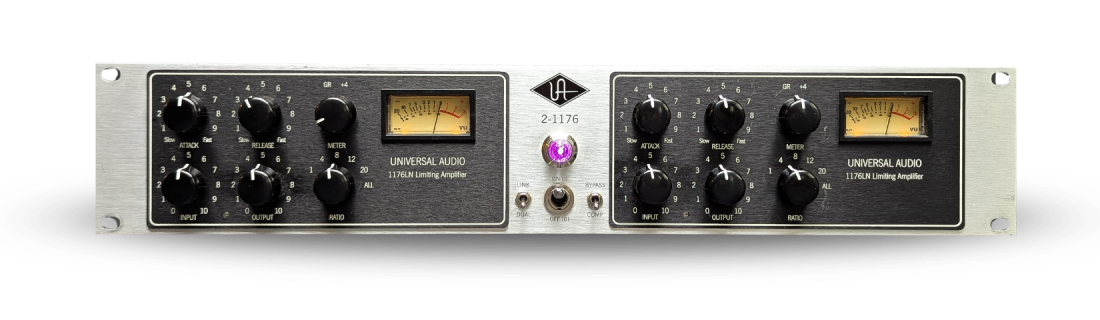
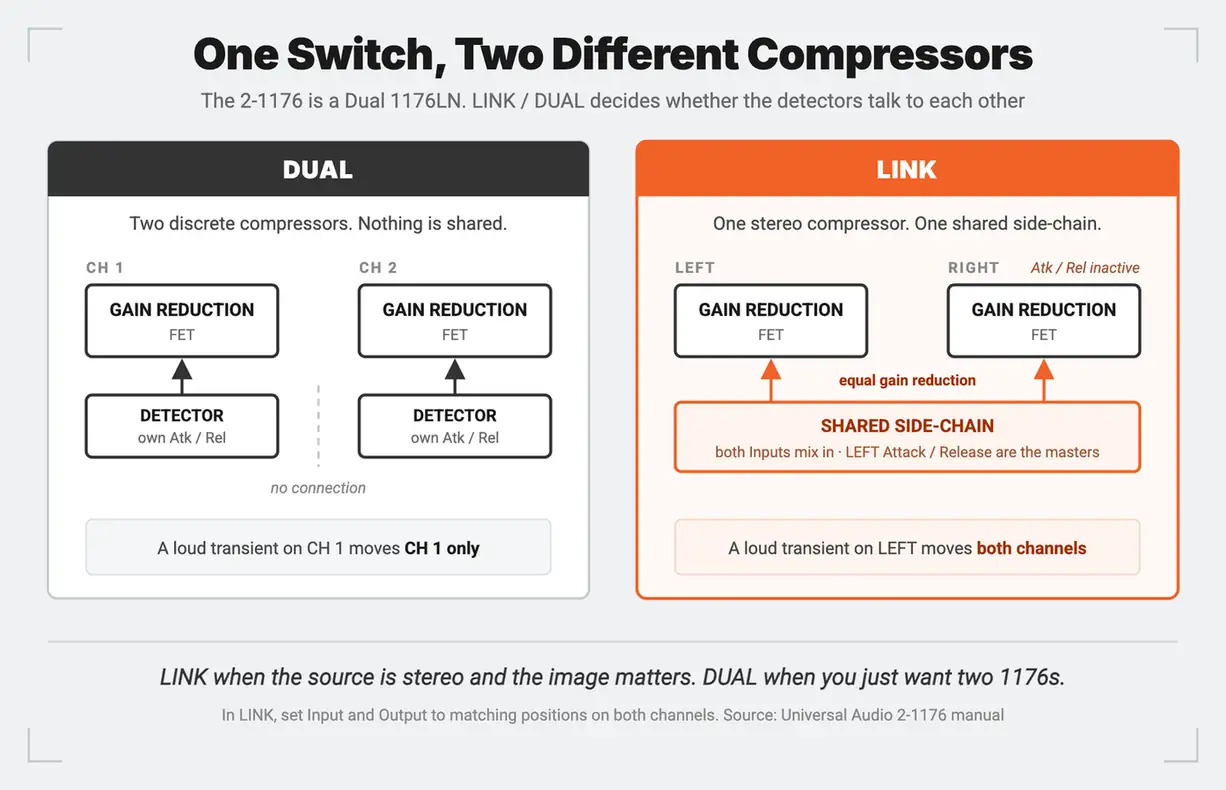
The Universal Audio 2-1176 is a Dual 1176LN Limiting Amplifier. It is two complete 1176 channels in one chassis, and a front-panel switch decides whether they work alone or together.
Start with the problem it solves. When you compress a stereo source with two unlinked compressors, each channel responds independently to its own level. If the left channel has a louder transient than the right, the left compressor triggers first and applies more gain reduction to that side. The stereo image shifts. On a stereo bus, a mix, or a pair of drum overheads, that is a problem, because the image should stay locked.
The 2-1176’s LINK / DUAL switch is the answer, and it is worth understanding both positions.
In DUAL, the two channels operate completely independently, giving you two discrete 1176 compressors with their own Attack, Release, Ratio, Input, Output, and metering. This is the mode most people forget the unit has, and it is the reason the 2-1176 is not simply a stereo tool. It is two mono 1176 channels whenever you need them.
In LINK, the two channels act as a single stereo compressor, applying equal gain reduction to both sides even when the transient activity is on one channel only. The Input knobs mix both signals into a shared side-chain, so the left and right contributions both drive the detector. The left channel’s Attack and Release become the master controls and the right channel’s stop functioning, which is by design. Universal Audio’s 2-1176 manual is explicit that Input and Output should be matched by hand on both channels for the linking to behave correctly.
Two more differences from the original are worth knowing. The Ratio is a six-position switch rather than four buttons: 1:1, 4, 8, 12, 20, and ALL. The 1:1 setting disables gain reduction while still passing signal through the circuit for colour, the same idea as the original’s Attack-off detent. And the ALL position reproduces the overdrive of pushing all four buttons in on an original 1176, as a repeatable, labelled setting.
The 2-1176 is patterned on Universal Audio’s 6176 channel strip and voiced after the blackface D and E revisions of the original, the ones built around a transformer input stage, the LN circuitry, and a Class A output stage. Engineers use it on stereo drum buses, room mic pairs, and mix buses, and it is stable enough to strap across a finished stereo mix as a premastering tool.
Reach for LINK when the source is stereo and the image matters. Reach for DUAL when you simply want two 1176s.
The 1176 is not a general-purpose compressor. It is specifically useful wherever transient control and harmonic density are the qualities you need most.
Remember the direction as you read these: higher numbers are faster.
The Access Analog platform has a Universal Audio 1176 available through the Analog Matrix plugin. You connect from your DAW, stream audio to the hardware, and the processed signal returns in real time. Attack, release, ratio, input, and output are all adjustable from the plugin interface. The hardware responds exactly as it would in a physical studio, because it is physical hardware.

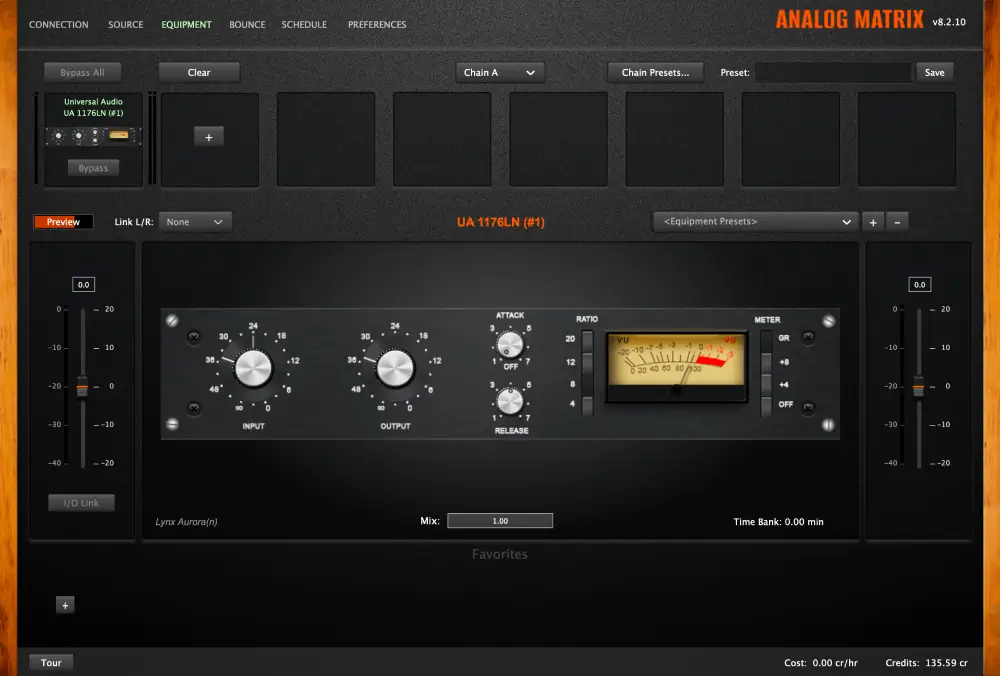
Like every unit on the rack, the 1176 can be reserved on its own. It is also included in the Pro tier of the Access Analog Subscription.
The Universal Audio 2-1176 is a distinct unit on the rack. Reserve it when your source is stereo and you need linked gain reduction, when you want two independent 1176 channels from one instance, or when you want all-buttons-in from its labelled ALL position.
Browse every Universal Audio unit on the platform on the Universal Audio manufacturer page, or see the full rack by processor type: compressor.
Sixty years of engineers have not been wrong about this circuit. The only thing that has changed is that you no longer need to own one to put a vocal through it.
What is the 1176 compressor used for?
The 1176 is primarily used for lead vocals, bass guitar, room microphones on drums, drum buses, and guitars. Its FET gain reduction element allows attack times down to 20 microseconds and release times down to 50 milliseconds, which makes it effective wherever fast, decisive level control is needed. Driven harder, its harmonic non-linearity adds the presence and density the unit is known for.
Which way do the 1176’s attack and release knobs go?
Clockwise is faster on both. This is the reverse of most compressors and the most commonly misremembered fact about the unit. Attack runs from about 800 microseconds fully counterclockwise to 20 microseconds fully clockwise, and release from about 1.1 seconds to 50 milliseconds across the same sweep. Turning Attack fully counterclockwise past the slowest setting reaches an Off detent that disables gain reduction while still passing audio through the transformers and the Class A output stage.
What ratio should I use on the 1176 for vocals?
4:1 is the standard starting point. It gives audible, musical compression without crushing the performance. Use 8:1 when the vocal needs more obvious control or when the compression should be part of the sound. Set the attack medium-slow, around 3 to 4, so consonants survive, and the release medium-fast, around 5 to 6, so the unit recovers between phrases. Aim for 2 to 5 dB of gain reduction on peaks for a smooth vocal and 5 to 12 dB for an aggressive one.
What is all-buttons-in on the 1176?
All-buttons-in means pressing all four ratio buttons, 4:1, 8:1, 12:1, and 20:1, at the same time. The 1176 was not designed to operate this way. Doing it sends the ratio to somewhere between 12:1 and 20:1 and shifts the bias points throughout the circuit, which changes the attack and release times. Distortion rises sharply because the attack develops a lag on initial transients. It is also called British mode, and it is a well-documented technique on drum room mics and on aggressive vocals.
What is the difference between the 1176 and the LA-2A?
The 1176 uses FET gain reduction with user-adjustable attack and release. The LA-2A uses a T4 optical gain cell whose timing is a physical property of the cell and cannot be adjusted at all, and whose release runs in two stages that depend on how hard and how long the unit has been working. The 1176 catches fast transients and adds harmonic density on demand; the LA-2A smooths longer phrases with a more forgiving character. We cover the LA-2A’s optical topology in full in the LA-2A deep-dive and compare the two directly in 1176 vs. LA-2A on vocals. Engineers often use both on one vocal chain precisely because their characters differ.
What is the 2-1176?
The 2-1176 is a Dual 1176LN Limiting Amplifier: two complete 1176 channels in one chassis with a front-panel LINK / DUAL switch. In DUAL the channels work completely independently, giving you two discrete compressors. In LINK they act as a single stereo compressor applying equal gain reduction to both sides, with the left channel’s Attack and Release serving as masters. It also carries a six-position Ratio switch with a labelled ALL position for all-buttons-in behaviour.
What does FET mean in audio compression?
FET stands for field-effect transistor. In the 1176 the FET is the gain reduction element, used as a voltage-controlled variable resistor forming the lower half of a voltage divider. Raising the voltage on its gate lowers its drain-source resistance and therefore the gain, and it can do this in microseconds. FETs are inherently non-linear, and while Universal Audio’s LN circuit was designed to keep the FET in its linear region and reduce that distortion, what remains is a large part of the unit’s character.
Is the 1176 available on the Access Analog platform?
Yes. The Universal Audio 1176 and the Universal Audio 2-1176 are both on the rack, available to reserve individually or through the Analog Matrix plugin, and the 1176 is included in the Pro tier of the Access Analog Subscription. You stream audio from your DAW to the physical hardware and the processed signal returns in real time. No hardware purchase required. Note that all-buttons-in is available on the 2-1176, via its labelled ALL ratio position, rather than on the 1176LN.