
This guide discusses how to make indie rock sound vinyl and details four recommended analog hardware chains for Drums, Guitars, Vocals, and the Mix Bus.
When you listen to a loud, ruckus band play in a small room, everything is wide open and unfiltered in a single space, and the reflections of those competing sounds are coming back to your ear and further influencing and blending with the original sound source, nearly instantly. Early recordings of The Beatles and Led Zeppelin captured these essential, musical characteristics because the musicians played at the same time, in rooms with very few microphones.
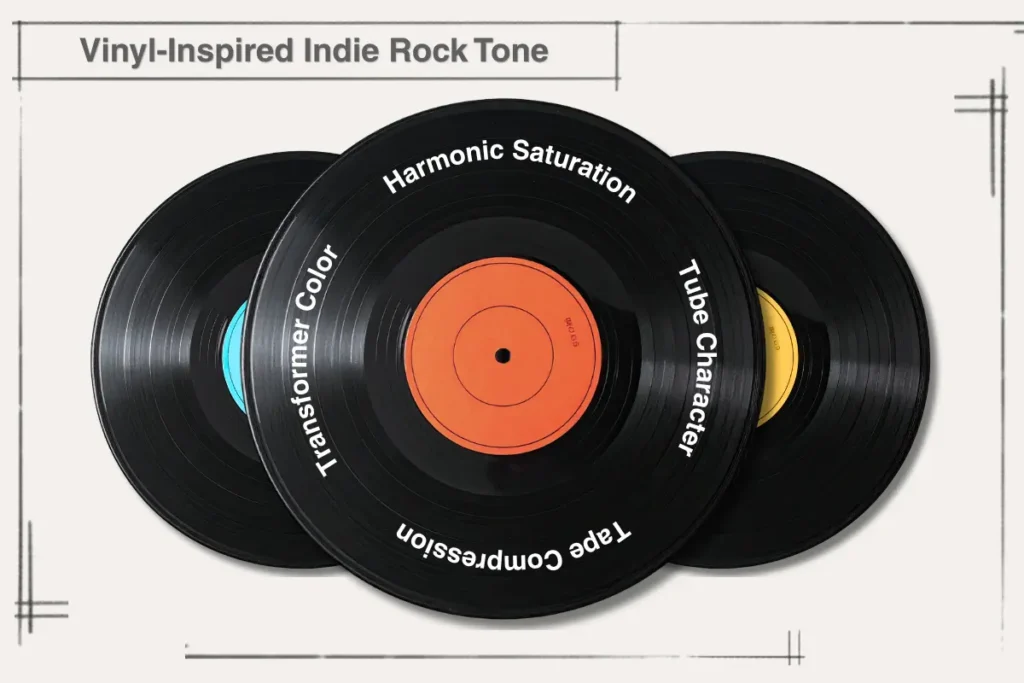
That “Indie” sound isn’t really as much about being sloppy or colored, or having a tonality or filtering that is “pleasant.” It is about making musical choices, and allowing sonics to combine in small spaces, and reinforce one another. It’s about going back to blending instruments instead of separating them. It’s about using a few sound sources, crafted-well, and aligned to the material. With the right gear, you can have both the convenience of using a DAW and the cohesion of that rich, saturated sound that “sounds like a record.”
The short answer is cohesion – tape compression, harmonic saturation, and coloration.
Tape-style saturation adds musically related harmonics and a slight compressive effect, which can make a mix feel fuller, warmer, and more connected. Analog stages such as transformers, tubes, and discrete gain circuits also introduce subtle nonlinearities that color the tone in ways many engineers hear as depth or character rather than as obvious distortion. That matters in indie rock, where you usually want drums to hit, guitars to feel lived-in, vocals to sit forward naturally, and the whole track to sound less clinical.
If your mix feels flat, brittle, or too “in the box,” the goal is not to sacrifice fidelity. It is to add the kind of color and dynamic behavior that makes a song feel played, not merely assembled.
Tape saturation is the soft, natural compression that occurs when magnetic tape approaches its saturation point. Unlike digital clipping, which is harsh and immediate, tape saturates gradually. Transients get rounded rather than chopped. The loudest peaks compress while quieter details push forward, creating a sense of density and cohesion that’s difficult to fake.
Real tape also generates harmonic content – primarily even-order harmonics that the ear interprets as warmth. These harmonics thicken the low-mids and add a subtle shimmer to the top end. It’s the difference between a guitar that sits flat in a mix and one that feels alive, with overtones that interact musically with the rest of the arrangement.
Analog circuits handle transients differently than digital systems. When a signal exceeds an analog circuit’s headroom, it saturates gradually rather than clipping harshly. This natural compression tames peaks musically while preserving punch.
High frequencies round off smoothly, recalling the behavior of analog tape. The low end gains definition and weight without becoming boomy.
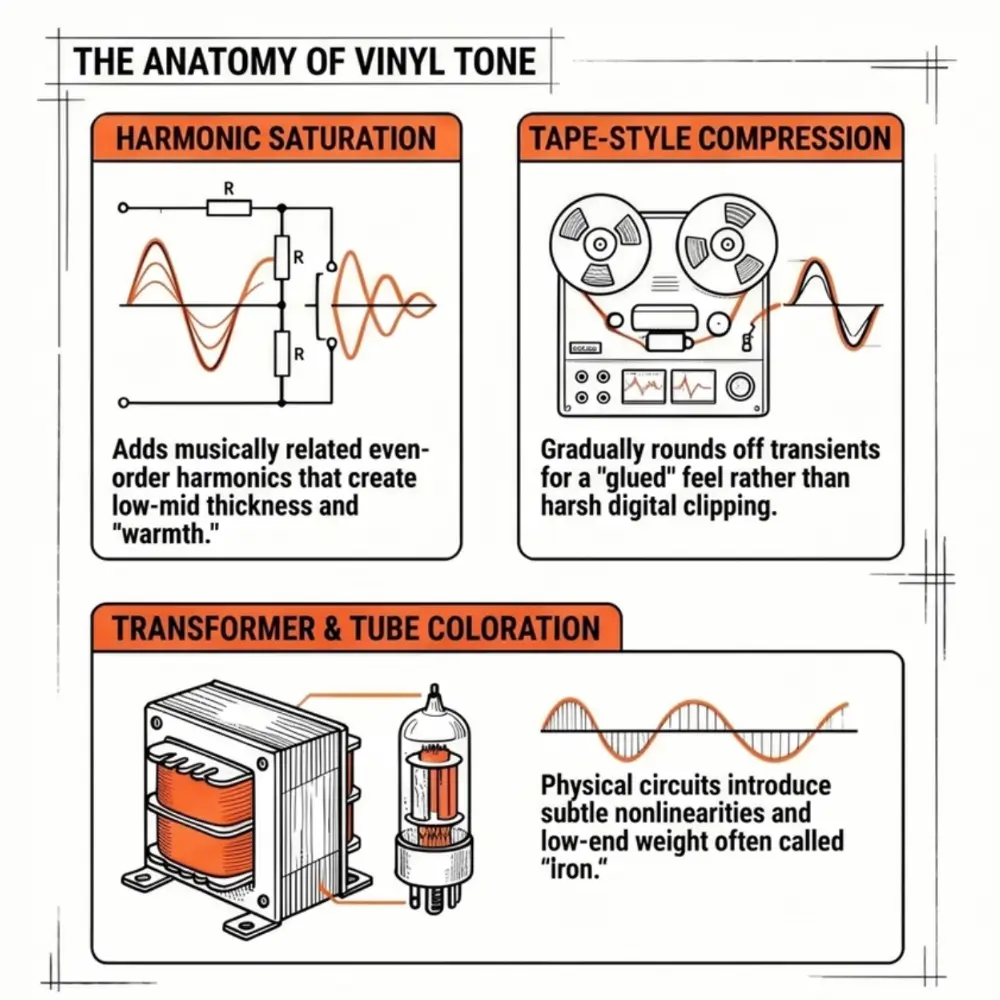
For that Indie, vinyl sound, consider using choice gear that treats the music like it would be treated if all of the musicians were playing in the same room. Take your 5 guitar tracks and compress them together in a single stereo unit. Glue together drum busses so they present to the listener as a complete kit. Overwhelm transformer-loaded gear with your bass guitar to tighten the bottom end and let the iron add harmonic sparkle. Use the broad musical curves of hardware eq to cut into sharp acoustic guitar and string sounds, not surgical digital sculpting. The overall result will be a track that sounds more like a great band in a single space.
Here are four chains purpose-built for indie rock, each targeting a different element of your mix.
Drums define the energy of an indie rock track, and this chain delivers punch with analog texture.
Start with the Universal Audio 1176 to control peaks and add urgency. It is a strong choice when you want the kit to feel more animated without killing the life in the transients. Set a moderate ratio (4:1) and a slower attack – around 1–3ms – so the initial snap of the snare and kick comes through before the compressor grabs. This preserves the live feel while taming peaks.
From there, the Tegeler Magnetismus 2 can add tape-style rounding and cohesion, helping the shells and cymbals feel like they belong in the same physical space. It also adds tape-style compression and saturation through its three Flux Modes – Eisen (iron), Kobalt (cobalt), and Nickel – each emulating a different tape formulation. For indie drums, Kobalt delivers a warm, slightly compressed midrange that glues the kit together without squashing dynamics. Use the transient shaper to dial back any harshness on the cymbals.
Finish with the Handsome Audio Zulu for extra analog texture and a more overtly vintage attitude. The Handsome Audio Zulu is a passive tape simulator. Its four tape formulas let you dial in the exact vintage character you want: TK for a 1960s vibe, MX for a creamy acoustic tone, EX for 90s rock clarity, or HX for controlled, modern transients. On the drum bus, the Zulu softens the digital edge and adds the kind of harmonic glue that makes a drum kit sound like it was recorded to tape through a vintage console.

Used subtly, this chain can move a drum bus away from sharp digital edges and toward something more glued, grittier, and more record-like. Used aggressively, it can turn sterile drums into something that sounds like it was sampled from a favorite indie LP.
Indie guitars often need more than brightness. They need shape, midrange personality, and a sense of dimensionality.
The Neve 1058 is a strong first stop for broad musical tone shaping. It is a Germanium preamp/EQ from the 1960s, one of the earliest Neve designs. Its transformers add a massive low-mid foundation, making guitars sound full and commanding, even at moderate levels. The built-in EQ is simple (fixed high and low bands with selectable mids), but it’s perfectly voiced for rock: a subtle mid boost around 2.5–3.5kHz pushes guitars forward without harshness.
The Pultec EQP-1A is ideal for enhancing weight and openness without making the sound narrow or harsh. The Pultec EQP-1A is used to sculpt the tone with its famously musical passive EQ. The classic “Pultec trick” – simultaneously boosting and attenuating the same low frequency – creates a unique curve that tightens the low end while adding body. On the high end, a broad boost at 8–10kHz adds air and string detail without the brittleness of digital EQ.
Then the Silver Bullet can add color, attitude, and that slightly larger-than-life quality that helps guitars sound expensive rather than overprocessed. The Louder Than Liftoff Silver Bullet mk2 finishes the chain with console-style coloration. Its dual MOJO amplifiers – American (A) and British (N) – let you choose between a cleaner, punchier saturation and a darker, more rounded tone. For indie guitars, the N (British) setting with light drive adds the kind of analog warmth that makes you feel like the guitars were tracked through a vintage desk. The built-in Baxandall EQ and AIR circuit provide final tone shaping without requiring another processor.
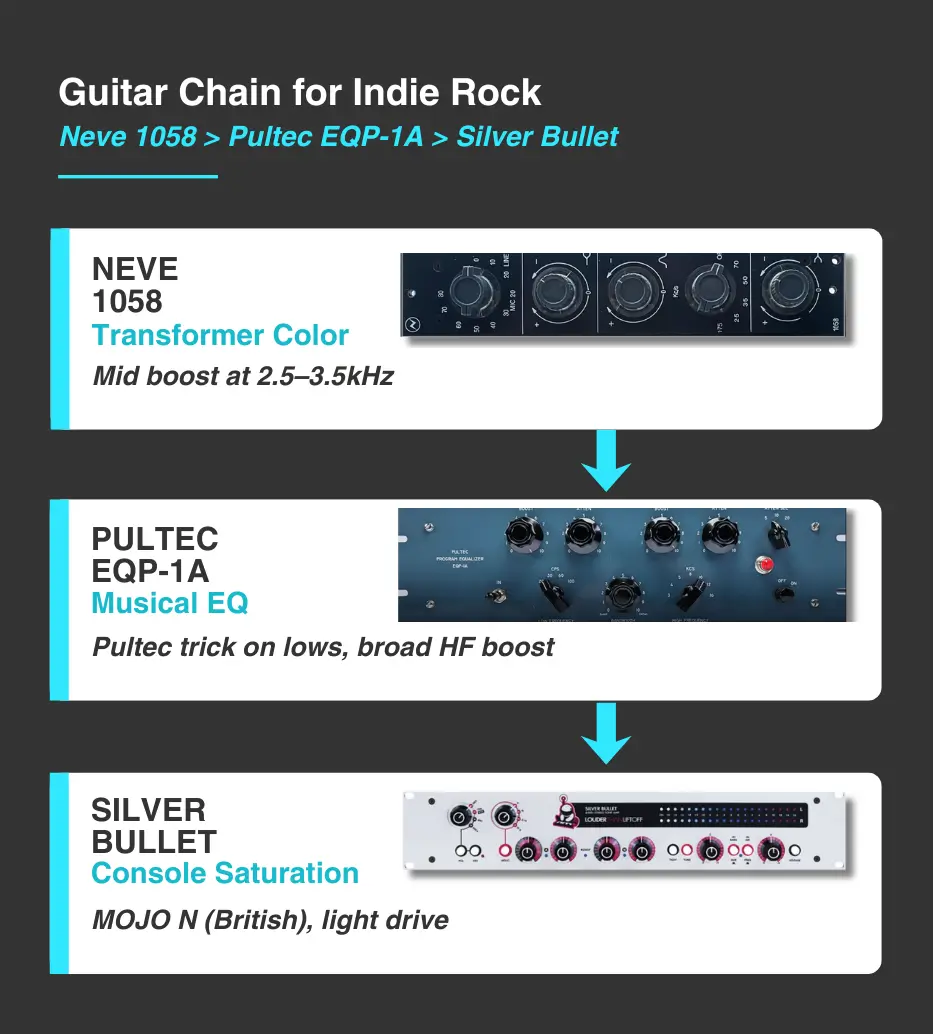
This kind of chain works especially well for rhythm guitars that need to hold the song together. Instead of pushing them with lots of narrow EQ or excessive saturation plugins, you can build tone with broader, more musical moves.
If the vocal is the emotional center of the song, this is the chain that helps it feel intimate and finished. Indie rock vocals need to feel intimate and slightly rough around the edges — not polished to a pop sheen.
The Teletronix LA-2A is a natural starting point because it smooths vocal dynamics in a way that often feels musical rather than obvious. The LA-2A is an optical tube compressor that handles vocals with almost effortless smoothness. Its electro-optical gain-reduction circuit (the T4 cell) responds to the signal’s average level rather than individual transients, so it compresses the overall dynamic range without clamping down on the natural expression of a performance. The attack is program-dependent, averaging around 10ms, so louder phrases compress naturally while softer moments breathe. Set Peak Reduction to achieve 3–5dB of gain reduction on the loudest passages.
After that, the Handsome Audio Zulu can introduce a little tape-like thickness and softness, which is useful when a vocal feels too sharp or disconnected from the track. The Zulu follows the compressor to add tape-style harmonics. On vocals, the MX tape formula works well – it adds a creamy, slightly midrange-forward character that helps vocals sit on top of a dense arrangement without needing volume. The Enhance control lets you blend in a brighter, more present version of the signal in parallel, which can add clarity without the harshness of digital high-frequency boosting.
The Pultec EQP-1A lets you shape the final tone with broad, flattering moves. At the end of the chain, the Pultec EQP-1A provides gentle frequency sculpting. A subtle low-end boost at 60–100 Hz adds chest and warmth to the vocal, while a broad high-frequency lift at 10–12 kHz opens up the air around the voice. Because the Pultec is a passive design with a tube makeup stage, these moves sound smooth and musical—nothing like the surgical precision (and sterility) of a parametric digital EQ.
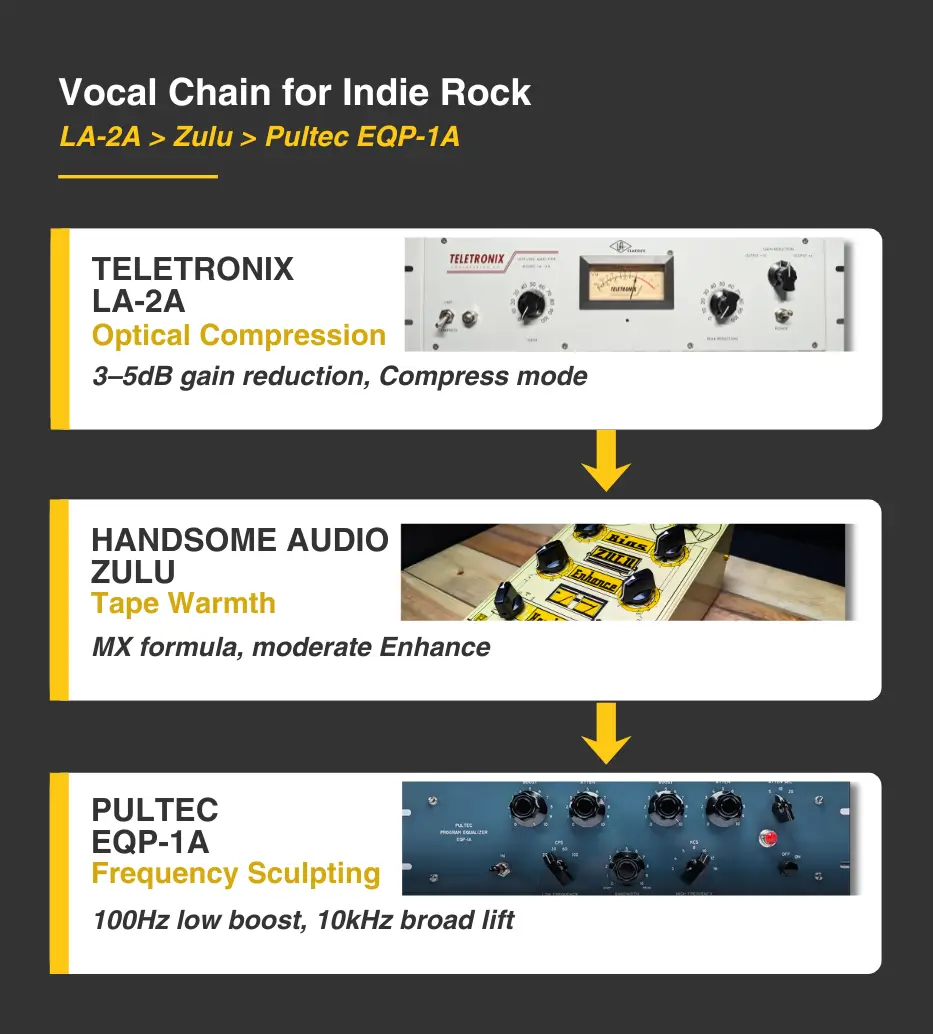
The result is not a “retro effect.” It is a vocal that feels more human, more present, and more naturally embedded in the mix – real vinyl tone.
This is where the whole record starts to feel intentional. This chain adds the final layer of analog cohesion that makes a mix feel like a finished record rather than a collection of tracks.
The SSL Fusion is designed for mixing and mastering applications. It is an all-analog stereo processor with five independent sections. For indie rock, the Vintage Drive circuit adds subtle harmonic saturation to the full mix—just enough to soften transients and introduce a sense of analog “glue” without audible distortion. The HF Compressor section gently tames harsh high frequencies, mimicking the natural high-frequency rolloff of tape. Use the Stereo Image section to slightly widen the mix, and the Transformer stage to add low-frequency weight.
Follow the SSL Fusion with the Rupert Neve Designs Master Bus Transformer for greater tonal density and analog weight. The Rupert Neve Designs Master Bus Transformer (MBT) adds Neve’s signature transformer coloration to the stereo bus. It introduces subtle harmonic richness and a sense of depth that’s hard to describe yet immediately recognizable. The mix just sounds bigger, wider, and more “expensive.” The MBT is designed to be transparent at unity, but even at conservative settings, the transformers add musical thickness to the low end and smooth clarity to the highs.
Finally, use the Black Box HG-2 to add harmonic richness and finish. The Black Box Analog Design HG-2 at the end of the chain is a tube harmonics generator with independent pentode and triode saturation stages. The pentode stage adds even-order harmonics for musical warmth, while the triode stage introduces grittier third-order harmonics, like printing a hot signal to tape. The parallel saturation circuit lets you blend harmonics within a specific frequency range (low, flat, or high) without affecting the dry signal’s dynamics. For an indie rock mix bus, keep the drive subtle and use the Air circuit to add a harmonic lift around 10kHz.
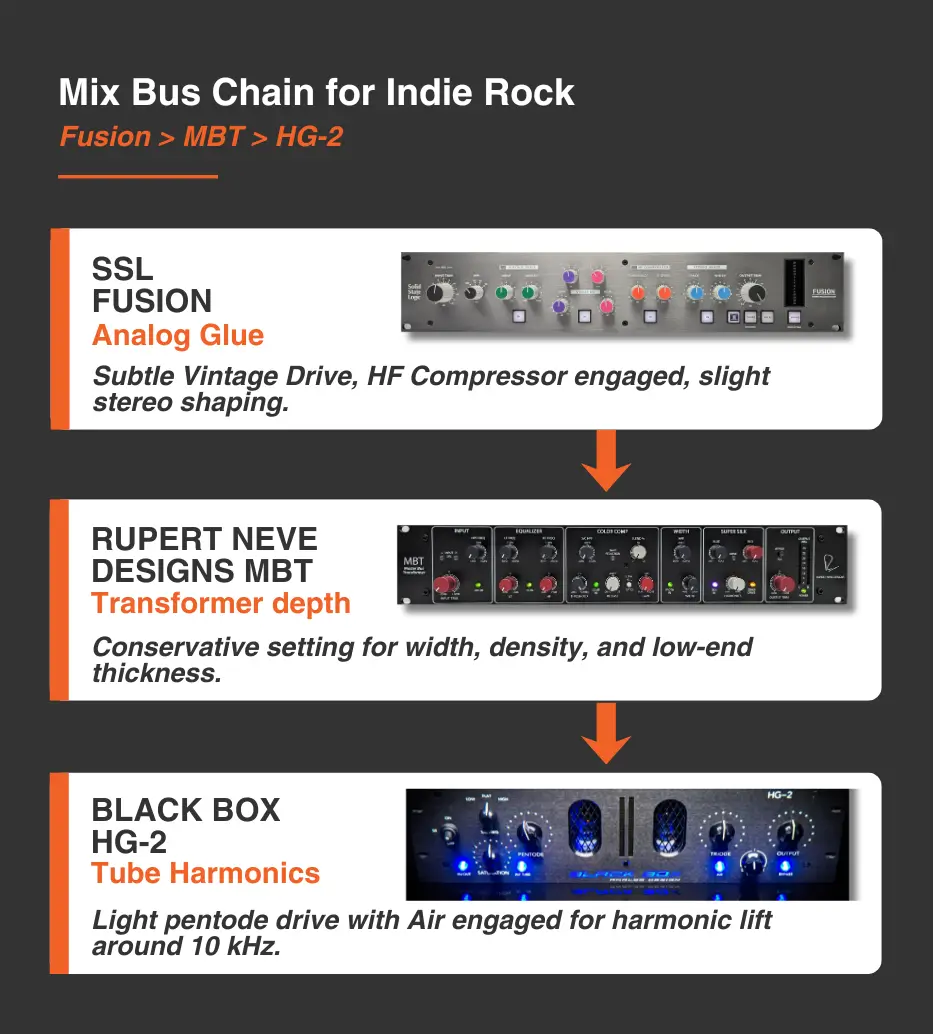
The key here is restraint. On an indie rock mix bus, you usually do not need dramatic settings. Small moves tend to be enough to make the chorus feel wider, the midrange feel richer, and the whole mix feel more like a record than a session.
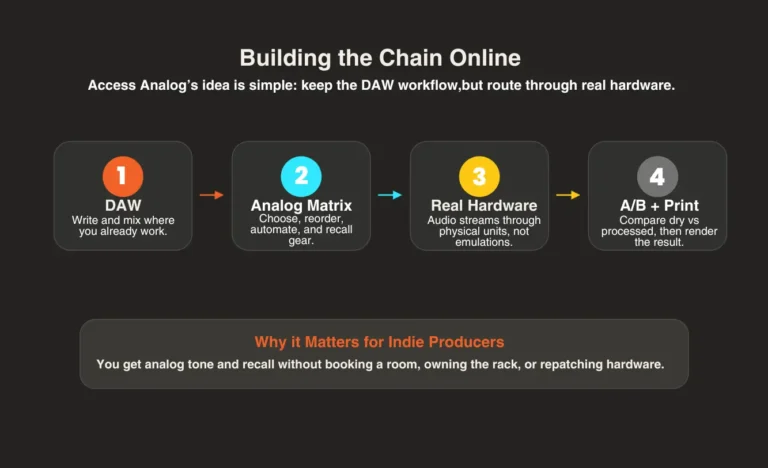
The workflow is straightforward.
Load the Analog Matrix in your DAW or open the standalone app. Choose the hardware you want, then build a chain in the order that fits the song. You can connect up to eight pieces of hardware, reorder them while listening, and save the result with full recall, presets, and automation. Once the chain is doing what you want, stream the audio in real time, A/B it against the unprocessed signal, and print the result in real time or offline.
This matters for indie producers because it removes the usual barrier to real hardware. You are not booking a studio, repatching a rack, or sacrificing recall. You are building a real analog signal chain from the same environment where you already write and mix.
Creating a convincing vinyl vibe is less about chasing noise or rolling off the highs and more about preserving movement, texture, and musical dynamics. The goal is to let the track breathe while using analog-style compression, saturation, and broad EQ choices to add subtle weight, depth, and cohesion that make vinyl-era records feel alive.
A slightly slower attack on compression often helps drums, guitars, and even the mix bus keep their shape before the analog color takes over.
Vinyl-era records have transients and fast limiting kills them. This is what gives analog-compressed tracks their sense of energy and dimension.
A little compression, a little tape-style rounding, and a little transformer color usually feels bigger than one stage doing too much.
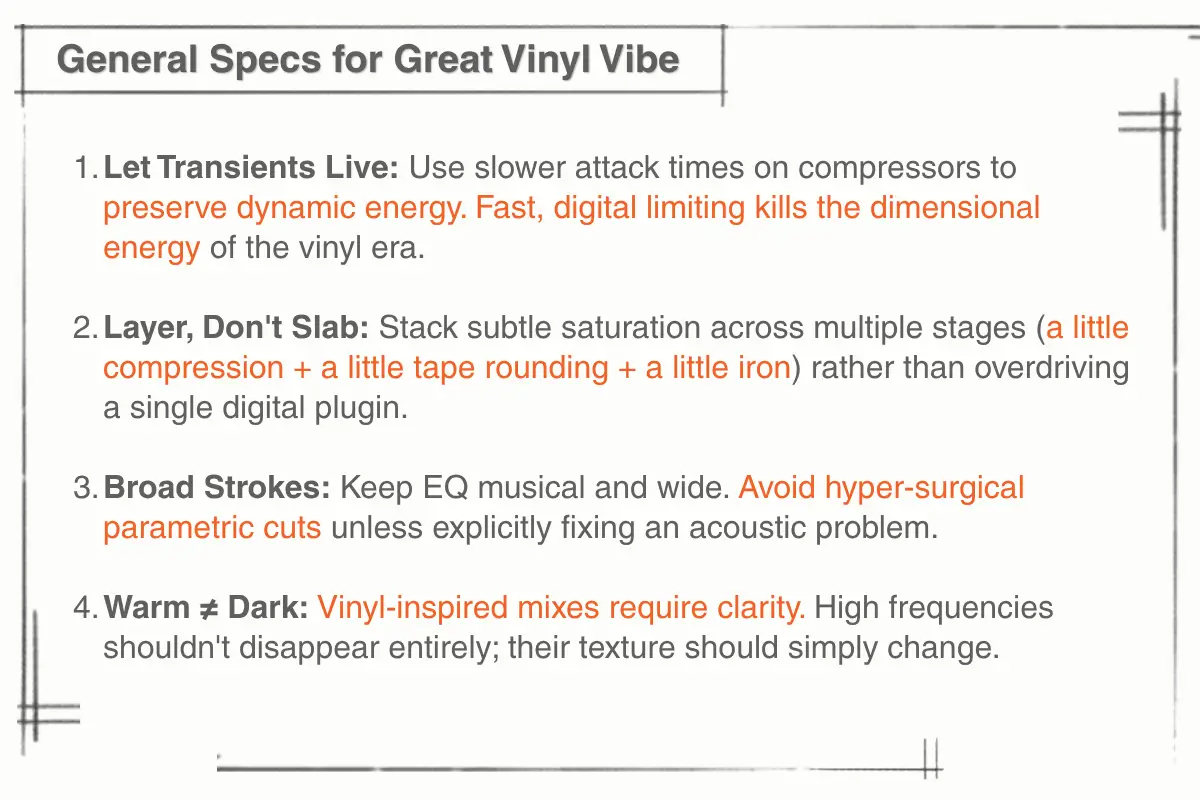
If the goal is a vinyl-inspired feel, avoid hyper-surgical moves unless you are correcting a problem.
Vinyl-inspired mixes still need clarity. What usually changes is the texture of the highs, not their complete loss.
And if the project is headed for vinyl pressing, remember that vinyl is less forgiving of excessive high-frequency harshness, sibilance, and wide low-end stereo information. A mix that sounds great for streaming may still need minor adjustments before cutting.
If you want indie rock to sound like vinyl, the answer is not nostalgia for nostalgia’s sake. It is tone, glue, texture, and depth. The difference between a good indie rock mix and one that sounds like a record pressed on wax comes down to harmonic complexity. Every transformer, tube stage, and tape path adds its own subtle layer of color and character. Those layers stack to create the rich, dimensional sound that defines vinyl-era production.
That is why real analog hardware still matters. Tape-style saturation, transformer color, optical compression, and broad musical EQ all help create the organic, emotionally believable quality that indie rock thrives on. Because Access Analog gives you access to actual hardware through the Analog Matrix, you can build those chains with real gear, not approximations, while keeping the flexibility of a modern DAW workflow.
For producers chasing that vintage-meets-modern finish, that is the real opportunity: not to imitate vinyl as an effect, but to make your mix feel worthy of being pressed to wax. Next time you’re mixing an indie track that feels too pristine, try routing your drum bus through the 1176 → Magnetismus 2 → Zulu chain. A/B the processed signal against the dry, and listen for how the transients soften, the harmonics thicken, and the whole kit starts to breathe. That’s not digital emulation. That’s real analog iron, tubes, and tape doing what they were built to do.
What is an analog gear chain for mixing?
An analog gear chain is a series of hardware processors, such as preamps, compressors, EQs, and tape saturators, connected in sequence so the audio passes through each unit. The order of the chain matters because each unit adds its own harmonic color, compression character, and frequency shaping to the signal.
How do you get a vinyl sound in a DAW?
To get a vinyl sound from your DAW, route your audio through real analog hardware that introduces harmonic saturation, tape-style compression, and transformer coloration. Services like Access Analog let you stream audio from any DAW through physical gear, such as a Pultec EQP-1A, 1176 compressor, or tape saturator, via a plugin insert.
What gives vinyl records their warm sound?
Vinyl’s warmth comes from the cumulative effect of analog signal stages: tape saturation adds even-order harmonics, transformers introduce low-frequency weight and “iron,” and tube circuits generate musical overtones. These layers of harmonic complexity create the dense, three-dimensional quality that digital processing alone struggles to replicate.
What is tape saturation, and why does it matter for indie rock?
Tape saturation is the soft, gradual compression that occurs when magnetic tape approaches its saturation point. Unlike digital clipping, tape rounds transients and pushes quieter details forward, creating density and cohesion. For indie rock, it glues drums, thickens guitars, and adds the lo-fi warmth that defines the genre’s classic sound.
Can you make indie rock sound like vinyl without a tape machine?
Yes. You can get much of that feel through analog compression, transformer color, saturation, and broad musical EQ. Try saturation-oriented devices such as the Zulu, Magnetismus 2, SSL Fusion, MBT, and HG-2.
What analog gear is best for indie rock vocals?
A popular chain for indie rock vocals is the Teletronix LA-2A optical compressor for smooth dynamic control, followed by a tape simulator like the Handsome Audio Zulu for midrange warmth, and a Pultec EQP-1A for gentle frequency sculpting. This combination keeps vocals intimate and slightly rough without over-polishing them.
What is the best mix bus chain for indie rock?
A proven indie rock mix bus chain is the SSL Fusion for analog glue and stereo shaping, followed by the Rupert Neve Designs MBT for transformer depth, and the Black Box HG-2 for tube harmonic saturation. This combination adds cohesion, width, and the harmonic richness that makes a mix feel like a finished record.
What is the best analog chain for indie rock drums?
A strong starting point is 1176 into Magnetismus 2 into Zulu. That gives you punch, tape-like thickness, and vintage-style saturation in one chain.
What is the Pultec trick?
The Pultec trick is a technique where you simultaneously boost and attenuate the same low frequency on a Pultec EQP-1A equalizer. Because the boost and cut circuits interact with slightly different curves, the result tightens the low end while adding body, a unique shape that’s impossible with standard digital EQ.
Why do analog compressors sound different from digital ones?
Analog compressors like the 1176 and LA-2A use physical circuits – FETs, optical cells, tubes -that respond to audio in nonlinear, program-dependent ways. They introduce subtle harmonic distortion and have natural attack/release characteristics that preserve transients and musical dynamics in ways that digital emulations approximate but don’t fully capture.
Can you use real analog gear without owning it?
Yes. Platforms like Access Analog give you remote access to real, robotically controlled analog hardware. You load a plugin in your DAW, build a chain from available gear, and stream audio through the physical units in real time. Every knob in the plugin controls the actual hardware.
How does Access Analog let you use real hardware online?
The Analog Matrix connects your DAW or standalone app to actual physical gear in the cloud, supports up to eight devices in a chain, and allows real-time streaming or offline rendering.
Is Access Analog a plugin emulation platform?
No. The Analog Matrix is not an emulation. It acts as a portal, connecting your digital audio workstation to actual physical gear in real time.