
Vocals are the hardest thing to compress well. Push too hard and the life goes out of the take. Push too little and the words duck behind the beat. The Tube-Tech CL 1B solves that better than almost anything: it is gentle, musical, and forgiving, which is exactly why it sits on lead vocals across so much pop, R&B, and hip-hop.
The CL 1B controls a vocal without flattening it. It adds warmth and glue while the performance stays intact.

It is an all-tube optical compressor, so it reacts to dynamics slowly and smoothly instead of clamping down like a fast FET. The catch is the price: the hardware runs about $5,000, which puts it out of reach for most home setups. With Access Analog you run a real CL 1B from inside your DAW, with full recall, so the same unit on the hit records is available without racking it yourself.
Because it makes a vocal sit still in the mix without sounding compressed. Introduced in 1991 by the Danish maker Lydkraft, the CL 1B became a studio standard for one reason: its optical gain reduction is slow and program-dependent, so it rides the level the way a great engineer rides a fader, not the way a brickwall clamps a peak.
That slow behavior is the whole point on vocals. Fast compressors grab transients and can dull consonants or pump on sibilance. The CL 1B leans into level changes gradually, so the top of the performance is controlled while the detail and air stay put.
That reputation has held for over thirty years. In studios worldwide the CL 1B is prized for a distinctive, transparent sound that stays clear even under heavy compression, for intuitive controls, and for flattering almost any source, which is why many engineers rate it a step above other optical compressors in sound, control, and build. It is a staple for vocals and critical instrument tracks alike.
It is the default vocal compressor in countless rooms because it adds control you feel but rarely hear.

Compressors are usually grouped by how they sense and reduce level. That detector type, more than any setting, defines the sound.
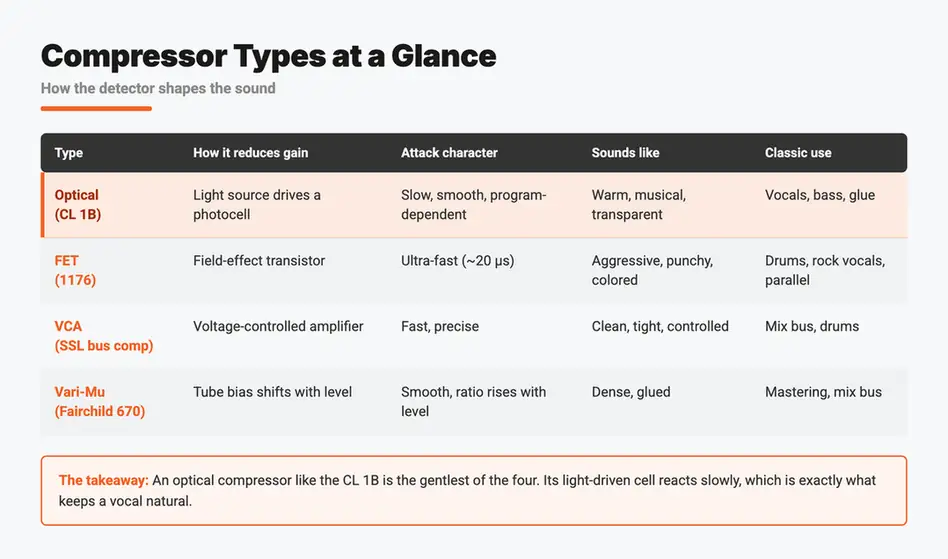
An optical compressor is built around a light source and a light-sensitive cell. As the signal gets louder, the light gets brighter, and the cell reduces gain. That cell does not respond instantly, and it does not recover instantly, which is what gives optical compression its soft knee and its forgiving release.
The CL 1B's gentleness is not a setting. It is built into how the optical cell responds to light.
That also answers the common "optical vs. VCA" question: a VCA design is fast and surgical, ideal for tight control on a bus, while the CL 1B is slow and rounded, ideal for keeping a vocal natural. Optical against FET is the classic vocal decision, and our 1176 vs. LA-2A comparison puts the two head to head. For the tube-based fourth family, here is how a vari-mu compressor works.
Smoothing from the optical cell is only half of it. The CL 1B's make-up gain comes from a real tube push-pull amplifier, built around an ECC83 (12AX7) input and phase-splitter stage and an ECC82 (12AU7) output stage, feeding balanced, fully floating output transformers. That stage adds up to 30 dB of gain, and as it works it adds low-order harmonics and a gentle density that engineers hear as warmth.
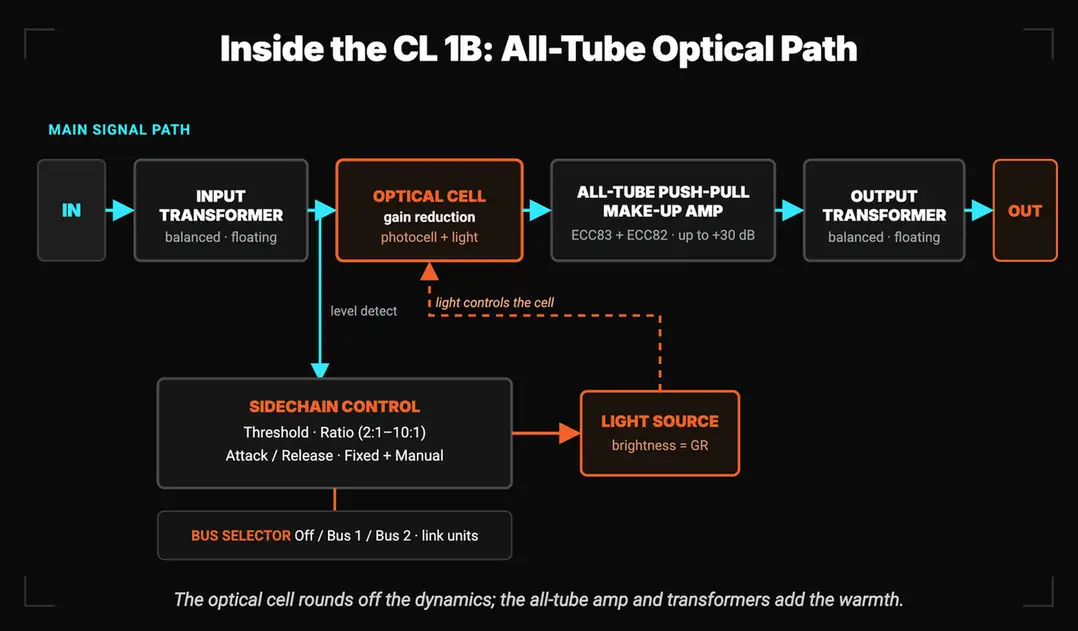
So two things happen at once on every vocal: the optical cell rounds off the dynamics, and the tube and transformer stage adds harmonic richness on the way out. Compression and tone color in one pass.
You are not just leveling the vocal. You are running it through a tube and a transformer, and that is where the body comes from.
A reliable starting chain is mic preamp into the CL 1B for compression, then a Pultec EQP-1A for tone, then into your DAW. Compress first so the level is consistent, then sweeten with EQ. You can flip the order if you want the EQ to drive the compressor, but comp-then-EQ is the easy win on most vocals.

A worked starting point for a lead vocal:
That gives smoother dynamics and a richer tone, with the vocal sitting forward but never squashed.
This is also the easiest place to bring in Access Analog. The CL 1B and the Pultec EQP-1A are both in the rack, so you can patch the whole chain inside the Analog Matrix plugin, dial it in, and the settings save with your session. It is the real hardware, not an emulation: the plugin acts as a portal to the physical units, controlled robotically in real time.

The CL 1B has a FIXED mode and a MANUAL mode for its time constants, plus a combined mode that produces program-dependent release (a fast peak triggers a faster release, and vice versa). FIXED mode is a great default for vocals because it stays consistent take to take. Use these as starting points, then trust the gain-reduction target over the panel numbers.
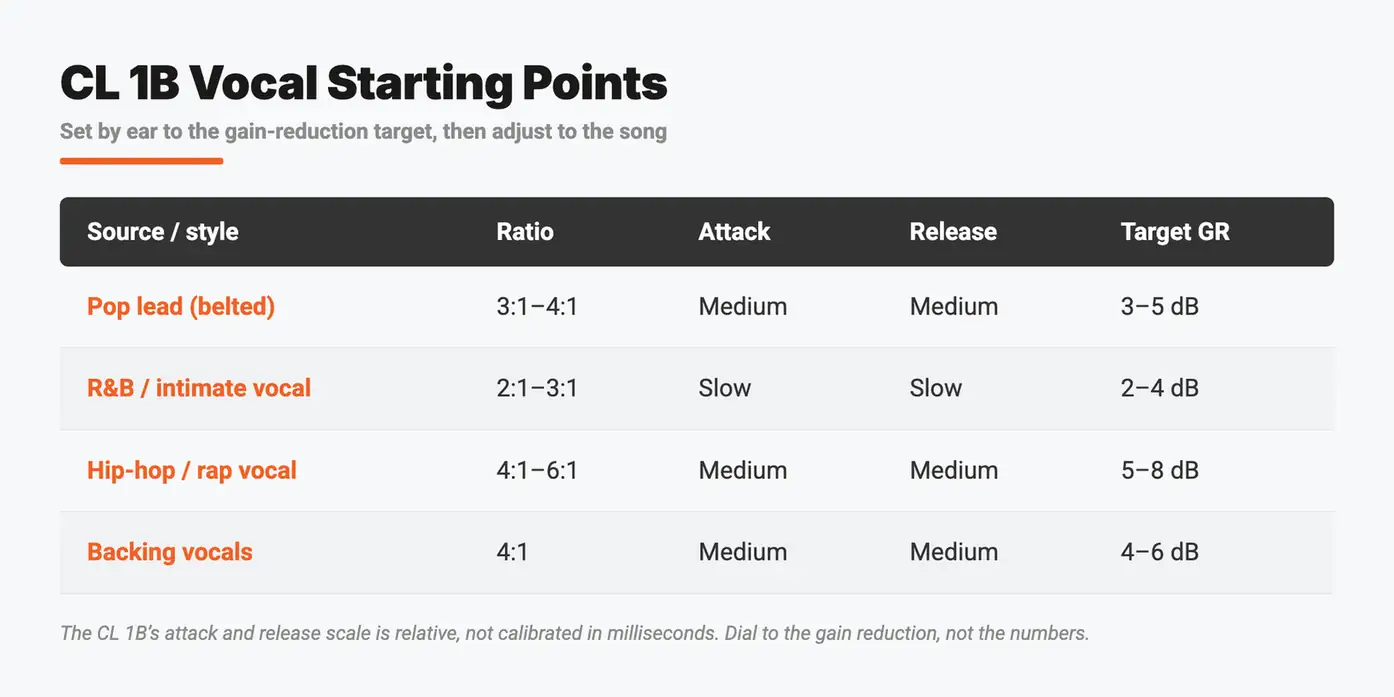
Slower attack lets consonants and transients through, which keeps a vocal intelligible. Faster attack tightens it, at the cost of some bite.
Yes, and that is why the CL 1B is a well-known secret in the rap community. On a rapped or belted vocal you can push 5 to 8 dB of gain reduction, sometimes more, and it still sounds like the performance rather than a pumping effect.
The reason is the optical cell. A fast FET at that depth would chatter on transients and start to pump. The CL 1B's slow, rounded response absorbs the same amount of level smoothly, so the vocal lands right on top of the beat, dense and upfront, without the squeeze drawing attention to itself.
The trick is not a special setting. It is that optical compression can go deep and still breathe.
If you want it even more aggressive, run the CL 1B into a faster FET like the 1176 for a two-stage approach: the CL 1B does the heavy, musical leveling, and a touch of FET adds the final snap. Rupert Neve Designs' OptoFET puts an optical and a FET compressor in one box, in either order, for exactly this kind of two-stage move.
The same qualities that flatter vocals make the CL 1B a workhorse on melodic and low-end sources.
If a part needs to sit steady and sound richer, the CL 1B usually does both at once.
The CL 1B has a Bus selector with three positions (Off, Bus 1, Bus 2). It lets two units share one sidechain, so the left and right channels react together and the stereo image stays centered under compression. That is how you would build a true stereo pair for mix-bus or stereo-source duty.
Worth being clear: the CL 1B is a mono, single-channel unit, so genuine stereo-bus compression takes a matched, linked pair. On its own, one CL 1B is at its best where it earns its reputation: a single vocal or instrument, where its smooth optical character does the most good.
The bus system is there for stereo work, but the CL 1B's home turf is the mono vocal up front in the mix.
The Tube-Tech CL 1B has been the go-to vocal compressor for over thirty years because it does the one thing vocals need most: it controls dynamics while keeping the performance human, then adds tube and transformer warmth on the way out. Optical smoothness plus an all-tube path is a combination plugins approximate but rarely fully capture.
With Access Analog you get the real unit, warmed up and ready, controlled from your DAW with full recall. The compression heard on the records, on your own vocal, today.
Run a real CL 1B on your next vocal and hear why it never leaves the chain.

What is the Tube-Tech CL 1B?
The CL 1B is an all-tube optical compressor made by the Danish company Lydkraft (Tube-Tech), introduced in 1991. It uses a light-driven optical cell for gain reduction and a tube push-pull amplifier for make-up gain, which gives it a smooth, warm, musical sound that made it a studio standard for vocals.
Why is the CL 1B so good on vocals?
Its optical gain reduction reacts slowly and gradually, so it controls a vocal's level without grabbing transients or dulling detail. The tube and transformer output stage then adds harmonic warmth, so the vocal sits forward in the mix and sounds richer at the same time.
What are good CL 1B settings for vocals?
A solid starting point is a 4:1 ratio, medium attack and release, and 3 to 5 dB of gain reduction on the loudest phrases. Because the attack and release scales are relative rather than calibrated in milliseconds, set them by ear to the gain reduction you want rather than to the numbers.
Optical compressor vs. VCA: which is better for vocals?
Neither is "better," they are different tools. A VCA compressor is fast and precise, which suits tight control on a mix bus or drums. An optical compressor like the CL 1B is slower and smoother, which suits keeping a vocal natural and forgiving.
Is the CL 1B good for hip-hop and rap vocals?
Yes. It is a favorite for rap because it can push 5 to 8 dB of gain reduction or more and still sound musical, keeping the vocal dense and upfront on top of the beat without the pumping you would get from a fast compressor at that depth.
Can you use the CL 1B on a stereo mix bus?
The CL 1B has a Bus selector for linking units, but it is a mono unit, so true stereo-bus compression requires a matched, linked pair. A single CL 1B is at its best on a mono source such as a lead vocal, bass, or keys.
How can you use a real Tube-Tech CL 1B without owning one?
Access Analog gives you remote, real-time control of a physical CL 1B from inside your DAW through the Analog Matrix plugin. It is the real hardware, not an emulation, with full recall so your settings save in the session, and sessions start at a few dollars instead of the roughly $5,000 the hardware costs.