
The Telefunken M15 is a fully discrete, mastering-grade analog tape machine built by AEG-Telefunken in 1971, and Access Analog has a real one racked and running.
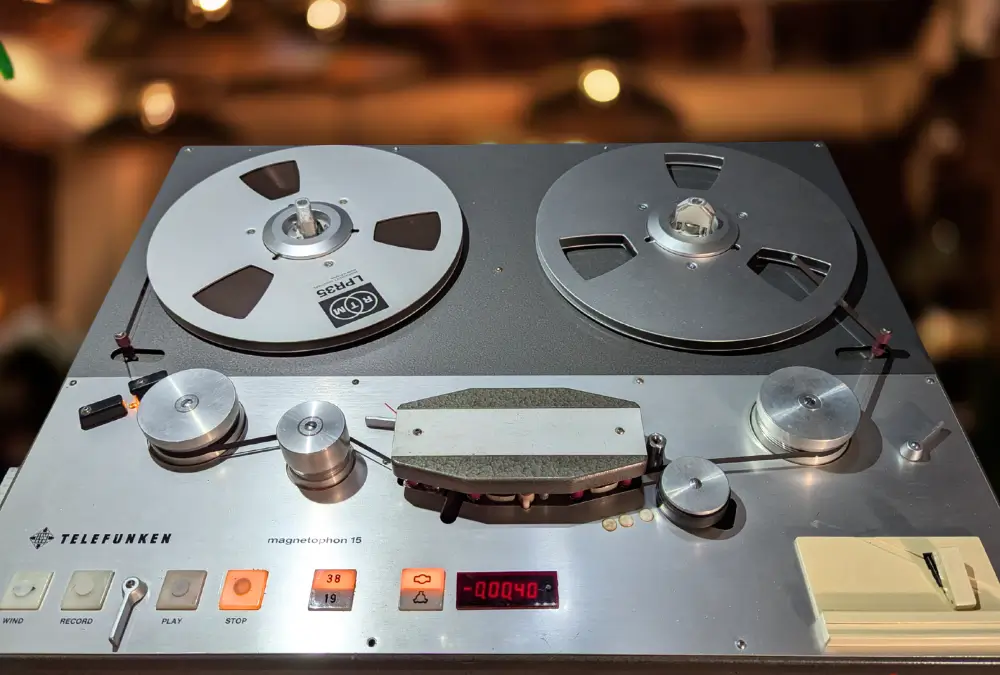
Not a model of one. The actual machine, actual tape crossing actual heads, driven by robotics and reached from your DAW through the Analog Matrix plugin.
Finding the right deck took months. Getting it to behave took nine more. What came out the other side is the simplest interface we have ever shipped: Record/Play, Stop, and Rewind.
This guide covers three things. Why we chose the M15 over the other legendary decks. How to gain stage into it, which is the whole game with tape. And the six M15 chain presets now on the platform, three of which mixing and mastering engineer Karl Barnes walks through in detail.
Tape isn't a setting you switch on. It's a level - magnetic juju - you go and find.
At Access Analog we are always looking for a game changing piece of gear that will have a huge impact for all the music enthusiasts that use our site. It's been obvious to the entire staff that a professional tape deck would be a next level up piece of gear.
The big question, what is the right tape unit for Access Analog? A Telefunken? A Studer? Sony? TEAC? After consulting with many Pros and users of the Mix Analog Tape unit it came down to the Telefunken M15 and the Studer A80. Both offer excellent studio level characteristics. Both have strong followings. In the end what sold it for us was the stellar Telefunken reputation, the reliability of the M15, and the strong following of Mix Analog users requesting the M15.
So we began our search for just the right M15. It took several months to identify an M15 in Germany that had just been fully restored with the proper conversion for US power. So we bought it and had it shipped to our studio server room. From the time it arrived it has been a huge learning curve. It has taken us more than 9 months to get the hardware working perfectly and work out all the nuances on the GUI. For the GUI we identified a very simple Record/Play, Stop, and Rewind button interface. It's soooo easy and sooo powerful.
This means that you're not recording on the first pass and then playing back multiple times as you adjust any downstream gear. You're getting a live record/playback on every session. Moreover, we fully erase the tape before the record head and after the playback head, so that no one else can hear your masterpiece.
That photo is the part that takes nine months. Those are the actuators sitting over the deck's own REC, PLAY, and STOP buttons. When you click Play in the plugin, something physically presses Play in our server room, the capstan spins up, and your mix starts crossing a head that was manufactured before most of our customers were born.
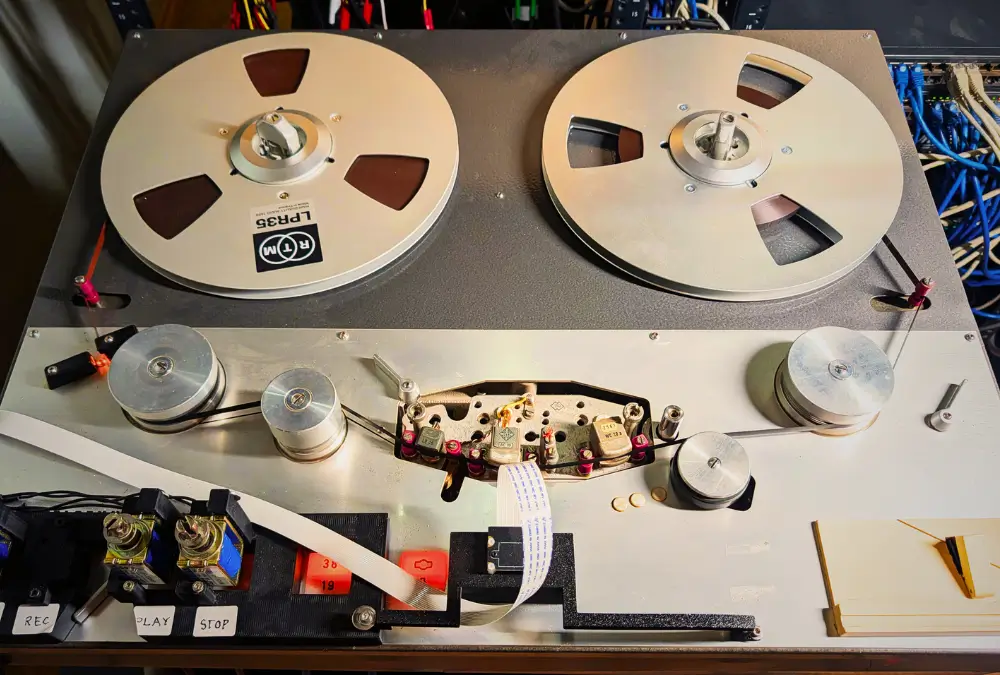
There is no emulation anywhere in this path. The three buttons in the plugin are three fingers on a 1971 transport.
So we're very proud and eager to bring this unique sound to every one of our customers so they too can get that vintage saturation and compression for their mixes that only a tape unit can offer.
Here is Karl Barnes, the mixing and mastering engineer and Access Analog partner who put the hours into this machine, in his own words.
Hey Karl here, back again with a quick little guide on my absolute favourite vintage tape deck of all time, the classy yet incredibly seductive Telefunken M15:
First off, let me give you an impression of this Übermensch. Although being incredibly transparent for its time (1971!!) Thus used heavily in mastering and radio facilities, this is an incredibly rich and warm sounding machine universally praised for its incredible sound and construction quality. Think softer highs, deeper and fuller soundstage, gentle taming of transients and legendary mix glue. In the good old days this deck would have been used heavily on jazz/classical/opera recordings and countless long haired German rock bands in the 70's. To say the Telefunken M15 was ubiquitous would be an understatement, not only would this deck be found in countless professional studio facilities across Europe but it would also be the deck of choice for the savvy European consumer wanting high quality tape playback. Well they certainly made a lot of these and for good reason! The vast majority of my work to date has been caressed by its wonderful sonics and my clients are just as obsessed with it as I am.
Start at the plugin's default, then drive the input gain up until the sound compresses and the transients soften, and back off from there. The input gain adjustment is an analog gain stage inserted after the D/A converter and before the tape machine input, so it sets the signal level going onto tape and therefore how much tape saturation ends up in your audio. The plugin drops your material to a comfortable starting level on its own, and the slider does the driving. Karl again:
Now you better familiarize yourself with the input and output gain controls on the AA plugin as these are going to be your main weapons to tame this beast. Make sure to occasionally auto calibrate the output as the audio balance coming OFF the tape may become unbalanced, keep that low end centred and your clients happy.
Proper Gain staging is the key to unlocking the magic of this box. The wizards at Access Analog have massively simplified this process by automatically bringing your audio down to a comfortable level and have also given us a handy slider for driving this beast. I recommend listening to your material at default, then slowly increase to the right to begin to hear the sound compress and transients soften until it's far too much. Great! You now have a limit of how far you can push the tape machine with your program material.
Time to experiment! Try listening to how the deck sounds below the default setting and how it sounds pushed to the limit and everywhere in between. Are the frequencies in your material changing? How is the soundstage, is it lush and open or is it more powerful and focused now? You are looking for a sweet spot, everything will suddenly lock into place. Did you find it? GREAT! Now make sure to click the bounce button, put your feet up and call yourself a professional.
Find the ceiling first, then work back down to the sweet spot. You cannot know where the good level is until you have heard the bad one.
For the transport side of things, including how much tape you have and what happens when it runs out, see Telefunken M15: Getting a Great Tape Sound.
The Telefunken M15 sure is a beast on its own but it is known to get a little lonely on the mixbus, give it some friends to jam out with!
Six M15 chain presets are on the platform. Karl built and documented three of them, one designed around each tier of the Access Analog Subscription: Essential, Pro, and Elite. Every unit in these chains is real hardware in our racks, and every position recalls with your session.
The Telefunken M15 itself is not included in any subscription tier. It carries its own cost on top of whatever plan you are on, because tape is a consumable. Elite tier subscribers get 50% off that cost, and everyone else pays the normal rate.
You also do not need a subscription at all. Every unit in every one of these presets can be booked individually with reservations or paid for with credits, so you can run any of these chains on any plan, or on no plan.
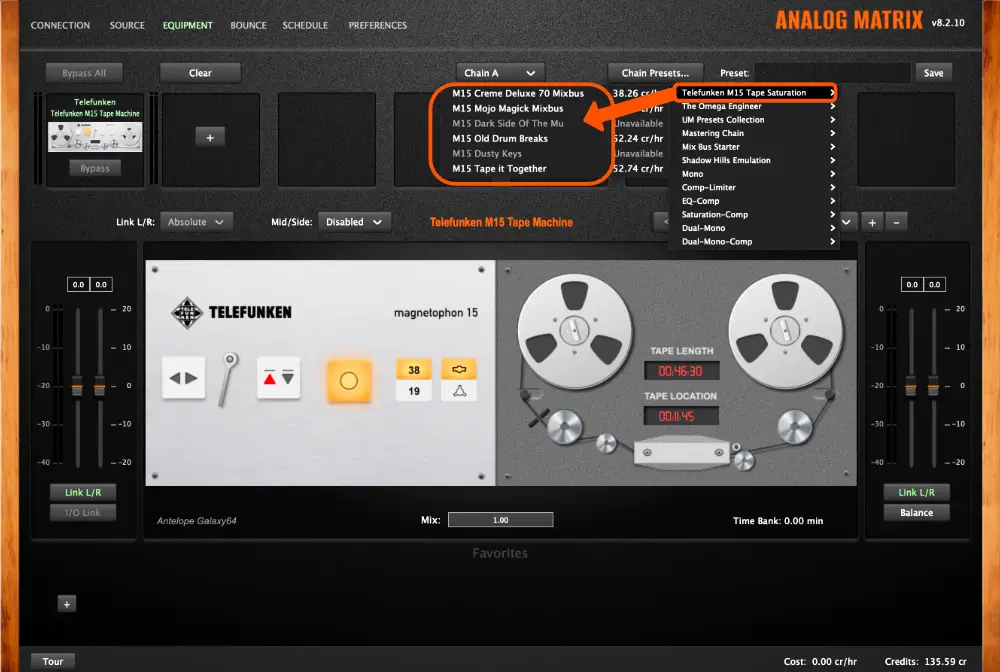
These are the three Karl walks through in detail below.
| Plan | Preset | Signal chain | Best for |
|---|---|---|---|
| Essential | M15 Creme Deluxe 70 Mixbus | M15 → Elysia XFilter → Tegeler Creme | Any bus. Classic flavors, modern twist, compression handled after tape |
| Pro | M15 Mojo Magick Mixbus | M15 → Chandler LTD-2 (pair) → Iron Age LH95 | Neve-style girth and an inductor midrange. Hip hop, heavy rock, anything needing weight |
| Elite | M15 Dark Side Of The Mu | Manley Variable Mu → Chandler Curve Bender → M15 → Bettermaker Limiter | Old school rock and roll mixbus, finished to level |
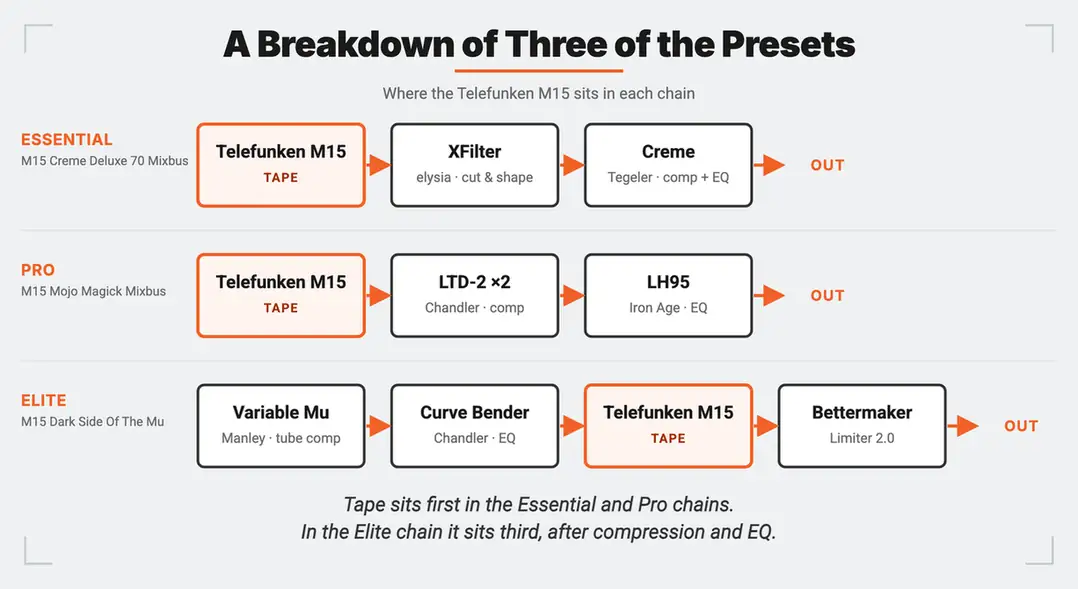
Note the ordering, because it is the one thing that is easy to get wrong. In the Essential and Pro chains the tape comes first and everything after it reacts to what tape did. In the Elite chain the tape sits third, so the compressor and EQ are shaping the signal before it is printed.
The other three M15 presets are there to explore in the plugin as well: M15 Old Drum Breaks, M15 Dusty Keys, and M15 Tape it Together.
Telefunken M15 → Elysia XFilter → Tegeler Creme
The XFilter is a clean, Class-A four-band EQ used here for surgical cutting, and the Creme is a VCA bus compressor with a Pultec-style passive EQ whose EQ section can be switched before or after the compressor. Karl:
A nice chain for any bus with a few classic flavors and a modern twist. Make sure to properly gainstage the 1st stage, try pushing it 25 percent up/crank it but low levels will work fine for this chain as we have a compressor added in later and won't need to rely on tape for our compression.
Load in the Elysia and use this primarily for cutting frequencies that sound less favourable coming off the tape, a little control in the bass and midrange is worth doing. I really like the shelves here, the notch cuts are also fantastic and super clean. Sometimes the passive boost button on the unit can be great before or after tape as this is a unique and untweakable top end boost. It's very special when this works so try this!
When you have done all of your cutting/tonal shaping to control the tape, smack in the Tegeler Creme! The creme is all about boosts! This will be program dependent but hard to get wrong, Tape and Pultec EQ's are like cookies and cream. Make sure to set the EQ POST Compression and play with the low end, 30hz can be a surprising but nice choice after the tape has applied some light filtering there, 60hz is a classic go to! Sometimes with the nice bass headbump from tape, I may go to 200hz and boost a shelf from there for a phat mix. Returning to the Elysia to make some cuts if needed, for some reason cutting the same frequency band on the elysia and boosting it on the eq section of the Creme works like magic! Now lets boost the top end, start from 10k and move all the way to the air band, find what works best for your music.
Lets engage the compressor now, I like 2:1 post tape but if we are not pushing the tape much into compression territory, try 4:1. It also works great on harder genres like hip hop and heavy rock. Attack times we can keep simple, if you mixed into a compressor plugin while you mixed then match those settings when you are replacing the process here. If not, a short release (100ms) and long attack (30ms) should get you in the ballpark, bringing a little more bite back from the tape and adding that radio ready tight polish. How much gain reduction depends on your taste, but try not to go above 2db so your mastering engineer at least has something to do later. DONE!
Cut on the transparent EQ, boost on the gorgeous one. That principle runs through all three of these chains.
Telefunken M15 → Chandler LTD-2 "Sterling Mod" (pair) → Iron Age Audioworks LH95
The LTD-2 is a hand-wired diode-bridge compressor based on the Neve 2254, the Class A predecessor to the 2264 and 33609, which is where the "Neve girth" comes from. The LH95 pairs active Baxandall shelves with a midrange built around a custom-wound Cinemag inductor. Karl:
Ok you know the drill, gain stage that thang! Here we want to aim for as much compression from the tape as we can get without killing the track, start with 75/80 percent to the right, adjust this gainstage later when we activate our compressors. Now these baddies are thicc, aim for gentle smoothing compression here, barely moving the dials if you can. I like to have around 200ms release and vary the attack to taste. 50ms or 10ms attack is perfect! Check out for that classic Neve sounding girth! At this point alongside the tape I find the low end to be quite enhanced and focused, perfect time for an eq to shape the rest!
For me the mid band is the money here and is the only section of the EQ that is a lovely vintage inductor style. Good news, all the mid frequency selections are excellent and are absolutely worth auditioning yourself. Usually I find myself adding more edge in post tape so the 2.3 up to 5.6 range is excellent here for bringing things like vocals and drums forward which is a great thing.
Lastly, look at the bax style shelf EQ's, likely the top end will be the only thing needing a major boost (this EQ only does 3db shelf steps!) so give that a hollar 1st, hell try the low end too. The Chandler should be helping to emphasise this range so if you feel that things are too muddled then tweak a digital eq going into the chain. I've said it before but cutting on a transparent eq and boosting the same range on a gorgeous sounding eq works very well for refining a frequency range. Don't take my word for it, go experiment!
Manley Variable Mu (v9) → Chandler Curve Bender → Telefunken M15 → Bettermaker Limiter 2.0
This is the chain where tape is not first. The all-tube Variable Mu compresses, the Curve Bender shapes, and only then does the signal hit the deck, so the M15 is responding to a mix that has already been sweetened. Karl:
This would be my old skool rock n roll mixbus. Tame the mix with a little compression on the vari mu, HPF engaged, attack at noon and somewhere between the fastest and second fastest release. Aim for minimal compression here, we will return to this unit later when tape is engaged.
Next use the curve bender however you might need to use an eq on your mixbus, for me its often sweetening what's missing and that's going to depend on the source material you're working with. The 70hz, 150hz are both special options for the low end on rock n roll and jazz, I also like the 91hz boost here on hip hop and dance music. You don't want to overdo it as the tape will add in more low end and we don't want it overcompressing and sounding boomy. 500hz is magic on the curve, a cut here can be excellent on polishing a boxy mix, for rock n roll though boost that thang 1st for size. Lastly the upper midrange options are all very forward sounding and tasty, particularly 1.2K and 4.2K for bringing out energy in vocals and guitars/tops of drums. My hands down favourite though is the 20k air shelf and this is excellent for pushing quite a bit of gain into the Telefunken which will soften it down in response, an interesting sound.
Now monitor your levels here, time to bring down the output of the Curve Bender to appear in your daw as -20, an acceptable range for initially getting to grips with what the Telefunken will do. Gainstage that thing, experiment with it. Return to your compressor and shape the attack based on how the Telefunken is shaping your transients now, a little adjustment of the EQ settings you had before will go a long way. If you find the audio a little unruly in the low end, make sure to adjust this on the curve bender or insert something more surgical like the Elysia Xfilter to shelf and cut any pesky resonances. Occasionally the Xfilter is worth placing after tape if you want to bring the treble up to modern production standards, experiment yourself!
Lastly the bettermaker limiter will get your music up to level, I like to use a bit of limiting here and a final digital limiter afterwards, much easier to finalize the level with clients then without needing to re record. There you go! All killer no filler. More of my chain presets will be coming onto the AA platform soon so keep an eye out!
For the record, every frequency Karl names on the Curve Bender is a real selection on the unit. The 35, 50, 70, 91, 150, 200, and 300 Hz positions live on the BASS band, 500 Hz and 1.2 kHz are Presence 2, 1.2 kHz and 4.2 kHz are Presence 1, and the Treble band tops out at 20 kHz with a peak or shelf switch. That 20k air shelf is exactly what he says it is.
The M15 softens whatever you push into it. That makes a bright EQ move upstream of tape behave completely differently than the same move after it.
If you're looking for a little inspiration to whet the whistle, here is some work of mine recorded/mixed to the rich sonic world of the Telefunken M15:
MOTHERED - A ROLE-PLAYING GAME - The Original Soundtrack
These tracks are hosted on Spotify, so you may need a Spotify account to play them.
Thanks for reading and happy hunting!
The Telefunken M15 is not included in any tier of the Access Analog Subscription. It is billed on top of your plan, whichever plan you are on, and it is available to non-subscribers too. Here is why, from Dan at Access Analog.
We'd love for the M15 to be free for all our Elite subscription users but the fact is that this unit has some very high maintenance costs and we plan to never cut corners. The tapes are $90 and maintenance requires we work on the unit every day. So we hope you're sympathetic to our costs and understand the unit will be 50% off the normal cost for Elite tier subscribers and the normal rate for everyone else.
We plan to ensure the highest level of tape quality by erasing the tapes daily followed by a weekly tape replacement. Additionally for the real enthusiast you can reach out to Chris or Dan at Access Analog and we can coordinate a tape purchase and use so that you can be guaranteed you're the first to use a brand new tape.
A tape machine is the one piece of gear in our racks that consumes something every time you use it. That is also exactly why it sounds the way it does.
These presets come from Karl Barnes, an analog-obsessed Mixing & Mastering Engineer and owner of Loom Sound Studio located in Edinburgh, Scotland. We want to be sure to recognize Karl for his help in testing and feedback at Access Analog.
As a fanatic audiophile, he has been working in the field for the last ten years wearing many hats as a producer, composer, mastering engineer, and sound designer. Preferring to ditch cold digital processors in favor of old-school analog mixing/mastering tools, his productions are full of character and vibe.
Karl also sat down with us for a Q&A: Q&A Session with Karl Barnes of Loom Sound Studio. Follow him on Instagram at @karlbarnes303.
What is the Telefunken M15?
The Telefunken M15 is a fully discrete, mastering-grade analog tape machine introduced by AEG-Telefunken in 1971, widely regarded as having one of the finest tape transports ever built. It uses a synchronous AC capstan with a large capstan drive and butterfly heads, and it was standard equipment in European mastering rooms, radio facilities, and classical and jazz recording studios. Access Analog runs a fully restored M15 that you can reach from your DAW.
Is the Telefunken M15 on Access Analog real tape or an emulation?
It is real tape. Access Analog has a physical Telefunken M15 racked with actual magnetic tape running across actual heads, and the Analog Matrix plugin robotically operates the transport in real time. There is no model, no convolution, and no DSP approximation anywhere in the signal path. If you want tape character without a reel-to-reel transport, the Walters Audio T805 gets it from a real tape element instead.
What's the difference between the Telefunken M15 and the M15A?
The original M15 has a fully discrete, transistor-based audio path, while the later M15A moved to an integrated-circuit design. Engineers who prefer the earlier machine are usually after that discrete circuitry. Access Analog runs the original M15.
What level should I send into the Telefunken M15?
The Analog Matrix plugin brings your audio down to a comfortable level automatically, so you start at the default and use the input gain adjustment to drive the tape from there. Raise it gradually until you hear the sound compress and the transients soften, which tells you the upper limit for your program material, then back off and hunt for the point where the mix locks into place. Because tape behavior is level-dependent, that input gain is effectively the main tone control.
What is the input gain adjustment on the Telefunken M15?
The input gain adjustment is an analog gain stage inserted after the D/A converter and before the tape machine input. It controls the signal level going onto tape, which in turn controls how much tape saturation ends up in the processed audio. It is real analog gain in the physical signal path, not a digital trim applied before the audio leaves your DAW.
Can I recall my Telefunken M15 settings?
Yes. You get full recall on every pass through the Analog Matrix plugin, so your settings store with your DAW session and restore the real machine to the same positions next time you open the project. The same applies to every unit in Karl's chain presets.
Which Access Analog plan do I need for Karl's presets?
Any of them, or none. Six M15 chain presets are on the platform, and Karl Barnes documented three in detail, one built around each tier of the Access Analog Subscription: M15 Creme Deluxe 70 Mixbus for Essential, M15 Mojo Magick Mixbus for Pro, and M15 Dark Side Of The Mu for Elite. The Telefunken M15 is not included in any tier, so it is billed on top of your plan regardless of which one you are on, with Elite tier subscribers getting 50% off. Every unit in these chains can also be booked with reservations or paid for with credits, so you can run any preset without a subscription.
Why does the Telefunken M15 cost more per hour than other gear?
A tape machine is consumable. Tape stock runs $90 a reel, the deck needs attention every single day, and Access Analog erases the tapes daily and replaces them weekly to keep quality consistent. That is why the M15 sits outside the subscription tiers and is billed on top of your plan. It is offered at 50% off the normal cost for Elite tier subscribers, and the normal rate for non-subscribers.
Does the tape run out during a session?
Yes, the reel is finite, which is one of the ways this differs from any plugin. The plugin displays tape length and tape location so you can see where you are, and the machine rewinds automatically. Telefunken M15: Getting a Great Tape Sound covers the transport side in detail.
Can I use the Telefunken M15 without owning one?
Yes. Access Analog gives you remote access to a real, fully restored Telefunken M15 from inside your DAW, along with 70+ other premium analog units, with full recall saved in your session. Download the Analog Matrix plugin and see the Telefunken M15 on Access Analog.