
Your mix sounds good. The balance is there, the parts are tight, nothing is fighting. And yet it still sits a step behind the records you're chasing. It sounds clean where they sound finished.

That last step is rarely about more plugins or a bigger room. It's about the kind of processing that happens when audio passes through real analog hardware: the high-end compressors, EQs, and saturators that shaped the records on the charts. The good news is you no longer need to own a rack, or even leave your DAW, to use them.
A great in-the-box mix gets you 90% of the way. Real analog gear is how you close the last 10%.
This guide walks through what analog actually adds, the specific gear chains that produce radio-ready vocals, drums, and mix-bus glue, and how you can run that exact hardware from your bedroom using Access Analog. Here's the short version:
The honest answer: your plugins are not the problem. A modern DAW and a well-chosen plugin set can produce a clean, balanced, genuinely competitive mix. Engineers make commercial records in the box every day. If your low end is controlled, your vocal is clear, and the mix translates from your monitors to a phone to a car, you've already done the hard part.
What's usually missing in the last stretch is dimension. In-the-box mixes tend to sound flat in the literal sense: everything sits on the same front-to-back plane, clean but a little two-dimensional. The depth, the air, and the sense that a record was carved out of space often come from how real hardware behaves when audio actually moves through it.
Plugins model the math of a circuit. That math is excellent, and it keeps getting better. But a physical unit is doing something messier: pushing real voltage through real components that interact, saturate, and drift in ways that are hard to fully capture in code. A useful way to picture the difference is current. Your DAW works at the level of an eyedropper, a few millivolts of signal. Analog hardware works like a firehose, swinging hundreds of volts through transformers and tubes. That intensity is part of what you're hearing.
Plugins get you to a great mix. Analog gear gets you to a finished record.
Three things, and it helps to name them separately, because each comes from a different physical cause.
Dimension. This is the front-to-back depth that makes a mix feel three-dimensional instead of pasted onto a single plane. It comes largely from harmonic complexity and the subtle, frequency-dependent phase behavior of transformers and tubes. Those tiny shifts give your ear cues about space, pushing some elements forward and letting others sit back. For that effect across a whole mix, see what analog summing actually changes.
Saturation. When a signal pushes a tube, a transformer, or a tape-style circuit, it generates harmonics that weren't in the original. Even-order harmonics (octaves and their relatives) read as warmth and richness. Odd-order harmonics add edge and presence. Add a little and a thin source gains body. The math is real, the result is musical, and it's the single biggest reason "analog" sounds the way it does.
Movement. Real circuits don't behave identically from moment to moment. An optical compressor's light cell recovers on its own curve. A transformer responds differently to a loud transient than a quiet one. This program-dependent behavior gives compression and saturation a living quality. Digital processing, by contrast, is deterministic: like a toaster set to make every slice the exact same shade of brown, it does precisely the same thing to every transient. That consistency is a strength for surgical work, and a limitation when you want a track to breathe.
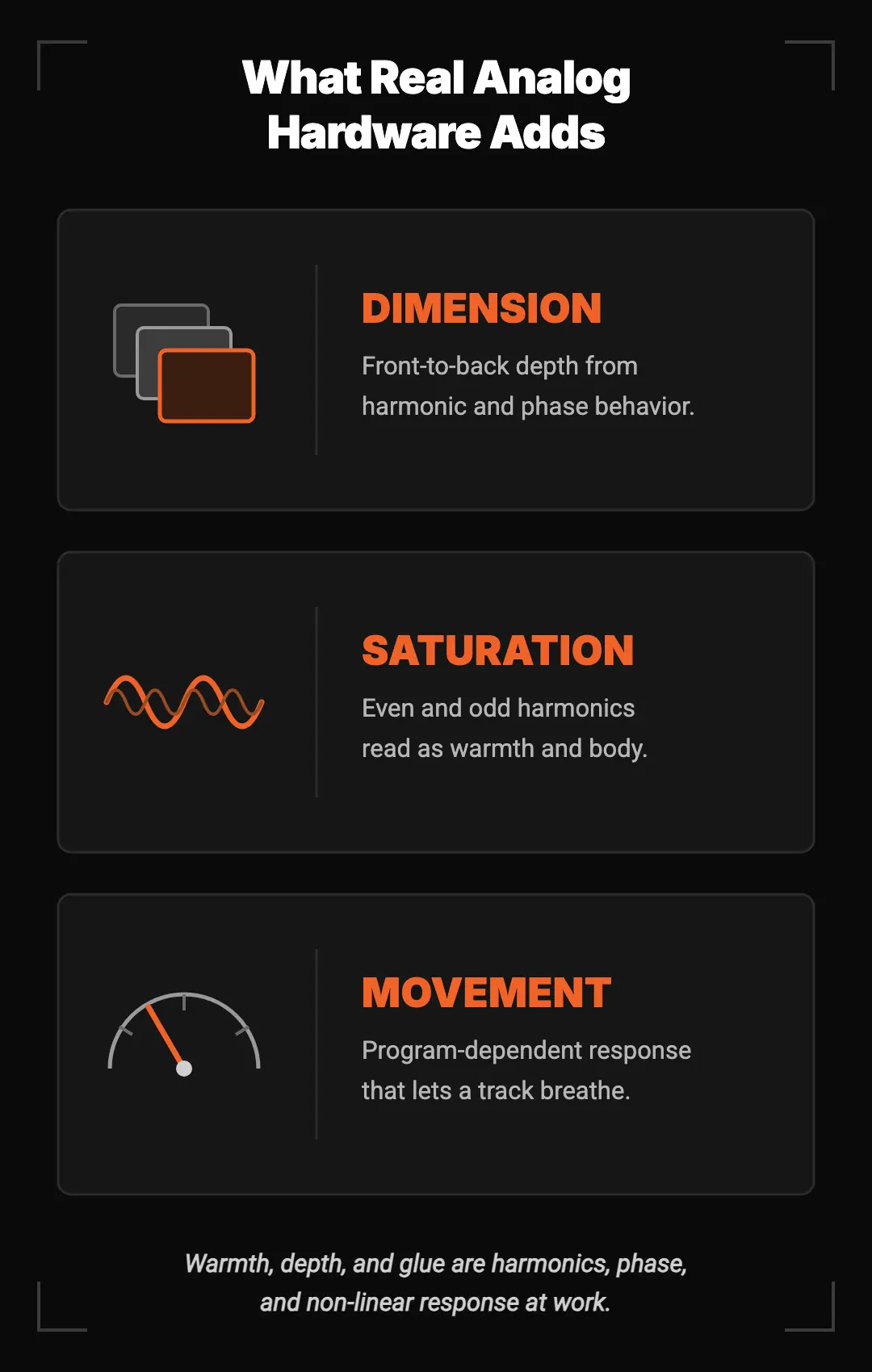
Warmth, depth, and glue aren't magic words. They're harmonics, phase behavior, and non-linear, program-dependent response, working on your audio.
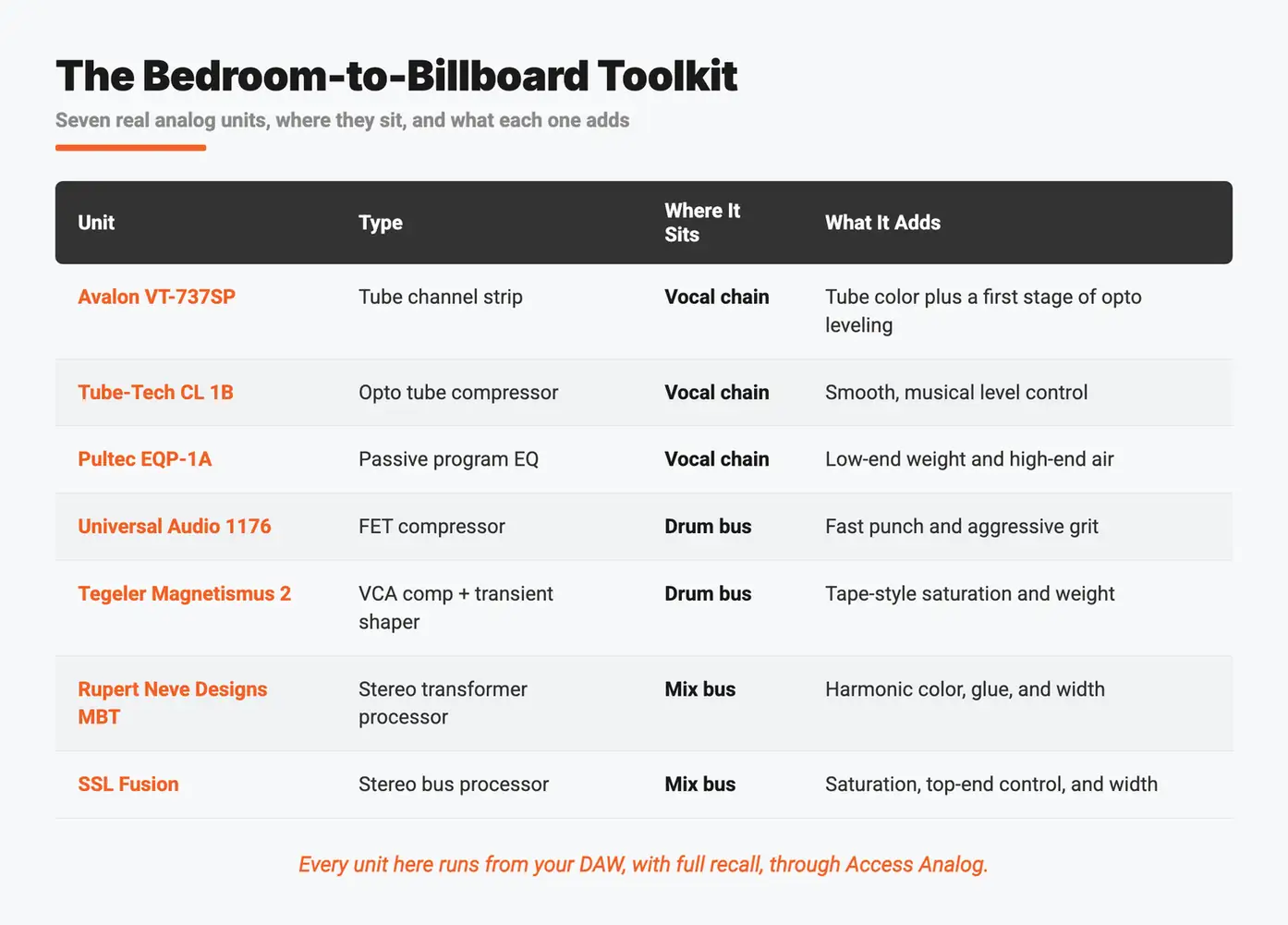
A polished lead vocal usually comes from stacking complementary stages: front-end tube color, two flavors of leveling, then passive EQ to sweeten. A proven chain is Avalon VT-737SP → Tube-Tech CL 1B → Pultec EQP-1A. For everything that happens before the chain, from the room to the mic, see ten ways to improve a vocal.
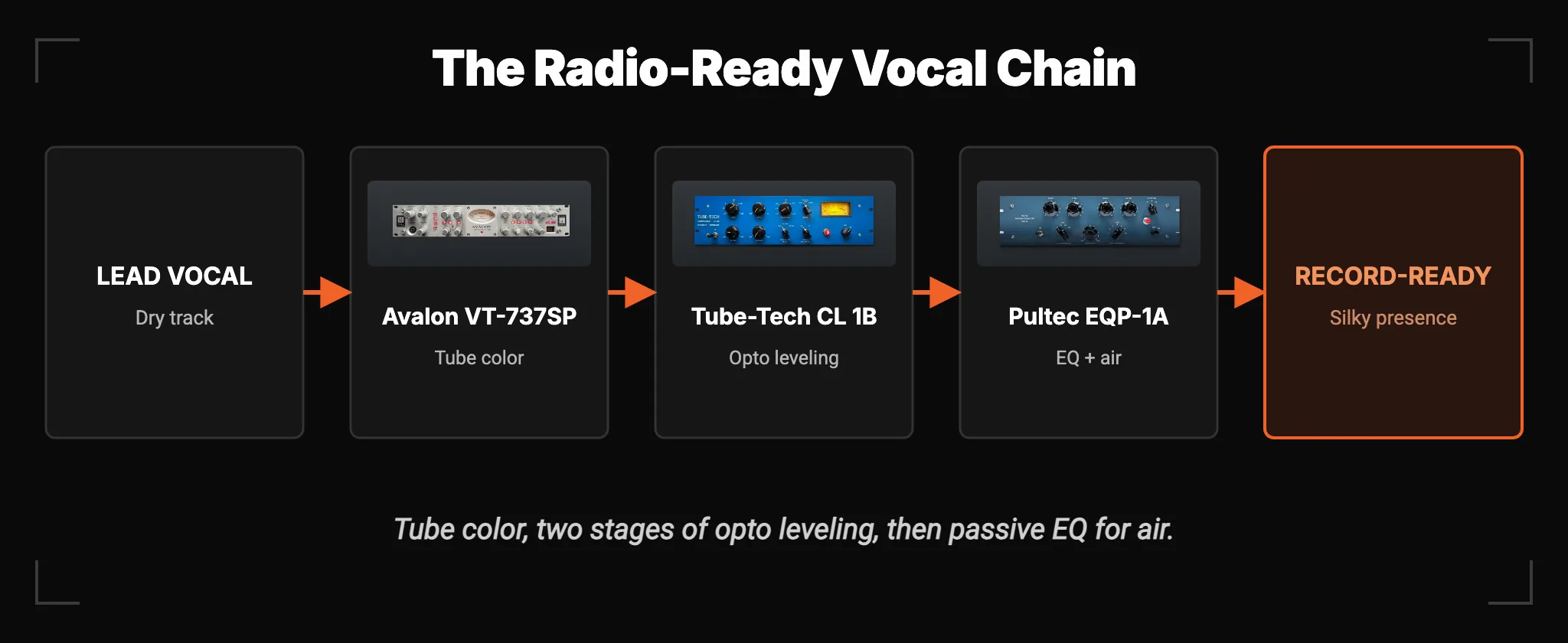
Avalon VT-737SP. This is a tube channel strip, and its internal order runs tube preamp into an opto-compressor into a four-band EQ (sweepable mids, shelving highs and lows), with the EQ switchable before or after the compressor. The channel is Class A throughout, built around four triode tubes, and the EQ section is discrete Class A. Its opto-compressor uses the same type of optical circuit the venerable LA-2A is built on. Use it for the front-end color and a first, gentle pass of optical leveling, just a dB or two, to set the vocal in place.
Tube-Tech CL 1B. An all-tube optical compressor, and the smoother, slower partner to the Avalon's faster catch. Its ratio is continuously variable from 2:1 to 10:1, with attack from 0.5 to 300 ms and release from 0.05 to 10 seconds, plus a switch for FIXED, MANUAL, or a combined FIX/MAN time-constant mode. This is the classic vocal leveler: set a low ratio and let it ride the broad dynamics so every word lands at the same place in the mix. Running the 737SP and the CL 1B in series is serial compression done right, two units each doing a small amount of work rather than one unit straining.
Pultec EQP-1A. A passive program equalizer with a tube makeup-gain stage, built today by Pulse Techniques to the original spec. The passive filter network gently loses level, and the tube output stage restores it while adding its own harmonic color. Its signature move is the low-end trick: boost and attenuate the same low shelf at once (try 60 or 100 Hz) for weight without mud, since the boost is broader than the cut. Then add a high-frequency shelf boost up around 10 to 16 kHz for air. That combination is where the "expensive vocal" sheen lives.
Tube preamp color, two stages of opto leveling, and passive program EQ: that's silky, record-ready presence.
Drums want two things a clean mix rarely supplies on its own: impact and density. The chain UA 1176 → Tegeler Magnetismus 2 delivers both, fast FET compression for punch followed by tape-style saturation for weight.
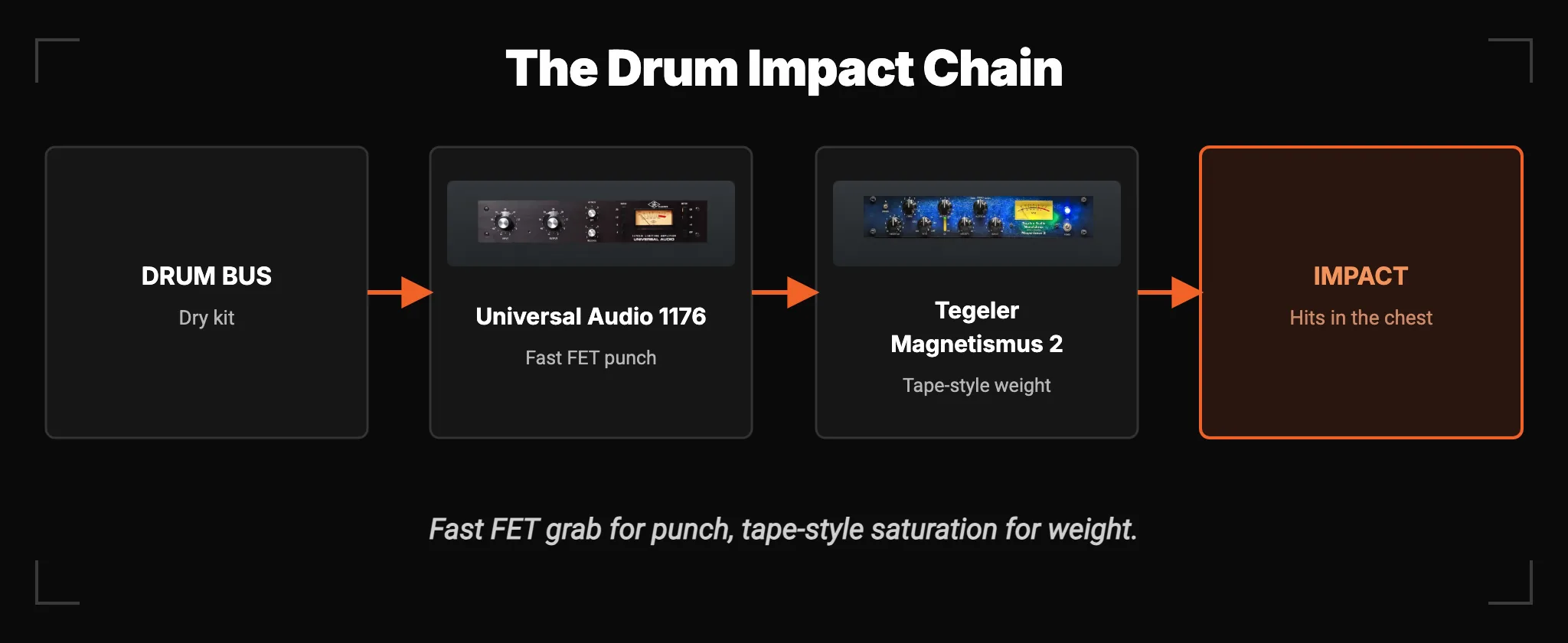
Universal Audio 1176. A FET compressor famous for its speed. Its attack can reach roughly 20 microseconds at the fastest setting, fast enough to clamp a transient the instant it arrives. Ratios are switch-selectable at 4:1, 8:1, 12:1, and 20:1, and pushing all four ratio buttons in at once engages the aggressive, program-dependent "all-buttons" mode. The lowest ratio, 4:1, is the most common everyday choice. On a drum bus, a fast attack with a medium release and a few dB of gain reduction tightens the kit and pulls up the room and sustain between hits, the sound of drums that feel bigger than the room they were tracked in. Many engineers blend the 1176 in parallel to keep transients intact while adding that density underneath.
Tegeler Magnetismus 2. A hardware processor that chains a VCA compressor, a transient shaper, and an output transformer into one box. Its character comes from three "Flux Modes," named Eisen, Kobalt, and Nickel after iron, cobalt, and nickel tape formulations, each emulating the saturation signature of a different tape type. It isn't a tape machine, and it isn't a plugin: it's analog circuitry shaped to behave like tape, adding harmonic density and a transformer-fed low-end weight. On drums, that saturation fattens transients and fills the space between hits, turning a tidy kit into one that hits you in the chest.
Fast FET grab for punch, tape-style saturation for weight: that's how drums go from neat to commanding.
The mix bus is the last place every element shares a circuit, which makes it the right place to add final width and glue. The chain Rupert Neve Designs MBT → SSL Fusion is built for exactly this. (Note the maker: the Master Bus Transformer is Rupert Neve Designs, Rupert's own company, not the AMS Neve console brand.)
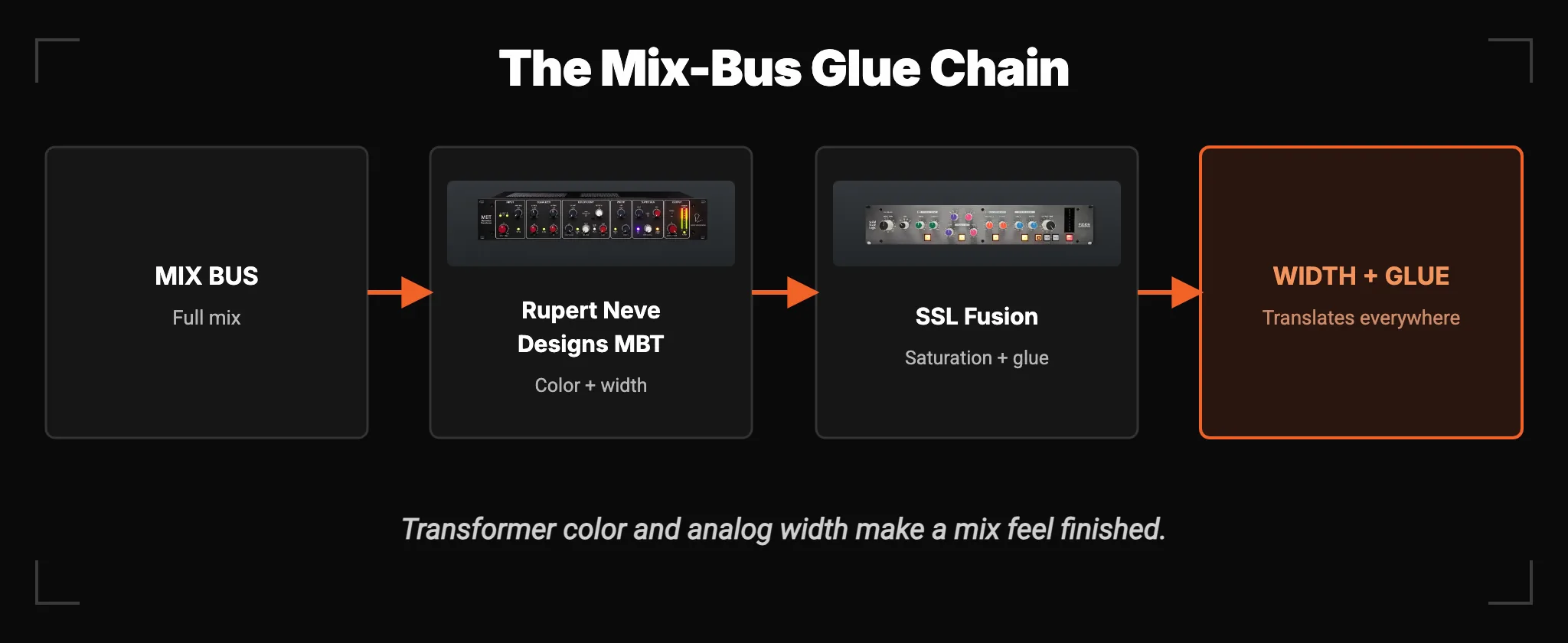
Rupert Neve Designs MBT. The Master Bus Transformer is an all-analog stereo tone-shaping processor built around custom Rupert Neve transformers. It's a coloration and glue unit, not a summing mixer. It gives you a two-band shelf EQ, a Color Comp optical compressor with a parallel blend, a Width control, and a Super Silk section that dials in transformer-style harmonic saturation. The Color Comp runs a fixed 20 ms attack, a 2:1 or 5:1 ratio, and up to 20 dB of Class-A make-up gain with a dry/wet Blend for parallel compression, while Super Silk adds second- and third-order harmonic, transformer-based saturation. Use it for transformer richness, a touch of opto glue, and width that opens the stereo field without smearing the center.
SSL Fusion. A stereo analog master-bus processor with five color tools in series: Vintage Drive (non-linear saturation), Violet EQ (a two-band shelving EQ for punch and shine, with HF bands at 8, 12, 16, and 20 kHz), an HF Compressor (a high-frequency-only compressor, crossover adjustable from 3 kHz up to 20 kHz, that smooths harsh top end the way tape would), Stereo Image (a true analog mid/side circuit for width), and a switchable Transformer stage that adds low-end saturation and a flattering high-frequency lift. Reach for it to set the final tone, tame the top, and widen the picture.
Keep the moves small. Mix-bus processing rewards restraint: gentle bus compression around a 2:1 ratio catching 1 to 2 dB of gain reduction, and EQ or saturation shifts of just 1 to 3 dB, are common starting points rather than rules. The goal isn't loudness, it's cohesion: making a collection of good tracks feel like one record.
Transformer color and analog width are what make a mix translate everywhere and feel "done."
Here's the part that changes the math: you don't have to buy any of it. Access Analog houses the real, physical units in a climate-controlled facility in Colorado and lets you patch into them from your DAW through the free Analog Matrix plugin. This isn't an emulation. You're hearing actual tubes, transformers, and optical cells process your audio in real time.
Every knob, switch, and selector is robotically controlled, so the whole signal chain saves with your session for full recall, and you can automate settings from plugin parameters the same way you'd automate anything else in your DAW. Conversion runs at 24-bit, 96 kHz with minimal jitter. Because the gear runs continuously, it stays at a stable operating temperature, always warmed up and ready. It's the workflow advantages of digital wrapped around the sound of real hardware.
The reach is the headline. Access Analog offers more than $350,000 of premium gear, and every unit in the chains above lives in the catalog: the Avalon VT-737SP, the Tube-Tech CL 1B, the Pultec EQP-1A, the 1176, the Tegeler Magnetismus 2, the Rupert Neve Designs MBT, and the SSL Fusion.
Pricing starts at $9.98/month, and new accounts get one free hour, so you can hear any of these on your own material before you commit a dollar to it.
The same gear that made the record you're chasing is now a plugin window away from the one you're mixing.
Not sure what to keep in the box? Here's how analog hardware and plugins compare.
The leap from a bedroom mix to a billboard record is not about square footage or a six-figure console. It's about access to the gear that adds the final 10%, the dimension, the saturation, the movement, and the engineers who know how to use it. The first half of that equation used to be the wall. It isn't anymore.
You already have the skills and the plugins to build a great mix. Add real analog hardware at the points that matter most, the vocal, the drums, and the mix bus, and "good" becomes "finished."
Run your next mix through the real thing, and hear the step you've been missing.
What makes a mix sound "commercial" or radio-ready?
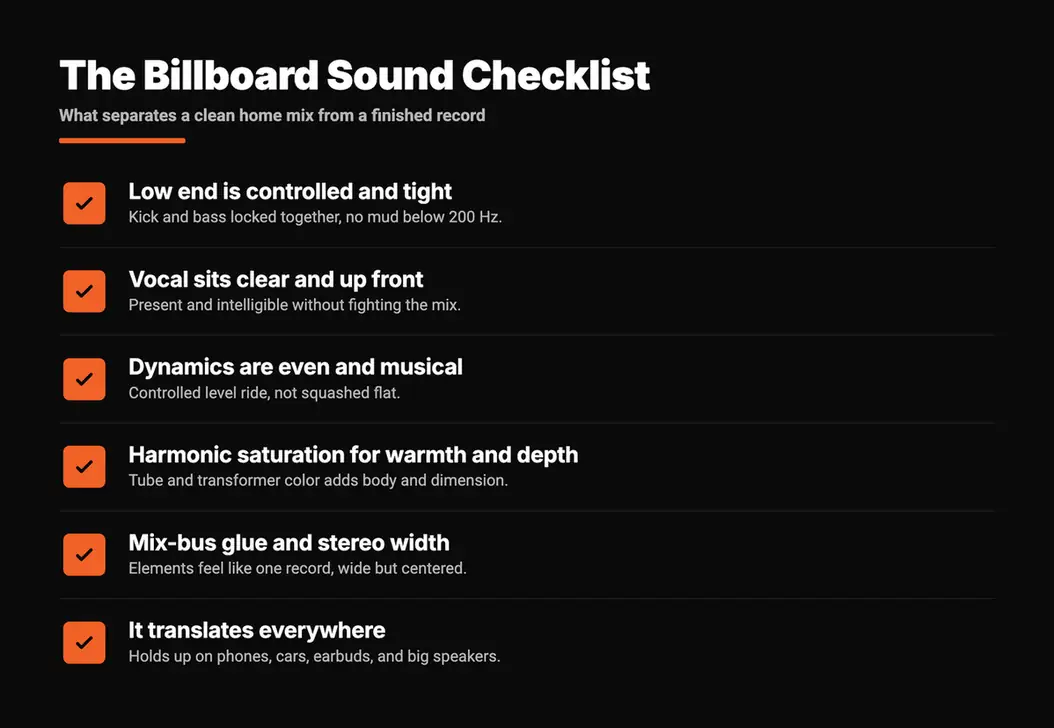
A commercial mix has a tightly controlled low end, even and musical dynamics, a clear vocal sitting up front, and a tonal balance that translates across phones, cars, and headphones. Most of that comes from arrangement, balance, and EQ before any single piece of gear. Real analog processing then adds the dimension and saturation that make a polished mix feel finished rather than just clean.
Do you need expensive analog gear, or is it really the engineer and the room?
The engineer, the room, and the mix decisions matter most: gear refines a good mix, it can't rescue a bad one. A clean, well-balanced mix in a treated room beats a sloppy mix run through a rack of classics every time. Analog hardware is the polish on top of solid fundamentals, not a substitute for them.
What are the essential analog signal processors for a home studio?
Setting up a home studio with analog signal processors can really elevate the quality and character of your recordings! These pieces of equipment are designed to shape your sound, adding clarity, power, and unique character to your tracks even before they hit your digital audio workstation. If you're looking to build a professional analog signal chain, most pros agree that the foundation consists of three main types of gear: microphone preamplifiers, compressors, and equalizers, and other outboard gear such as gates, expanders, summing mixers.
Does analog gear actually sound different from plugins?
Yes, though the gap has narrowed and good plugins are genuinely excellent. The audible difference comes from harmonic saturation, subtle phase behavior, and program-dependent, non-linear response that real components produce as voltage moves through them. On many mixes the effect is the last 10 to 20%: depth, warmth, and movement rather than a night-and-day change.
What should I put on my mix bus to make it sound finished?
A common chain is gentle glue compression (around 2:1, catching 1 to 2 dB of gain reduction, with a slow attack), light EQ, and a touch of saturation or transformer color, with every move kept to a few dB. Analog units like the Rupert Neve Designs MBT and SSL Fusion are popular here because they add width and harmonic richness, not just level control. The aim is cohesion and translation, not loudness.
What's the difference between mix-bus processing and mastering?
Mix-bus processing shapes the full mix while you're still mixing, gluing elements together and setting the overall tone. Mastering treats the finished stereo file for final loudness, tonal balance, and consistency across a release and across playback systems. If your track will be professionally mastered, avoid heavy limiting on the mix bus so you don't process the same material twice.
Can you really get a professional sound in a bedroom studio?
Yes. With acoustic treatment, accurate monitor placement, careful gain staging, and reference tracks, a bedroom studio can produce commercial-quality mixes. The main limits are usually the room and your objectivity, not a lack of expensive hardware. Adding real analog processing at key stages closes much of the remaining gap to a big-studio sound.
How can I use real analog gear without buying it?
Access Analog lets you process your tracks through real, physical analog hardware controlled robotically from your DAW via the free Analog Matrix plugin, with full recall and automation. You get the actual sound of units like the 1176, Pultec EQP-1A, and SSL Fusion without racking, maintaining, or buying them, starting at $9.98/month with one free hour for new accounts. It's a way to put studio-grade hardware in a home-studio workflow.